| Attribute | Detail |
|---|---|
| What it is | An AI agent that drafts clinical notes and reviews them for documentation compliance |
| Built for | Clinicians, clinical supervisors, QA and compliance leads at hospital and ambulatory, home health, hospice and home care providers |
| Core use cases | AI clinical note generation • Documentation compliance and integrity review |
| Time per note | Under 5 minutes to a draft, down from 30-90 minutes of manual charting |
| How rules are set | Plain-language templates and compliance rules edited by clinical staff. Live the moment you save. |
| Data layer | EHR read and write through FHIR and MCP • Information extraction MCP tool of Caregence |
| Triggers | Visit completion in the EHR, mobile app submission, document upload, API call, webhook or scheduled task |
| Decision model | AI drafts and flags. A clinician reviews and signs. |
Documentation is now the second job in healthcare.
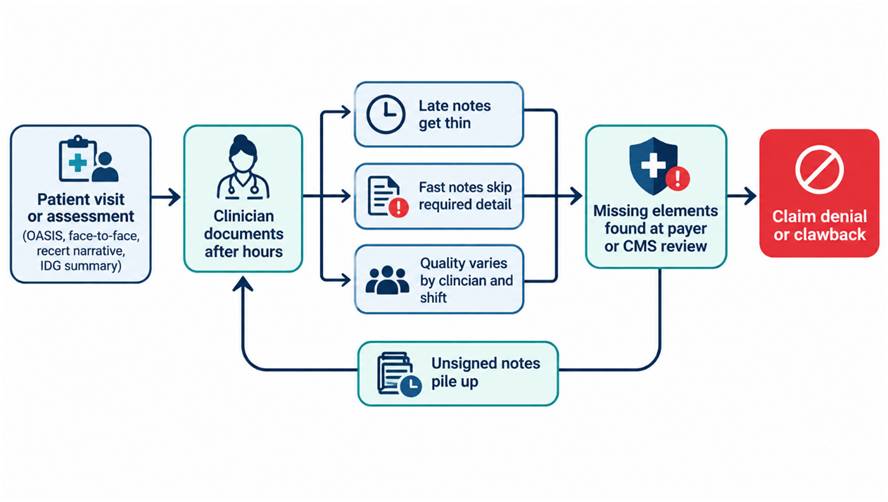
Every visit, assessment and care plan update has to be written, reviewed and defensible, and the clinicians writing it are the ones who should be at the bedside. Patients get shorter conversations. Clinicians take charting home, with primary care physicians logging a median of 36.2 minutes in the EHR per visit booked for 30. Home health and hospice carry the heaviest load, since OASIS assessments, hospice face-to-face notes and recertification narratives all have to hold up to payer and CMS review. Late notes get thin, rushed notes skip what auditors look for, and one missing element can turn a paid claim into a denial or clawback. Templates and scribes add cost and another system, while quality still drifts from clinician to clinician.
The gap between a finished visit and a defensible note is where denials start.
The clinical AI documentation agent takes what a clinician captured at the visit, whether that’s brief notes or an uploaded form, and turns it into a structured draft in your note template. It pulls context from the EHR, checks the draft against your documentation and compliance rules, and flags what’s missing. The clinician reviews, edits and signs.
Caregence completes the draft in under 5 minutes, against 30-90 minutes of manual charting.
A visit closed in your EHR or mobile app starts the workflow inside the Caregence platform. Five steps take it from visit to signed note.

| Logic & rules | Process & flow | Integration & output |
|---|---|---|
| Note templates and required elements | Mandatory versus optional inputs | Notification recipients and conditions |
| Terminology, abbreviation and style rules | Workflow branching by note type | EHR fields to read and write |
| Completeness and integrity thresholds | Trigger source and escalation paths | Coding, billing and QA outputs |
| Compliance rules by payer or program | Review routing by clinician role and discipline | Follow-up workflow triggers |
Caregence is EHR-agnostic. It sits above your systems as an orchestration layer, connecting through FHIR and MCP, so there is no migration.

A visit marked complete or a note saved in your existing EHR or mobile app
Any EHR, RCM or scheduling tool can POST to a Caregence endpoint
Nightly sweeps for unsigned notes or weekly documentation quality reports
A completed draft can automatically trigger the compliance review workflow
Every workflow step is timestamped against the patient record: the inputs pulled, the draft generated, the gaps flagged, the edits the clinician made, the signature applied and the notification sent. Consistent, documented review across every note removes the variance auditors look for.
| Dimension | Manual documentation | Caregence |
|---|---|---|
| Time per note | 30-90 minutes of charting | Under 5 minutes to a draft |
| Note consistency | Varies by clinician and by shift | Same template and rules applied to every note |
| Changing the templates | IT ticket and a development cycle | Text edit, live on save |
| Gap detection | Found after a denial or an audit request | Flagged before the note is signed |
| Audit evidence | Reconstructed after the fact | Timestamped at every step, automatically |
| Capacity ceiling | Fixed by clinician hours | Scales with visit volume |
Bring one week of real visit notes. We'll run them through the workflow and show you the drafts and flagged gaps next to your own.
Book a 20-minute walkthrough