
| Attribute | Detail |
|---|---|
| What it is | Agentic AI in healthcare for prior authorization and claims management |
| Built for | Prior authorization coordinators, revenue cycle, and utilization management teams |
| What it covers | Data capture, verification, submission, status tracking, and EHR write-back in one workflow |
| Programs supported | Medicare, Medicaid, and commercial plans |
| How rules are set | Plain-language configuration your own staff can edit, live on save |
| Triggers | Intake portal, EHR, CRM, API call, webhook, or scheduled batch |
| Decision model | The agent submits, tracks, and reports. The payer decides. A coordinator handles exceptions. |
An approval process with no visibility, no consistency, and no finality

Prior authorization requires a payer’s approval before treatment can proceed, and that approval carries no fixed timeline. Each payer applies its owncriteria, often clarified only after a first request is denied. Once submitted, a request has no reliable visibility into its status, and the resulting delay is linked to disease progression and avoidable hospitalizations. Even an approval can be reversed after care is delivered, shifting the financial risk to the provider or the patient.
One continuous workflow carries a request from a patient ID to a tracked decision.

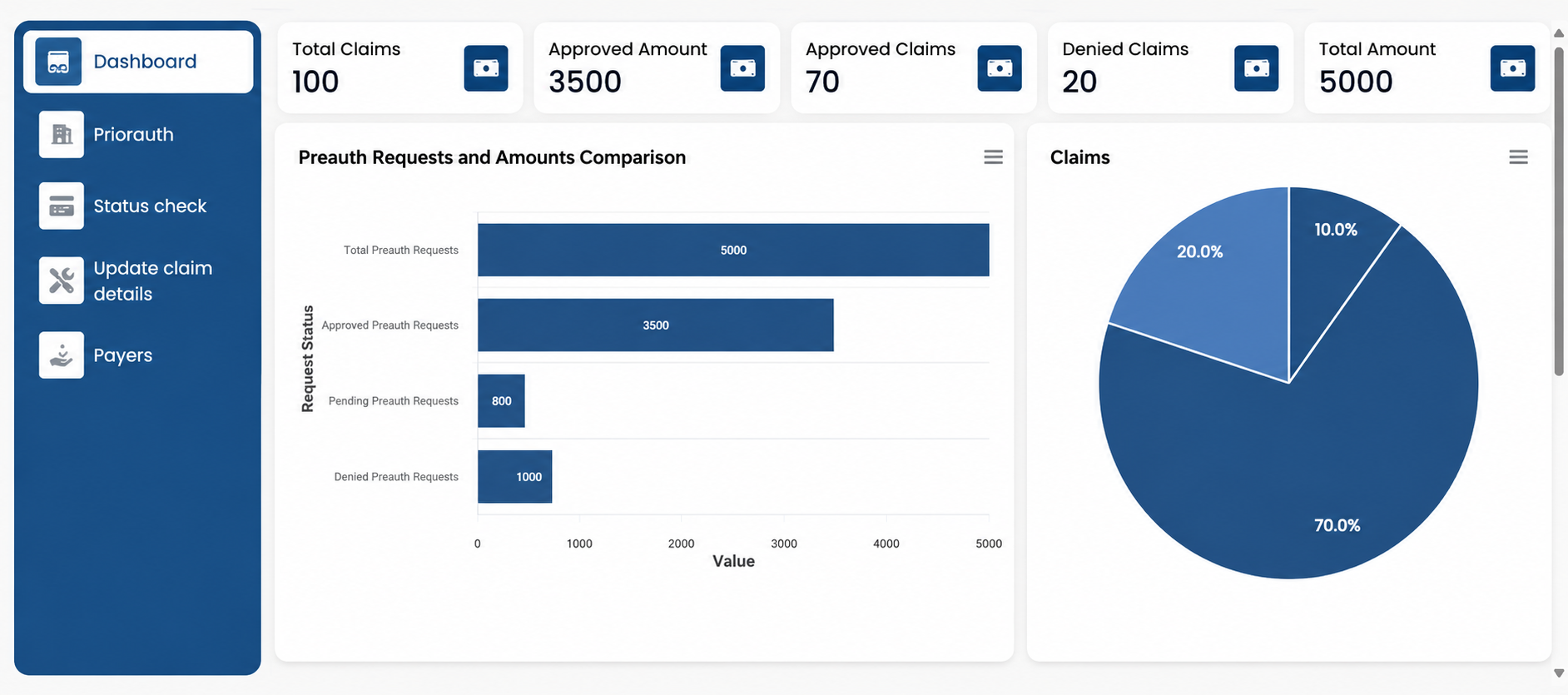
Visibility for coordinators, oversight for compliance, and a trend line for leadership
| Role | What they get |
|---|---|
| Intake and authorization teams | See missing items, auto-assemble the packet, and push complete requests in minutes |
| Clinicians | Early visibility into required documentation and medical necessity criteria |
| Revenue cycle leaders | Throughput, denial reasons, and aged requests tracked from one dashboard |
| Compliance officers | An auditable trail for every edit, submission, and payer touchpoint |
| Executives | Time-to-decision and cost-to-authorize trending in the right direction |
Faster approvals, fewer denials, less time lost to paperwork
Faster approvals, with cleaner packets and the right channel selected the first time
Fewer denials, through a pre-check of coverage, codes, and medical necessity before submission
Lower cost per request, by removing manual entry and repetitive follow-up
Less administrative load, so intake and clinical staff recover hours for patient care
Fewer reschedules and abandoned treatments, from faster, more predictable turnaround
Encrypted, access-controlled, and fully auditable by design

See how the Predictive Matching Agent fills shifts, balances caseloads, and keeps your best caregivers/ nurses from walking out the door.
Book a meeting with our team