Walk into any hospital command centre and you'll find dashboards for everything: bed capacity, denial rates, discharge lag. Answers are harder to come by. The data lives in Epic, Oracle Health , or other EHRs. The claims live in silos. The referral sits in a fax queue. Ambulatory practices carry a lighter version of the same problem, with front-desk teams juggling five-point solutions that don't talk to each other.
None of this is a technology shortage. It's a wiring problem, and it shows up first in the numbers that matter most: length of stay, denial rate, referral leakage, etc.


Beds stay occupied while discharge paperwork catches up to the clinical decision.

Notes take longer to finish than the visits that generated them, and under-coded visits quietly leave risk-adjusted revenue on the table.

Care gets delayed at the door and teams spend their time appealing claims they could have prevented from being denied.

Patients you're best positioned to treat, and specialist handoffs, disappear into inboxes, portals, and competing networks.

Schedulers and staff spend their day managing friction and no-shows instead of managing patients.

Three to five bolt-on AI tools running in parallel, none of them sharing a data layer.
Your EHR already holds the complete chart. What it doesn't hold is the full picture, or the labor that gets a patient from admission to the next setting of care. Closing both gaps, without touching the EHR you depend on, is what makes a hospital AI-ready. We build it as three layers over the systems you already run, joined by one conversational interface .
We ingest from every source you run — clinical, financial, operational, and post-acute — using FHIR, HL7, and native APIs. Duplicate identities resolve into one Master Patient Index, so a true Patient 360 view replaces records scattered across systems.
Ask a question in plain language and get an insight pulled from your own data, plus the next best action the platform can carry out. A case manager asking which discharges are highest-risk today gets the same one-way-in as a CIO reviewing throughput.
Prior authorization, denials management, care coordination, and patient engagement run as drag-and-drop workflows, on schedules or triggers. Every action is logged and written back into the EHR, so the record stays current while the work actually gets done.
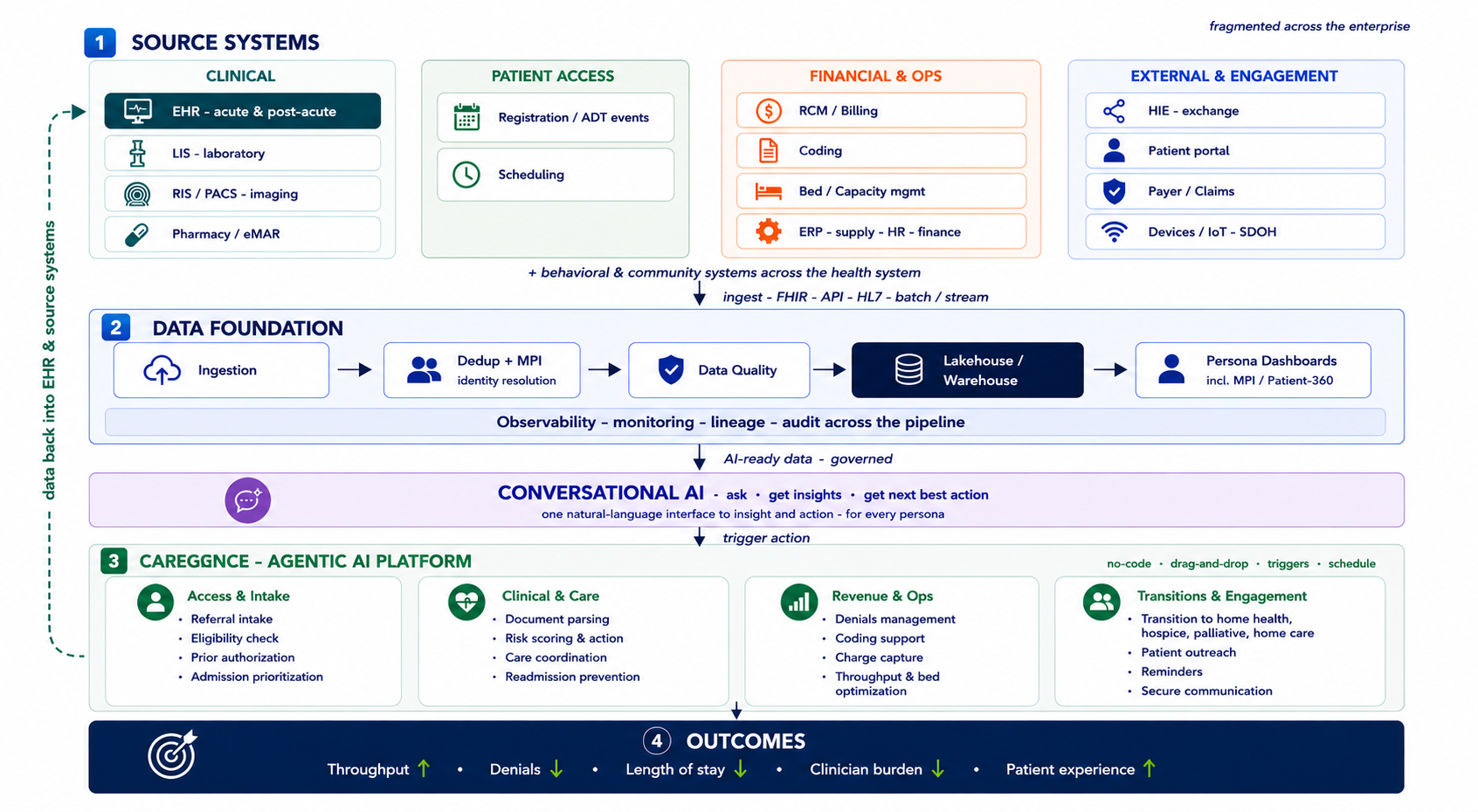
Hospitals and ambulatory clinics run on a wide mix of clinical, payer, and engagement systems, and that’s fine. Inferenz doesn’t ask a health system to rip any of it out. Caregence handles the EHR integration, connecting to the EMR, the revenue-cycle stack, the referral network, and the patient engagement tools already in use, and turns them into one coherent data layer. Below is the landscape of healthcare interoperability solutions we typically integrate with; if a system isn’t listed, it’s very likely we can still connect to it.
| Category | Common Platforms & Systems |
|---|---|
| Hospital & ambulatory EMR | Epic, Oracle Health, MEDITECH, Altera, athenahealth, eClinicalWorks, NextGen, Veradigm, Elation, Greenway |
| Payer & revenue cycle | Epic Resolute, athenaCollector, Waystar, Optum/Change Healthcare, Availity, R1, FinThrive, Tebra |
| Pharmacy | Epic Willow, Omnicell, Pyxis, Surescripts, DoseSpot |
| Workforce & scheduling | UKG/Kronos, Workday, QGenda, symplr |
| Finance & ERP | Workday, Oracle, Infor, Strata |
| Referral, discharge & patient engagement | Epic in-basket, Ensocare, Aidin, WellSky CareInsights, naviHealth, Luma Health, Phreesia, Klara, Weave |
| CRM | Salesforce Health Cloud, Epic Cheers, HubSpot |
| Health information exchange | Care Everywhere, CommonWell, Carequality, TEFCA/QHINs, Health Gorilla, Particle Health |
| Cloud & data infrastructure | Epic Cogito/Caboodle, Snowflake, Databricks, Azure, AWS, GCP |
Inferenz starts with the data sourced from every EMR/EHR, payer, and scheduling system unified into one FHIR-enabled foundation with a real Master Patient Index across governed bronze, silver, and gold layers. From that gold layer, Caregence runs predictive models, workflows, and agents that write decisions back into the EMR, deploying on your own Snowflake, Databricks, Azure, or AWS environment with no rip-and-replace.
Caregence ships with ready-to-use AI agents built for real operations, connected to existing systems through an interoperable, MCP-based framework. The agents most relevant to hospitals and ambulatory clinics:


Caregence’s predictive models for healthcare give hospitals and clinics early visibility into risk, staffing demand, and compliance gaps, drawing on patterns across intake, visit, and claims data. The categories most relevant to hospitals and ambulatory clinics:
Every hospital we work with starts in a different place, but these are the use cases Inferenz typically stands up first for a hospital system, each powered by a specific combination of agents and predictive models.


We already work across post-acute care, home health, and hospice, so your discharge and referral data has somewhere real to go, tracked end to end.
Clinical and operations leaders handle no-code workflow automation building and adjusting workflows in a drag-and-drop builder, without opening an IT ticket.
Runs on the Snowflake, Databricks, Azure, or AWS environment you already have. No forced migration, no vendor lock-in.
Every agent decision is explainable and traceable, built for HIPAA-aligned environments from the ground up.
CMS-0057-F requires 72-hour and 7-day prior-authorization decisions through FHIR-based APIs starting January 2027. Our workflows are built for that deadline now, not scrambling to meet it later.
Adoption of AI in healthcare with Caregence™ changes how care is delivered, measured, and scaled, beyond the cost-effective nature of operations.
in patient service margins
in hospital days for high-risk patients
document completion process
Hospitals and clinics are one part of the picture. The same data foundation and Caregence™ agents extend across the entire care journey:

Caregiver-client matching, EVV compliance, MLTSS authorization, and recruiting automation across personal care agencies.

OASIS accuracy, prior auth, clinician routing, and readmission prevention across skilled home health agencies.

Eligibility screening, HOPE compliance, IDG coordination, and family communication at the end of life
A short call with a healthcare AI strategist is usually enough to know if there's a fit.
Book a 20-Minute Strategy Call