













Summary
A standalone readmission risk score doesn’t move a hospital’s numbers, the 2025 and 2026 evidence both say so. What works is scoring patients at three points around discharge, routing every flagged risk to a named owner with a deadline, and measuring intervention completion alongside the readmission rate itself. The piece closes with a 90-day pilot design and the three-part rule for deciding whether to scale it.
Introduction
Every hospital COO has sat through the meeting set up for predictive analytics in healthcare. A dashboard lights up red with high-risk discharges, a task force gets formed, and six months later the 30-day readmission rate hasn’t moved. The score wasn’t wrong. Nobody built a workflow around it.
That’s the gap most readmission-risk programs fall into. The real job isn’t predicting who comes back. It’s identifying which discharges need an intervention, assigning that intervention to a named person, and finishing it before the patient hits the next failure point. Get that right, and readmission risk prediction stops being a compliance exercise and starts closing one of the quietest leaks in hospital capacity: a bed that reopens three days later because a discharge bounced back was never actually freed. If length of stay and discharge delay are the front half of your throughput problem, as we cover in The Hospital Throughput Crisis: How COOs Are Using AI to Cut LOS and Discharge Delays, readmissions are the back half nobody puts on the same whiteboard.
Predictive modelling in healthcare is not starting from zero here. Somewhere in the building, a predictive model is already scoring patients. What’s usually missing isn’t the math. It’s the workflow, the named owner, and the deadline attached to what the model finds.
Why readmission risk prediction alone won’t move your numbers
Most vendor demos sell prediction as the finish line. The evidence says otherwise. A randomized evaluation of causal machine learning across 19 hospitals and 9,959 patients tested a sharper idea: instead of targeting patients with the highest predicted risk, target the ones most likely to benefit from outreach. The trial found a 30-day readmission rate of 7.7% for benefit-based targeting against 8.2% for standard care. That gap wasn’t statistically significant.
The model itself worked fine operationally. What the study actually proved is less comfortable: a high AUC, the number vendors love to put on a slide, doesn’t tell you whether an intervention will land. Readmission risk stratification only pays off when it’s measured against preventability and available outreach capacity, not against how cleanly the model separates high-risk from low-risk patients on paper. Grade your program on discrimination alone, and you’re grading the wrong exam.
Most hospitals aren’t starting this comparison from scratch, either. The LACE index, built on length of stay, acuity, comorbidities, and emergency-department visits, has been the default readmission screening tool for well over a decade, and it remains a fair baseline to test any newer model against. The honest question was never LACE versus a fancier algorithm. It’s whether either one, on its own, changes what a care team actually does before the patient leaves. A model that beats LACE on a validation set but doesn’t move a single workflow decision hasn’t improved anything a COO can put on a scorecard.
What the 2026 evidence actually shows
A more encouraging picture comes from a nine-hospital study published in 2026. Researchers compared 4,662 discharges supported by virtual nursing against 4,662 traditional discharges with similar baseline risk scores. Emergency-department readmissions within 30 days landed at 3.7% for the virtual-nursing group, versus 13.3% for the control group.
That’s a real difference, and it’s still a retrospective implementation study, not a randomized trial. It shows what the workflow model can do, not that the algorithm alone caused the drop. The prediction was attached to a full discharge operating system: medication reconciliation, teach-back, follow-up scheduling, barrier resolution, and a structured post-discharge contact plan. A score sitting alone on a dashboard, with no closed-loop task behind it, is unlikely to touch outcomes at all.
This is where the scoring engine must earn its place inside the workflow, not just inside a model registry. Inferenz’s Caregence™ Predictive Models, built on their data science and predictive analytics services embed this kind of risk model directly into clinical and operational workflows, so a discharge score triggers action instead of sitting in a report nobody opens until the next steering committee.
Score at three moments, not once
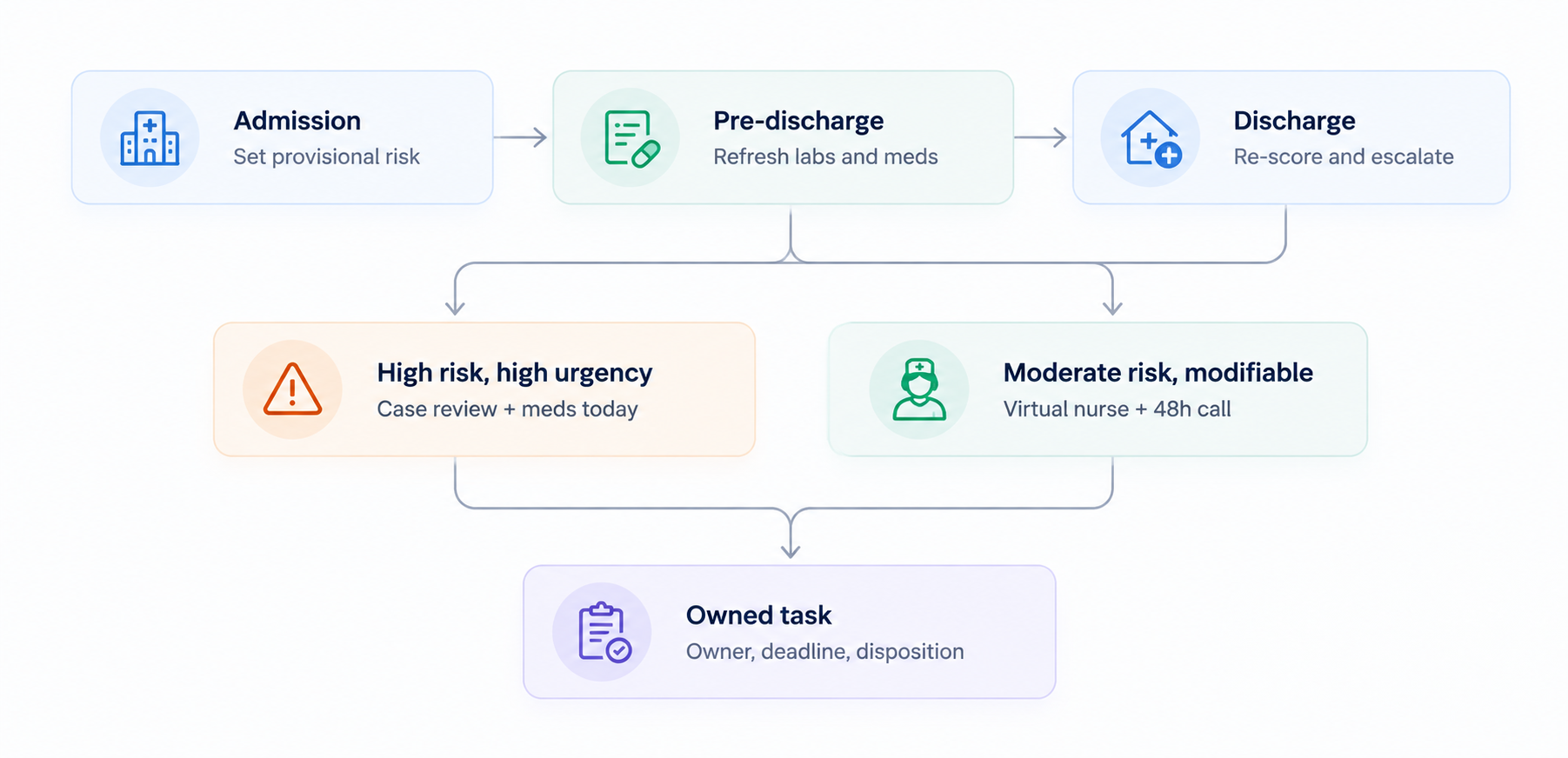
A single admission-time score is a snapshot from before the patient’s condition, medications, and discharge plan took final shape. Three checkpoints work better:
- At admission: establish a provisional risk and flag likely barriers.
- 24 to 48 hours before discharge: refresh the score using current labs, utilization data, medication changes, functional status, social needs, and discharge destination.
- At discharge and again 48 to 72 hours after: re-score or trigger a rules-based escalation the moment a patient misses a prescription fill, a follow-up visit, or a home-service connection.
The second and third checkpoints carry more operational weight than the first, because they’re the only ones where the team can still change what happens to the patient. None of this works if a case manager has to log into four systems to see current labs, medications, and social-needs data in one place. That’s a real-time readmission risk dashboard problem before it’s a prediction problem, which is why MPI and Patient 360 matters as much here as the model itself. The use of predictive AI in discharge planning could include a risk assessment tool that refreshes on stale or fragmented data will confidently produce the wrong answer.
 Two lanes, not one risk list
Treating every elevated score the same way guarantees alert fatigue. Split the response into two lanes instead:
- High risk, high urgency: same-day case-management review, medication reconciliation, a follow-up visit booked before discharge, and resolved transportation, caregiver, food, housing, or equipment barriers.
- Moderate risk, high modifiability: a virtual nurse or transition coach, teach-back, a 48-hour call, a pharmacy and primary-care connection, and automated escalation if contact fails.
The model should optimize for risk times preventability times available intervention capacity, not risk in isolation. That’s the same principle behind the benefit-based targeting study above, applied at the operational level instead of the modeling level. Case managers should keep override authority. They see context a model never will, and a program that strips out clinical judgment for the sake of algorithmic purity tends to lose clinician trust fast, which is its own kind of failure.
Turn every alert into an owned task
A risk score without an owner is just anxiety with a percentage attached. Every alert needs three things: an owner, a deadline, and a disposition.
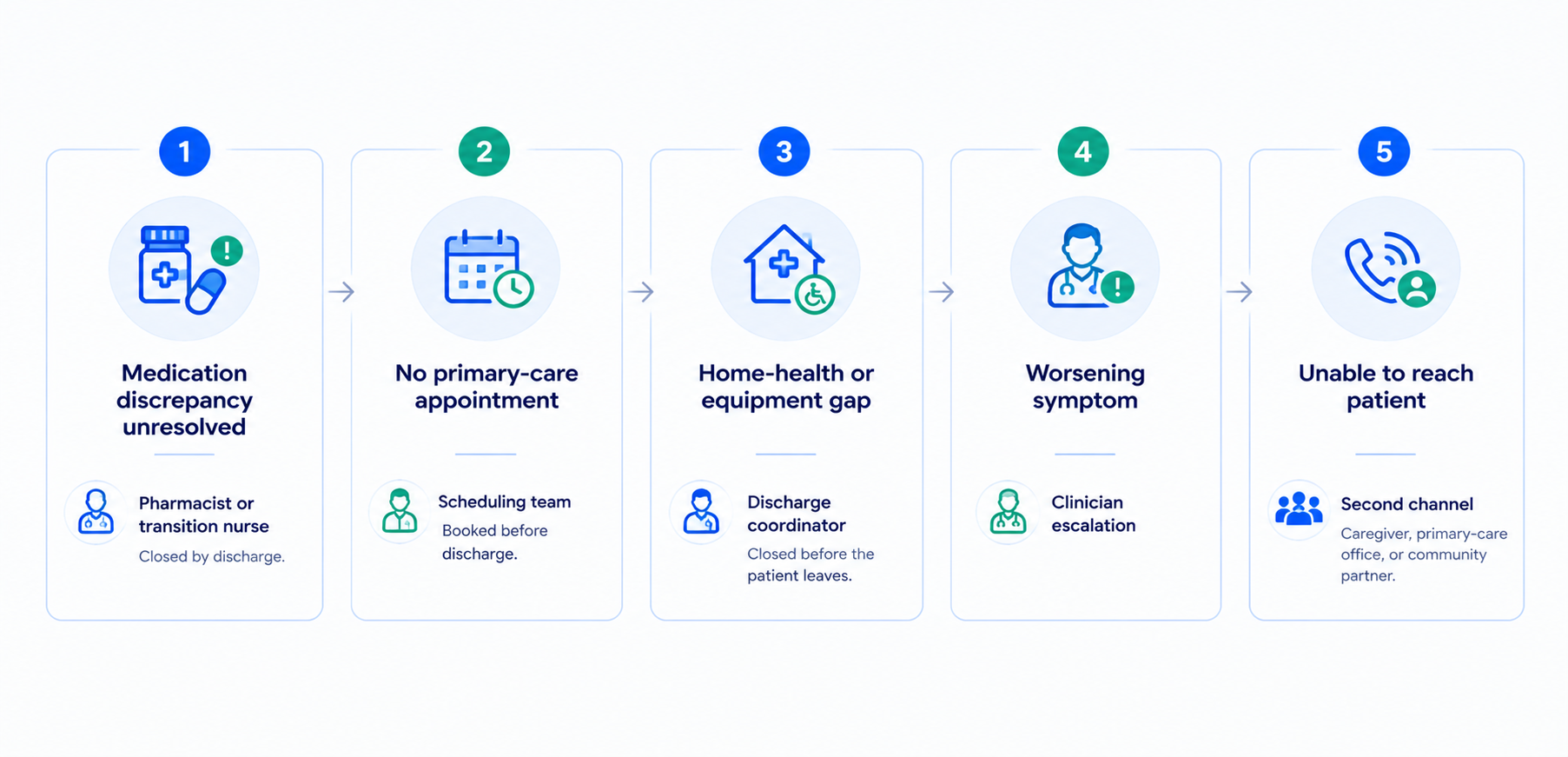 This is intelligent automation in healthcare doing the unglamorous work it’s actually good at: not diagnosing anyone, just making sure a task doesn’t fall through a shift change. It’s also a clean example of agentic AI applications in healthcare done right, where the agent’s job is routing and follow-through, not clinical judgment. Inferenz’s Risk Analyzer Agent is built around exactly that pattern. It tracks vitals, visit patterns, and clinical events to flag deterioration early, routes the next best action to the right team automatically, and keeps tracking whether that action closed on time.
Pair that with a structured post-discharge contact channel for the 48-hour call and teach-back steps, and the dashboard finally shows something more useful than a headcount of high-risk patients. It shows open tasks and how long they’ve been sitting there.
What COOs and CNOs should actually measure
Two categories of metrics matter here and mixing them up is a common mistake.
Leading indicators tell you if the workflow is running: the share of eligible discharges scored before the decision window closes, the share of high-priority patients with a named owner within four hours, medication reconciliation completed before discharge, follow-up appointments booked before discharge, successful patient contact within 48 hours, and alert acceptance, override, and closure rates by unit.
| Leading indicators (is the workflow running?) | Outcome & balancing measures (did it work?) |
| % of eligible discharges scored before the decision window closes | 7-, 30-, and 90-day all-cause readmission |
| % of high-priority patients with a named owner within 4 hours | ED revisits without admission |
| Medication reconciliation completed before discharge | Time to first post-discharge contact |
| Follow-up appointment booked before discharge | Staff workload and after-hours burden |
| Successful patient contact within 48 hours | Mortality and observation stays |
| Alert acceptance, override, and closure rates by unit | Calibration by race, language, payer, disability, rurality, discharge destination |
There’s a hard financial backdrop to all this. CMS’s FY 2026 rule continues to publish Hospital Readmissions Reduction Program payment-adjustment factors for discharges beginning October 1, 2025, alongside hospital-level social-risk and behavioral-health diagnosis coding data. That turns readmission and equity monitoring into a standing operating concern for a COO, not a side project the data-science team reports on once a quarter.
It also connects directly to whatever value-based or bundled-payment contracts your finance team is already tracking. A readmission avoided inside a bundled episode isn’t just a quality win. It’s margin your CFO can point to on the same call where HRRP penalties get discussed, which is usually the fastest way to keep a discharge-workflow program funded past its first budget cycle.
A 90-day pilot you can actually finish
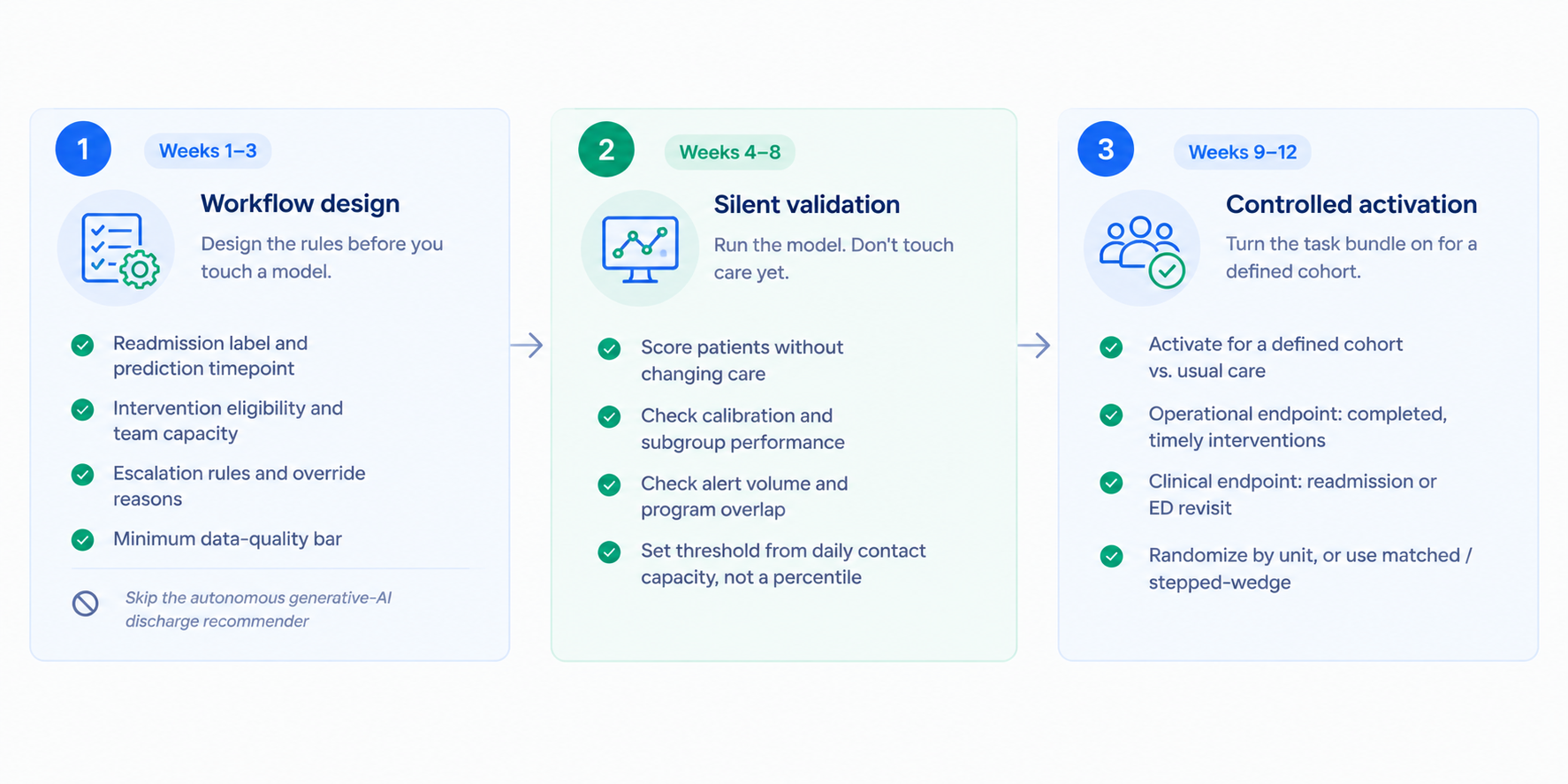
Pick one service line with real volume and a defined transition team, is what we suggest as part of our data quality, governance, and compliance services. Heart failure, COPD, general medicine, and oncology all work well as a starting point. Ninety days is short enough to keep executive attention and long enough to get past the noisiest weeks of any new workflow.
 The decision rule before you scale
Fund the program past the pilot only if it clears three bars at once: a usable signal that calibrates well in your own population, operational conversion where alerts turn into completed actions inside your real staffing model, and clinical value where the intervention arm improves readmission or revisit outcomes without pushing workload, inequity, or safety risk onto your staff.
The 2026 virtual-nursing results are encouraging, and they’re still observational, published as an early-access manuscript still working through peer edits. Pilot the workflow. Measure intervention completion, not just the risk score. Scale after your own data backs it, not after a vendor’s.
None of this is really about the algorithm. A discharge isn’t finished when the patient walks out the door. It’s finished when they don’t come back for a preventable reason, and getting there is a staffing and workflow discipline with a model attached to it, not the other way around. This is where a digital patient engagement platform can extend the workflow beyond the hospital, helping care teams maintain meaningful patient engagement, follow-up, and communication after discharge.
Treat readmission risk prediction as the entry ticket, not the finish line, and you’ve also closed one of the least visible drains on your throughput math, because every bed a readmission reopens is one your capacity planning already counted as free.