













Executive Summary
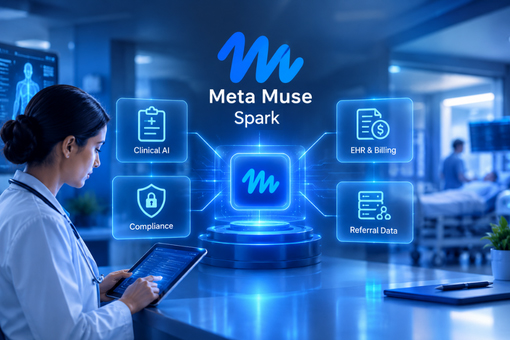
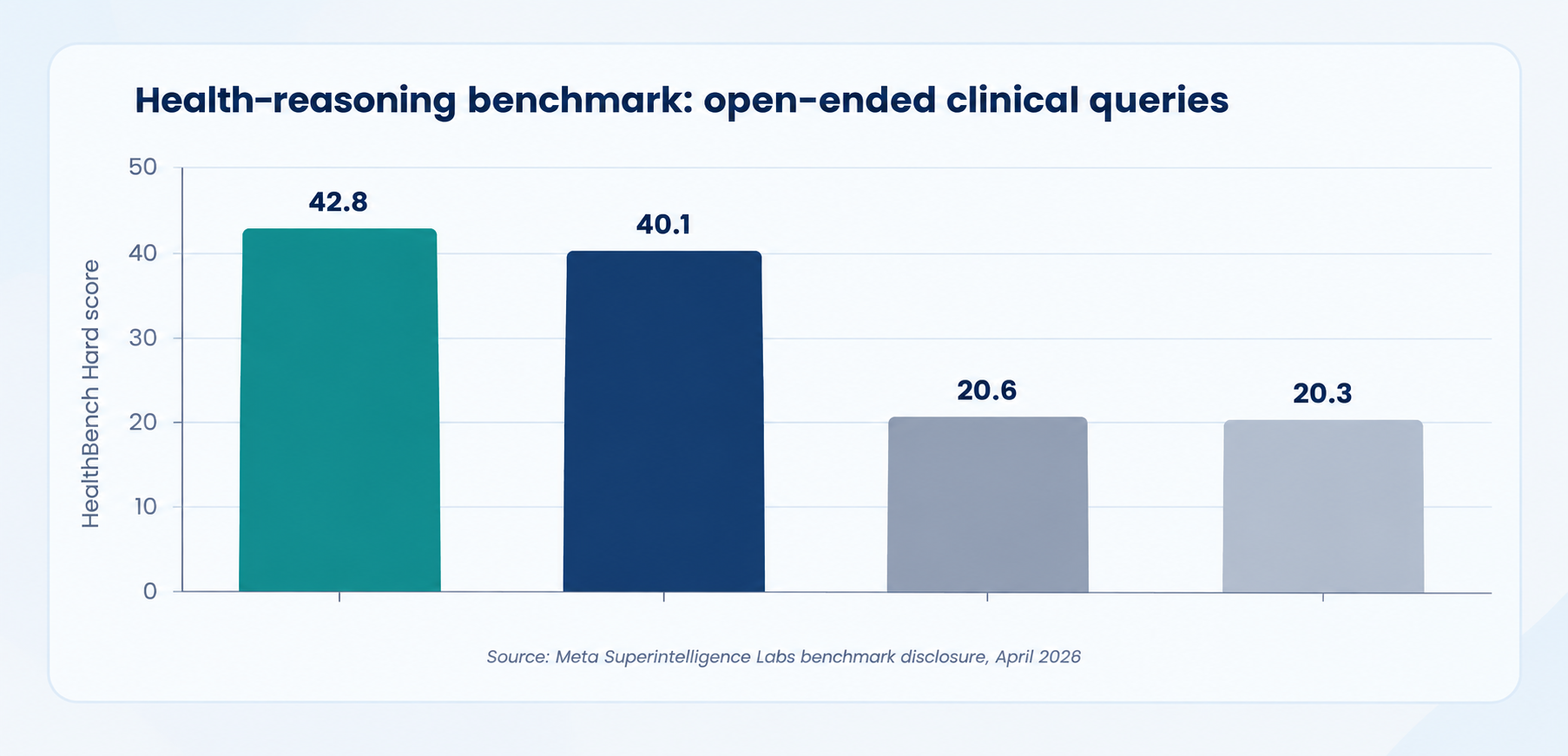
Meta entered consumer health AI on April 8, 2026, with the launch of Muse Spark, the first model to come out of its newly formed Meta Superintelligence Labs. It isn’t a healthcare product in any enterprise sense. It’s a general-purpose assistant, folded into Facebook, Instagram, WhatsApp, Messenger, and Ray-Ban Meta glasses, that happens to be unusually good at answering health questions. Meta says it worked with over 1,000 physicians to curate the health-reasoning training data. Independent benchmarks back that claim: Muse Spark scores 42.8 on HealthBench Hard, ahead of GPT-5.4 (40.1), Gemini 3.1 Pro (20.6), and Grok 4.2 (20.3).
What is Muse Spark?
Meta describes Muse Spark as “small and fast by design, yet capable enough to reason through complex questions in science, math, and health.” It’s proprietary: no open weights, unlike the Llama line it replaces as Meta’s flagship effort. It ships with three interaction modes. Instant handles quick answers. Thinking works through multi-step reasoning. Contemplating orchestrates multiple agents in parallel for the harder problems, Meta’s answer to Gemini Deep Think and GPT Pro.
- Built by Meta Superintelligence Labs, formed after Zuckerberg’s reported dissatisfaction with Llama 4’s progress and led by former Scale AI CEO Alexandr Wang, following a $14.3B investment for a 49% stake in Scale AI.
- Rolling out across the Meta AI app, web, WhatsApp, Instagram, Facebook, Messenger, and Ray-Ban Meta AI glasses, which means multimodal, “see what I see” health queries are a real near-term use case, not a roadmap slide.
- Free to use, with rate limits, and offered via private-preview API to select partners: a distribution strategy, not a licensing one.
I personally believe that Meta isn’t trying to build a HIPAA-compliant AI. It’s trying to make the Meta AI app the place a billion people ask their first health question. That alone resets what people expect from every other health AI product, long before Meta ever touches an enterprise or provider workflow. Caregence by Inferenz on the other hand, helps build healthcare-specific autonomous AI agents on a HIPAA-compliant platform.
Use Cases This Opens Up
Consumer-facing
- First-line health Q&A at massive scale, inside apps people already open dozens of times a day, which removes the step of seeking out a dedicated health app.
- Multimodal symptom and visual triage via Ray-Ban Meta glasses: “what is this rash,” “read this medication label,” “what does this lab report say,” using camera-based context instead of typed description.
- Biometric and lab-trend visualization. Muse Spark actively prompts users to “paste your numbers” (glucose, blood pressure, lab panels) so it can chart trends over time.
- Pre-visit preparation: drafting questions for a doctor, plain-language explanations of a diagnosis or procedure, digital patient engagement, medication interaction lookups.
Where it does not extend (today)
- No clinician-facing workflow: no EHR integration, no charting, no order entry. This is a consumer assistant, not a Dragon Copilot or Cortex Agents competitor.
- No regulatory clearance. Meta makes no FDA claims, and none of the frontier consumer models, Muse Spark included, are cleared as diagnostic tools.
- No enterprise or provider-side product announced. Unlike Google’s Med-Gemini via Cloud Healthcare API or Anthropic’s Claude for Life Sciences, there’s no B2B healthcare offering attached to Muse Spark today.

Compliance: The Part That Should Concern Healthcare Leaders
This is the section that matters most if you’re building compliance-first healthcare AI. Muse Spark’s health capability is arriving inside a company with an unresolved, material healthcare-privacy track record, and the model inherits that posture by default.
The regulatory gap
- Meta is not a HIPAA-covered entity, and Muse Spark carries no Business Associate Agreement. Clinicians interviewed by WIRED were blunt about it: handing clinical details to the tool is a genuine data-handling risk, not a theoretical one.
- Meta’s generative-AI policy allows chat data to be retained for training and to influence advertising. That’s the opposite of the data-isolation guarantee enterprise health platforms are expected to provide.
- Muse Spark requires login via an existing Meta account (Facebook, Instagram, or WhatsApp), which means health queries are tied to an identity graph already used for ad targeting, even though Meta states sensitive health signals are filtered out of ad ranking.
WHY IT MATTERS
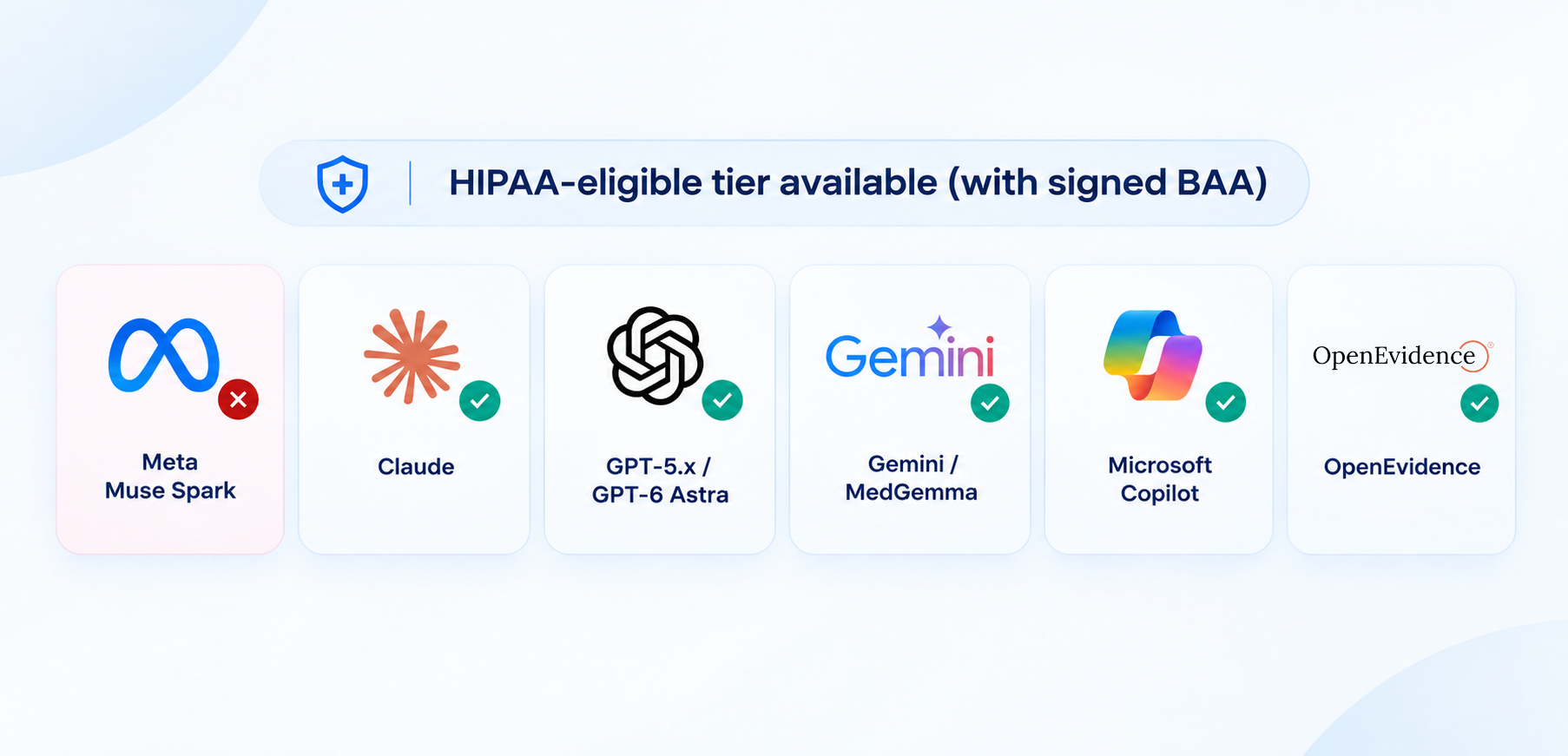
Every credible enterprise health AI vendor scopes HIPAA eligibility to a specific, contractually governed product tier. Muse Spark, as shipped today, has no such tier. It’s the free consumer assistant. Full stop.
Recent history that makes this scrutiny warranted
Meta faces ongoing litigation over the Meta Pixel lawsuit allegedly transmitting protected health information (appointment scheduling, medical conditions, provider names) from hospital patient portals back to Facebook, without valid HIPAA authorization or a BAA in place with the hospitals involved.
That exposure hasn’t cooled off. Through mid-2026, HIPAA Journal tracked a fresh wave of hospital settlements tied to pixel-based tracking tools, including an $800,000 settlement fund at Concord Hospital Health System, with plaintiffs’ firms now reaching smaller providers and specialty clinics rather than only the largest health systems.
Independent testing by WIRED in April 2026 found that Muse Spark actively solicits raw lab and biometric data, and in at least one documented case produced clinically dangerous guidance: a near-starvation meal plan in response to an extreme-fasting prompt.
Where the rest of the market stands, for contrast
- Claude and GPT-5.x/GPT-6 Astra: HIPAA-eligible under a signed BAA on enterprise and API tiers. PHI handling is a contractual, auditable commitment, not a policy footnote.
- Google Cloud Healthcare API (Med-Gemini) and Microsoft’s enterprise Copilot and Dragon Copilot tiers follow the same pattern: HIPAA eligibility is scoped to specific, governed enterprise products, never the free consumer assistant.
- MedGemma (Google, open weights) sidesteps the BAA question entirely by supporting fully on-premise, self-hosted deployment. No PHI ever leaves the customer’s environment.
The pattern across every credible healthcare AI vendor is the same. Compliance is a property of a specific, contractually governed product tier, never the free consumer chatbot. Muse Spark, as shipped, sits entirely outside that boundary. And that’s not a gap Meta is likely to close quickly. Closing it would mean re-architecting the data handling, advertising, and identity systems that its entire consumer business model runs on.
Competitive Landscape
| Platform | Health strength | HIPAA / BAA | Primary audience |
| Meta Muse Spark | Strong on HealthBench Hard (42.8); trained with 1,000+ physicians | Not HIPAA-eligible; consumer product, ad-linked data policy | Consumers, via Meta apps & glasses |
| Claude (Opus/Sonnet) | Leads HealthBench Professional; strong calibration & uncertainty handling | HIPAA-eligible with BAA on API/Enterprise; life-sciences MCP connectors | Enterprises, providers, life sciences |
| GPT-5.x / GPT-6 Astra | Competitive HealthBench scores; large context for longitudinal records | HIPAA-eligible via Azure OpenAI / enterprise tiers with BAA | Enterprises, ambient scribing, developers |
| Google Gemini / MedGemma | Strong multimodal imaging; MedGemma open weights for on-prem builds | Cloud Healthcare API HIPAA-eligible; MedGemma self-hosted, no BAA needed | Developers, imaging, cloud-native health teams |
| Microsoft Copilot / Dragon Copilot | Deep clinical documentation heritage; large deployed scribe base | HIPAA-eligible enterprise tiers; six-figure enterprise commitments typical | Health systems, ambient documentation |
| OpenEvidence | Most-used LLM tool among physicians surveyed (HOMERuN) | Purpose-built for clinicians; evidence-citation model | Practicing physicians |
Here’s the honest read. Muse Spark is benchmark-competitive on health reasoning, but it’s playing in a different lane than the enterprise and clinical AI market. It isn’t displacing OpenEvidence among physicians, Dragon Copilot inside health systems, or Claude and GPT-6 Astra in provider-facing platforms. It’s competing with WebMD, Google search, and asking a friend, just at a scale none of those can match.
How This Shapes Healthcare Going Forward
The upside
- Genuine democratization of first-line health information for populations with limited access to care. That’s a real, non-trivial public-health benefit, if the guardrails hold.
- Competitive pressure on Google, OpenAI, and Microsoft to keep improving consumer-facing health reasoning, which raises the baseline quality of free health information across the board.
- Multimodal, wearable-based health interaction through smart glasses becomes mainstream faster than it otherwise would have. This is a genuinely new interaction pattern, not an incremental one.
The risk
- A consumer AI with no HIPAA obligation, ad-linked data retention, and a documented history of soliciting sensitive health data at massive scale is a regulatory incident waiting to happen. Regulators (HHS/OCR, state attorneys general, EU regulators) are already primed by the Pixel litigation to scrutinize Meta’s health-data practices specifically.
- Clinically dangerous outputs at consumer scale, like the extreme-fasting example, create real patient-safety exposure well before any enterprise deployment. This is happening in production, today, to real users.
- The blurring of “consumer wellness chat” and “medical advice” in the public’s mind makes it harder for patients to tell a compliant, provider-sanctioned AI tool apart from a free assistant with no clinical accountability. That’s a trust problem the entire industry inherits, not just Meta.
The tension
Muse Spark proves a consumer AI can be genuinely good at health reasoning. It also proves, through its own vendor’s litigation history, that being good at health reasoning and being safe to trust with health data are two completely separate engineering and governance problems.
Bottom Line
Muse Spark is a serious model with real health-reasoning capability, built by a company with a real health-privacy problem it hasn’t resolved. Its near-term impact on the broader healthcare AI market is indirect but significant.
The platforms that win the next phase of healthcare AI won’t be the ones that simply reach the most users first. They’ll be the ones that pair Muse Spark-level reasoning with a signed BAA, an auditable data trail, and a governance model built for PHI from day one.
Muse Spark raises consumer expectations for what a health-aware assistant should feel like, and it sharpens the public compliance conversation by giving regulators and patients a concrete, litigated example of what “not HIPAA-eligible” actually costs.