













Summary
Caregence is a HIPAA compliant healthcare native agentic AI platform from built by Inferenz that treats HIPAA compliant AI as an architectural principle, not a final checklist. Every AI agent operates on minimum-necessary access, every action is logged, and the infrastructure is isolated and governed by design, so healthcare organizations can adopt agentic AI healthcare workflows without trading away patient privacy or security.
Introduction
Healthcare is entering a new era where artificial intelligence goes beyond answering questions and generating summaries. Modern AI systems can reason, coordinate workflows, retrieve information from multiple systems, and execute tasks autonomously. As a result, this new paradigm, agentic AI, has the potential to transform healthcare operations by freeing providers to focus on patient care while intelligent agents handle repetitive administrative and clinical work.
Yet this transformation raises an important question: how do healthcare organizations embrace autonomous AI without compromising patient privacy, regulatory compliance, or security?
The Caregence platform, by Inferenz, revolves around trust. Innovation alone is not enough in healthcare. Every AI interaction must be built on a foundation of security, accountability, and responsible data governance. HIPAA compliance is woven into the architecture of our agentic AI platform from the very beginning.
Why security must evolve alongside AI
Healthcare organizations manage some of the world’s most sensitive information. Medical histories, diagnostic reports, insurance details, prescriptions, and laboratory results aren’t just data points they represent deeply personal aspects of an individual’s life.
Traditional software applications typically process information in predictable ways. Agentic AI introduces dynamic decision-making instead. Within a healthcare workflow automation environment, AI agents:
- Retrieve data from connected systems EHR/EMR, payer platforms, claims, CRM, HR/payroll, and RCM
- Reason across multiple sources to determine the right next step in a workflow
- Interact with healthcare systems to complete tasks like intake, authorization, or documentation
- Collaborate with other agents, coordinated through an orchestration layer, to complete complex, multi-step workflows
This expanded capability raises the bar for governance. Healthcare providers need assurance that AI agents access only the information necessary for a specific task, that every interaction is recorded, and that patient information stays protected throughout the process. Security, therefore, must evolve alongside intelligence.
HIPAA as an architectural principle
Many organizations treat HIPAA as a compliance checklist completed near the end of software development. Caregence takes a different approach.
HIPAA principles influence architectural decisions from day one. Our approach begins with secure design principles, ensuring every feature – from the core platform to individual pre-built agents – is built with privacy, governance, and regulatory requirements in mind from the outset. That philosophy embeds security into every layer of the platform: infrastructure, application design, AI orchestration, and operational monitoring.
Designing agentic AI with privacy in mind
An autonomous healthcare agent should never have unrestricted access to patient information simply because it ‘can’ perform a task. Each AI agent operates with carefully defined responsibilities instead.
Consider an AI agent assisting a clinician with discharge documentation. It doesn’t require unrestricted access to every record in the Electronic Health Record (EHR). It retrieves only the information relevant to that patient’s discharge, processes it within a secure environment, records its activity for auditing, and completes the workflow without retaining unnecessary data.
This principle of minimum necessary access sits at the center of responsible healthcare AI, and it aligns directly with HIPAA’s privacy expectations.
How Caregence protects healthcare data
Protecting healthcare information takes more than encryption or authentication alone – it takes multiple layers of defense working together across the entire AI lifecycle. Within Caregence, sensitive healthcare information is protected through a security-first architecture built around confidentiality, integrity, and availability.
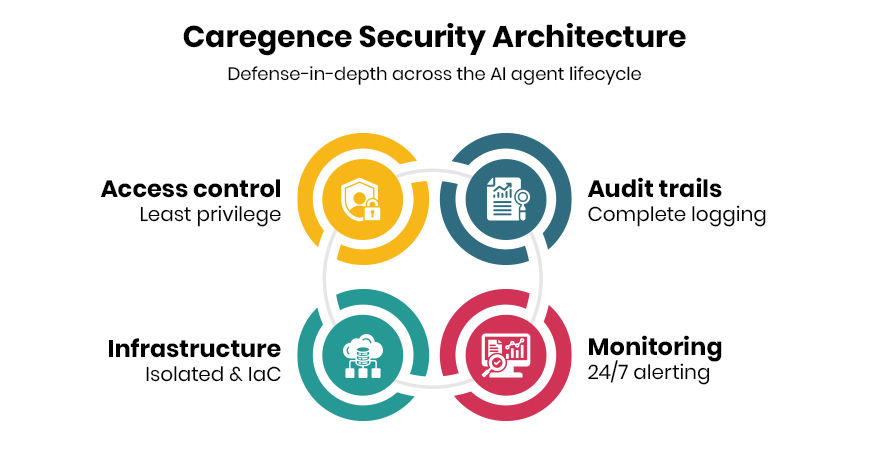
The platform’s four protective layers, at a glance:
- Secure identity and controlled access: every request from an AI agent or authorized user is validated before access is granted. Role-based permissions ensure clinicians, administrators, and support staff interact only with the information their role requires, using secure identity management rather than shared credentials.
- Secure infrastructure by design: Caregence operates within enterprise cloud environments using isolated networking, secure storage, managed databases, secret management, and Infrastructure as Code (IaC), minimizing public exposure and enforcing controlled communication between services.
- Comprehensive audit trails: every meaningful interaction is traceable. Authentication events, AI agent activity, administrative actions, and system operations are all logged to support monitoring, incident investigation, and compliance reporting.
- Continuous monitoring: observability practices give visibility into application health, infrastructure performance, and AI workload behavior, with automated alerting so technical teams can respond before an issue touches a clinical workflow.
Trust cannot exist without transparency, and uptime alone isn’t the goal, the goal is patient services that stay reliable and secure.
Responsible AI beyond compliance
Regulatory compliance sets the minimum standard. Responsible AI demands more.
At Caregence, we believe healthcare AI should be transparent, accountable, and explainable wherever possible. Our platform supports AI governance healthcare practices that include:
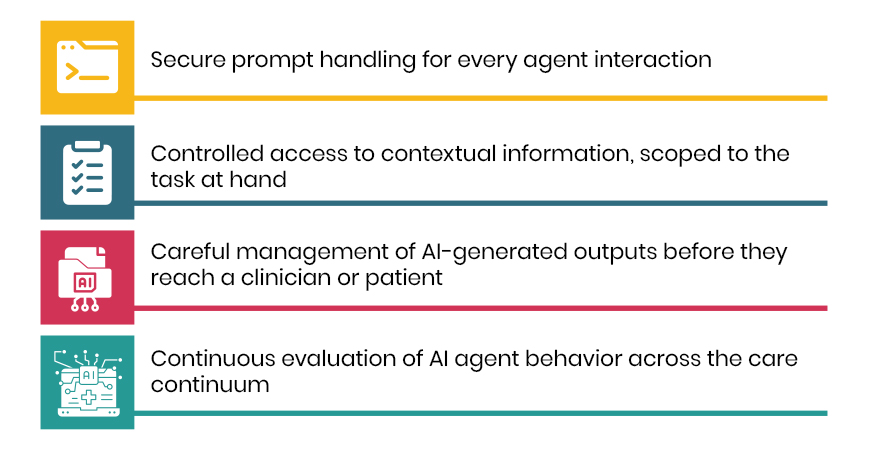
These practices help healthcare organizations deploy AI confidently while keeping oversight of every automated decision.
Enabling healthcare innovation without increasing risk
Healthcare organizations often face a difficult choice between adopting innovative technologies and maintaining strict regulatory compliance. Agentic AI changes that conversation.
When security and governance are embedded into the platform itself, organizations can accelerate digital transformation without adding operational risk. Administrative workflows become more efficient, clinicians spend less time on repetitive documentation, and healthcare teams gain intelligent assistance while maintaining confidence that patient information stays protected.
Innovation and compliance no longer compete. They reinforce each other.
The Caregence Vision
The future of healthcare will be defined not simply by smarter AI, but by trustworthy AI. As autonomous systems grow more capable, patients and providers will expect healthcare AI platforms to demonstrate accountability, transparency, and security by design.
At Caregence, our mission is to build agentic AI that healthcare organizations can trust. Every architectural decision reflects our commitment to protecting sensitive healthcare information while empowering providers to deliver faster, more efficient, and more personalized care.
HIPAA compliance is an important milestone, but our vision extends beyond meeting regulatory requirements. We strive to build an AI platform where security enables innovation, governance strengthens automation, and trust becomes the foundation for every intelligent healthcare interaction.
Because in healthcare, the most valuable outcome isn’t just smarter technology, it’s the confidence that every patient interaction is handled with the care, privacy, and responsibility it deserves.