














Summary
Interoperability compliance rarely fails at the FHIR endpoint. It fails one layer down, in the governance gaps nobody mapped: unclear data ownership, missing lineage, and access rules built for a paper world. Here is the checklist hospital data teams need in place before the next audit, and before the next AI proposal reaches the board.
Why Data Governance Gaps Are Causing Interoperability Compliance Failures
Your board didn’t ask about your firewall. It asked why the AI pilot stalled.
Somewhere in that answer sat a governance gap nobody had mapped: who owns the patient identity record, who approved that vendor’s data access, and why nobody could produce a lineage trail when the question came up.
That pattern is showing up across hospital systems heading into 2026 and 2027. Most compliance conversations start with the wrong question. Teams ask which FHIR APIs they need, when the harder problem sits one layer down: does anyone actually own this data, and can the organization prove it on demand?
Interoperability in healthcare, the ability to move and use patient data across systems, isn’t new. What’s new is the enforcement. CMS-0057-F pushes payers toward five FHIR-based APIs by January 2027, and starting that performance period, hospitals and clinicians attest under Medicare’s Promoting Interoperability program that they used one electronically. USCDI v3 sets the data classes those exchanges have to carry. Know what CIOs need to know for implementing CMS-0057-F before the deadline with an AI-ready hospital here.
None of it works without governance underneath: a defined steward, a documented access policy, a lineage trail that survives an audit.
The cost of skipping that layer isn’t theoretical. IBM’s report puts the average healthcare breach at $7.42 million, the highest of any industry it tracks, for the 14th year running, with healthcare organizations taking an average of 279 days to identify and contain an incident. Most of those breaches trace back to access that never should have existed: a role that outlived the employee, a vendor connection nobody reviewed, a system nobody classified as high-risk in the first place.
Governance itself is fragile right now. 80% of data and analytics governance initiatives will fail by 2027, largely because they launch without a real, or manufactured, crisis forcing the issue. A board demanding an AI comeback plan after a stalled pilot is, uncomfortably, exactly the kind of crisis that tends to get governance funded. Use it while it’s open.
Data Governance vs. Data Management: The Difference That Decides Whether You Pass an Audit
Auditors and vendors use these terms interchangeably. Don’t.
Data management refers to the operational layer: pipelines, storage, and integration, the plumbing that moves data from your EHR to your warehouse to your reporting tools.
Data governance services work on the accountability layer sitting above it: who owns each dataset, who’s allowed to touch it, what quality standard it has to meet, and how you’d prove all of that to a regulator on a Tuesday afternoon with no notice.
You can run excellent data management and still fail an interoperability audit, because of the lack of data quality, governance, and compliance services rendered by experts. The auditor does not care whether your pipelines run. They’re asking about accountability in every measure.
 The Data Governance Checklist for Interoperability Compliance
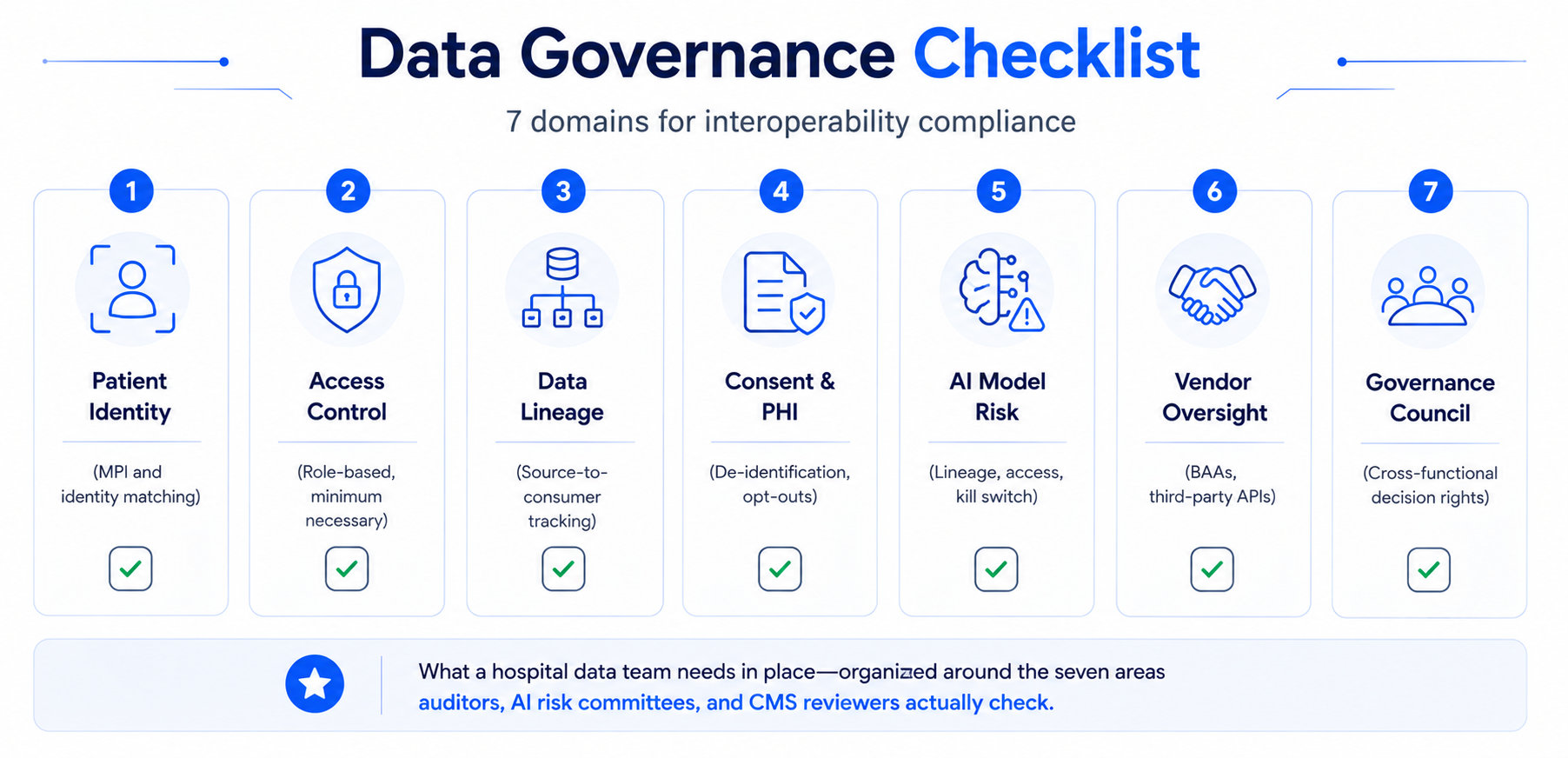
Here is what a hospital data team needs in place, organized around the seven areas auditors, AI risk committees, and CMS reviewers actually check.
Master Patient Index and Patient Identity Matching Governance
- A single, deduplicated patient identity across the EHR, billing, and any third-party app connecting through your Patient Access API.
- Documented match and merge rules, with one named owner accountable for identity accuracy under a real data stewardship program, not a shared inbox.
- A defined process for resolving duplicate or fragmented records before they reach a FHIR endpoint, not after a mismatch reaches a patient.
This is usually the first gap an interoperability audit finds. Inferenz’s MPI and Patient 360 solution is built around exactly this problem: resolving identity once, at the source, instead of downstream in every report that touches it.
Role-Based Access Control for PHI: A Practical Checklist
- Access mapped to role, not individual, with periodic recertification built into the calendar, not left to memory.
- The HIPAA minimum necessary access standard applied by default at the point of provisioning, not discovered during an audit.
- Automatic access revocation tied to HR offboarding, not a quarterly manual review that runs two months behind reality.
Data Lineage Tracking and Data Quality Management Under HIPAA
- Lineage tracked from the source system to every downstream consumer, including third-party apps pulling through your APIs.
- Quality rules for completeness, accuracy, and timeliness defined per data domain, not applied as one blanket rule across every table.
- FHIR API data governance readiness confirmed before go-live: source mapping, terminology bindings, and error handling all documented, not assumed.
Data lineage tracking under HIPAA isn’t a nice-to-have diagram for a slide. It’s the artifact that turns “we believe our data is accurate” into something you can actually show a regulator.
PHI De-Identification, Redaction, and Consent Management
- De-identification and redaction procedures documented and tested against real records, not assumed to work because a vendor said so.
- Consent captured, stored, and enforced at the point of exchange, not just at intake and never revisited.
- Opt-out mechanisms, including Provider Access API opt-outs, reflected in near real time as part of ongoing consent management for interoperability, not batch-updated overnight.
Data Governance Requirements Before Deploying Clinical AI Models
- Every clinical or operational AI model has documented lineage back to its training data source.
- AI model risk management in healthcare applies the same minimum necessary rules to model access as to human access. A model doesn’t get a pass because it’s software.
- A named owner and a defined kill switch for every production AI agent, not a data scientist’s laptop as the unofficial control point.
BAA and Third-Party Data Oversight
- Business Associate Agreements reviewed against actual data flows, not boilerplate language nobody has revisited since signing.
- Third-party API consumers, meaning apps pulling through your Patient Access API, vetted before connection, not after an incident.
- Annual reassessment of vendor access scope tied to what a vendor actually uses, not what they originally requested three renewals ago.
Building a Cross-Functional Data Governance Council
- Representation from clinical informatics, compliance, security, and IT. Not IT alone, and not compliance alone.
- Decision rights defined in writing: who can approve a new data flow, and who can block one.
- A standing cadence, monthly at minimum, with documented minutes an auditor can actually review.
How to Build a Data Governance Framework for USCDI v3 and HIPAA Compliance, Together
Trying to satisfy USCDI v3, HIPAA, and CMS-0057-F as three separate projects is how most governance programs balloon in cost and stall in scope. USCDI v3 defines what data classes must move. HIPAA defines who’s allowed to see them and under what conditions. CMS-0057-F defines how fast, and through which technical standard, they move.
The fix isn’t three parallel workstreams. It’s one governance framework, built around a single data catalog, with three lenses applied to the same classification pass: check every dataset against USCDI v3 scope, HIPAA sensitivity, and CMS-0057-F exchange requirements at the same time. Hospitals that treat these as separate compliance tracks end up documenting the same dataset three times, in three formats, for three different reviewers, and by year two, none of the three documents agree with each other.
What Auditors Actually Expect to See
Ask any compliance officer who has been through an interoperability review and the documentation requests repeat almost word for word:
- A current data inventory mapped to USCDI v3 classes.
- An access control policy with evidence of enforcement, not just a written policy sitting in a shared drive.
- Lineage diagrams for any data exposed through a FHIR endpoint.
- BAAs matched to actual API consumers, updated within the last twelve months.
- Incident response records showing governance controls were tested, not only documented.
- Minutes from governance council meetings that show decisions were made, not just discussed.
If your data team can’t produce these inside a week, that’s the gap worth closing first, before the next AI pilot goes to the board, not after.
How to Prevent Data Breaches Through Better Data Governance
Breach prevention gets framed as a security problem. Most of the time, it’s a governance problem wearing a security costume. Access that outlived its purpose, a vendor connection nobody reviewed, a dataset nobody classified as sensitive: none of those are firewall failures. They’re governance failures that a firewall was never going to catch.
Healthcare data breach prevention through governance means closing the gap before an attacker finds it: recertifying access on a schedule, classifying data by sensitivity at ingestion, and reviewing vendor scope annually instead of at renewal time only. It’s slower and less dramatic than incident response. It’s also considerably cheaper.
Data Governance Maturity and Your Ability to Deploy AI Safely at Scale
This is the part that matters most for a transformation leader trying to move past a stalled pilot. A large number of organizations still report little or no formal data governance framework, even as they keep adding AI use cases on top of that same ungoverned data. That gap is exactly where pilots stall. Not because the model performed badly, but because nobody could answer who owns the training data, who approved the access, or how the decision gets audited six months later.
A governance program built to the checklist above does double duty. It gets a hospital through the interoperability audit, and it gives every future AI proposal a foundation to stand on: defined ownership, traceable lineage, and access rules that already meet minimum necessary. That’s the difference between a pilot that stalls in month four and one that reaches production with the board’s confidence intact. We’ve written more on why 59% of health systems are still AI immature, and what separates them from the ones scaling AI safely.
Who Should Actually Sit on Your Data Governance Council
Skip the instinct to hand this entirely to IT. A council that actually functions usually includes:
- A clinical informatics or CMIO representative, who understands what the data means at the bedside, not just in the schema.
- Compliance and privacy leadership, who understands HIPAA and state law exposure.
- Security, who understands where the real attack surface sits.
- A data or platform architect, who understands what’s technically enforceable versus aspirational.
- An executive sponsor with the authority to say no to a data flow, not only yes.
The Real Deadline Isn’t the API
CMS-0057-F’s January 2027 deadline is a governance deadline wearing a technical disguise. Building an AI-Ready Infrastructure for Hospitals & Ambulatory care starts with establishing the ownership, access, and lineage layer that makes compliance and future AI initiatives sustainable. Hospitals that build this foundation first will find the FHIR compliance work comparatively straightforward. The ones that skip it will end up explaining the same gap to their board twice: once at the audit, and again at the next AI pilot review.