














Summary
A hospice data governance framework gives your leadership team named owners, tested data rules, and traceable records across HOPE, CAHPS, and claims data. This article lays out the hospice CMS compliance framework that protects your Annual Payment Update, prepares your hospice team for the October 1, 2026 election statement addendum rule, and holds up when CMS asks for proof.
Introduction
A hospice data governance framework decides whether your organization can prove, record by record, that CMS requirements were met. On October 1, 2026, a mandatory election statement addendum becomes part of every Medicare hospice election. Calendar year 2026 HOPE records keep counting toward your fiscal year 2028 payment update. A hospice CMS compliance framework built on real governance ties each of those obligations to a named owner, a tested rule, and evidence you can pull in minutes.
Picture a hospice team reviewing its quarter. The charts are clean. The overall HOPE timeliness number reads 92%, which feels safe. Then someone splits it by site, and one location, running a different EMR, sits at 84%. Nobody owned that site’s data. The rolling percentage hid the problem until it was a problem.
That gap is what this article closes. It’s the fourth article in our hospice series and builds on the hub, How Hospice Organizations Build a CMS-Ready Data Foundation. Here you’ll find what to govern, who should own it, and a checklist leaders at hospice care agencies can use this quarter.
What is data governance in a hospice organization?
Data governance in a hospice organization is the set of decisions about who owns each data domain, which quality rules apply, who can access the data, and how every change gets recorded. It covers clinical data in the EMR, billing and claims data, HOPE submissions in iQIES, and CAHPS records handled by an outside vendor. HIPAA data governance sits inside it: minimum-necessary access, audit logs, and PHI controls apply to every one of those systems.
Healthcare data governance and compliance are related, and they aren’t the same thing. Compliance asks whether you met a requirement. Governance asks whether you can prove it again, for every record, without heroics.
A hospice can pass HOPE this quarter through overtime and manual checks and still have no governance. That’s compliance without maturity. Maturity means the result holds when your quality director leaves or you add a fifth site. It also means one person can answer a CMS reviewer’s question without calling three departments.

Why Hospice CMS Compliance Now Depends on Data Governance
The Hospice Quality Reporting Program (HQRP) draws on three data sources: HOPE assessments, the CAHPS Hospice Survey, and Medicare claims, according to CMS’s January 2026 HQRP guide. Each fails in its own way, so each needs its own governance.
HOPE Timeliness and the 90% Threshold
Hospices must submit and have accepted at least 90% of HOPE records within 30 calendar days of the admission date, the HOPE Update Visit (HUV) completion date, or the discharge date. Compliance is judged on records whose target date falls in the calendar year, so records dated January 1 to December 31, 2026 decide the fiscal year 2028 payment update.
The penalty is a 4 percentage point cut. For FY 2027, CMS set the payment update at 2.3%, so a hospice that misses HQRP requirements gets a 1.7% reduction instead, per the CMS FY 2027 final rule fact sheet. That’s a six point swing on the same patients and the same care.
The math is unforgiving. A hospice filing 1,000 HOPE records in a year can afford 100 late ones. The 101st costs four points of payment. And “accepted” is a status in iQIES, not in your EMR, so if nobody owns the accepted-status check, late records sit unnoticed until year end.
CAHPS Hospice Survey Data and Your Vendor
Every Medicare-certified hospice takes part unless it qualifies for the newness exemption or the size exemption (fewer than 50 survey-eligible decedents in the prior year). A CMS-approved vendor runs the survey and submits data quarterly. Compliance means the vendor submits complete, accepted data for all 12 months of the collection year. HOPE and CAHPS have separate requirements, and failing either one triggers the reduction, as the CMS reconsideration page explains.
Here’s the governance gap. Your hospice sends the vendor a monthly list of decedents and caregivers, and that list comes from your EMR. A wrong or late list means wrong or late survey data. Give the list an owner, reconcile it against discharge records, and check the CAHPS data warehouse account so you see what the vendor actually submitted.
Claims Data, HCI, HVLDL, and the SSVI
Two HQRP quality measures come from Medicare claims: Hospice Visits in the Last Days of Life and the Hospice Care Index. Because CMS pulls claims directly, hospices count as fully compliant on that requirement automatically. The exposure is data quality. The claim is the record, and CMS reads it whether you reviewed it first or not.
The FY 2027 final rule, issued July 30, 2026, finalized the Service and Spending Variation Index (SSVI). It scores each hospice from 0 to 16 using nine claims-based measures covering utilization and non-hospice spending, and a higher score signals potential concern. CMS published provider-level scores based on FY 2024 and 2025 claims and made no substantive changes to the methodology. It also says it monitors metrics such as live discharge rates, average visits per routine home care day, and non-hospice spending per day.
So, a governed hospice runs its own version of those numbers every month. Reconcile clinical visit records against billing, review live discharge patterns, and catch discrepancies before a federal score reflects them.
The Compare Tool Icon and Public Reporting
CMS finalized an icon on the Medicare.gov Care Compare tool for hospices that submit no quality data, or under 90% on time, within a year. It takes effect no earlier than FY 2028. CMS reports that 22.06% of hospices were non-compliant in FY 2024, 23.53% in FY 2025, and 20.37% in FY 2026. Roughly one in five is missing the mark, and the icon puts that gap where families and referral sources look.
What should a hospice data governance framework include?
Strong HQRP data governance rests on five components. Skip one and the others carry weight they weren’t built for.
Ownership and Stewardship
Every data domain gets one named steward: HOPE records, CAHPS lists, claims and billing, and election statement addendum data. Orphan fields are where missed timepoints hide.
Data Standards and Quality Rules
Write down what “complete” means for each HOPE timepoint, then automate the check. A missing HUV date should trigger an alert while the 30-day window is still open, not after it closes.
Lineage and Reconciliation
You need to trace any record from the clinical entry to the iQIES acceptance receipt. Layering data into raw, cleaned, and reporting-ready zones makes that trace practical, which we cover in Medallion Architecture Explained.
Access and Privacy Controls
Role-based access, PHI logging, and de-identified evidence packs keep HIPAA obligations intact while your hospice team shares data across IDG, billing, and QA.
Monitoring, Escalation, and Audit Evidence
Dashboards by site and by timepoint, thresholds that trigger escalation, and archived reports that prove what you knew and when.
| Data domain | Typical steward | Core control | Evidence a reviewer can ask for |
| HOPE records | Quality or QA director | Timepoint alerts and daily accepted-status check in iQIES | Submission and acceptance reports by record and date |
| CAHPS lists and vendor data | Compliance officer | Monthly list reconciliation against discharges | Vendor submission confirmations for all 12 months |
| Claims and billing | Billing or revenue cycle lead | Clinical to billing reconciliation before claims drop | Reconciliation logs and exception resolutions |
| Election statement addendum | Admissions and IDG lead | Required-field checks and version control | Signed addendum with timestamp and determinations |
Who owns Data Governance across IDG, Billing, and QA Teams?
Build a Governance Council with one accountable executive
Committees can advise, but they can’t be accountable. Name one executive, often the COO or the compliance officer, who answers for HQRP data outcomes. Under that person, seat a council with your IDG lead, billing, QA, IT, and compliance, and have it meet monthly to review exceptions by site, domain, and timepoint.
Stewards then handle the daily work. The QA steward watches HOPE. The compliance steward owns the CAHPS vendor relationship. The billing steward owns the clinical to claims match. Everyone knows whose name is on which number.
Stop one missed hope update visit from becoming a compliance failure
One late record won’t fail you. A pattern buried inside a percentage will. Treat each HOPE timepoint as a scheduled task created at admission, with an alert to the steward when the window is closing. Pull a daily iQIES accepted-status report. Track rolling timeliness by site each week and set an escalation threshold well above 90% so you have room to correct.
That last step matters most. A 90% floor gives you no margin, so govern to an internal target that leaves one.
How to govern the hospice election statement addendum in 2026
In final rule CMS-1851-F, published in the Federal Register on August 3, 2026 and effective October 1, 2026, CMS made the addendum mandatory for every Medicare hospice election. Before, hospices provided it only when a beneficiary or representative asked. The addendum lists the conditions, items, services, and drugs the hospice has determined are unrelated to the terminal illness and related conditions, and therefore not covered by the hospice benefit. CMS also notes it gives non-hospice providers the information they need for claims, per its fact sheet.
The regulation text sets delivery in the first five days of the election effective date. That turns a document into a data workflow. Governance should cover these points:
- Store each related or unrelated determination as a structured field tied to the plan of care, so it can be queried and audited.
- Version every addendum and keep the signed copy, or the recorded refusal or unable-to-sign status, linked to the election record.
- Alert the admissions steward when an election is approaching its five-day mark without an addendum on file.
- Connect addendum data to your claims review, because CMS has tied non-hospice spending to the SSVI.
Reconciling clinical, billing, and CMS submission data
The hard question in any review is whether three sets of records agree: what clinicians documented, what billing claimed, and what CMS received. A governance framework runs that comparison on a schedule, so a reviewer never gets there first. Our piece on connecting EHR, billing, and CMS reporting covers the integration side in detail.
One billing detail deserves a flag. The FY 2027 rule extends the telehealth allowance for the hospice recertification face-to-face encounter through December 31, 2027, and adds a requirement to report modifiers or codes for those encounters. Those data points need a clean home in your billing feed.
Build reconsideration-ready evidence
When CMS finds a hospice non-compliant, it notifies through the Medicare Administrative Contractor and an electronic letter in iQIES. The hospice then has 30 days from the date on that letter to request reconsideration, by email only, with supporting documentation. CMS decisions typically follow in September, and an unresolved finding means the payment reduction starts October 1. These details come from the CMS reconsideration page.
Proof of timely submission, iQIES submission reports, and vendor confirmations all count as evidence. Requests can’t include PHI or PII, and files can’t exceed 20 MB. Keep de-identified evidence packs ready all year, because 30 days passes fast.
Centralizing governance for multi-site and multi-EMR hospices
If your sites run different EMRs, standardize the definitions before you standardize the tools. Agree on one data dictionary for HOPE timepoints, one reconciliation routine, and one reporting view that rolls every site into a shared dashboard. A central governance team owns the rules. Site stewards own execution and report exceptions upward.
Hospice data governance checklist for HOPE, CAHPS, and claims reporting
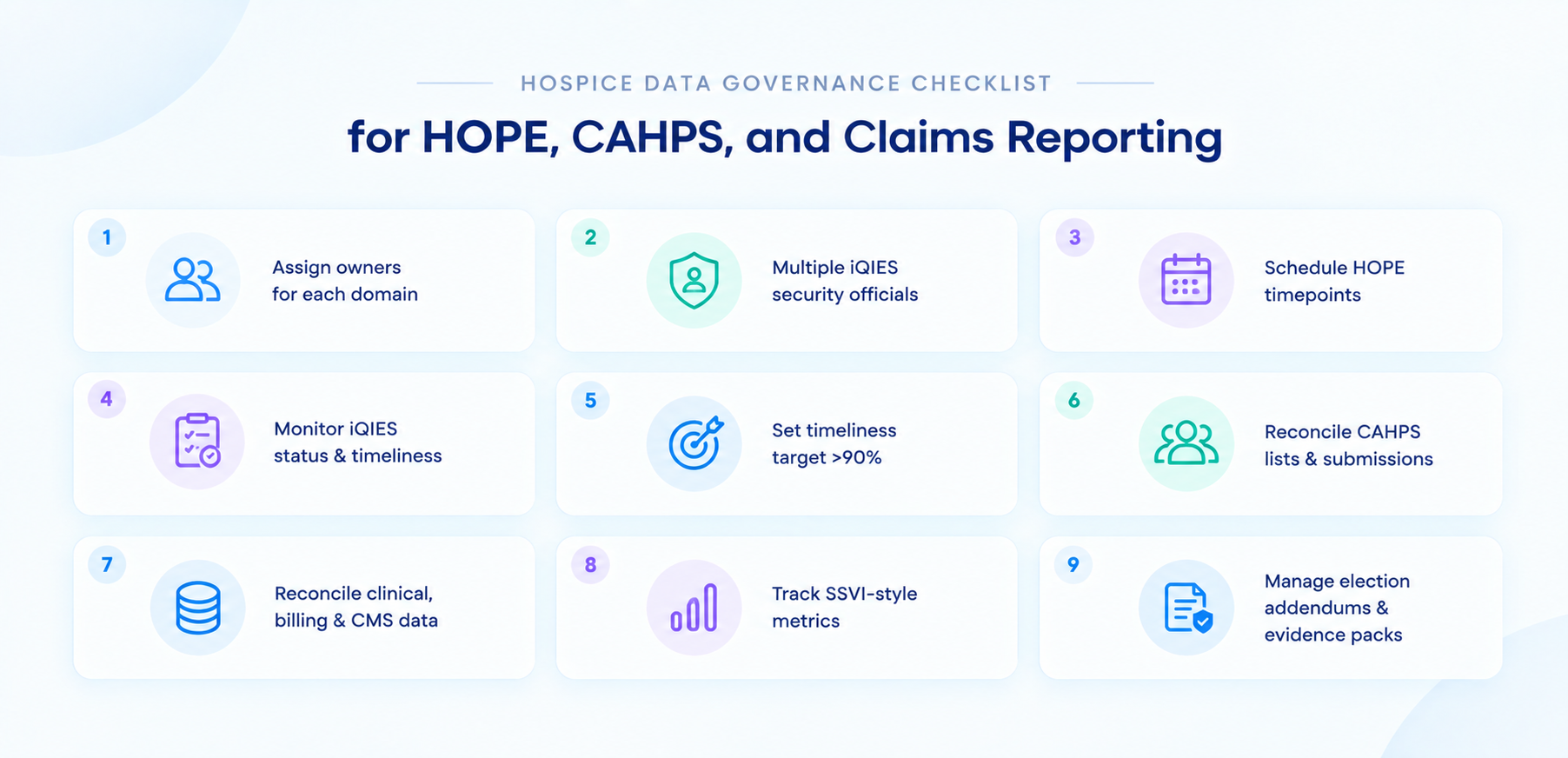
- Name one accountable executive and one steward for each data domain.
- Register more than one iQIES Provider Security Official, since CMS recommends it.
- Schedule every HOPE timepoint at admission and alert stewards as windows close.
- Run a daily accepted-status check in iQIES and a weekly rolling timeliness view by site.
- Set an internal timeliness target above 90% and define an escalation path.
- Reconcile the monthly CAHPS decedent and caregiver list against discharge records, and monitor vendor submissions.
- Reconcile clinical, billing, and CMS submission data on a fixed schedule.
- Track your own SSVI-style utilization and non-hospice spending metrics each month.
- Structure and version election statement addendum data, and keep de-identified evidence packs ready for reconsideration.
Where AI-Powered automation for Hospice fits after governance
Automation earns its keep once the rules are written down. Alerts for closing HOPE windows, addendum tracking, and reconciliation checks are all rule-driven work that AI-powered automation for hospice can run continuously. Automate a process with no owner and you just move mistakes faster.
That’s why governance comes first in this series. The foundation in our hub article supports these controls today and the forecasting and agent use cases coming next.
How Inferenz approaches data governance consulting services for hospice teams
Inferenz works with hospice and home-based care organizations on ownership models, data quality rules, lineage, and integration across EMR, billing, and CMS reporting systems. If you’re weighing data governance consulting services, start with your highest-risk domain, usually HOPE timeliness, and build outward from there.