














Summary
A Medicare Administrative Contractor’s additional documentation request gives a hospice 45 calendar days to produce a complete record for the one claim it’s questioning. Most compliance teams can pull that claim in minutes. Far fewer can show, system by system, exactly how it got there, and that second skill is what a real audit tests.
Introduction
The letter rarely looks like the start of something serious. It names a patient, a date of service, a benefit period, and a deadline. From there, someone at the hospice has to rebuild the full story behind that record: which system captured the physician’s narrative, when the election statement was signed, whether the diagnosis on the claim still matches the diagnosis in the chart, and who touched the file along the way. That rebuild is exactly what audit-ready data lineage is built to answer, ideally long before any letter shows up.
Most hospices can answer that question eventually. Very few can answer it inside the 45 calendar days a Medicare Administrative Contractor (MAC) allows for an Additional Documentation Request, and fewer still can answer it the same way twice if a second reviewer asks. That gap, between having the data and being able to prove where it came from, is the specific problem data lineage is built to close. CMS and the HHS Office of Inspector General have both gotten sharper at testing for exactly that gap.
What “Audit-ready” actually means, and why it’s different from “Data-ready”
A hospice can be data-ready and still fail an audit. Data-ready means the EMR holds a diagnosis, the billing system holds a claim, and the two roughly agree. Audit-ready means the hospice can show, for any single record an auditor picks, the full chain of custody: which system created the data element, which system or person changed it, when the change happened, and why. That chain is data lineage, and it’s a meaningfully different deliverable from data quality alone.
The distinction matters because CMS and OIG reviewers aren’t just checking whether a number is correct. They’re checking whether the hospice care agencies can reconstruct, on demand, how that number came to be. A hospice that connects its EMR, billing, and referral intake data has usually solved the double-entry problem that eats staff time. It still has separate work to do on the lineage problem, because a clean interface moves data between systems without automatically recording where each value originated or who last touched it.
The audits that actually show up at a hospice’s door
Three oversight mechanisms account for almost every real compliance event a hospice will face, and each one tests data lineage in a slightly different way.
- OIG compliance audits, built on statistical sampling and extrapolation. The HHS Office of Inspector General runs an ongoing series of hospice compliance audits, and it doesn’t review every claim to do it. It pulls a sample, commonly around 100 claims, checks each one against Medicare requirements, and when the error rate is high enough, extrapolates the dollar impact across the full population of claims the hospice billed for that period. CMS’s own 2026 oversight update pointed to how real that exposure has become, noting that enhanced review in four states alone had already produced more than 200 hospice Medicare enrollment revocations. OIG picks which hospices to review in the first place using computer matching, data mining, and data analysis techniques run against claims data, so audit risk starts building long before any letter shows up. A hospice that can’t trace a sampled claim back through its clinical and billing history has no real way to challenge either the finding or the extrapolation that follows it.
- MAC medical review, through Additional Documentation Requests and Targeted Probe and Educate. MACs run both broad and targeted reviews of hospice claims. Under Targeted Probe and Educate, a MAC pulls 20 to 40 claims per round from providers with the highest denial rates or the most unusual billing patterns, running up to three rounds with individualized education between each. The clock on any ADR starts the moment it lands.
- HQRP compliance, enforced through the HOPE submission threshold. Since October 1, 2025, the Hospice Outcomes and Patient Evaluation
- (HOPE) tool has replaced the Hospice Item Set, and every record now has to move through iQIES, the only channel CMS accepts since the legacy QIES/ASAP system was retired. CMS requires 90% of HOPE records submitted within 30 days of the relevant admission, discharge, or update-visit date, or the hospice loses 4 percentage points off its Annual Payment Update. That threshold functions as a lineage problem more than a paperwork one: the data has to flow cleanly from the point of clinical assessment into iQIES without someone manually re-keying it under deadline pressure.
CMS has also been raising the general level of scrutiny hospices operate under. In 2026, the agency proposed new transparency measures built partly on a Service and Spending Variation Index that scores hospices using claims-based utilization metrics, publishes those scores, and flags high-scoring hospices for additional review. The same announcement noted that roughly 20% of hospices were out of compliance with HQRP reporting requirements in CY 2025, a rate CMS described as comparable to prior years. That consistency is the tell and this is a widespread industry gap.
What CMS’s Medicare Advantage Audit Framework Signals for Hospice
Hospice program audits don’t run on the same protocol as Medicare Advantage program audits, and it’s worth being precise about that before drawing any comparison. Still, the logic CMS applies to one Medicare program tends to surface in the others eventually, and the classification system CMS already uses for Part C and Part D audits is a useful preview of where hospice oversight is headed.
CMS’s Part C and Part D program audit framework sorts findings into an Observation, for noncompliance that doesn’t need a formal fix, a Corrective Action Required (CAR), for noncompliance that does, and an Invalid Data Submission (IDS) finding, reserved for cases where a sponsor cannot produce an accurate, complete “universe” of records and CMS cannot determine compliance as a result. CMS has also been evaluating Compliance Program Effectiveness (CPE) less as a checklist of written policies and more as a live conversation about how a plan actually detects and corrects problems as they happen.
The IDS classification is really a test of whether a sponsor can produce a defensible, complete record on demand, and a single incorrect answer is a much smaller problem than a universe of records nobody can reconstruct. Risk Adjustment Data Validation (RADV) audits, the mechanism CMS uses to verify Medicare Advantage risk-adjustment payments, run on a related logic: the diagnosis on a claim has to trace back to a specific, contemporary clinical encounter, or CMS claws back the payment.
Hospice oversight runs on a different vocabulary altogether: OIG extrapolation, MAC documentation requests, and SSVI scoring. The underlying test is the same one regardless. Can the organization produce a complete, source-traceable universe of records on demand? A governed data lineage layer exists to pass exactly that test.

Data Lineage vs. Data Provenance: A Distinction That Matters Once CMS Asks
The two terms get used interchangeably, and in a hospice audit context, the difference is worth keeping straight. Data provenance answers where a piece of data originated: which system, which form, which staff member entered it first. It’s answers the fuller question: every system and transformation that record passed through afterward, including edits, merges, and exports, on its way to the CMS submission.
Data Provenance vs. Data Lineage
| Data Provenance | Data Lineage | |
| What it answers | Where a piece of data originated | Everywhere that data went afterward |
| Scope | A single point in time: the system, form, or staff member who first entered it | The full path: every system, edit, merge, and export the record passed through |
| Example (election statement) | Confirms the election was signed in the EMR on a given date | Confirms that update also reached billing and the referral record before any revocation, benefit-period change, or new admission touched the same patient again |
| What it catches | Who entered a value, and when | Desynchronization between systems, the exact pattern CMS’s hospital-hospice claims edits are built to flag |
| Why a hospice needs both | Establishes the starting point of the record | Establishes whether that record stayed consistent all the way to the CMS submission |
A hospice election statement is a good example of why the difference matters. Provenance tells you the election was signed in the EMR on a given date. Lineage tells you whether that election status update also reached billing and the referral record before a revocation, a benefit-period change, or a new admission touched the same patient again. CMS’s newer claims edits, the ones comparing hospital and hospice claims for overlapping services and flagging admission-date and billing-date mismatches, are built to catch exactly the kind of desynchronization a gap like this creates.
What a Defensible Audit Trail Actually Has to Show
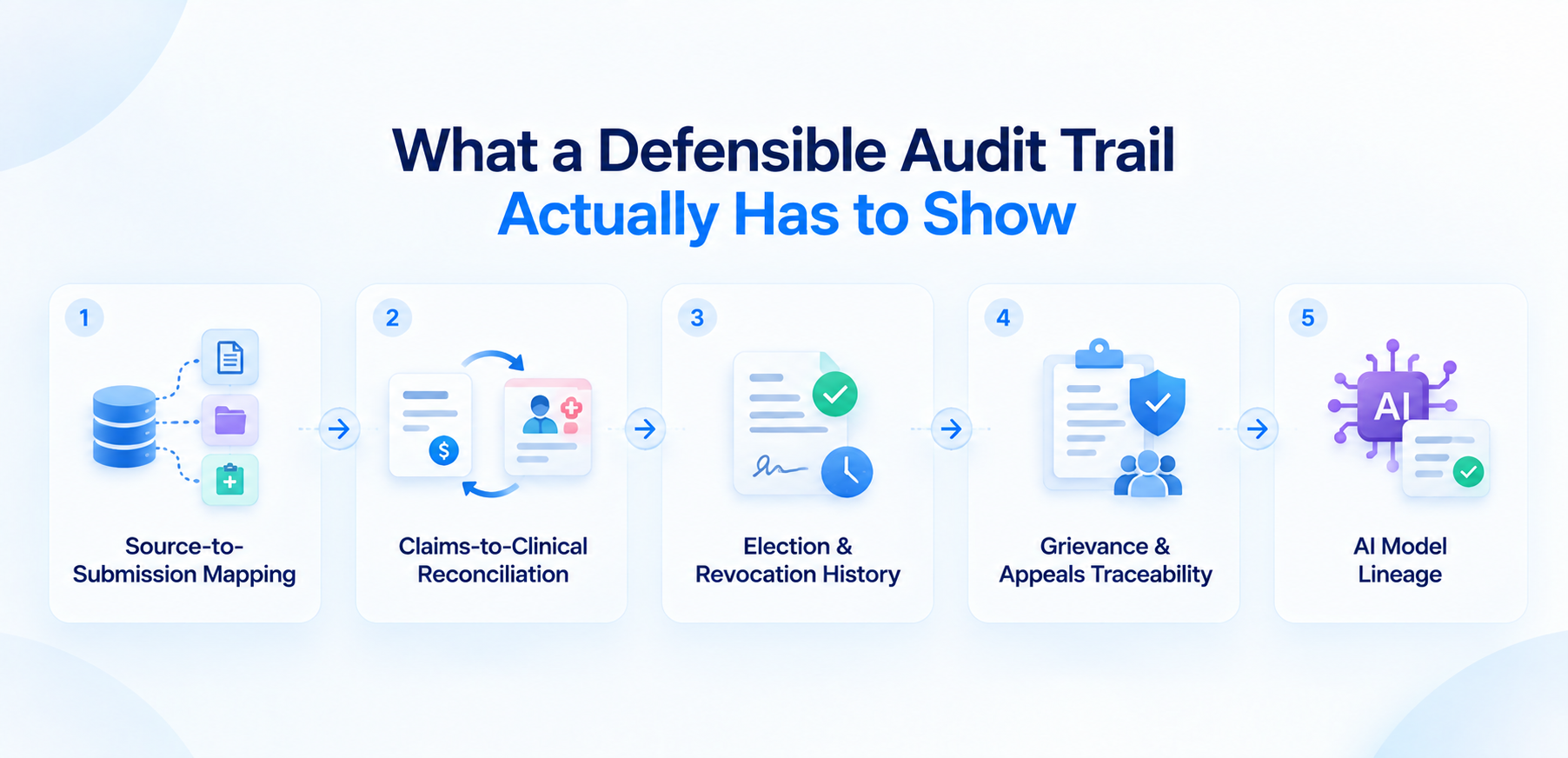
When a MAC, a state surveyor, or an OIG auditor asks a hospice to defend a record, they’re rarely asking for a single data point. They’re asking for a reconstruction. A defensible audit trail needs to show, for any patient and any date range:
- Source-to-submission mapping. Which system captured the original clinical assessment, referral, or diagnosis, and every hop that data made on its way into a HOPE record, a claim, or an iQIES submission.
- Claims-to-clinical reconciliation. Whether the level of care, visit dates, and diagnosis codes on the claim still match the clinical documentation behind them, since a mismatch here is the specific pattern CMS’s newer hospital-hospice billing edits are designed to catch.
- Election and revocation history. A timestamped, cross-system record of every election statement, revocation, and benefit-period change, so EMR, billing, and referral records can’t disagree about a patient’s current status.
- Grievance and appeals traceability. A hospice’s own complaint and grievance records, plus any Medicare claim appeals filed on a beneficiary’s behalf, need the same source-to-outcome trail as clinical data, because surveyors and MACs both ask for it.
- AI model lineage, where applicable. If a hospice uses AI to support documentation, eligibility screening, or care planning, an auditor can reasonably ask which data informed that output and what a clinician reviewed before it reached the record. Most hospices haven’t built for this yet, and it’s becoming a standing expectation.
Where Hospice Data Lineage Actually Breaks
Four gaps account for most of the lineage failures we see in hospice organizations, and every one of them is fixable without touching the underlying systems.
- The first is the referral-to-EMR handoff, where a referral arriving by fax or portal gets keyed in as a new patient record and later turns out to duplicate one created through a different intake path.
- The second is election status drift, where a revocation updates in one system only, creating the exact mismatch CMS’s audit logic is built to flag.
- The third is the pharmacy and durable medical equipment gap, where medication and equipment data still move by phone and fax while everything else has been automated, leaving a hole in the same clinical record CMS is checking.
- The fourth, and increasingly the most consequential, is the spreadsheet workaround: the export someone pulls into Excel to reconcile two systems by hand, which quietly becomes the record of truth nobody can trace back to its source once an auditor asks where a number came from.
These line breaks mean that hospice care agencies will repeatedly bank on erroneous data for their processes. Fixing the data lineage is crucial for these organizations to rely on accurate data and make informed decisions.
Building the Lineage Layer Without a Rip-and-Replace
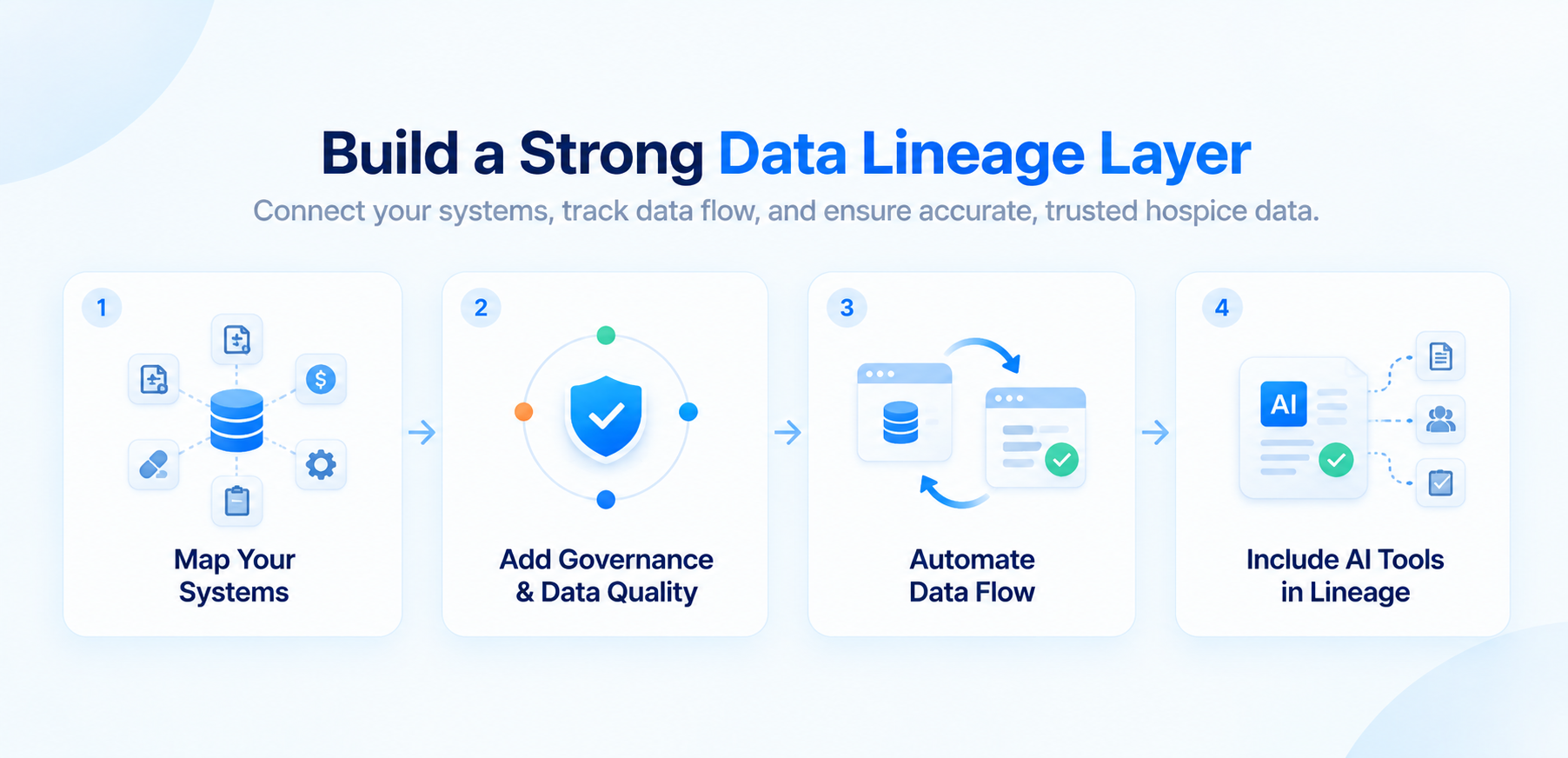
Fixing this leakage starts with a governed data layer that sits underneath the EMR, the billing platform, and the referral tools a hospice’s staff already know and use every day. That layer tracks, at the record level, where data entered the organization, every system it moved through, and every transformation applied along the way. In practice, that means:
- Mapping the systems first, before the tools. Before evaluating any data lineage software, a hospice needs a clear map of every system that touches a patient record: EMR, billing, referral intake, pharmacy, DME, and any AI tools layered on top. Lineage mapping only works when it starts from a complete inventory.
- Treating lineage as one feature of a broader governance foundation. Standalone data lineage tracking works best as part of a wider data quality management and governance framework. A point tool that only visualizes lineage after the fact does little to fix the upstream data quality gaps that create the mismatches auditors flag in the first place.
- Building automated, near-real-time interfaces. The same bidirectional integration principles that solve hospice EMR-to-billing double entry also generate a cleaner lineage record along the way, because a system that writes and reads data automatically leaves a far more traceable trail than one staff bridge by hand.
- Treating AI documentation and eligibility tools as lineage sources. Any AI system touching clinical documentation, eligibility screening, or care planning needs its own record of what data it used and what a clinician confirmed, a gap Inferenz has covered separately in the context of hospice AI readiness generally.
A hospice’s own data quality, governance, and compliance program is the natural home for this work, since lineage without governance mostly produces a very detailed record of an ungoverned mess. Inferenz has built this kind of foundation for post-acute care organizations moving off 32 disconnected source systems onto one governed data platform, the same underlying problem most hospices face at a smaller scale.
What to Have Ready Before the Letter Arrives
Continuous audit readiness looks different from the once-a-year scramble most hospices still run today. The organizations that stop dreading MAC letters and OIG notices tend to share a few habits: they can pull a complete case file, source-to-submission, for any patient within minutes; their compliance officer reviews a sample of records against CMS’s current claims-edit logic on a standing schedule; and their hospice and palliative care operations team treats data governance as an ongoing operational function.
That shift, from periodic to continuous, is also where CMS’s own compliance language across every Medicare program keeps pointing: fewer point-in-time checklists, more real-time evidence that an organization catches and corrects its own problems before an outside reviewer does it.