











Summary:
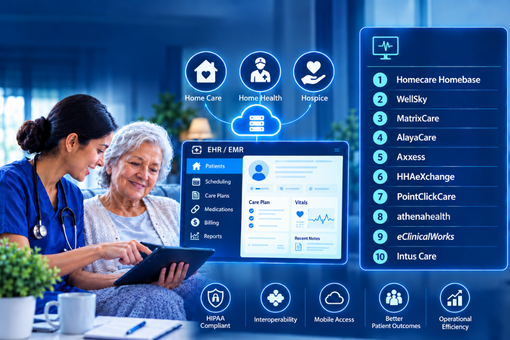
Home health, hospice, home care, and post-acute leaders are choosing among ten dominant systems in 2026: Homecare Homebase and WellSky for enterprise home health and hospice, MatrixCare for multi-line post-acute organizations, AlayaCare and Axxess for cloud-native home care and private duty, HHAeXchange for Medicaid EVV compliance, PointClickCare for skilled nursing, athenahealth and eClinicalWorks for ambulatory and hospital-adjacent settings, and Intus Care for PACE programs. The right choice depends on care setting, payer mix, and how well the winning system talks to everything else you run.
Why this decision carries more weight than it used to
A home health or hospice agency picks a core clinical system once every seven to ten years. Get it right, and that system becomes the operational backbone for referrals, scheduling, billing, and every OASIS or HOPE assessment a clinician files. Get it wrong, and the organization spends the next decade working around software instead of with it.
That decision has gotten harder heading into 2027. Three forces are converging on post-acute and home care leadership teams at once.
- First, CMS has raised the compliance bar. Under the expanded Home Health Value-Based Purchasing Model, an agency’s Calendar Year 2025 performance already determines the payment adjustment (up to plus or minus 5 percent of Medicare fee-for-service revenue) that lands on 2027 claims. Starting with the CY 2027 program year, CMS also requires all-payer OASIS data submission, so an EHR’s OASIS accuracy tools now matter for every patient on the census, not just the Medicare ones.
- Second, the workforce math hasn’t improved. Caregiver and clinician shortages remain the top constraint most home-based care leaders name, pushing vendors toward AI-assisted scheduling, documentation, and referral intake because there simply aren’t enough hands to do it the old way.
- Third, and this is the one CXOs underestimate most, the industry keeps consolidating. Every acquisition arrives with its own EHR, its own patient records, and its own definition of a “duplicate” patient. The question is no longer just which system your clinical team likes. It’s which system, or combination of systems, you can actually run as one business.
This guide breaks down the ten platforms home care, home health, hospice, and post-acute organizations evaluate most often in 2026, what each does well, where each falls short, and where the real integration work begins once the contract is signed.
How we evaluated these platforms
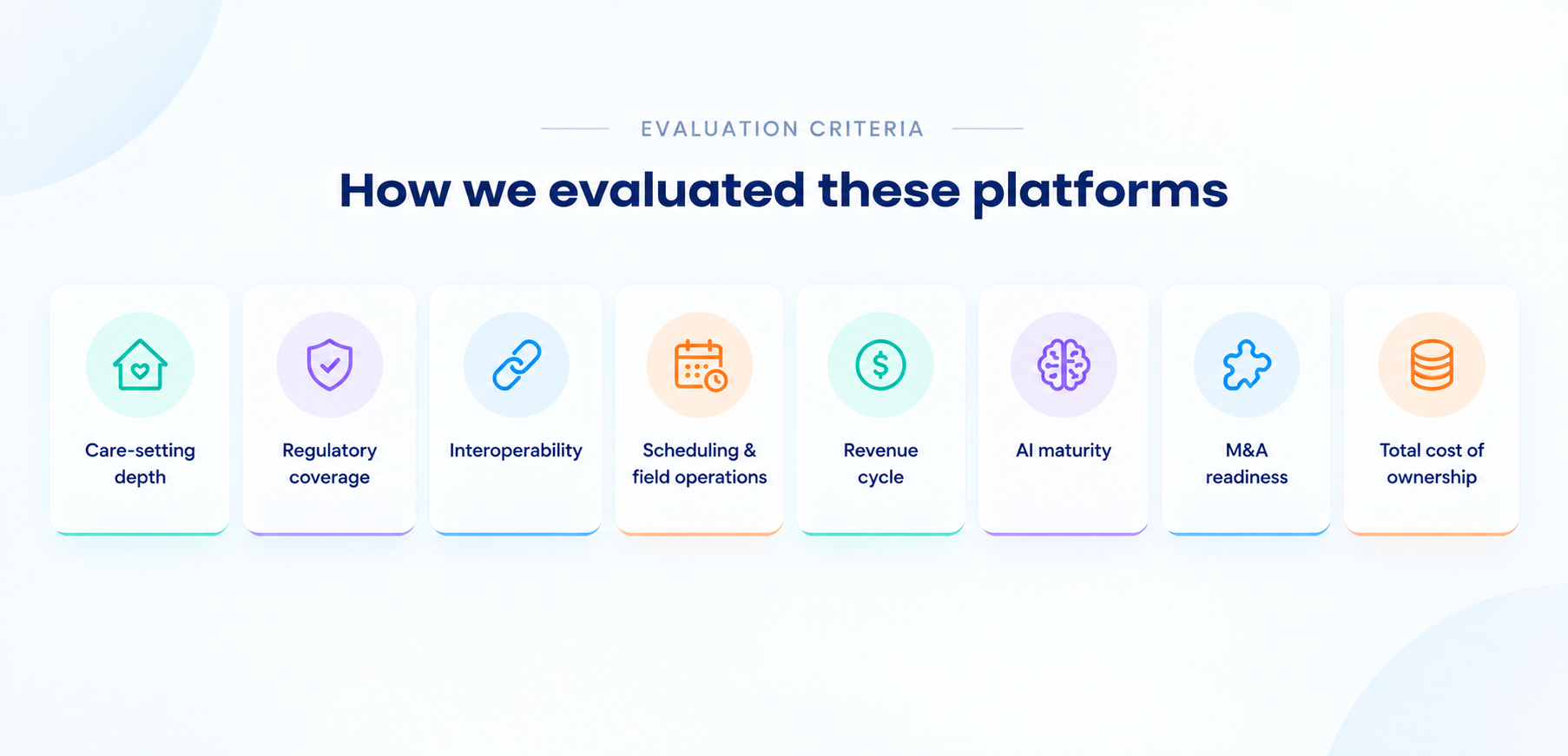
Each platform was scored against the criteria CXOs, COOs, and compliance officers actually use in an RFP:
- Care-setting depth: purpose-built workflows for home health, hospice, home care, skilled nursing, or PACE, not a generic template
- Regulatory coverage: OASIS-E, HOPE, MDS/PDPM, HIPAA, HITRUST, SOC 2, and Electronic Visit Verification (EVV) under the 21st Century Cures Act
- Interoperability: HL7 FHIR support and participation in Carequality, CommonWell, and TEFCA
- Scheduling and field operations: route optimization, offline documentation, caregiver matching
- Revenue cycle: claims scrubbing, denial management, payer-specific workflows
- AI maturity: ambient documentation, predictive risk models, agentic workflows
- M&A readiness: how well the platform handles multiple source systems after an acquisition
- Total cost of ownership, since almost none of these vendors publish list pricing
What’s actually changing in 2026
Documentation is going ambient. Nearly every platform now ships some version of AI-assisted charting: an ambient scribe that drafts the note during the visit, a predictive model that flags hospitalization risk, or a natural-language layer that answers a plain-English question instead of six menu clicks.
Interoperability stopped being optional. A decade ago, “does it talk to the hospital’s EHR” was a nice-to-have. Today referral sources, ACOs, MCOs, and CMS expect clean data exchange through Carequality, CommonWell, or TEFCA, and platforms that still hoard patient data are losing referral relationships over it.
Quick comparison: the top 10 at a glance
| Platform | Best for | Primary care settings | Deployment |
| Homecare Homebase | Large, multi-state home health and hospice enterprises | Home health, hospice, personal care, private duty | Cloud, point-of-care mobile |
| WellSky | Agencies of any size wanting one home-based care system of record | Home health, hospice, palliative care, personal care | Web-based |
| MatrixCare | Organizations spanning SNF, senior living, home health, and hospice | SNF, senior living, home health, hospice, private duty | Cloud |
| AlayaCare | Cloud-native home care and private duty agencies scaling across states | Home care, home health, private duty, remote monitoring | Cloud, mobile-first |
| Axxess | Mid-size home health, hospice, and home care agencies wanting modular tools | Home health, hospice, home care, pediatric home care | Cloud, mobile |
| HHAeXchange | Medicaid personal care agencies and MCOs needing EVV | Personal care, Medicaid HCBS, home health | Web-based |
| PointClickCare | Skilled nursing and senior living, plus their post-acute referral network | SNF, senior living, assisted living, home health, hospice | Cloud |
| athenahealth | Ambulatory and hospital-adjacent primary care, including home-based primary care | Ambulatory, primary care, specialty | Cloud, single-instance |
| eClinicalWorks | Ambulatory practices and community health centers, with post-acute facility support | Ambulatory, community health, hospital, post-acute | Cloud or on-premise |
| Intus Care | PACE (Programs of All-Inclusive Care for the Elderly) organizations | PACE, interdisciplinary senior care | Cloud, Snowflake-backed |
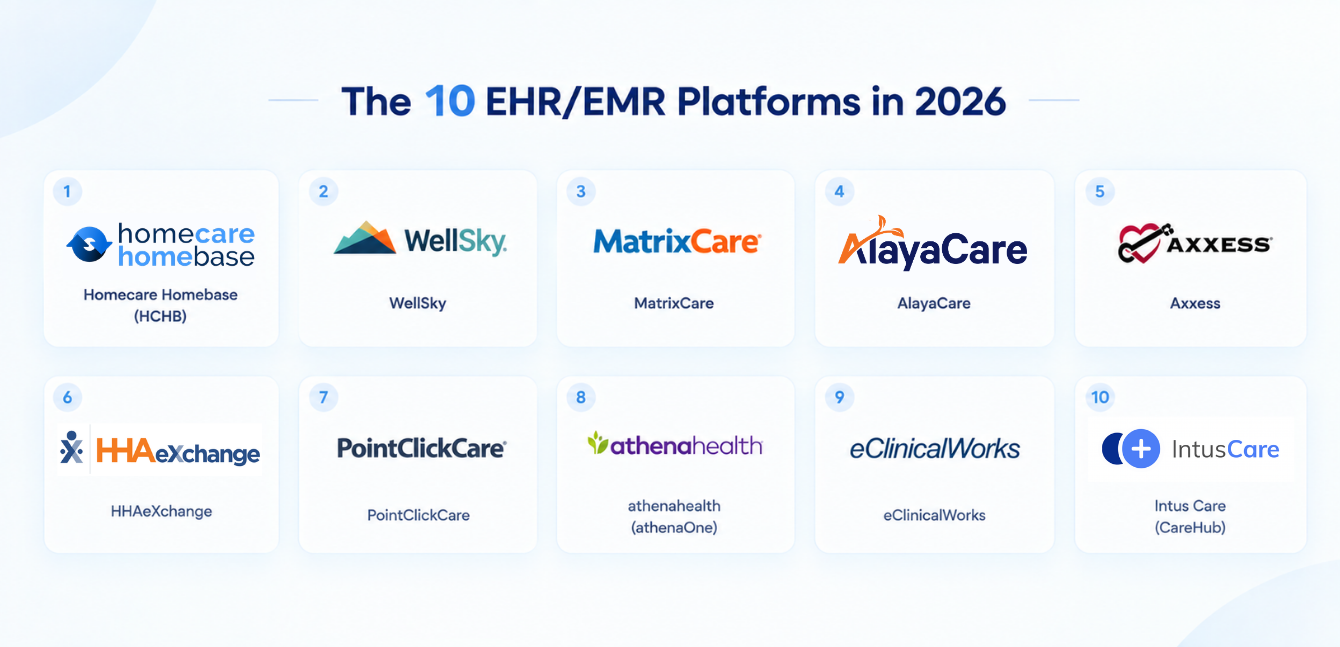
 The 10 EHR/EMR Platforms in 2026
1. Homecare Homebase (HCHB)
Best for: large, multi-site home health and hospice enterprises that need point-of-care documentation, scheduling, and revenue cycle on one configurable platform.
Homecare Homebase has been the backbone of large-scale home-based care since 1999. The platform serves all ten of the largest home health agencies and eight of the ten largest hospice agencies in the country.
Owned by Hearst, HCHB built its reputation on point-of-care depth: Mobile PointCare handles offline documentation, CareManager covers personal care field staff, and the HCHB Intelligence Suite layers Smart Scheduling and predictive hospitalization-risk models on top.
Key features:
- Offline-capable mobile documentation for OASIS and hospice IDG workflows
- Smart Scheduling matched by geography, skill, and availability
- Predict: Hospitalization Risk for proactive care planning
- Community Connect for interoperable data exchange
- Billing and revenue cycle tools built around PDGM
Where it fits, and where it doesn’t: HCHB is built for scale, and agencies running a handful of locations often find the configuration overhead and multi-month onboarding hard to justify. For a multi-state enterprise, it remains one of two platforms (with WellSky) that dominates the large end of the market.
2. WellSky
Best for: agencies wanting one system of record across home health, hospice, palliative, and personal care, with predictive analytics built into daily workflows.
WellSky calls its home health product the Intelligent Health Record, baking real-time predictive insights (seven-day mortality risk, live discharge risk) directly into the clinician’s workflow. More than 4,500 agencies and 1.6 million home health and hospice patients run on the platform, and its hospice product is HOPE-compliant out of the box with a dedicated operational dashboard.
Key features:
- Predictive insights for hospitalization and discharge risk
- Referral management with AI-assisted response, added in 2026
- HOPE-compliant hospice documentation and dashboard
- Centralized eligibility, authorizations, and denial management
- Agency performance analytics for QAPI and referral relationships
Where it fits, and where it doesn’t: WellSky’s reputation as “The Clinician’s Choice” for ease of use is earned, and its interoperability posture suits organizations proving outcomes to referral partners. Some agencies cite pricing as the reason they migrate away, since the tiered per-census model climbs fast at scale.
3. MatrixCare
Best for: post-acute organizations spanning SNF, senior living, home health, and hospice under one EHR family rather than a patchwork of point solutions.
MatrixCare, owned by ResMed, has served the post-acute space since 2001 and now serves more than 15,000 long-term care providers, the second-largest long-term care EHR platform behind PointClickCare. Its home health and hospice line descends from Brightree and was named Best in KLAS across multiple categories in 2024.
Key features:
- Unified EHR across SNF, senior living, home health, hospice, private duty
- MDS 3.0 and PDPM-aware compliance tools
- Interoperability with hospitals, labs, and pharmacy partners
- Real-time analytics and mobile point-of-care charting
Where it fits, and where it doesn’t: A pure-play home care agency often finds MatrixCare’s breadth is more platform than it needs. For a multi-line post-acute group, that breadth is the entire point, and several independent comparisons rate it ahead of PointClickCare for organizations spanning home health, hospice, and senior living together.
4. AlayaCare
Best for: cloud-native home care, private duty, and home-based care organizations wanting AI embedded across scheduling, billing, and documentation from day one.
Founded in Canada in 2014, AlayaCare has grown to serve more than 2,000 home care agencies across North America. AlayaLabs, its dedicated data science team, builds the scheduling algorithms, the Clinical Notes Detector that flags warning signs automatically, and remote patient monitoring dashboards that cut unnecessary visits.
Key features:
- AI-powered scheduling and route optimization with live GPS
- Remote patient monitoring and HIPAA-compliant telehealth
- Family and stakeholder portal
- Open API (Alayaconnector) for third-party EMR and CRM integration
Where it fits, and where it doesn’t: AlayaCare’s open API stands out in a market that mostly treats integration as an afterthought, which makes it a strong pick for agencies already running a broader tech stack they don’t want to abandon. Where it fits less well is for smaller, single-location operators who don’t need that level of extensibility and would rather have a simpler, more prescriptive setup out of the box.
5. Axxess
Best for: small to mid-size home health, hospice, and home care agencies wanting modular tools without an enterprise-scale commitment.
Axxess (formerly AgencyCore) has quietly become one of the most widely deployed platforms in the segment, with 9,000-plus organizations, ONC 2015 CEHRT certification, SOC 2 Type II compliance, and more than 40 interoperable integrations. Its ‘Ask Axxess’ tool lets staff query records conversationally instead of navigating menus.
Key features:
- Modular product lines: home health, hospice, home care, pediatric
- Interactive wound manager and OASIS scrubber
- Ask Axxess conversational search
- Bulk hospice scheduling and on-call monitoring
Where it fits, and where it doesn’t: Modular pricing makes Axxess approachable for agencies that don’t need every feature immediately. A minority of reviews flag integration gaps for complex, multi-payer operations, worth stress-testing in a pilot.
6. HHAeXchange
Best for: Medicaid personal care agencies, MCOs, and state programs needing best-in-class Electronic Visit Verification and Medicaid-specific billing compliance.
HHAeXchange built its reputation as the leading EVV system for Medicaid-funded personal care, certified by CMS as an official EVV Aggregator in several states, connecting state Medicaid programs, MCOs, providers, and caregivers under the 21st Century Cures Act’s EVV mandate.
Key features:
- GPS and fixed-object EVV with pre-billing validation
- CMS-certified EVV Aggregator status in multiple states
- Claims matching against EVV data before adjudication
- CarePay payroll built specifically for home care
Where it fits, and where it doesn’t: For an agency running primarily on Medicaid personal care contracts, HHAeXchange’s EVV depth is hard for a generalist EHR to match. Agencies with a broader private-pay mix often pair it with a separate clinical system rather than run everything through it.
7. PointClickCare
Best for: skilled nursing and senior living operators needing a connected referral network reaching into home health, hospice, and hospital systems.
PointClickCare has been rated the top Long-Term Care Software Provider by KLAS for six consecutive years and holds roughly 60 percent skilled nursing market share. Its real relevance here is the network effect: 27,000-plus long-term and post-acute providers, 3,100-plus hospitals, and a Marketplace of 210-plus integrated partners, the largest interoperability ecosystem in the category.
Key features:
- Point of Care app for bedside vitals and medication administration
- AI-powered Chart Advisor, expanding into senior living in 2026
- Marketplace ecosystem across 20 use case categories
- Deep interoperability through Kno2, Carequality, and CommonWell
Where it fits, and where it doesn’t: PointClickCare’s financial tooling and SNF depth consistently rate ahead of competitors, though MatrixCare edges it out for organizations centered on home health, hospice, and senior living rather than skilled nursing.
8. athenahealth (athenaOne)
Best for: ambulatory practices and hospital-adjacent primary care, including home-based primary care, needing cloud-native interoperability and a hands-off revenue cycle.
athenaOne bundles athenaClinicals, athenaCollector, and patient engagement into a single-instance cloud system that updates automatically for all 160,000-plus providers at once, no manual upgrade cycle, no version to fall behind on. athenahealth’s claims-scrubbing engine runs more than 29,000 rules with a first-pass acceptance rate north of 95 percent.
Key features:
- Single-instance cloud with automatic, zero-downtime updates
- FHIR R4 APIs, plus CommonWell, Carequality, and TEFCA participation
- 250-plus pre-integrated Marketplace apps
- AI-native documentation and ambient scribing
Where it fits, and where it doesn’t: athenahealth earned the 2026 Best in KLAS award for independent ambulatory practices, but it’s built for clinic-based workflows, not field-based home visits, so home health and hospice agencies typically look elsewhere for their core system even when athenahealth sits upstream as the referring physician’s EHR.
9. eClinicalWorks
Best for: ambulatory practices, community health centers, and hospital-affiliated post-acute facilities wanting one AI-forward vendor across EHR, revenue cycle, and patient engagement.
eClinicalWorks has scaled to more than 850,000 users and 180,000 physicians on Microsoft Azure. Its 2026 direction centers on agentic AI: Sunoh.ai for ambient documentation, healow Genie for automated patient calls and scheduling, and PRISMA for searching a patient’s consolidated record across outside systems. CommonWell and Carequality exchange is free, unlike some competitors.
Key features:
- ai ambient scribe and healow Genie call automation
- PRISMA record-search across outside health systems
- healow patient portal, TeleVisits, remote monitoring
- 50-plus specialty templates, including post-acute facility support
Where it fits, and where it doesn’t: eClinicalWorks’ AI ecosystem is one of the more mature in ambulatory care, but home health and hospice-specific field workflows aren’t its focus, so home-based organizations typically use it as a connected upstream system rather than their primary EHR.
10. Intus Care (CareHub)
Best for: Programs of All-Inclusive Care for the Elderly (PACE) organizations needing an EMR built around interdisciplinary, value-based senior care rather than a generic long-term care template.
Intus Care is the most specialized platform here, deliberately so. Its CareHub EMR launched in May 2025 and expanded to 33 PACE programs across 16 states within its first year, fast adoption in a niche most organizations had been running on generic long-term care software. CareHub sits inside a broader ecosystem including PRISM (population health), IRIS (AI risk adjustment), and ILLUMINATE (2026 CMS PACE Audit Protocol compliance).
Key features:
- Interdisciplinary team (IDT) care planning built for the PACE model
- Out-of-the-box TPA and Carequality integration
- Snowflake-backed warehouse with natural-language querying
- Compliance tooling aligned to the 2026 CMS PACE Audit Protocol
Where it fits, and where it doesn’t: For a PACE organization, CareHub’s specificity is the whole value proposition. Outside of PACE, it isn’t relevant, and organizations running PACE alongside home health or hospice still need a second system for those lines.
Where Inferenz adds value: PACE participants are often hospice-eligible, and CareHub’s own roadmap points toward curated, normalized data, precisely the direction Inferenz’s MPI and Patient 360 work builds toward for organizations running CareHub alongside a separate home health or hospice EHR.
How to choose: a decision framework by care setting
Start with care setting; it eliminates more of the list than any other filter.
- Enterprise home health and hospice: Homecare Homebase or WellSky. Both are strong; the decision usually comes down to clinician preference in a pilot.
- Multi-setting post-acute (SNF, senior living, home health, hospice): MatrixCare, with PointClickCare as the alternative if skilled nursing is your largest line.
- Home care, personal care, private duty: AlayaCare for AI-native scheduling and an open API, Axxess for modular, incremental pricing.
- Medicaid personal care and managed care: HHAeXchange, usually run alongside a separate clinical EHR.
- Skilled nursing with post-acute network reach: PointClickCare, with MatrixCare as the multi-setting alternative.
- Ambulatory, hospital-adjacent, or home-based primary care: athenahealth’s percentage-of-collections model versus eClinicalWorks’ AI-forward, flatter fee structure.
- PACE programs: Intus Care’s CareHub, with no real generalist substitute.
After care setting, weigh interoperability, EVV and compliance coverage for your payer mix, total cost of ownership including migration, and AI maturity, in that order. Pilot with your own census before signing. Every demo looks smooth; month three, with your actual edge cases, is where the real gaps show up.
What the RFP never asks: what happens to your data after you sign
Every vendor here shows up with a clean demo and a tidy patient list. Almost none will walk through what your data looks like eighteen months after go-live, once you’ve completed an acquisition or accumulated years of records your last vendor never fully migrated.
That’s the gap Inferenz was built to close. Inferenz is a data and AI engineering company for US healthcare enterprises, with a HIPAA-aligned agentic AI platform called Caregence that sits on top of whatever EHR an organization already runs, built and governed to earn clinical trust rather than bypass it.
The work isn’t theoretical. Inferenz helped a national home care provider managing over 60,000 patients unify more than 40 disconnected source systems, including multiple EMRs left behind by a decade of acquisitions, into one governed warehouse. The engagement resolved duplicate identities through AI-powered de-duplication, built an M&A onboarding framework that gets every new entity analytics-ready within 8 to 10 weeks, and shipped three AI applications into production, including a caregiver recommendation engine that fills last-minute cancellations automatically.
None of that required replacing the underlying EHR. It required someone who understood how to make the EHR, or the five EHRs, actually work together. If you’re choosing between the platforms above, or already running two or three after a merger, that’s the conversation worth having before the next acquisition closes. Book a strategy consultation with Inferenz to talk through what unifying your EHR data would look like for your organization.
The bottom line
Every platform here can run a home care, home health, hospice, or post-acute organization competently. The differences that matter show up in your care settings, payer mix, growth plans, and how well your system shares data with everything else you run. Pick on those factors, pilot before you commit, and plan the data unification work from day one rather than after your third acquisition forces the issue.