













Summary
CMS-0057-F rewires how payers move data to hospitals and patients, and the compliance work is landing on CIO desks well before the January 2027 deadline. This guide breaks down what the rule actually requires, what is already in force, and why the data foundation it demands is the same one your AI strategy needs.
Somewhere in the past two years, prior authorization stopped being a back-office irritation and became a board agenda item.
That shift has a name: CMS-0057-F, the CMS Interoperability and Prior Authorization Final Rule, finalized in January 2024. It forces Medicare Advantage organizations, Medicaid and CHIP managed care plans, and Qualified Health Plan issuers to build standardized, FHIR-based APIs and cut authorization turnaround times.
Hospitals are not who this rule technically regulates. That distinction rarely survives contact with a real IT roadmap. Your EHR vendor now has to certify against a new data standard. Your Promoting Interoperability attestation changes starting the 2027 performance period. Your denial patterns, your prior authorization workflows, your patient data exchange, all of it sits directly downstream of a rule written for payers.
Here is the part most compliance briefings leave out.
The exact data work this rule demands, clean patient identities, governed data lineage, standardized FHIR resources, is the same work that separates hospitals running safe, working AI from hospitals still explaining a stalled pilot to their board. Building an AI-Ready Infrastructure for Hospitals & Ambulatory care means creating this foundation once and using it across compliance, interoperability, analytics, and AI initiatives. Treat the two as separate projects and you will fund both twice. Treat them as one, and the compliance budget quietly becomes your AI-readiness budget. This guide walks through what CMS-0057-F actually requires, what is already due, and how to use the deadline as the forcing function your AI roadmap has been missing.

What CMS-0057-F Actually Requires, and Who It Is Really Aimed At
CMS-0057-F directly regulates Medicare Advantage organizations, Medicaid and CHIP managed care plans, state Medicaid and CHIP fee-for-service programs, and Qualified Health Plan issuers on the federally facilitated exchanges. Not hospitals. That is the technical answer, and it is also the least useful one, because three things pull hospitals into the compliance perimeter anyway.
- EHR vendors have to certify against ONC’s updated standards, which means your Epic, Oracle Health, or MEDITECH environment inherits new data requirements whether your compliance team asked for them or not.
- Starting with the 2027 performance period, MIPS eligible clinicians, eligible hospitals, and critical access hospitals must attest under the Medicare Promoting Interoperability Program that they requested at least one prior authorization electronically through a Prior Authorization API. That single line turns a payer-side API into a provider-side reporting obligation.
- Your providers will be pulling and pushing data through the new Provider Access and Payer-to-Payer APIs every day, whether or not your organization ever reads the final rule.
None of this means you can sit back and wait for your EHR vendor to sort it out. Certification timelines slip, and “on the roadmap” is not the same as “in production.” A vendor’s compliance promise is worth confirming against the ONC Certified Health IT Product List (CHPL), the federal government’s public, authoritative registry of every health IT product that has actually been tested and certified, before it lands anywhere near a board slide.
The Four FHIR APIs Under CMS-0057-F
| API | What It Does | Production Deadline |
| Patient Access API | Extends existing patient data access to include prior authorization decisions, so patients can pull claims, clinical, and PA data through third-party apps. | January 1, 2027 |
| Provider Access API | Lets in-network providers pull member claims, clinical, and PA data for treatment and care coordination. | January 1, 2027 |
| Payer-to-Payer API | Moves up to five years of claims and clinical history when a patient switches health plans. | January 1, 2027 |
| Prior Authorization API | Automates PA request submission, decision tracking, and specific denial reasons. | January 1, 2027 for the payer’s API. (Note: For hospital attestation, CY2027 is an optional bonus measure; it becomes mandatory starting CY2028 (per the FY2027 IPPS Final Rule)) |
 The Deadline Math: What Is Already Due and What Is Coming
Two clocks are running, and hospitals that only watch one of them get caught out.
The operational provisions, decision turnaround of 72 hours for urgent requests and 7 calendar days for standard ones, specific denial reasons, and five years of retained authorization history, took effect January 1, 2026 for most impacted payers. The heavier lift, the actual production FHIR APIs, is primarily due January 1, 2027, per CMS’s own guidance.
Running in parallel, ONC finalized a separate but connected deadline: as of January 1, 2026, USCDI v3 became the only certified baseline data standard, replacing USCDI v1 entirely. Any hospital whose EHR vendor has not confirmed USCDI v3 and FHIR US Core alignment is already behind schedule, regardless of what the calendar says about 2027.
What Happens If Your Hospital isn’t Ready
CMS-0057-F itself does have no fixed penalty schedule. Enforcement alerts run through each program’s existing mechanisms:
- Medicare Advantage organizations face corrective action plans or monetary penalties through CMS’s standard MA oversight process,
- Medicaid and CHIP managed care compliance is monitored by individual states through contract approval and renewal, and
- Qualified Health Plan issuers on the federal exchange must apply annually if they need an exception.
None of that is comfortable, but none of it hits your hospital’s Medicare payment directly.
The exposure that does hit your hospital sits one level over, in information blocking. If your organization cannot produce a documented, defensible reason for withholding electronic health information from a legitimate Provider Access or Payer-to-Payer request, HHS-OIG can investigate. Certified health IT developers, health information networks, and health information exchanges face civil monetary penalties of up to $1 million per violation.
Hospitals and clinicians face a separate track of “appropriate disincentives” that have been active since July 31, 2024: denial of Promoting Interoperability program credit, negative MIPS payment adjustments, and exclusion from ACO shared savings programs for Medicare Shared Savings Program participants. In September 2025, HHS-OIG and ASTP/ONC jointly announced this is now an active enforcement priority.
Compliance Is the Floor. AI Readiness Is the Bar.
Recent peer-reviewed research on hospital AI infrastructure makes a point worth sitting with: AI implementation without a solid data and governance foundation tends to produce the same failure pattern everywhere, poor model performance, data silos, and compliance exposure, regardless of how good the underlying model is. Enterprise architecture, IT governance, and FHIR-based data standardization are not parallel tracks to an AI strategy. They are the prerequisite for one.
That is the real opportunity hidden inside a compliance deadline. A hospital that treats CMS-0057-F as a checkbox exercise will spend 2026 patching interfaces. A hospital that treats it as the forcing function for a genuine data foundation walks into 2027 with clean identities, governed lineage, and standardized FHIR resources already in place, which happens to be exactly what a safe, board-defensible AI initiative needs on day one.
The Data Foundation Hospitals Actually Need
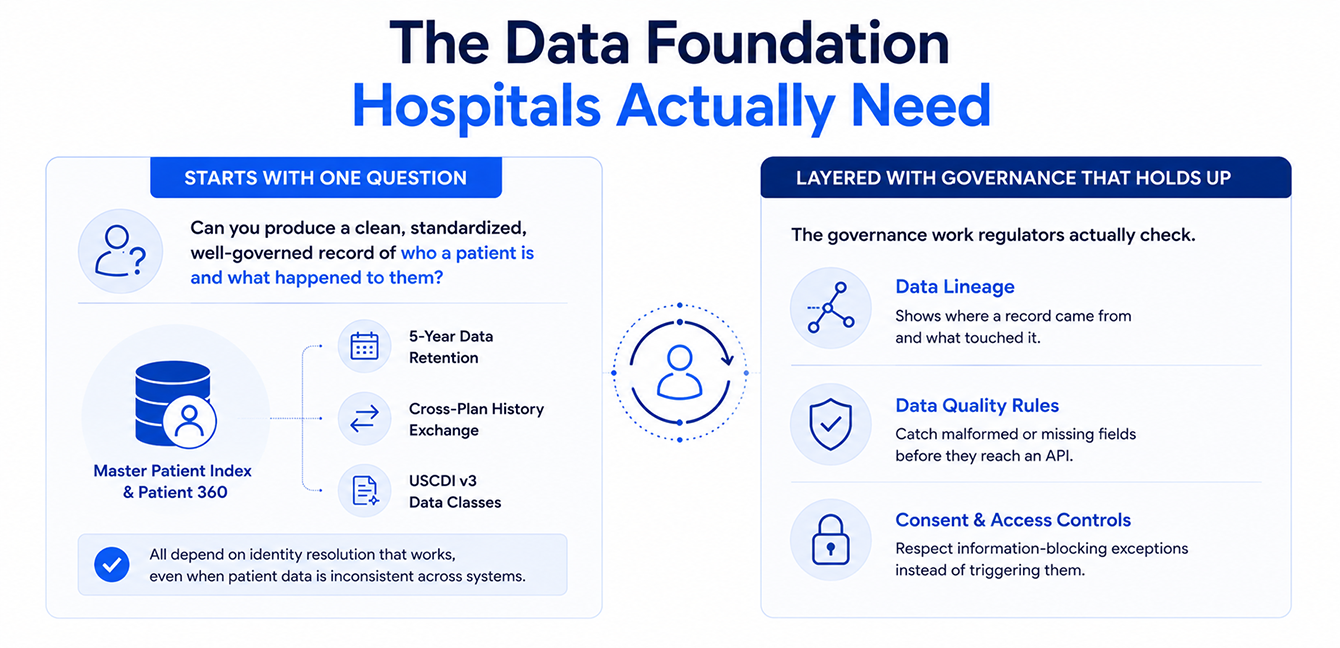 Every requirement in CMS-0057-F ultimately traces back to one question: can you produce a clean, standardized, well-governed record of who a patient is and what happened to them? A Master Patient Index and a true Patient 360 view answer that question for regulators and for AI agents at the same time. The five-year data retention requirement, the cross-plan history exchange, the USCDI v3 data classes, all of it depends on identity resolution that does not fall apart when the same patient shows up under three slightly different name spellings across two EHRs and a billing system.
Layer on top of that the governance work regulators actually check: data lineage that shows where a record came from and what touched it, quality rules that catch malformed or missing fields before they reach an API, and consent and access controls that respect information-blocking exceptions instead of triggering them.
Inferenz’s MPI and Patient 360 solution is built for exactly this layer. Hospitals also increasingly need a TEFCA and QHIN participation strategy, since national network exchange is becoming the default expectation rather than the exception. Joining early through a QHIN can also do double duty, satisfying Payer-to-Payer style exchange expectations through one connection instead of negotiating separate pipes with every plan.
Data Foundation Checklist, Mapped to CMS-0057-F
| Foundation Element | Why CMS-0057-F Needs It | Why AI Needs It |
| Master Patient Index / identity resolution | Powers accurate 5-year data retention and cross-plan history exchange. | One clean patient record instead of fragmented duplicates feeding every model. |
| Data lineage and provenance | Required to show where exchanged data originated for audits. | Traceability regulators and clinicians can both trust. |
| USCDI v3 data class mapping | Baseline standard for all certified data exchange from January 2026. | Standardized inputs models can actually be validated against. |
| Consent and access governance | Prevents information-blocking exposure on Provider/Payer-to-Payer requests. | Guardrails that keep AI agents inside defined access boundaries. |
| Data quality and validation rules | Catches malformed records before they reach a production API. | Reduces bias and error carried into AI outputs. |
Compliant on Paper vs. Operationally Ready 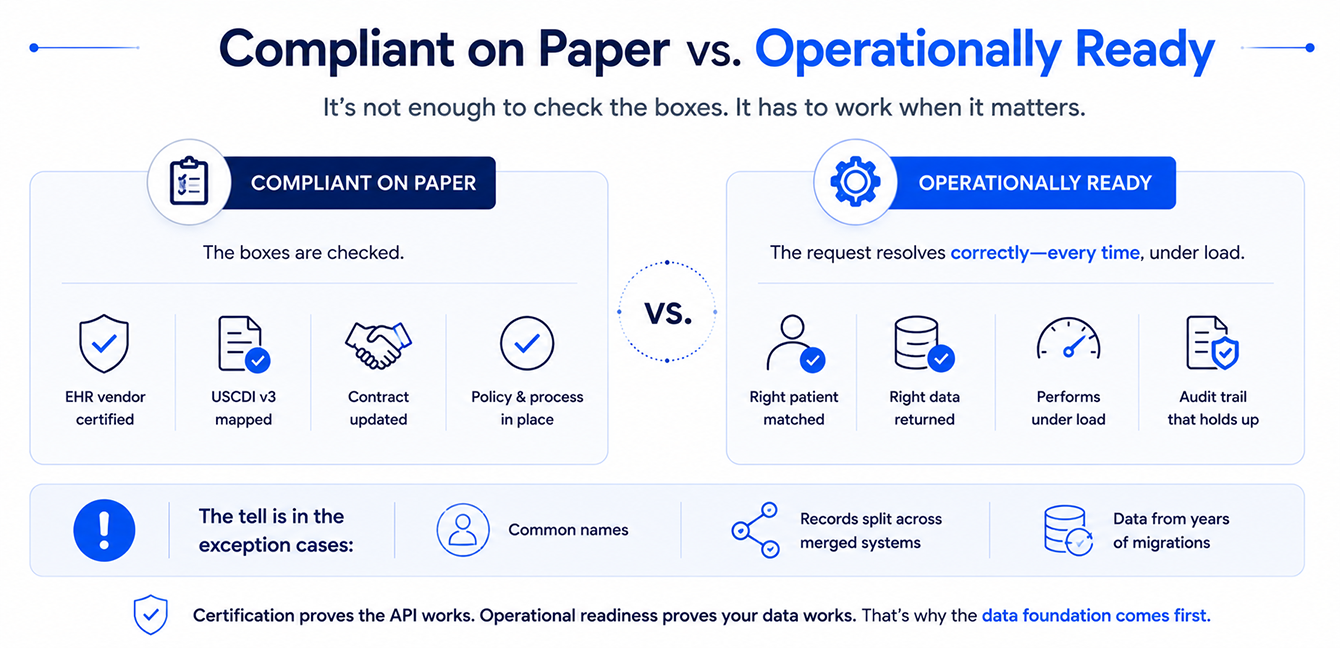
There’s a gap almost nobody’s compliance briefing names directly. A hospital can be compliant on paper, EHR vendor certified, USCDI v3 mapped, contract language updated and still fail the moment a real Provider Access request or Payer-to-Payer exchange hits the system. Paper compliance means the boxes are checked. Operational readiness means the request actually resolves correctly under load, with the right patient matched, the right data returned, and an audit trail that survives scrutiny.
The tell is usually in the exception cases: patients with common names, records split across a merged health system, data that arrived through three different EHR migrations over the last decade. A vendor’s certification says the API works. It doesn’t say your specific data will move through it cleanly. That’s a data quality and identity resolution question, not a certification question, and it’s exactly why the data foundation work above matters more than the API build itself.
Where the FHIR Build Decision Fits
Once the data foundation question is answered, the next one follows fast: do you build FHIR infrastructure in-house, buy a vendor platform, or integrate an agentic layer on top of what you already run? Most 400-bed hospitals do not have two years and a standing FHIR engineering team to spare, and a full custom build was rarely the right answer even before the deadline moved up. The faster, lower-risk path for most hospitals is an integration layer, one that sits on your existing Epic, Oracle Health, or MEDITECH instance and handles the Prior Authorization API workflow without a rip-and-replace project.
Information Blocking, TEFCA, and the Governance Layer CIOs Cannot Skip
Peer-reviewed policy analysis of the rule frames CMS-0057-F as the operational half of a broader prior authorization reform push, one that pairs API-enabled data exchange with real accountability for turnaround time and denial transparency. That framing matters for CIOs because it signals where enforcement attention is heading next: not just whether the APIs exist, but whether hospitals and payers actually use them instead of defaulting to fax and phone workarounds.
Information blocking rules under the 21st Century Cures Act sit directly underneath this. If your organization cannot produce a defensible, documented reason for withholding electronic health information from a legitimate Provider Access or Payer-to-Payer request, that is an information-blocking exposure, not a data-governance inconvenience. The ONC Certified Health IT Product List remains the reference point for confirming your EHR vendor’s certification status before you take their compliance roadmap at face value. Inferenz’s Data Quality Governance and Compliance practice was built to close exactly this gap. Our data management experts will provide the required support to ensure that your operations are aligned in terms of data governance standards and compliance regulations.
The Comprehensive CMS-0057-F checklist for CIOs
If you’re starting now, it is recommended to work in this order to meet CMS-0057-F standards:
- Confirm your EHR vendor’s actual certification status against the ONC Certified Health IT Product List, not their roadmap slide. Ask specifically for USCDI v3 and FHIR US Core alignment dates.
- Audit your Master Patient Index for duplicate and fragmented identities. Every downstream requirement, data retention, cross-plan history, AI readiness, depends on this being solid first.
- Map your current data against USCDI v3 data classes to find where gaps exist before an auditor or a failed API call finds them for you.
- Decide your Prior Authorization API path (build, buy, or integrate) with a realistic view of your engineering capacity, not an optimistic one.
- Document your information-blocking exception process now, since enforcement is active as of September 2025, not pending.
- Use the CY2027 optional bonus window on the Electronic Prior Authorization measure as a low-stakes test run before it becomes mandatory in CY2028.
CMS-0057-F was written for payers, but it landed on your desk anyway, and the January 2027 deadline is closer than most 2026 budget cycles account for. The hospitals that come out ahead will not be the ones that treat this as a narrow API integration project. They will be the ones that use the deadline to finally fund the data foundation their AI strategy already needed, one Master Patient Index, one governance framework, one standardized FHIR layer at a time. Explore Inferenz’s data and AI solutions for hospitals to see where your hospital stands today.