













Summary
A practical framework for hospital CIOs deciding whether to build, buy, or integrate a FHIR prior authorization API before the January 2027 CMS-0057-F deadline. Every cost, risk, and governance trade-off below is sourced, not pitched.
Ask five vendors how to fix prior authorization and you’ll get five different answers, each one conveniently pointing back to whatever that vendor sells. One recent study found radiologists face a prior authorization request on 91% of the orders they write, the highest rate of any medical specialty. That reality is pushing hospital leaders toward a decision they cannot keep deferring: standing up a FHIR prior authorization API before the CMS-0057-F clock runs out in January 2027.
Three paths sit on the table right now.
- Build it yourself.
- Buy a point solution.
- Integrate an agentic layer on top of the systems you already run.
Each one solves a different problem, and each one creates a different risk.
What a FHIR Prior Authorization API Actually Does
A FHIR prior authorization API is the technical mechanism CMS-0057-F requires payers to expose so providers can check coverage rules, submit documentation, and get a structured answer back, approved, denied with a specific reason, or flagged for more information, without a phone call or a fax.
It runs on three of HL7 FHIR’s Da Vinci implementation guides working together. CRD checks whether an order needs authorization before it is even placed. DTR gathers the documentation the payer will actually require. PAS submits the request and tracks its status through to a decision.
The rule applies to Medicare Advantage organizations, state Medicaid and CHIP programs, and Qualified Health Plan issuers on the federal exchanges. Self-insured employer plans and traditional Medicare fee-for-service are not directly covered, though many commercial payers are aligning voluntarily.
CMS projects the shift will save the healthcare system roughly $15 billion over ten years, mostly by cutting the manual back-and-forth between provider and payer staff. There is a compliance layer for hospitals too: eligible clinicians must attest to submitting at least one electronic prior authorization through a FHIR API to remain MIPS compliant, starting with the 2027 performance period.
The Three Paths on the Table
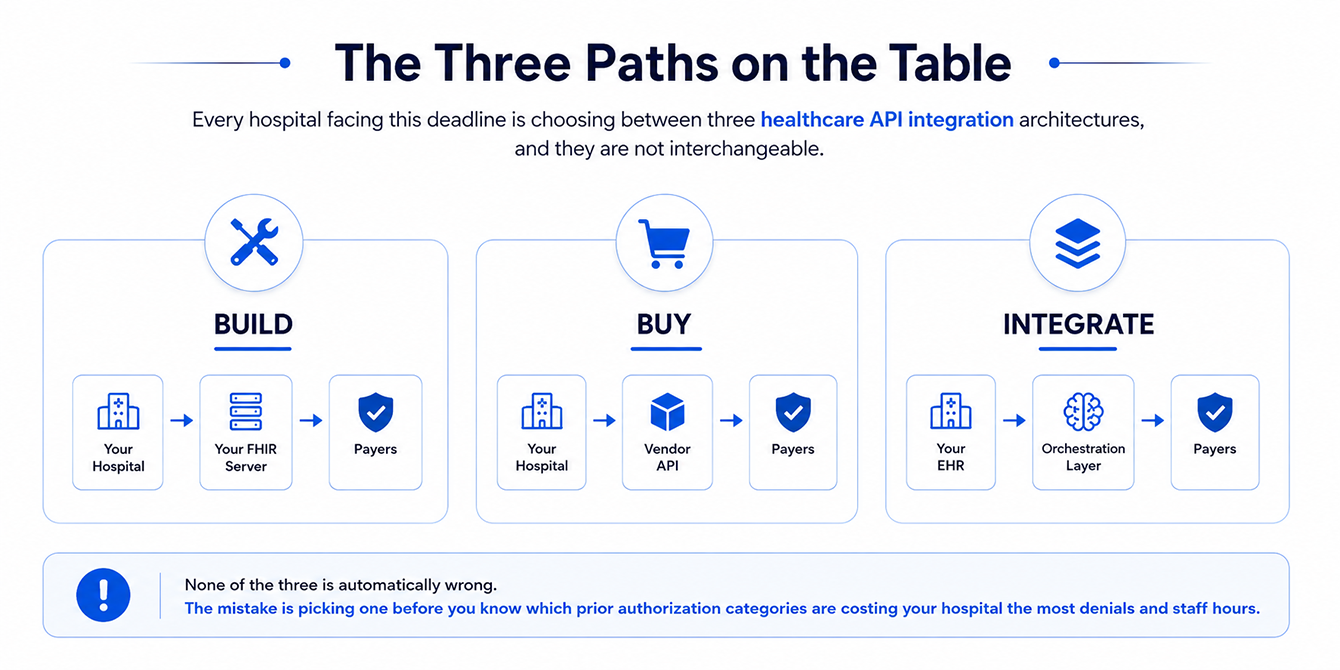
Here are the three healthcare API integration architectures: build, buy and integrate.
- Build means standing up your own FHIR server, mapping every payer’s rules by hand, and maintaining the integration with your own team indefinitely.
- Buy means licensing a vendor’s packaged prior authorization API, usually scoped to one function like imaging or specialty pharmacy. It is fast to turn on, but it is one more system your IT team now has to babysit.
- Integrate means placing an orchestration layer, often an agentic one, on top of the EHR and payer connections you already have. It reads clinical data, checks the CRD, DTR, and PAS rules, and routes anything ambiguous to a human instead of guessing.
None of the three is automatically wrong. The mistake is picking one before you know which prior authorization categories are costing your hospital the most denials and staff hours.
Why building in-House Rarely Pays Off for Hospitals
The cost of building a FHIR prior authorization API in-house in hospitals and ambulatory organizations sounds manageable on a slide, until you count the bill. Building an AI-Ready Infrastructure for Hospitals & Ambulatory care requires a data foundation that can support FHIR integration alongside broader analytics and AI initiatives. Enterprise-scale FHIR integration connecting multiple payer and EHR systems runs into six figures before a single payer contract is fully mapped, and the assessment and mapping phase alone often takes six to twelve months before any code ships.
A study of ten health systems that had already deployed patient-facing APIs found the same barriers kept resurfacing across every one of them: security concerns, an immature app ecosystem, EHR vendor hesitation around data sharing, and standards still settling underneath them.
None of that goes away because your own engineers wrote the code. It just moves in-house, permanently. Unless there is budget for a standing team whose only job is chasing payer rule changes, build tends to consume exactly the three to nine months of executive runway that gets burned when a pilot stalls halfway through integration.
Why Buying a Point Solution Solves One Problem and Creates Another
Buying a packaged prior authorization API gets one workflow moving fast, usually imaging or specialty medication, since those categories carry the heaviest authorization load. But an AI-ready hospital rarely stops at one use case.
Five different point tools for five different departments means five vendor contracts, five data models, and five places where a denial can quietly fall through the gap. Published research on agentic prior authorization architecture makes the same point from the engineering side: the real gains come from systems that integrate FHIR, EDI, and legacy interfaces under one governance layer, not from bolting another single-purpose tool onto an already fragmented stack.
Why an Agentic Integration Layer Is Winning Out
The path gaining the most traction right now is the third one: prior authorization automation built as an agentic AI layer that sits on top of the EHR and payer systems a hospital already runs, instead of replacing them.
One 2026 study of a multi-payer radiology deployment reported a 65.4% reduction in denials, a 33.9% improvement in authorization cycle time, and 97.4% alignment between payer and practitioner decisions, all without a system replacement. That figure comes from a single early-stage publication rather than a peer-reviewed multi-site trial, so treat it as directional, and ask any vendor citing similar numbers for their own validation data.
The architectural pattern behind those results shows up across other published research too: an agent extracts the clinical data, validates it against payer rules, assembles the required documentation, and escalates anything ambiguous to a human reviewer instead of guessing on its own.
How to integrate FHIR prior authorization API with existing EHR?
Integrate means learning how to integrate a FHIR prior authorization API with your existing EHR, rather than replacing it: an orchestration layer, often an agentic one, sits on top of the EHR and payer connections you already have. It reads clinical data, checks the CRD, DTR, and PAS rules, and routes anything ambiguous to a human instead of guessing.
This is the model behind platforms like Caregence, Inferenz’s HIPAA Compliant Agentic AI Platform for Healthcare. It connects directly to EHR, payer, claims, and RCM systems already in place. The prior authorization agent and the clinical AI documentation agent are both governed and auditable by design. For a CIO who has already lived through one AI pilot that could not explain its own decisions, that auditability tends to matter more than the automation itself.
Comparison tables based on cost, risk, governance, and best fit
Check out the individual tables to assess the best approach to take for your needs, whether you need to build the solution inhouse, buy one outright or integrate with your present systems.
Cost & Timeline
| Build | Buy | Integrate | |
| Cost profile | Runs into six figures before a single payer contract is even fully mapped | Lower upfront cost per tool, but cost compounds as departments add more point tools | Mid-range; reuses EHR and payer connections you already have instead of building or licensing from zero |
| Timeline to value | Assessment and mapping alone often takes 6-12 months before any code ships | Fastest to turn on for one workflow, weeks not months | Faster than build since it layers on existing infrastructure, proven use-case by use-case |
| Executive runway risk | Consumes 3-9 months of runway when a pilot stalls mid-integration | Low risk per tool, but risk compounds across contracts | Lower, since it’s validated on one high-volume category before expanding |
Risk Profile
| Build | Buy | Integrate | |
| Primary risk | Security concerns, immature app ecosystem, EHR vendor hesitation on data sharing, standards still settling | Point-solution sprawl: five tools means five contracts, five data models, five places a denial can fall through the cracks | Vendor-trust risk replaces technical risk; depends on how governed the agent layer actually is |
| Maintenance burden | Stays in-house permanently, team must chase every payer rule change indefinitely | Distributed across vendors; IT still has to babysit each one separately | Centralized under one orchestration layer |
| Failure pattern | Pilot stalls halfway through integration | Solves one department, doesn’t scale hospital-wide | Requires proof of auditability before scaling past the first use case |
Governance & Control
| Build | Buy | Integrate | |
| Audit trail | Fully owned and controlled, but resource-intensive to maintain | Vendor-defined, varies contract to contract | Governed and auditable by design, not retrofitted after deployment |
| Decision transparency | High, but the burden sits entirely on your team | Depends on whether the vendor’s decisioning is black-box or transparent | Agent extracts data, validates against payer rules, assembles documentation, and escalates anything ambiguous to a human |
| Data scope | One system, fully controlled | Siloed per point tool | FHIR, EDI, and legacy interfaces unified under one governance layer |
Best Fit & Evidence
| Build | Buy | Integrate | |
| Best fit when | You have budget for a standing team whose only job is chasing payer rule changes | One workflow (imaging, specialty pharmacy) needs a fast, single-department fix | Multiple departments need orchestration and you want proof before committing further |
| Supporting evidence | Barriers documented across ten health systems that had already deployed patient-facing APIs | Sprawl risk described in published agentic prior authorization architecture research | One 2026 multi-payer radiology deployment reported 65.4% fewer denials, 33.9% faster cycle time, 97.4% payer-practitioner alignment (single study, treat as directional) |
| Example in market | Your own IT team | Point-solution vendors scoped to one function | Caregence (Inferenz), an agentic layer connecting EHR, payer, claims, and RCM systems |
A Quick 6-Point Checklist Before You Choose
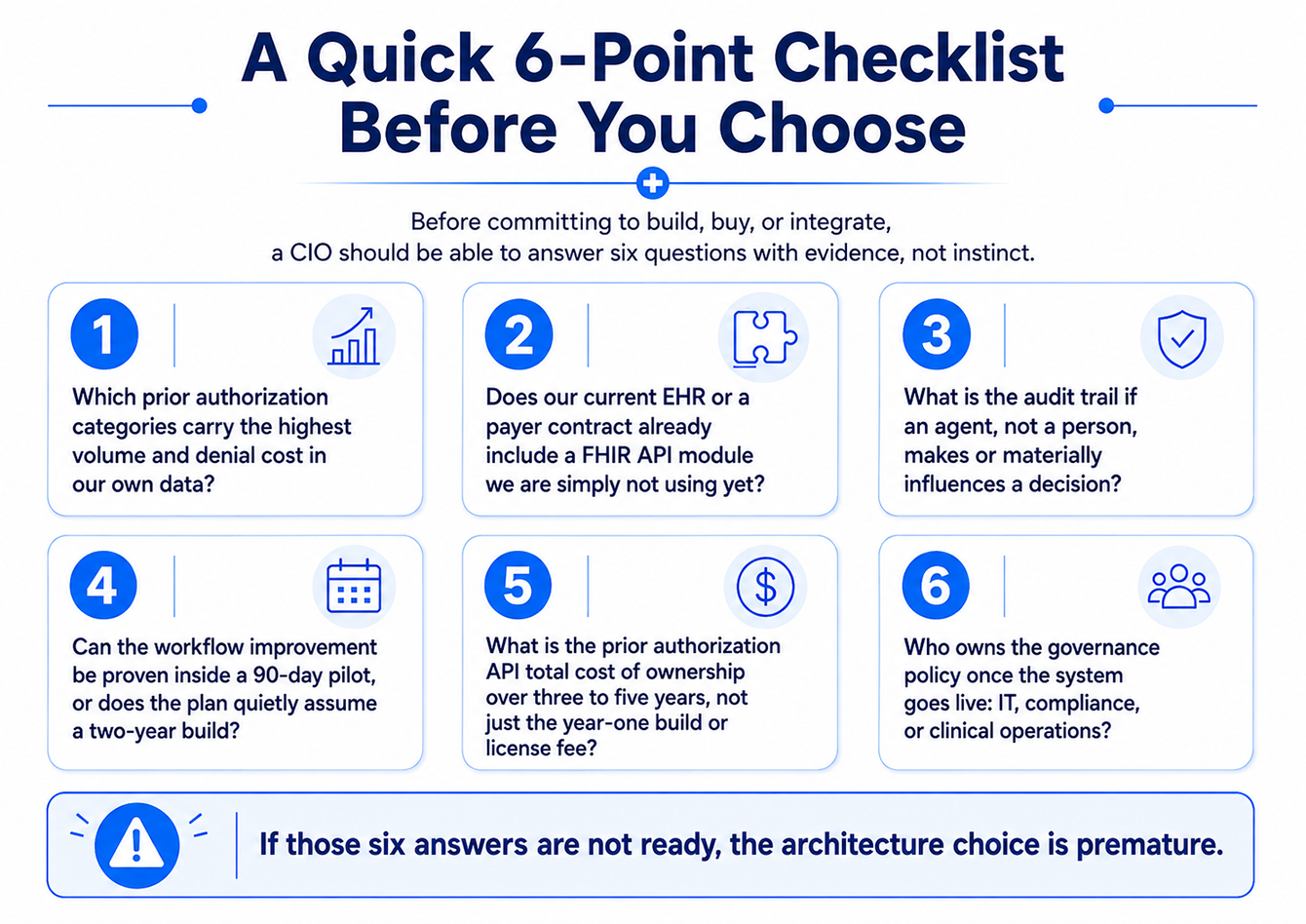 Before committing to build, buy, or integrate, a CIO should be able to answer five questions with evidence, not instinct.
- Which prior authorization categories carry the highest volume and denial cost in our own data?
- Does our current EHR or a payer contract already include a FHIR API module we are simply not using yet?
- What is the audit trail if an agent, not a person, makes or materially influences a decision?
- Can the workflow improvement be proven inside a 90-day pilot, or does the plan quietly assume a two-year build?
- What is the prior authorization API total cost of ownership over three to five years, not just the year-one build or license fee?
- Who owns the governance policy once the system goes live: IT, compliance, or clinical operations?
If those six answers are not ready, the architecture choice is premature.
Should we build our own prior authorization API or buy one?
Neither by default. Run the checklist given above first, on your own denial data, before committing. Building suits hospitals with a standing FHIR team and budget for ongoing payer-rule maintenance. Buying suits a single high-volume use case. Most mid-size hospitals land on integrating an agentic layer over what they already have.
The Bottom Line
CMS-0057-F does not leave room to wait for certainty. The hospitals moving fastest are not building everything from scratch, and they are not buying five disconnected tools either. They are the ones layering a governed agentic system over what they already own, proving it on their highest-volume denial category first, then expanding.
Get the workflow and data readiness questions answered before the architecture conversation starts, and the vendor pitch stops being the thing driving the decision.
Know how selecting the right path can prove crucial to align with CMS-0057-F for an AI-ready hospital.