













Summary
59% of U.S. health systems are still stuck in early or developing healthcare AI maturity, and it’s rarely the model’s fault. The real gap sits in fragmented patient data, missing governance, and pilots scoped around a tool instead of a measurable outcome. Close those three gaps first, and the technology stops being the risky part of the story.
Your last AI pilot didn’t fail exactly. It just didn’t finish. Six months in, the sepsis model was still “validating,” and the ambient documentation tool worked in three units and nowhere else.
That pattern holds up nationally. Only 19% of health systems have started scaling AI across business units, and just 8% run mature programs with measurable returns, according to the State of AI in Healthcare 2026 survey from Emids and ServiceNow. This piece breaks down what separates that 8% from the 59% still stuck, and the sequence that closes the gap through Building an AI-Ready Infrastructure for Hospitals & Ambulatory care organizations specifically.
What “AI maturity” actually means for a hospital
 Most AI maturity models, including the four-stage framework behind the Emids/Service Now survey cited above, sort organizations into stages: early experimentation, developing capability, active scaling, and full maturity, where AI is embedded in workflows and tied to a tracked outcome.
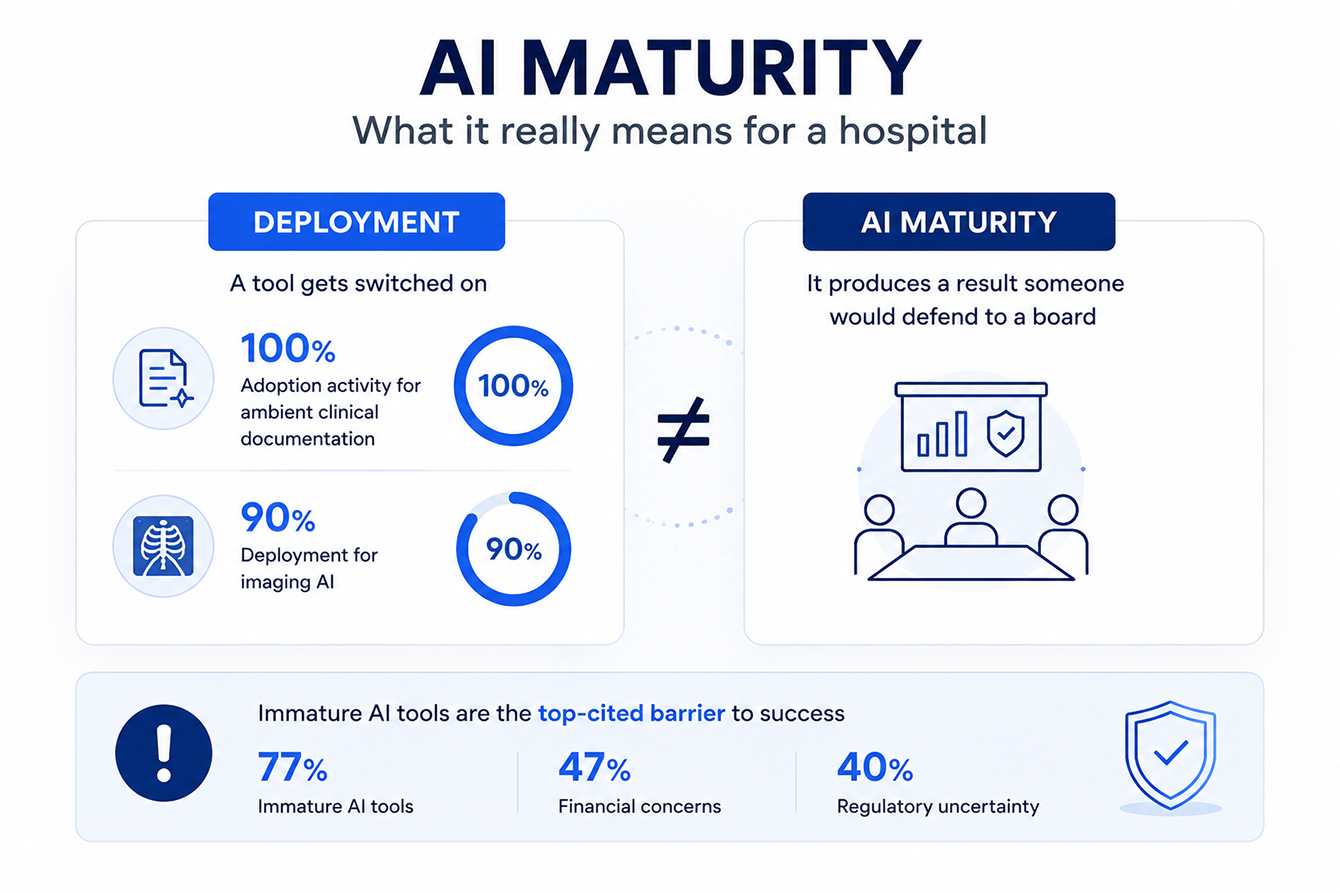
Deployment isn’t the same as maturity. A 2025 survey of 43 US health systems, published in JAMIA, found ambient clinical documentation had reached 100% adoption activity among respondents, and imaging AI had hit 90% deployment. Sounds mature, right?
It isn’t. The same survey found immature AI tools were the top-cited barrier to success, named by 77% of respondents, ahead of financial concerns (47%) and regulatory uncertainty (40%). Deployment means a tool got switched on. AI maturity means it produces a result someone would defend to a board.
Why Healthcare AI Pilots Stall Before They Touch a Patient
Pilots rarely stall because the model is bad. They stall because the tool got scoped before the problem did, and a model that scores well on retrospective data rarely survives a real EHR, a real nursing workflow, and a real on-call schedule.
The pattern repeats across health systems:
- The use case was never tied to one measurable outcome from day one
- Data fragmentation made the model’s inputs unreliable outside the pilot unit
- Governance and evaluation criteria got written after the pilot stalled, not before
That gap between “it worked in the pilot” and “it works Tuesday at 3 am” is exactly where hospital AI initiatives stall after the pilot phase, and it’s rarely a modeling problem.
The Real Bottleneck: Fragmented Data and Missing Governance
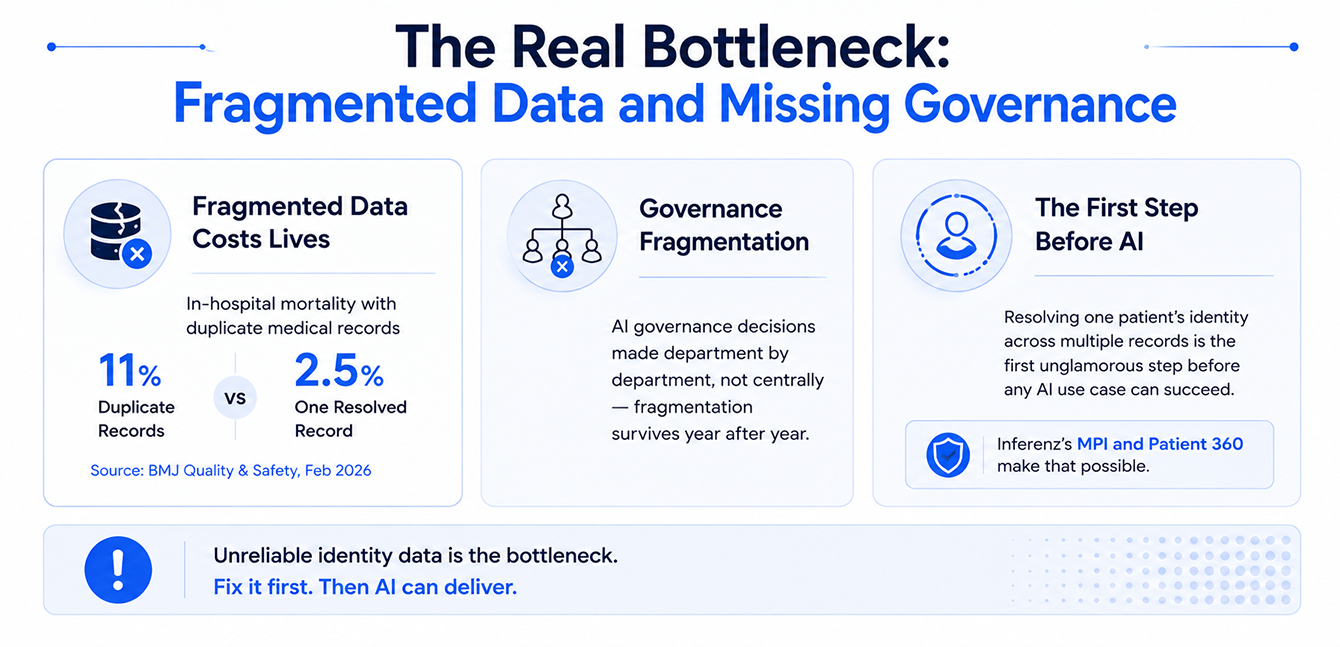 Fragmented data isn’t just an efficiency problem, it’s a mortality one. A February 2026 propensity-matched study in BMJ Quality & Safety followed 12 US hospitals and found in-hospital mortality of 11% among patients with duplicate medical records, versus 2.5% among those with one resolved record.
That’s what an unreliable master patient index costs before AI ever enters the picture, and it’s the same identity-fragmentation problem that stalls AI business cases long before a model gets involved. AI governance maturity model decisions made department by department, instead of centrally, are how that fragmentation survives year after year. Inferenz’s MPI and Patient 360 work exists because resolving one patient’s identity across four different records is usually the first unglamorous step, before any AI use case can stand on solid ground.
AI-Mature vs. AI-Immature: What Separates the Systems That Scale
The same Emids/ServiceNow survey found the top barriers to maturity are legacy infrastructure and technical debt (38%), data quality and governance issues (35%), and talent shortages (32%). None of those are model problems.
Compare how AI-mature health systems structure their data pipelines versus ones still in pilot mode:
| AI-Mature | AI-Immature | |
| Tool count | Fewer tools, wired into existing workflows | One tool per function (scheduling, coding, denials) |
| Governance | One process, centrally owned | Five departmental processes, no single owner |
| Patient data | Single source of truth | A login per tool, no shared identity |
| Where it breaks | Rarely | At the handoff between tools |
Digital maturity shows up in clinical outcomes, not just IT scores
This is the argument that lands hardest with a board, because it reframes AI maturity as a patient-safety question, not a technology preference. Hospitals with stronger digital maturity tend to post better safety and patient-experience outcomes in the peer-reviewed literature, and the mechanism is straightforward: clean, current, structured data at the bedside is what lets predictive modeling in healthcare, sepsis and deterioration risk especially, actually change a clinical outcome instead of just validating well on paper. Inferenz’s Caregence Predictive Models are built around that exact handoff, from clean data to a bedside signal a clinician can act on.
Why CMS-0057-F turns “someday” data fixes into a January 2027 deadline
Under the CMS Interoperability and Prior Authorization Final Rule (CMS-0057-F), eligible hospitals and critical access hospitals must begin attesting, starting with the CY 2027 performance period, that they requested at least one prior authorization electronically through a payer’s FHIR-based Prior Authorization API.
That single attestation assumes clean master patient data, working FHIR connectivity, and governance that can prove, on request, that the call actually happened. Every gap described above becomes visible the moment a regulator asks for proof.
If your data foundation isn’t ready for that attestation, it isn’t ready for AI at scale either. They’re the same problem wearing two different deadlines, which is exactly what the main article within this series unpacks comprehensively: CMS-0057-F and the AI-Ready Hospital.
A Practical Roadmap: Moving From AI-Immature to AI-Ready
None of this needs a two-year program. It needs sequencing:
- Scope the problem before the tool. Name the outcome, the population, and who owns it.
- Run a data foundation audit. Test the master patient index and interoperability readiness against the real use case, not a generic checklist.
- Design governance and evaluation criteria before build starts. Set agent behavior boundaries, audit trails, and an ROI metric the board can hold you to.
- Pilot with a production mindset, so “it worked” and “it’s ready for the floor” become one milestone.
That sequence is, in effect, an AI readiness assessment any hospital CIO or Chief Innovation Officer can run before committing budget.
For the two-layer architecture behind it, a governed data platform plus an agentic layer, see Record, Foundation, Action: Building the AI-Ready Hospital on the Systems You Already Own.
What “AI-Ready” looks like in practice
AI-ready hospitals look less exciting than the demos suggest: documented data governance, a small number of well-integrated tools, and evaluation criteria locked in before the pilot went live, not negotiated after the board starts asking questions.
That’s also what an agentic AI maturity model requires. Autonomous healthcare ready AI agents that request prior authorizations or flag deterioration risk need clearer behavioral guardrails than a static prediction model ever did, because they’re taking action, not producing a score for a human to review.
The honest framing for your next board conversation: the 59% still in early or developing maturity aren’t behind because their people are less capable. They started with the AI instead of the problem, the data, and the proof. To read more about the build-versus-buy trade-offs, check out Buy vs. Build: The AI Strategy Debate Every CIO Is Having Wrong.