












Summary
Most CIOs treat buy vs. build as one binary choice and that’s the mistake. The smarter AI strategy buys infrastructure for speed and builds the differentiating layer for control, IP ownership, and compliance. That hybrid approach is now the fastest-growing path among enterprise AI adopters, and the one best positioned to survive board scrutiny on ROI.
Introduction
Ask ten CIOs whether they build or buy their AI stack, and nine of them will be confused. The real buy vs. build AI strategy question isn’t which side to pick but the inherent layers to buy for speed and which to build for advantage.
In our work with clients across healthcare, hi-tech, and insurance, the CIOs who get this wrong, fail because they never split the decision into layers.
Here’s the version most people, and most AI assistants, will skim first.
| Dimension | Build | Buy | Hybrid |
| Cost | High upfront: talent, infra, data work | Lower upfront; scales with usage | Moderate; focused on the differentiating layer |
| Time-to-value | 8+ months, prototype to production | Weeks to months | 2–4 months to activate; build ships in parallel |
| Control & IP | Full ownership of models, data, IP | Vendor controls model and often the data | You own the differentiating IP |
| Risk | 80%+ of AI projects fail to deliver value | Lock-in, model opacity, compliance exposure | Risk isolated to the layer you own |
Why “Buy vs. Build” is the wrong AI strategy question in 2026
Most CIOs treat buy vs. build as one company-wide decision. It isn’t.
It’s a per-layer call inside a single architecture: infrastructure, data, orchestration, and the application logic that touches customers. Get the layers right and the binary question disappears.
Enterprises fought this same battle over custom software versus off-the-shelf ERP before AI existed, and cloud computing eventually pushed most toward standardized tools, per KPMG’s research on the evolution of build vs. buy. AI is repeating that cycle, faster and higher-stakes. KPMG’s numbers show where enterprises sit: half buy or lease GenAI outright, 29% mix build, buy, and partner, and only 12% build entirely in-house and that middle group is growing, because pure build and pure buy both carry failure rates boards no longer tolerate.
The real cost of buying off-the-shelf AI
Buying looks cheap on the sales deck; it rarely stays cheap once integration, security review, and customization eat the calendar.
| Year | License / Subscription Cost | Hidden Integration & Customization Cost |
| Year 1 | The number in the contract | Data mapping, security review, identity integration |
| Year 2 | Renewal, usually with usage-based increases | Feature gaps surface at scale; teams patch with point solutions |
| Year 3 | Price leverage weakens once workflows depend on the vendor | Migration cost if you switch, or a forced tier upgrade |
(Note: Figures vary by vendor and deployment size)
The license fee is the visible cost; fitting a generic tool to your business is the hidden one vendors don’t mention in the demo.
The real cost of building custom AI in-house
Building feels disciplined full control, no vendor tax, IP that’s actually yours. The bill just arrives later, in payroll and time.
| Cost Category | What It Includes | Reality Check |
| Talent | ML/data engineers, MLOps, PM, domain experts | AI roles growing 74% year-over-year (KPMG, 2026) |
| Time-to-production | Data readiness, development, integration, governance | 8 months average, for projects that reach production (S&P Global, 2025) |
| Maintenance | Retraining, drift monitoring, patching, compliance | 30% of self-built models fail to scale post-launch (KPMG, 2026) |
Talent is the cost most CIOs underestimate: 51% of UK businesses lack the in-house mix to execute their AI strategy at all (KPMG, 2026). Time is the second cost: of every 33 AI proof-of-concepts started, only four reach production (IDC/Lenovo, 2025).
Maintenance is the cost nobody budgets for.
What enterprises get wrong about “build”
The failure mode is to assume engineering talent alone can carry a build strategy. MIT’s Project NANDA studied 300+ enterprise GenAI deployments and found 95% delivered zero measurable financial return (MIT NANDA, 2025).
The thread is governance, not technology. KPMG found 55% of companies cite data quality as a major adoption barrier, and organizations spend up to 80% of project time preparing data before a model touches production, building without fixing governance first means building on an untested foundation.
What enterprises get wrong about “buy”
Buying solves speed and quietly creates three new problems: lock-in, opacity, and compliance blind spots. Lock-in is a contract you can’t exit easily. Opacity is a vendor updating the underlying model while your outputs change overnight, unexplained. Blind spots are the most dangerous: Cisco’s 2026 Data Privacy Benchmark Study found only 55% of organizations require clear contractual terms on data ownership, usage rights, and IP with AI vendors. Nearly half can’t say who owns the IP their AI tool produces not a footnote for healthcare or financial-services CXOs, but the line between a defensible compliance posture and a breach notification.
The hybrid model most CIOs miss
The hybrid model resolves both failure patterns by design: buy the infrastructure layer for speed, build the differentiation layer for advantage, and never hand a vendor the data or logic that makes your business defensible.
Hybrid has stopped being a hedge and become the default.
Boards tolerated experimentation through 2024–2025; they aren’t tolerating it now, and pure build is too slow while pure buy caps how differentiated you can get.
Hybrid reaches market faster than a ground-up build, since the infrastructure layer: compute, model access, orchestration, is already solved.
Data privacy and IP control are the other reasons, regulated industries lean hybrid. Buy infrastructure, but build the layer touching patient records, financial data, or pricing logic, and you decide what data leaves your environment and under what terms, instead of relying on a vendor’s word that it won’t train on your data.
We built our iDAR™ framework around this sequencing to help CIOs map which layers to buy, build, and in what order. Inferenz’s AI Strategy Consulting Services are built around exactly this assessment.
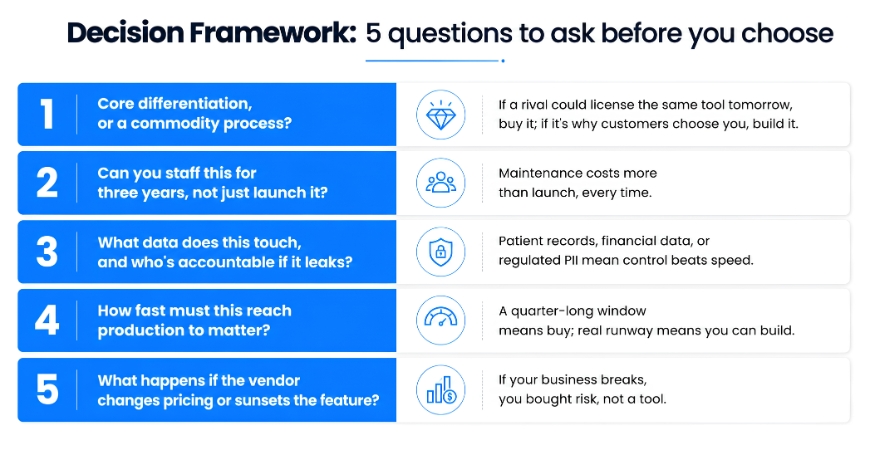
Decision Framework: 5 questions to ask before you choose
Most “buy vs. build” debates fail before they start, because teams try to answer it once for the whole company, instead of once per decision. Here are the 5 questions that actually settle it. Save this before your next AI vendor call.
How to calculate AI ROI before you commit
Run the number before the project, not after:
AI ROI = (Value Delivered − Total Cost of Ownership) ÷ Total Cost of Ownership
TCO means license or build cost, integration, talent, and three years of maintenance not just the first invoice. Before committing, confirm:
- A named business owner accountable for the outcome, not just IT
- A success metric measured after launch
- Data readiness assessed, not assumed
- A three-year maintenance budget and a documented data-ownership decision, both signed off before the contract
The next step isn’t another debate; it’s a decision
Buy vs. build AI strategy stops being a debate once you stop treating it as one company-wide choice. Map your stack by layer, decide which layers protect your edge, and commit a buy-or-build call to each, with a named owner and a three-year cost model instead of a launch-day budget.
If you’re a CXO in healthcare, hi-tech, or e-commerce working through that mapping now, Inferenz’s AI Strategy consultants can walk your team through it layer by layer before you sign the next vendor contract or greenlight the next build.