













Summary
Most hospice referral intake delays trace back to manual eligibility checks, scattered referral channels, and slow physician signatures. Automated eligibility screening lets your team check every referral against the same criteria in minutes. It flags gaps early. This guide shows where the time goes, what to automate first, and what the 2026 research supports.
Introduction
Hospice referral intake delays are the time between a referral arriving and a patient being admitted. This article shows how automated eligibility screening shortens that window for hospice care agencies. It’s written for COOs and intake directors. You’ll see what slows admissions, which fixes you control, and what the evidence says.
The stakes show up in federal data. The median hospice stay for Medicare decedents was 19 days in 2024. MedPAC reports that more than one in four enrolled only in the last week of life. Every day lost at intake comes out of a stay that’s already short.
This is the second article in our series on predictive analytics for hospice operations. The main article of this series, How Hospice Organizations Turn Governed Data Into Forecasts Leadership Can Defend, explains and extends the process of how clean referral and admission data feeds leadership forecasts.
Where hospice referral intake delays come from
Delays start in two places: at the referral source and inside your own intake process. You control the second directly and can influence the first.
| Cause | Where it sits | What it looks like | Typical fix |
| Late hospice conversations | Referral source | Hospice comes up only when death is near | Liaison outreach, referral feedback loop |
| Scattered referral channels | Your intake | Fax, email, portal, and EHR referrals are keyed in by hand | One intake queue |
| Manual eligibility review | Your intake | A nurse reads each packet and results vary by reviewer | Automated screening |
| Missing documents | Both | Gaps surface after the first review, then phone calls start | Completeness check on arrival |
| Certification delays | Your team and the physician | The patient is ready and the signature is still pending | Digital workflow with reminders |
| Coverage checks | Your intake | Payer eligibility is confirmed by hand, late in the process | Real-time verification |
| Family decision time | Patient and family | The family needs time before electing | Early education, staff support |
| The referral side MedPAC points to physicians who wait until death is near and families who prefer regular care first. Your intake team can’t remove those causes. It can make sure no referral waits once it arrives. |
What the 48-hour hospice admission timeline covers
The 48-hour rule sets the deadline for the registered nurse’s initial assessment after election. Eligibility certification runs on its own clock.
| Requirement | Deadline | Rule |
| Initial assessment by the hospice RN | Within 48 hours after election of hospice care is complete, unless the physician, patient, or representative asks for sooner | 42 CFR 418.54(a) |
| Comprehensive assessment by the IDG | No later than 5 calendar days after election | 42 CFR 418.54(b) |
| Written certification of terminal illness | Before the hospice submits its claim | 42 CFR 418.22(a) |
| If written certification isn’t ready | Oral certification within 2 calendar days, and written before the claim | 42 CFR 418.22(a)(3) |
| Early certification | Allowed up to 15 calendar days before the election takes effect | 42 CFR 418.22(a)(3) |
- Early certification means your team can request signatures ahead of election day for patients who already screen as eligible.
- The physician’s narrative has to reflect the patient’s individual circumstances. Check boxes and standard language don’t meet the rule.
What automated eligibility screening does
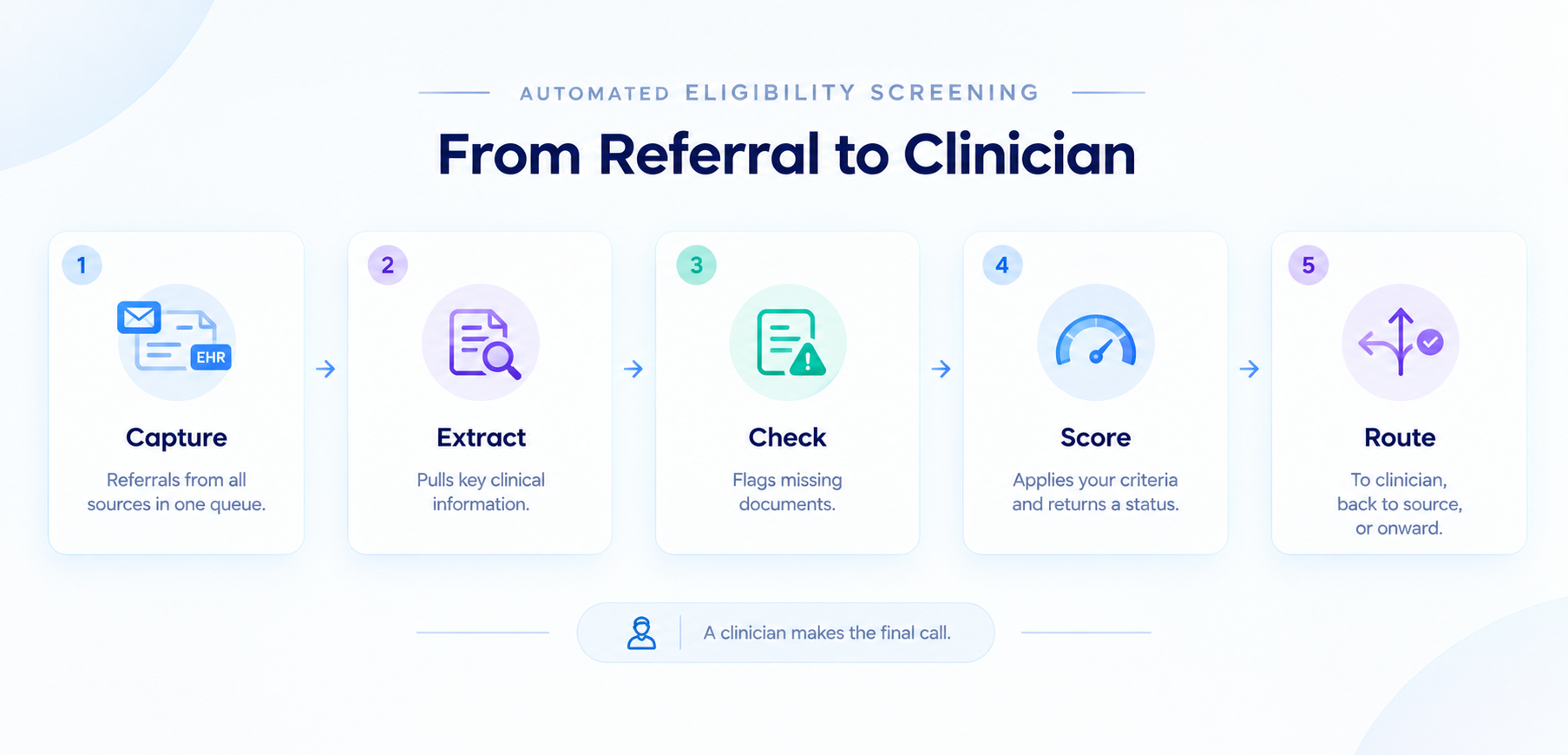
Automated eligibility screening reads a referral packet and pulls out the clinical signs that matter. It scores them against criteria your clinical leaders wrote. Then it returns a status for a clinician to confirm.
- Referrals from fax, email, portal, and EHR land in one queue.
- Document processing pulls diagnosis, functional status, hospitalizations, and decline indicators from the record.
- The system flags missing documents right away and requests them.
- Your written criteria produce a status with the reasons attached.
- Eligible referrals move on, borderline ones go to a clinician, and incomplete ones go back to the source.
A clinician makes the final call. The tool gives every packet the same review, whatever the day or the reviewer.
Intake Automation vs. Eligibility Screening
Vendors use both terms loosely, so separate them before you buy.
| Dimension | Referral intake automation | Automated eligibility screening |
| What it does | Moves referral data between channels and systems | Scores clinical indicators against your criteria |
| Output | A complete record in your EHR or CRM | A status with reasons for a clinician to confirm |
| Saves time on | Keying, routing, acknowledgments | Packet review and follow-up calls |
| Needs clinical rules | No | Yes |
| Weak spot | Speeds up referrals nobody has screened | Depends on complete, accurate source data |
Payer verification belongs in the same workflow
Hospice eligibility verification automation also covers payer checks for Medicare, Medicare Advantage, and Medicaid. Run them in the same workflow so coverage and clinical status come back together.
Speed needs accuracy
MedPAC reports an aggregate live-discharge rate of 19.1% in 2024. It says high rates can signal a hospice admits patients who don’t meet eligibility criteria. Consistent, documented scoring protects your admissions as well as your timeline.
What the 2026 research says about automated screening
A 2026 meta-analysis in npj Digital Medicine pooled seven randomized trials covering 125,666 patients. The trials tested algorithms inside hospital and clinic EHRs that flag patients who may need palliative care. They did not test hospice-side intake screening.
| Finding | Result | What it means for you |
| Palliative care consultations | Relative risk 2.19 for non-cancer patients and 5.31 for cancer patients | Algorithms prompt earlier conversations at the referral source |
| Hospice use | Relative risk 0.97 (95% CI 0.95 to 1.00) across two trials | No clear lift in hospice enrollment overall |
| Timing of hospice start | One included trial found usual-care patients more likely to start hospice in the last 3 days of life | The authors suggest timing can improve even when totals stay flat |
| Staff capacity | In one included trial, fewer than half of eligible patients received a consultation, largely due to workforce limits | Flags only help when someone can act on them quickly |
The authors also report high variation between trials and note that all of them ran in the United States.
What this means for your hospice
- Referral-source algorithms run inside other organizations’ EHRs. You can support them through liaison relationships, and you don’t control them.
- Hospice-side screening sits in your hands. The review didn’t test it, so your own baseline is the evidence that matters.
- Capacity decides results. Pair automation with staff who answer flags the same day.
Baseline these six metrics before you automate
You can’t judge ROI without a starting point. Pull these from the last 90 days.
| Metric | How to measure | What it tells you |
| Referral-to-decision time | Hours from receipt to eligibility status | Where manual review slows you down |
| Referral-to-admission conversion | Admissions divided by eligible referrals | Whether faster decisions turn into census |
| Time to admission | Hours from referral to election | Total delay, including physician and family steps |
| Missing-document rate | Share of referrals incomplete at first review | Channel and referral source quality |
| Certification turnaround | Hours from request to signature | Physician workflow friction |
| Median stay by referral source | Days, grouped by hospital, SNF, and clinic | Which relationships send patients late |
Fix the channel problem first: fax, email, portal, and EHR
Referrals that arrive through four channels get four different levels of care unless one workflow sits underneath them. Good hospice referral management technology starts there.
- Route every channel into one queue and time-stamp each handoff.
- Use one required-fields checklist, whichever channel the referral used.
- Send an automatic acknowledgment so the referral source knows you have it.
- Return incomplete packets with a specific list of what’s missing.
To automate the referral intake process without creating new data silos, connect it to your EHR and billing systems. Our guide to hospice EMR and referral data integration shows how.
Build a feedback loop with hospitals and SNFs
- Send each referral source a monthly summary: volume, time to decision, share of complete packets, and median stay.
- Flag sources whose volume is falling or whose referrals are arriving later.
- Review the pattern with your liaisons, since they own the relationship.
Those drops add up fast. Our look at referral leakage to post-acute care explains the revenue side.
Close the certification gap
A referral can be screened, covered, and ready, and still wait on a signature.
- Trigger the certification request the moment screening returns eligible.
- Give the physician a one-page clinical summary drawn from the record.
- Let the physician write the narrative. The rule bars check boxes and standard language.
- Use e-signature, automatic reminders, and escalation to the medical director.
- Track hours from request to signature every week.
What one day of intake delay costs
For patients with a short prognosis, the date of death is fixed. Each day lost at intake is a day of care that never happens.
| Revenue at risk Days lost × average daily payment × referrals affected |
MedPAC puts the average Medicare hospice payment at about $191 per day in 2024. If 40 referrals a month wait an extra 1.5 days, that’s about $11,460 a month in unbilled care (40 × 1.5 × $191). Treat the number as an illustration. Your rates, levels of care, and delay data will change it.
The figure leaves out the harder losses. Families get fewer days of support. Referral sources send the next patient to a faster hospice.
How to choose hospice intake automation software
Ask every vendor to demonstrate these capabilities on your own referrals. Intake is one of several workflows where AI-powered automation for hospice now delivers value, and our overview of AI in hospice care covers the rest.
| Capability | Ask the vendor to show |
| Live payer verification | Does it check coverage against the payer in real time, or only route paperwork? |
| Editable clinical rules | Can your clinicians change criteria without a developer ticket? |
| Visible reasoning | Does every score list the source documents and values behind it? |
| Audit trail | Are inputs, rules, scores, and confirmations time-stamped and exportable? |
| Clinician in control | Do borderline cases route to a person who confirms eligibility? |
| Channel coverage | Does it take fax, email, portal, and EHR referrals? |
| EHR write-back | Does the status land in your hospice EHR without re-keying? |
A 90-day plan for your hospice team
- Days 1 to 30: Baseline the six metrics and map every referral channel.
- Days 31 to 45: Write screening criteria with your medical director. Give non-cancer diagnoses such as heart failure, COPD, and dementia their own checklists. The 2026 meta-analysis notes palliative care delays are especially common there.
- Days 46 to 90: Pilot on one channel or one referral source and compare against baseline each week.
- Day 90: Decide whether to extend, using conversion and time to decision as the deciding numbers.