













Summary
Robotic process automation has grown from bots that click through screens into intelligent automation that reads documents, routes exceptions and hands work to AI agents, and US providers like Inferenz now compete on process fit, exception handling and governance.
The work done by the top 10 RPA and intelligent automation companies spans process discovery, document processing, bot and agent orchestration and ongoing operations. Prospects match a partner to their processes and pilot one before going ahead with them.
Introduction
Robotic process automation grew up on a simple promise: let software do the clicking. The promise has widened. Bots now read documents, route exceptions and hand work to AI agents, and buyers shop for RPA and intelligent automation partners like Inferenz as much as for software licenses. Searching for RPA companies turns up vendor lists that all look alike, so this guide compares the field on evidence you can check.
Automation has moved past the experiment stage. Banks, hospital systems and government agencies all run bots in production, and what’s left to settle is how much AI to put on top.
Public agencies are moving the same way. Gartner predicts that at least 80% of governments will deploy AI agents to automate routine decision-making by 2028, and its survey of 138 government respondents found that 41% cite siloed strategies and 31% cite legacy systems as key adoption challenges.
Private companies are moving the same way, and the next step is agents. McKinsey’s 2026 survey found that about two in ten respondents are scaling AI agents across their organization, a share that rises to 40% in companies with more than $1 billion in revenue.
This guide profiles ten US-based firms, explains how we chose them and shows how to match one to your processes.
Full disclosure: We kept the field to US-headquartered firms which are dynamic and futuristic in the RPA and intelligent automation domain and highly relevant to American buyers. We ranked every company on the criteria below and included Inferenz too.
Top 10 RPA and intelligent automation companies at a glance
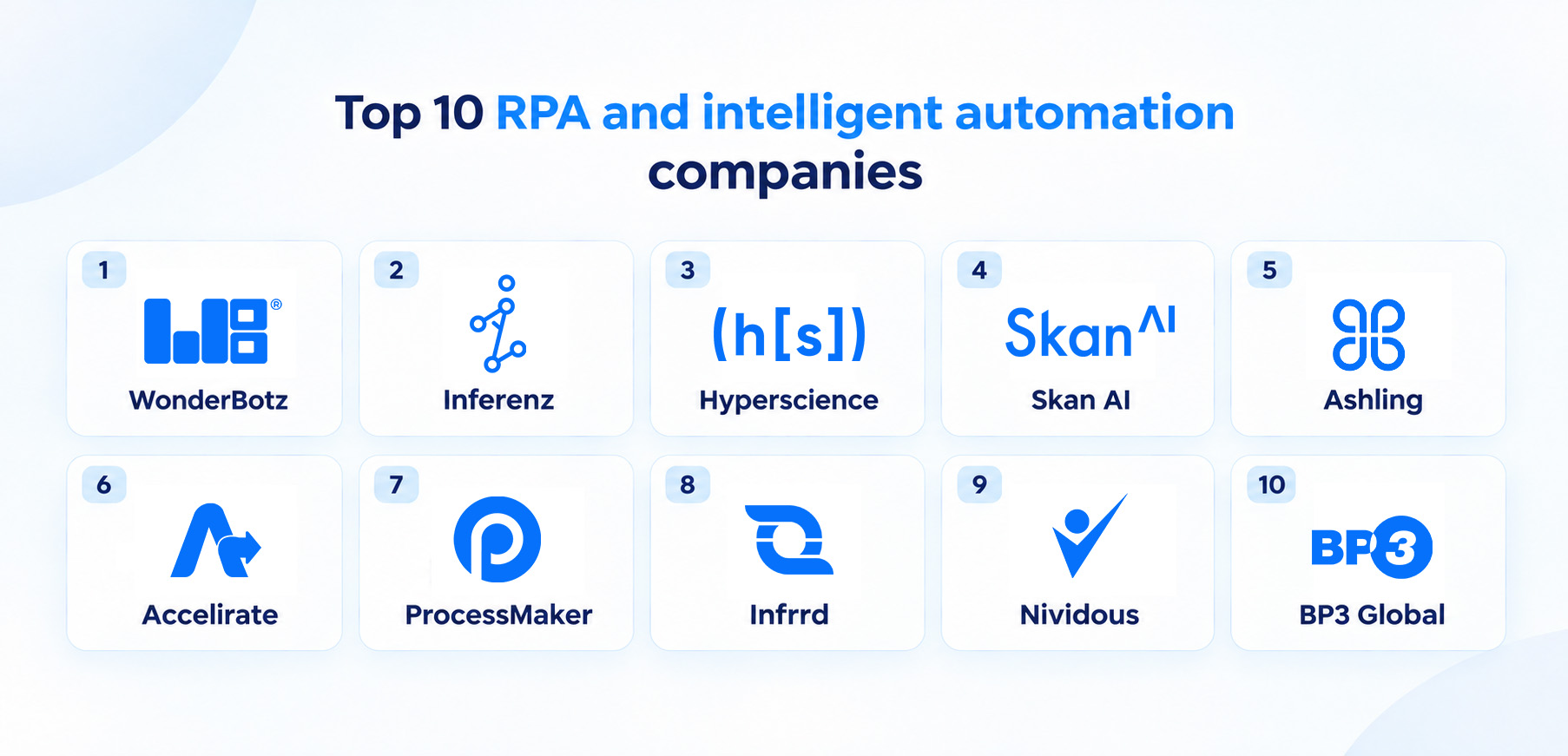
| # | Company | Model | Best for | Headquarters and signals |
| 1 | WonderBotz | Services | Intelligent automation and agentic process management | Princeton, New Jersey, founded 2017, 2026 Inc. 5000 |
| 2 | Inferenz | Services | RPA plus AI and integration for healthcare, insurance and hi-tech | Round Rock, Texas, seven-part lifecycle, Caregence agents, 30+ accelerators |
| 3 | Hyperscience | Platform | Document-heavy processes at large organizations | New York, founded 2014 |
| 4 | Skan AI | Platform | Process intelligence that shows where to automate | Menlo Park, California, founded 2018, $63 million Series C in 2026 |
| 5 | Ashling | Services | Intelligent automation and agentic AI consulting | Chicago, founded 2017, SS&C Blue Prism partner |
| 6 | Accelirate | Services | AI-enabled automation with integration depth | Sunrise, Florida, founded 2016 |
| 7 | ProcessMaker | Platform | Low-code workflow and process automation | Durham, North Carolina, founded 2000 |
| 8 | Infrrd | Platform | Intelligent document processing for invoices and mortgages | San Jose, California, founded 2015 |
| 9 | Nividous | Platform | RPA, AI and low-code in one intelligent automation platform | Mount Laurel, New Jersey, founded 2011 |
| 10 | BP3 Global | Services | Process automation and BPM consulting | Austin, Texas, founded 2007 |
What do RPA and intelligent automation companies do?
RPA companies provide software robots, or services to build them, that copy the clicks and keystrokes people use to complete a repetitive task across applications. Intelligent automation companies add AI to that base, so the bot can read a document, classify a request, decide on an exception or call an AI agent. Together the work usually covers six jobs:
- Assessment: finding processes with enough volume and stable rules to automate.
- Bot design and build: scripting the workflow for structured, rule-based tasks.
- Intelligent workflows: adding classification, triage and decision support with AI.
- Document processing: extracting data from forms, emails and PDFs with NLP.
- Integration: linking CRM, ERP, EHR and finance systems through APIs and screens.
- Governance and monitoring: audit trails, access controls and bot health checks.
Analysts now fold much of this into broader labels such as business orchestration and automation, so a vendor may describe itself with a different term than the one you searched. Compare capabilities, and don’t get hung up on the label.
How we ranked these RPA companies
Dozens of vendors claim automation expertise. We kept US-headquartered companies of comparable scale with public evidence you can check, and each met most of these six criteria:
- Process breadth: proven automation of structured work, documents and exceptions.
- AI capability: document intelligence, decisioning or agents layered over the bots.
- Integration: connectors or services for the systems you run, including legacy applications.
- Governance: audit trails, access controls and monitoring that hold up in a review.
- Evidence: dated awards, funding news, named customers or published outcomes in public sources.
- Support model: implementation help, managed services or migration support.
We kept a firm only when at least two independent sources agreed on its headquarters and founding year, and we dropped companies that were acquired and absorbed into a larger vendor. Treat the order as editorial judgment, and give every number a pilot before it supports a business case.
The 10 RPA and intelligent automation companies to know in 2027
1. WonderBotz
Best for: intelligent automation and agentic process management.
WonderBotz was founded in 2017 by two former Big Four partners and is headquartered in Princeton, New Jersey. It helps enterprises launch, modernize and manage intelligent operations, combining AI agents, automation, human expertise and governance across the leading automation platforms. Its Agentic Process Management framework, relaunched on October 27, 2026, rests on four pillars: orchestration, fidelity, stewardship and data foundation. It ranked No. 2,421 on the 2026 Inc. 5000 with 137% revenue growth from 2022 to 2025, and it reports that a healthcare client cut back-office processing time by 90% (company-reported).
2. Inferenz
Best for: enterprises that want RPA, AI and system integration delivered as one program, especially in healthcare, insurance and hi-tech.
Inferenz is a data and AI engineering company with US operations in Round Rock, Texas, and more than 200 specialists. Its automation practice moves from rule-based RPA toward hyperautomation, combining bots with AI for classification, triage and document processing and integrating with CRM, ERP, EHR and finance systems under audit trails and access controls. In healthcare, the Caregence Prior Authorization Agent completes the payer portal, submits the request and tracks status until a decision arrives, writing the result back to the EHR. Inferenz replaced manual portal entry with RPA for a national home care workforce and automated ingestion across 12 source systems for a nationwide entertainment operator. For processes that cross many systems, one team that owns the bots, the AI and the integrations keeps handoffs from becoming the weak link.
3. Hyperscience
Best for: document-heavy processes at large organizations.
Hyperscience was founded in 2014 and is headquartered in New York. It builds an enterprise AI platform that reads, understands and processes documents at scale and passes the data to downstream systems and processes. It reports 99.5% accuracy and FedRAMP High authorization, and says Gartner named it a Leader in the 2026 Magic Quadrant for Intelligent Document Processing, positioned highest for ability to execute among 15 vendors (company-reported). Forrester also named it a Leader in its Q2 2026 Wave for document mining and analytics platforms.
4. Skan AI
Best for: process intelligence that shows where automation will pay off.
Skan AI was founded in 2018 and is headquartered in Menlo Park, California. It captures how work really happens across applications and teams and turns it into a context graph that shows which processes are worth automating and gives AI agents the context to act. It reports clients that include one in four Fortune 50 companies and seven in ten top US banks, a 30% average productivity lift and $500 million in delivered value (company-reported). In August 2026 it announced a $63 million Series C co-led by Cathay Innovation and Dell Technologies Capital.
5. Ashling
Best for: intelligent automation and agentic AI consulting.
Ashling was founded in 2017 and is headquartered in Chicago. It describes itself as an intelligent automation and agentic AI consulting firm that finds the processes worth automating, designs programs that scale and then delivers and runs the solutions. It reports 250 specialists, 500 prebuilt accelerators, work for more than 300 brands and a Net Promoter Score of 82 (company-reported). SS&C Blue Prism named it a WorkHQ Pioneer Partner in June 2026, and it has grown by acquiring Machina, fourTENS and Reveal Group.
6. Accelirate
Best for: AI-enabled automation with integration depth.
Accelirate was founded in 2016 and is based in Sunrise, Florida. It describes itself as an AI-first provider of agentic automation services, with a 5-Week Activator program, built-in AI governance and products such as FlowAgent for MuleSoft and AcceliQA. It has grown through the acquisitions of Revelation AI, a Platinum Salesforce Partner, and Eshia Solutions, a MuleSoft integration specialist. It reports more than $300 million in realized ROI from automation, and a top-five US insurer on its site cites five agents live by week five and $2.4 million in annual savings (company-reported).
7. ProcessMaker
Best for: low-code workflow and process automation.
ProcessMaker was founded in 2000 and is headquartered in Durham, North Carolina. It sells a business process automation and orchestration platform that coordinates workflows, systems, business rules, people and AI, including tools to build and govern AI agents. The company says Gartner ranked its platform in the top five across all four evaluated use cases in the 2026 Critical Capabilities for Decision Intelligence Platforms (company-reported). It is a platform you operate, so compare it with a services partner on who builds and maintains the workflows.
8. Infrrd
Best for: intelligent document processing for invoices and mortgage files.
Infrrd was founded in 2015 and is headquartered in San Jose, California. It builds intelligent document processing software that extracts data from complex, unstructured documents such as invoices and loan files, and it says fields are found across changing layouts without a document template. In 2026 it launched a developer-focused document automation API. Its own buyer guidance centers on accuracy on your documents, straight-through processing rate and exception quality, which are sound tests to apply to any vendor.
9. Nividous
Best for: RPA, AI and low-code in one intelligent automation platform.
Nividous was founded in 2011 and is based in Mount Laurel, New Jersey. Its platform spans RPA, agentic process automation, document processing and low-code, with governance, audit trails and human-in-the-loop escalation built in, and it is SOC 2 certified. It reports ROI in four to six months, a 60% throughput gain and more than 80% less manual effort, and its quick-start program promises production roll-out in three to four weeks (company-reported). Use cases include IT service desk, supply chain and finance.
10. BP3 Global
Best for: process automation and BPM consulting.
BP3 Global was founded in 2007 and is headquartered in Austin, Texas. It is a consultancy in business process management, RPA and AI that helps clients align people, process and platforms, working with platform partners such as UiPath and Appian. Its services run from strategy and design through automation and ongoing support. It has acquired Agilify, transformAI and Extra Technology to broaden its intelligent automation bench, and it has been named among the top consulting companies in Texas.
How to choose an RPA company
Automation goes best when the process is understood before the tool is chosen. Each step below narrows the field and keeps the project tied to a result you can measure.
- Step 1: Pick the process and measure it. Choose a process with high volume and clear rules, then record its cycle time, error rate and exception rate. Those numbers become the baseline for every claim a vendor makes.
- Step 2: Redesign before you automate. Remove steps that exist only because of old habits. Automating a messy process produces a faster mess, so fix the workflow first.
- Step 3: Map the systems and documents involved. List the desktop applications, web portals, APIs and document types the process touches. Some tools shine on screen-based tasks, and others are built for documents or system integration.
- Step 4: Decide how much AI belongs. Rule-based bots suit stable, structured tasks. Document AI helps with invoices and forms, and agents can handle judgment calls. Decide where people stay in the loop for exceptions.
- Step 5: Shortlist on evidence. Ask for processes running in production at organizations like yours, and for references you can call. Check public sources for dated proof, and ask how long the automations have been live.
- Step 6: Pilot one process with a before and after. Run the process for a few weeks, compare results with the baseline and review every exception. A pilot that handles the awkward cases tells you more than one that only handles the easy ones.
- Step 7: Plan operations and governance. Applications change, and bots break when they do. Settle who monitors the automations, who fixes them, how credentials are secured, how audit trails are kept and who owns the roadmap after launch.
Many automation and AI projects stall because the process around them stays outdated. The Inferenz piece on business process reengineering for AI and ML systems makes the case for redesigning the workflow before any bot is built.
Questions to ask every RPA vendor
- Fit: Which processes like ours have you automated, and what share needed human review?
- Exceptions: What happens when a screen changes or a document arrives in a new format?
- AI layer: Which steps use AI, and how are the outputs checked?
- Governance: What audit trails, access controls and approval rules ship with the bots?
- Integration: Which of our systems have you connected, and how?
- Cost: How are licenses priced as bot counts and runs grow?
- Ownership: Can our team maintain the bots after launch?
RPA and intelligent automation trends to watch in 2027
- Bots hand work to agents. Platforms now orchestrate people, robots and AI agents in one flow.
- Orchestration becomes the label. Analysts group RPA with workflow and decisioning under business orchestration and automation.
- Governance moves into the platform. AI gateways and agent logs are turning into standard features.
- Process intelligence comes first. Buyers want to see where work stalls before they commit to a bot.
- Document intelligence gains ground. Extraction and classification are now the usual first AI step beside a bot.
Final thoughts
The best RPA companies in 2027 will show you how a bot behaves when something unexpected happens. They’ll name the AI steps, explain the governance and show dated proof. Choose the partner whose strengths match your processes, pilot on one workflow with a clear before-and-after, and redesign the process before you automate it.
If your processes cross healthcare, insurance or hi-tech systems and need bots, AI and integration working together, Inferenz is a good place to start the conversation.