











Summary
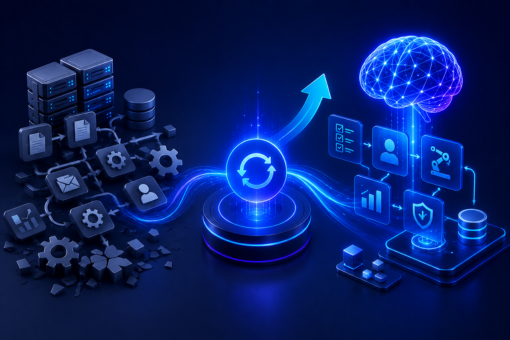
AI and ML initiatives fail not because models underperform, but because the processes around them remain broken. Business Process Reengineering (BPR) gives organizations the structural foundation to turn AI from a technology experiment into a measurable operational advantage.
Introduction
Artificial Intelligence and Machine Learning are transforming industries at an unprecedented pace. Organizations across healthcare, finance, e-commerce, and logistics are investing heavily in AI-driven solutions to improve decision-making, automate workflows, and deliver better customer experiences.
However, one critical mistake many organizations make is introducing AI into outdated business processes.
AI alone does not create transformation. Real transformation happens when businesses rethink and redesign their processes to fully leverage AI capabilities. This is where Business Process Reengineering (BPR) becomes essential.
What is Business Process Reengineering?
Business Process Reengineering is the practice of fundamentally rethinking and redesigning business workflows to achieve significant improvements in efficiency, speed, quality, and cost.
Instead of making small incremental improvements, BPR asks a deeper question:
“If we were designing this process today with modern technology like AI, how would it look?”
This mindset helps organizations remove unnecessary steps, automate repetitive tasks, and build workflows that are optimized for intelligent systems.
Turning AI Insights into Automated Actions
In many organizations, AI models generate predictions or insights that still require manual review. For example, a fraud detection model might identify suspicious transactions, but analysts still need to review each case manually.
With Business Process Reengineering, the workflow is redesigned so that AI predictions directly trigger actions:
- Low-risk transactions are automatically approved
- High-risk transactions are automatically blocked
- Only ambiguous cases are escalated to human analysts
This dramatically improves efficiency while maintaining control.
Improving Data Quality for Machine Learning
Machine learning models rely heavily on high-quality data. Unfortunately, traditional business processes often generate inconsistent or incomplete data.
By redesigning workflows, organizations can ensure that data is:
- Captured automatically
- Standardized across systems
- Validated in real time
Better data pipelines lead to more reliable and accurate machine learning models.
Eliminating Human Bottlenecks
Many operational processes involve multiple layers of manual approvals and handoffs between teams. When AI is introduced without redesigning the workflow, these bottlenecks remain.
Business Process Reengineering helps organizations redesign processes so that:
- AI handles repetitive decision-making
- Humans focus on complex exceptions
- Workflows move automatically between systems
This reduces operational delays and improves scalability.
Enabling Scalable MLOps
AI systems are not static. Models must be continuously monitored, retrained, and validated to maintain performance.
BPR helps organizations integrate these lifecycle steps into automated pipelines, including:
- Model monitoring
- Drift detection
- Retraining workflows
- Governance and compliance checks
This allows AI systems to operate reliably in production environments.
Real-World Use Case: Healthcare Care Coordination
Healthcare is one of the industries where inefficient processes can directly impact patient outcomes.
Consider a traditional patient referral workflow:
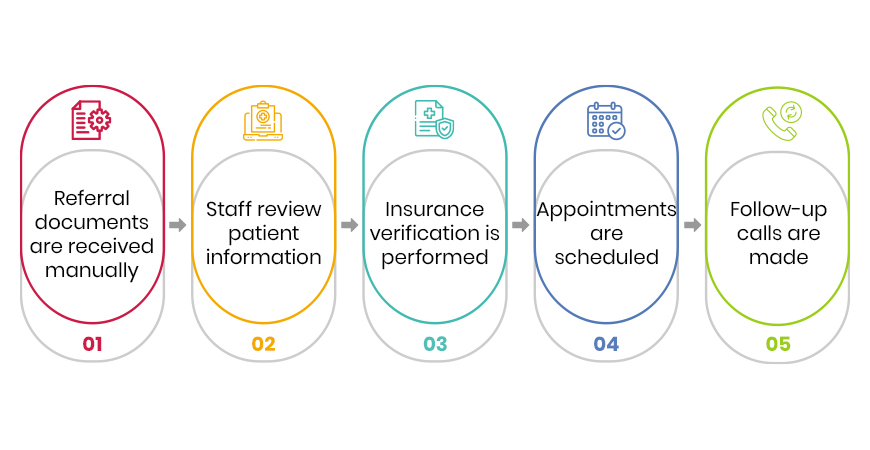
This process is time-consuming and prone to delays.
With Business Process Reengineering combined with AI, the workflow can be redesigned:
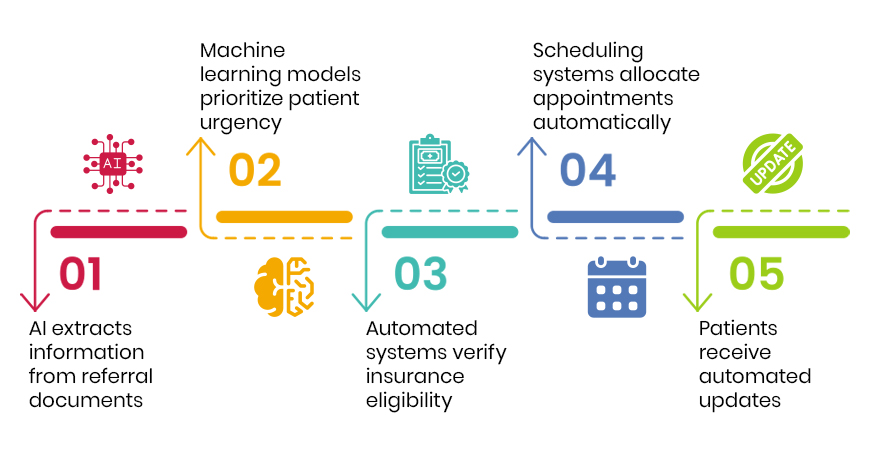
The result is faster patient access to care, reduced administrative workload, and improved operational efficiency.
From the Field
Inferenz helped one of the largest US-based home care organizations build a production-grade ML platform on AWS SageMaker that replaced ad-hoc notebook deployments with governed, auditable CI/CD pipelines. Deployment time dropped from two days to under two hours, production incidents fell by 50 to 80 percent, and the data science team recovered 20 to 40 percent of its capacity previously lost to firefighting.
Read the full case study: How Structured ML Operations Reduced Incidents and Accelerated Deployment for a Home Care Provider
AI Success Requires Process Transformation
Organizations often view AI adoption as a technology upgrade. In reality, it is a process transformation initiative.
Successful AI systems require:
- Redesigned workflows
- Automated data pipelines
- Integrated decision systems
- Continuous monitoring and governance
Without these structural changes, even the most advanced models will struggle to deliver real business impact.
Our RPA and Intelligent Automation Services helps organizations redesign workflows with AI-powered automation at the core, bridging the gap between process redesign and production-ready intelligent systems.
Final Thoughts
Artificial Intelligence has the power to reshape industries, but technology alone cannot deliver transformation.
To unlock the full value of AI and Machine Learning, organizations must rethink how work gets done. Business Process Reengineering provides the framework to redesign operations around intelligent systems, enabling faster decisions, automated workflows, and scalable AI-driven operations.
In the modern enterprise, the real competitive advantage will not come from simply building smarter models. It will come from building smarter systems that operationalize intelligence at scale.