












Introduction
Care at home is no longer a side channel of American health care. It’s where patients want to be, where payers want to see value, and where regulators are looking hardest for proof that every dollar reaches a real patient. That convergence defined NACH 2026, the National Alliance for Care at Home Annual Meeting & Expo in Washington, DC, held October 27 to 30.
Over four days, executive leaders from home health, hospice, palliative care and home care worked through AI, enrollment policy, serious illness care and the workforce that holds it all together. Three threads ran through the week: concrete AI use cases, a close look at federal program integrity priorities, and a steady focus on the mission, from honoring veterans to supporting families.
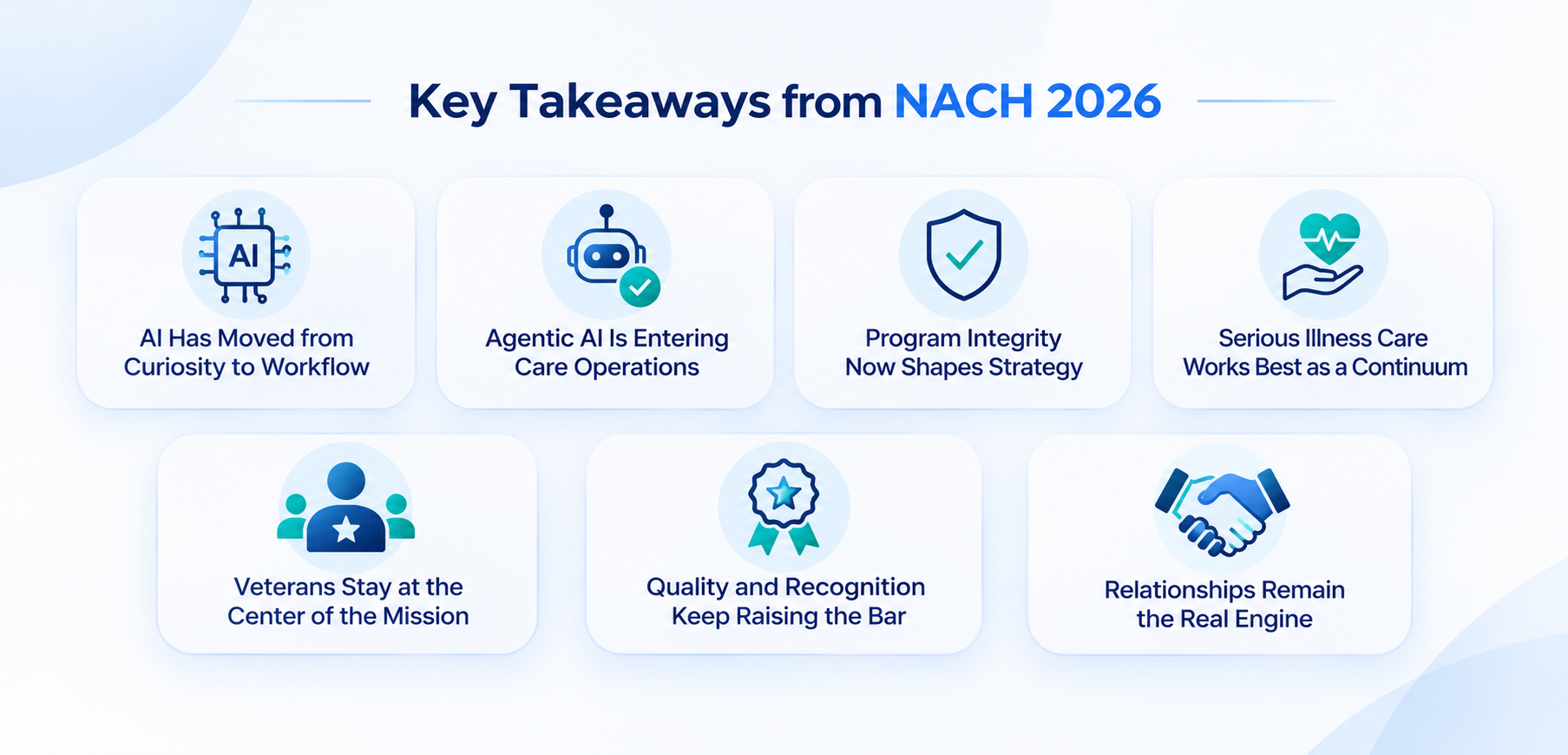
The takeaways below pull those threads into seven points leaders can act on, followed by the questions the industry is still asking.
Key Takeaways from NACH 2026
1. AI Has Moved from Curiosity to Workflow
The AI conversation got specific this year. Leaders talked about automating eligibility verification, authorizations and coordination of benefits, the repetitive checks that eat clinical and administrative hours. The promise is simple. Take administrative burden off the team, and clinicians spend more time with patients.
Data decides how far any of this goes. Plenty of hospice AI projects fail without data readiness, because a model can only work with what the EMR, billing and referral systems hand it. Clean, connected data comes first. The tools follow.
Where to start
Pick one administrative workflow, set a baseline and measure time saved per case. A narrow pilot teaches more than a broad rollout.
2. Agentic AI Is Entering Care Operations
Agentic AI, meaning systems that can learn, make decisions and act on routine tasks, drew serious attention. The appeal for home care and hospice is plain. Staffing is tight everywhere, and software that works alongside care teams can take on intake work such as eligibility verification and prior authorization, and support scheduling. Our strategic framework for agentic AI in home care operations is a good place to see where it fits.
3. Program Integrity Now Shapes Strategy
Federal policy was the loudest topic in the building. CMS used its panel time to discuss the nationwide enrollment moratorium for hospices and home health agencies. So far, 250 home health agencies and 50 hospices have been blocked from enrolling, and any extension has to run in six-month periods.
CMS is weighing geographic limits and a “gold card” for providers with strong compliance records, and it acknowledges that some compliant providers get caught in the net, even if most are untangled. The Alliance backs the fight against fraud and calls the nationwide pause overly broad, with a real risk of care gaps in rural areas where home health access is already tight. Home Health Care News covers the panel for the full details.
What this means for compliant agencies
Expect closer attention to documentation, ownership and billing patterns. Agencies with clean, consistent records should find reviews easier. Those without them will feel the pressure first.
4. Serious Illness Care Works Best as a Continuum
Home health, specialty palliative care and hospice deliver the most when they operate as one continuum. Specialty palliative care bridges the gap before hospice, so patients get support earlier and families know what comes next. The same thinking extends to pediatric care, where children with medical complexities and their caregivers need support that spans programs.
5. Veterans Stay at the Center of the Mission
Honoring veterans ran through the week, from the recognition ceremony at the Alliance Foundation Gala to the keynotes and education sessions.
6. Quality and Recognition Keep Raising the Bar
Quality standards and recognition for end-of-life care shared the agenda with technology. A newly introduced award for excellence in end-of-life care, accreditation conversations and a closing look at the history of home care all pointed the same way: the workforce carries the load, and excellence deserves to be measured and celebrated.
7. Relationships Remain the Real Engine
Between sessions, leaders traded notes over dinners, receptions and breakfasts, and first-time attendees joined the conversation alongside long-time members. Collaboration across home health, hospice, palliative care and technology teams was a recurring theme in attendee recaps, and Seattle in 2027 is already on many calendars.
Questions Leaders Are Asking After NACH 2026
How will AI change eligibility and authorization work in home care and hospice?
It will take over the repetitive checks first. Eligibility verification, authorizations and coordination of benefits all follow defined rules, which makes them natural candidates for automation. Clinical judgment stays with the care team. The goal is to hand clinicians back the hours that paperwork now consumes.
How should agencies prepare for audits while program integrity pressure builds?
Start with documentation quality. Notes that read well can still miss what a reviewer needs. Our look at AI documentation that looks perfect and still fails a hospice audit digs into why polished documentation can still fail a review, and what compliance-first documentation requires.
How can home health, palliative care and hospice work as one continuum?
Build shared referral pathways and clear handoffs, then share the data behind them. Specialty palliative care works as a bridge before hospice, and that bridge only holds when each program can see the same patient story.
What Hospice and Home Health Leaders Should Do Next
- Check the data foundation. Map where eligibility, referral, clinical and billing data live, and fix the obvious gaps before buying any AI tool.
- Pilot one administrative workflow. Pick eligibility verification or prior authorization, set a baseline, and measure time saved per case.
- Tighten documentation and ownership records. Assume a closer look is coming and make clean records the default.
- Strengthen continuum partnerships. Agree on referral criteria and handoff steps with palliative, home health and hospice partners.
Inferenz helps hospice and palliative care organizations unify scattered data and add AI agents for referral intake, eligibility screening and audit readiness.
Summary: NACH 2026 in Seven Points
- AI moved from curiosity to workflow, starting with eligibility, authorizations and coordination of benefits.
- Agentic AI is entering care operations, and data readiness decides how far it goes.
- CMS’s enrollment moratorium and the Alliance’s response kept program integrity high on the agenda.
- Serious illness care works best as a continuum across home health, palliative care and hospice.
- Veterans, quality and recognition keep the mission visible.
- Relationships across the sector remain the engine of progress.
- The next step for most leaders is one focused pilot on a clean data foundation.
Final Thoughts
NACH 2026 showed an industry holding two truths at once. Scrutiny is rising, and so is the promise of technology that gives clinicians their time back. The leaders who come out ahead will pick a few moves, fix their data, and keep the patient at the center. That list is a good place to start.