












Summary
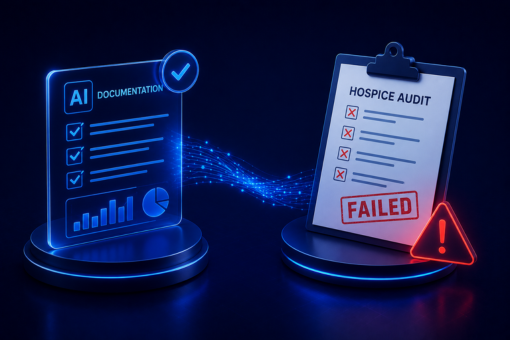
Most AI clinical documentation tools produce hospice notes that read well and fail audits. Generic AI was never built to reason through jurisdiction-specific Local Coverage Determinations or the clinical-regulatory logic Medicare Administrative Contractors actually use.
This article breaks down why that gap exists and what compliance-first documentation actually needs.

Introduction
A hospice nurse wraps up a home visit at 9pm. She is exhausted, the family is anxious, and she still has to finish tonight’s note before tomorrow’s IDT meeting. She opens the AI-generated draft. Clean sentences, professional tone, not a typo in sight. She signs off and moves on.
Six months later, that exact note comes back flagged in a Targeted Probe and Educate (TPE) audit.
The prose was fine. The compliance case was not there.
The note never established, in language a Medicare Administrative Contractor (MAC) could point to, why this specific patient is expected to have six months or less to live. That is not a formatting problem. That is a fundamental misunderstanding of what AI clinical documentation for hospice requires to be defensible.
This is not an isolated case. It is the pattern.
Why general AI clinical documentation tools cannot handle hospice compliance
Hospice News recently reported that hospice leaders across the country are converging on the same finding: most AI documentation tools were built for home health broadly, not hospice specifically.
They do not understand:
- Local Coverage Determination (LCD) criteria and how they vary by jurisdiction
- The clinical logic separating a hospice recertification narrative that is well-written from one that is genuinely audit-ready
- The comparative decline language CMS reviewers are trained to look for
- What the new HOPE quality-reporting framework expects in terms of person-centred nuance
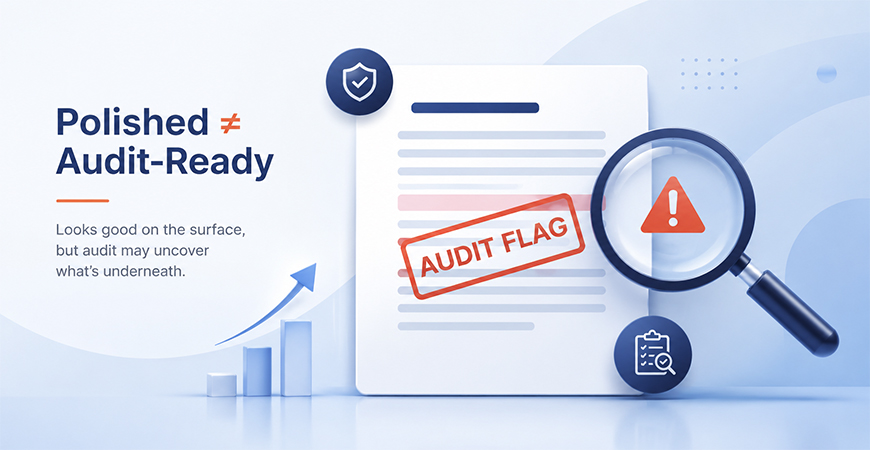
One of the hospice CEOs summarized it directly: general AI models can produce narratives that are clinically polished and still fail an audit, because polish and compliance are not the same thing.
More than half of hospices nationwide are already managing multiple simultaneous audits. TPE audit rates keep climbing. This is not a hypothetical risk for future planning. It is an operational reality for most hospice organizations today.
The LCD problem no one is talking about
Here is what makes AI clinical documentation for hospice harder than it looks on the surface level.
Medicare hospice eligibility is not governed by a single national standard. Despite being a federal benefit, terminal-status criteria are published as jurisdiction-specific LCDs, written separately by three different Medicare Administrative Contractors:
- CGS
- NGS
- Palmetto GBA
These three MACs use different logic:
- CGS and NGS diverge substantively on ALS and renal disease, applying different lab thresholds and different qualifying criteria other than terminology.
- Palmetto GBA abandons the itemized-checklist approach entirely for five of its seven disease categories, replacing it with a narrative “structural and functional impairment” standard that carries no numeric thresholds at all
A generic AI model trained on general clinical notes has no mechanism for knowing which of these three regulatory regimes governs the patient in front of it, let alone applying the right one correctly.
The result is documentation that may satisfy one MAC’s expectations while failing another’s entirely, with no warning to the clinician who signed off on it.
What compliance-first hospice AI needs?
The fix for a compliance-first hospice AI is not a larger language model. It is a system built from the regulation outward, not from the sentence inward.
A documentation tool built for hospice compliance needs to do four things that most general AI tools currently do not:
- Resolve jurisdiction before screening begins. The system must identify the patient’s state, MAC assignment, and governing LCD before it touches a single eligibility criterion.
- Walk through disease-specific pathways item by item. Required criteria and supporting criteria must be kept distinct and evaluated separately, not summarized into a generic “probably eligible” assessment.
- Distinguish between a criterion that is not met and one that is simply not yet documented. Real gaps need to surface for clinical follow-up. They should never be quietly absorbed into a narrative that reads as complete when it is not.
- Know its role in the clinical workflow. The tool screens eligibility. It does not diagnose. The physician certifies. That boundary is not optional, and it cannot be designed around.
These are not feature requests. They are the minimum viable architecture for AI clinical documentation in hospice that can withstand a TPE audit or a Comprehensive Error Rate Testing (CERT) review.
How Caregence approaches AI Clinical Documentation for hospice
The Caregence clinical documentation AI engine was designed around the compliance logic described above. It is not a general documentation tool adapted for hospice. It is built from the regulatory structure outward.
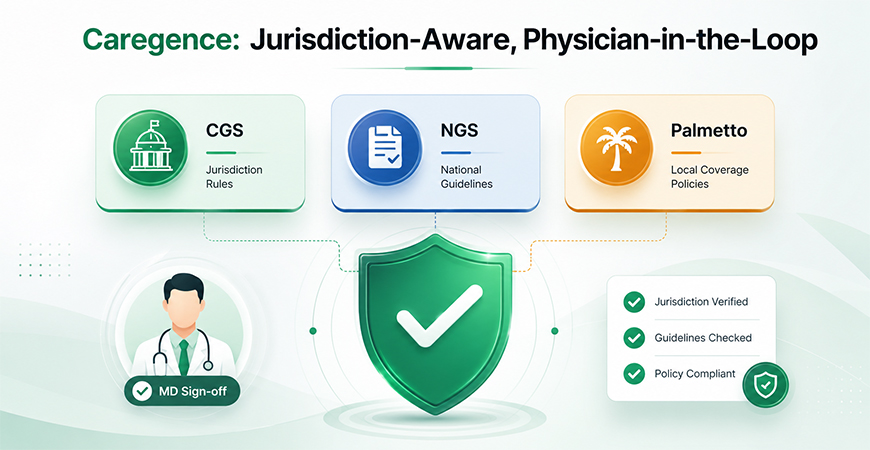
Here is how it works in practice:
- Jurisdiction resolution first. Before screening begins, Caregence identifies the patient’s state, MAC assignment, and the specific LCD that governs their diagnosis. An ALS or renal patient in an NGS jurisdiction is measured against NGS thresholds, not CGS’s or Palmetto’s.
- Disease-specific pathway screening. The system works through each diagnosis pathway the way a compliance-minded clinician would: required criteria evaluated separately from supporting criteria, documentation gaps flagged explicitly rather than inferred around.
- Certification-ready narrative output. A completed screen translates directly into narrative language built around the “paint a picture with evidence” standard that CMS reviewers and MACs are trained to apply. The documentation is defensible, not just readable.
- Physician certification remains the physician’s call. The system supports the clinical and compliance case. It does not make the determination. That boundary is architectural, not a disclaimer.
If your current AI clinical documentation tool can produce a well-structured note but cannot tell you which LCD it screened against, it is not a compliance tool. It is a drafting tool. In a benefit this audit-heavy, that distinction carries real financial and regulatory risk.
What this means for hospice organizations right now
The hospice sector is operating in an environment where audit pressure is structural, not cyclical.
TPE rates are climbing. The HOPE framework is adding new quality-reporting requirements. Payers are scrutinizing hospice recertification narratives more carefully than at any prior point. And the cost of a failed audit is not just the recoupment. It is the retrospective review that follows, the staff hours consumed by response documentation, and the referral relationships that erode when a provider’s compliance record comes into question.
The organizations that will navigate this environment most effectively are not the ones with the most advanced general AI tools. They are the ones whose AI understands:
- Which MAC governs each patient
- Which hospice LCD applies to each diagnosis
- What the difference is between a well-written note and an audit-ready one
- Where the documentation gaps are before the auditor finds them
That is bar you need to set for AI implementations.