








Summary
Databricks Data + AI Summit 2026 was not a feature release, but a declaration. The Lakehouse is no longer just where enterprises store and query data. It is where agents do the job for your business. Here is what changed, what it means, and why it matters now.
Introduction
Every year, the tech industry produces a hundred summits that announce things.
Databricks Data and AI Summit 2026 (DAIS) was different.
What Databricks put on the table in San Francisco this June was an architectural argument about where enterprise AI is actually headed, and it landed with the kind of coherence that makes you reconsider how you have been thinking about your data stack.
The theme, if you had to name it, was this: the Lakehouse is now the control plane for the agentic enterprise. Not just a place to store data. The place where agents govern, reason, act, and get held accountable for what they do.
For Inferenz, a Databricks partner building agentic AI solutions in healthcare and enterprise, several of these announcements land directly in the infrastructure we build on and deploy for clients.
Here is our read on what mattered most and what you should actually do about it.
The context problem is finally being taken seriously
If you have ever deployed an AI model and watched it produce a confidently wrong answer, you already know the core problem DAIS 2026 addressed.
It is not model quality. It is context.
As Ali Ghodsi, founder and CEO of Databricks put it during the keynote: “Most enterprise AI today is just guessing with false confidence. If you’re a CFO and AI can’t tell you why margins changed, that’s not an AI problem. That’s a context problem.”
Genie Ontology is Databricks’s answer to that. It is a live context layer that continuously reads your data, documents, queries, and applications to build a machine-readable map of what your business actually means by its own terms.
- What does “active user” mean in your system?
- What is your definition of “churn”?
- When did your ARR calculation change, and why?
This is not a static data dictionary someone fills in once and forgets. Genie Ontology updates continuously, weighs sources by authority (similar to how PageRank works), and feeds that knowledge directly into Unity Catalog’s semantic layer.
The downstream effect: every agent, every dashboard, and every AI-generated report pulls from one shared, authoritative understanding of your business rather than each making its own guesses.
The company with the best context layer will have a larger AI advantage than the company with the most data. That sentence from the Bain team covering the summit deserves to sit with you for a moment.
Genie One: an AI coworker that actually knows your business
Genie One is now generally available, and it is a significant step past what most enterprise AI assistants can actually do.
- It connects to over 50 applications, including Gmail, Slack, Teams, Jira, and Confluence.
- It can answer questions grounded in your actual governed lakehouse data, draft documents, schedule tasks, monitor changes, and explain why something happened.
- On a benchmark of 28 real-world enterprise data questions, Genie answered 84.5% correctly on the first attempt. The best general-purpose coding agent on the same test scored 52.4%.
The difference is the ontology layer underneath. Genie is not searching documents. It is reasoning against a live, governed representation of your business. That is what separates a useful answer from a plausible one.
For enterprise teams evaluating where to start with agentic AI, Genie One is the fastest path to ROI for non-technical business users. No seat-based pricing, either. Each user gets 150 DBUs of free LLM usage per month, with pay-as-you-go beyond that.
LTAP: Forty years of infrastructure debt, addressed
Here is a problem most enterprises have accepted as permanent: your transactional systems and your analytical systems have always been two separate things. Separate databases, separate formats, ETL pipelines running between them, two slightly different copies of the same data that never quite agreed.
LTAP (Lake Transactional/Analytical Processing) changes that.
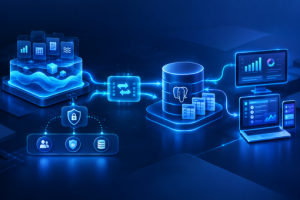
The mechanics: Lakebase, Databricks’s serverless PostgreSQL database (now at 12 million launches per day), stores transactional data directly in Unity Catalog using Delta and Iceberg formats.
No ETL. No sync. Hidden copies disappear. Every analytical engine reads the same governed file.
For AI agents, this is foundational. An agent that needs to read a customer’s live order history and then run six months of purchasing analysis currently must query two systems and reconcile two copies of data. With LTAP, there is one copy, one governance layer, and one point of truth.
New Lakebase capabilities at the summit:
- cross-cloud disaster recovery
- git-style database branching (spin up a full-fidelity clone of production in sub-seconds for safe testing), and
- Lakebase Search, which brings hybrid vector and full-text retrieval natively into PostGRES.
Lakehouse//RT, powered by a new engine called Reyden, rounds this out with sub-100ms query latency at 12,000 queries per second directly on Delta and Iceberg tables. PointClickCare’s benchmarks showed it running more than a third faster than their prior warehouse, on their own healthcare dataset, without a separate serving system.
Agent Bricks: The platform that does the other 99%
Building an AI agent is not hard anymore. The hard part is everything else.
Memory across sessions. Security when agents execute code. Cost management when agents run at scale. Evaluation. Monitoring. Governance of what they can access. That is the 99% of engineering work that does not show up in demos but determines whether your deployment works in production.
Agent Bricks is now a full-stack platform for exactly that. Over 100,000 agents have been built on it. AstraZeneca, 7-Eleven, Fox, and Block all run production agents on Agent Bricks. The 2026 expansion added:
- Managed agent memory powered by Lakebase, persistent across sessions
- MCP-connected retrieval from Unity Catalog and external tools like GitHub, Jira, and Google Drive
- Secure sandboxed compute environments for code execution
- Multi-model support: OpenAI, Anthropic, Gemini, Qwen, Grok, all governed under Unity Catalog
- Omnigent, a meta-orchestration layer for managing agents across different frameworks, models, and tools when your stack is not monolithic
For teams building with Claude Code SDK, LangGraph, CrewAI, or OpenAI Agent SDKs, Omnigent is the layer that lets these coexist under one governance model instead of sprawling across disconnected stacks.
Databricks also moved five products into the free tier: Genie Code, Serverless GPUs, Lakebase, Agent Bricks, and Lakeflow Designer. You can now prototype an entire agentic application from data pipeline to agent logic to served endpoint without spending anything.
Unity AI Gateway: Governance that happens at runtime
This is the announcement that regulated industries have been waiting for.
Traditional AI governance asked: who can access which data, which model is approved? That works for humans. It breaks down for agents that act autonomously, spawn subagents, call external tools, and generate outputs at volume.
Unity AI Gateway governs what agents actually do at the moment they do it.
- Hard spend caps.
- Real-time PII detection.
- Prompt injection prevention.
- Full trace capture of every tool call, MCP interaction, and subagent action.
- Security policies written in SQL that respond to agent behavior in context, not just static rules applied at the edge.
At Inferenz, our work in healthcare AI has always required governance to be a first-class concern. What Unity AI Gateway represents is exactly the infrastructure required to move agentic AI from pilot deployments into production clinical environments.
We cover this in more depth through our Generative and Agentic AI services and the governance architecture that underpins our Caregence platform.
OpenSharing: Open standards win again!
Databricks launched Delta Sharing in 2021 to solve cross-organizational data sharing without copying files. It became the most widely adopted open data-sharing protocol in the industry.
OpenSharing extends that logic to the full AI stack. Data, models, agent skills, and Genie Agents can now be shared across organizations and clouds via a single Linux Foundation-hosted open protocol.
The practical enterprise use case is Genie Agent Sharing: share a governed AI interface with a partner or customer, giving them curated access to your data and reasoning capabilities without exposing your underlying logic, proprietary calculations, or source tables. You control what they can ask, how much data they can export, and how many requests they can make.
SecureConnect removes the networking headache: cross-cloud storage connections without per-recipient firewall configuration.
What this means for Inferenz clients
Inferenz is a Databricks partner. We build on this platform. Several of the Databricks summit announcements directly expand what we can deliver:
- Genie Ontology strengthens the semantic layer that our healthcare clients need for AI to reason correctly about clinical terms, payer rules, and care metrics without every agent reinventing the definition.
- Lakebase and LTAP close the gap between transactional care data and the analytical models that power Caregence predictive risk intelligence. Patient records that update in real time can now feed directly into risk models without ETL delays.
- Agent Bricks governance and Unity AI Gateway provide the runtime controls our healthcare deployments require. HIPAA-compliant agentic AI is not just a compliance checkbox. It is an architecture. These capabilities make that architecture standard rather than custom-built for every engagement.
For enterprise clients working on data and cloud modernization or evaluating where agentic AI fits in their stack, the LTAP architecture eliminates an entire tier of infrastructure that was previously unavoidable. One governed copy of data, one permission model, one source of truth for both operational and analytical AI.
Five things worth acting on now
Most enterprises left the summit with a list of things to watch. These five are worth starting this quarter.
Define your semantic layer before your agents do it for you.
Genie Ontology is only as good as what Unity Catalog already knows. If your organization has never agreed on what “revenue” or “active user” officially means, that conversation is now blocking your AI roadmap.
Consolidate your database tier.
Running a separate operational database alongside Databricks? Lakebase and LTAP give you a clear path to one governed system. The git-style branching alone makes the evaluation worth an afternoon.
Audit your agent governance.
Most AI pilots have no runtime enforcement. If your governance stops at the data catalog, it is not governance. Unity AI Gateway fixes that, but only if you implement it.
Prototype on Agent Bricks before building custom.
Lakebase, Agent Bricks, and Serverless GPUs are all free tier now. There is no budget justification for building a custom agentic stack before you have tested what is already there.
Treat context as a strategic asset.
The next AI advantage will not come from model selection. It will come from the organization whose agents have the clearest, most authoritative understanding of what the business means. That is a semantic architecture decision, not a procurement one.
Final thought
The debate in enterprise AI used to be about which model to choose. DAIS 2026 made clear that this was always the wrong question.
The model is not the constraint. The architecture around it is.
Context, governance, live data, and runtime control are the infrastructure that determines whether your AI delivers or stalls. Databricks built a year’s worth of announcements around exactly those four things.
For enterprises that have been waiting for the infrastructure to catch up to the ambition, it just did.