







Summary
A single patient view gives each home health patient one verified identity across the EHR, EVV, scheduling, billing and CRM systems. This guide shows home health CXOs how an enterprise master patient index (EMPI) resolves duplicate records, the seven steps to build the view, and the metrics that prove it works.
Introduction
Home health now runs on more software than any one team can see at once. A referral lands in a CRM, the clinical record lives in an EHR, visits are verified in an EVV platform and claims move through a billing system, and each of them issues its own patient ID. When those IDs disagree, patients answer the same intake questions twice. Referring physicians receive two versions of the same status. Care plans lag behind what clinicians already know.
A compliance clock is sharpening the problem. For start-of-care dates on or after January 1, 2027, CMS intends to count OASIS data from patients who are neither Medicare nor Medicaid beneficiaries toward the annual payment update, so assessments from every payer will need to sit on the right chart.
Identity is the first layer of any single source of truth across EHR, EVV, billing and CRM, because reporting, scheduling, billing and AI all inherit whatever the patient record says. This guide covers what a single patient view contains, why records split, how matching works, a seven-step build plan and the metrics that show the work is paying off.
What Does a Single Patient View Include in Home Health?
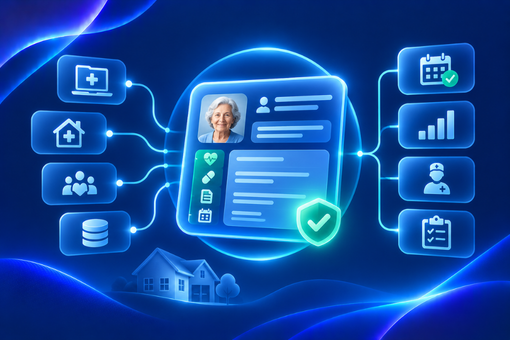
A single patient view in home health combines identity, clinical, scheduling, financial and referral data for one person, all keyed to a single enterprise ID. That ID sits above the local IDs, so each system keeps its own record while a live crosswalk ties them together.
| Source system | What it holds | Local identifier | Common identity problem |
| EHR or EMR | Orders, OASIS assessments, visit notes, medications | Medical record number | Duplicate charts from registration typos |
| EVV | Visit start and end, location, service type | Medicaid or payer ID | ID formats that differ from the EHR |
| Scheduling | Assigned clinician, visit frequency, cancellations | Internal client or episode number | Client records recreated after reassignment |
| Billing and RCM | Claims, authorizations, remittances | Account number and payer IDs | Several payer IDs for one patient |
| CRM and referral | Referral source, intake status, conversion | Lead or referral ID | Record created before an MRN exists |
A mature view also pulls in telehealth, remote monitoring and workforce data, then lays everything on one timeline from referral to discharge. That timeline is the Patient 360 layer, and it attaches to the right person only because identity was resolved first.
Why Do Home Health Systems End Up With Duplicate and Fragmented Patient Records?
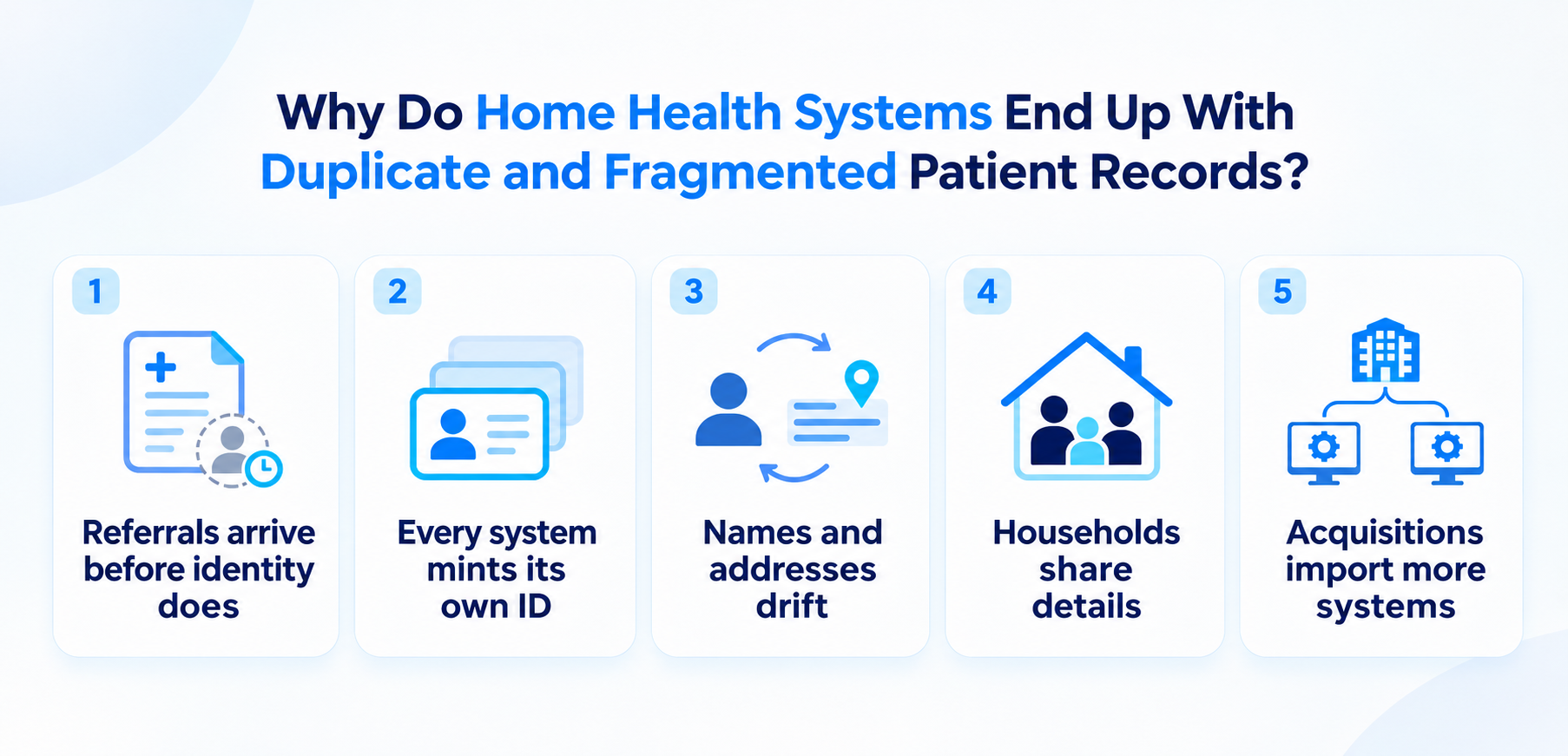
Duplicate medical records form when systems create patients independently, with no shared identifier and no matching check at registration. Home health adds five twists of its own.
- Referrals arrive before identity does. CRM and intake records start life before an MRN exists, so the first version of a patient often carries partial demographics.
- Every system mints its own ID. The EHR, EVV platform, scheduler and billing tool each issue a number, and nobody owns the crosswalk between them.
- Names and addresses drift. Nicknames, maiden names, hyphenated surnames, typos and a patient who winters in another state all create near-matches.
- Households share details. Spouses, siblings and twins can share an address, a phone number or a birth year, which makes lookalike records risky to merge.
- Acquisitions import more systems. Each acquired agency arrives with its own EMR and its own version of the same patients.
Small gaps do most of the damage. In a 2026 JAMIA study that matched patients shared between UCLA Health and Cedars-Sinai, the most common reason a rule-based EHR module missed true matches was a Social Security number it didn’t use. Other causes included misspelled names, middle-name differences, compound surnames and mismatched phone numbers, emails or addresses.
What Does a Fragmented Patient Record Cost?
A fragmented patient record costs safety, time and revenue, and 2026 research now ties duplicate charts to measurably worse outcomes.
A February 2026 study in BMJ Quality & Safety compared 1,698 hospitalized adults who had duplicate charts with 4,388 patients who had a single chart, across 12 hospitals in one US health system. In-hospital death occurred in 11% of the first group and 2.5% of the second. After adjustment, patients with duplicate charts were almost five times as likely to die in hospital and 3.5 times as likely to need intensive care.
The design is observational, so it shows an association and can’t prove cause, and the data come from a single health system. The release describes duplicate-record prevalence as thought to be between 5% and 10%. The cohort was hospital inpatients and didn’t include home health patients, yet the mechanism travels. When a clinician can’t see allergies, medications or history, decisions get made on partial information.
In home health, the cost lands on every desk in the C-suite.
| Who feels it | Where fragmented identity shows up |
| CEO and board | Census, referral and growth figures that count the same patient more than once |
| COO | Repeated intake questions, delayed starts of care and schedules built on a partial history |
| Chief clinical or nursing officer | Clinician time lost hunting across charts, and a higher chance of acting on an incomplete history |
| CFO | Claims that can be held or denied when patient details differ across EVV, authorization and billing records |
| Compliance officer | OASIS assessments split across duplicate charts, with non-Medicare, non-Medicaid OASIS data counting toward the annual payment update from January 1, 2027 |
| CIO or chief data officer | Every integration, dashboard and AI pilot inherits the duplicates underneath it |
| Referral partners | Conflicting status updates and unclear ownership of orders |
What Is an Enterprise Master Patient Index, and How Does It Build One Record?
An enterprise master patient index (EMPI) is the identity layer that matches records across every system an organization runs and assigns each person one persistent enterprise ID. A basic master patient index (MPI) does that inside a single application. An EMPI does it across the EHR, EVV, billing and CRM, and keeps a live crosswalk back to every local ID.
The work runs in five stages, and the order matters:
- Feeds from every source that touches a patient land in one governed place.
- Names, dates of birth and addresses are parsed into one format, using FHIR where it exists and HL7 where it must.
- Records are matched, merged and governed, and the enterprise ID and crosswalk are created.
- Quality checks, gaps-in-care flags and risk signals attach to the unified record.
- Dashboards, assistants and agents read the resolved identity.
Skip ahead and you get confident answers about the wrong person. A risk score built on a fractured record scores a fragment.
How Does Patient Matching Work, and Which Method Fits Home Health?
Patient matching uses deterministic, probabilistic or referential methods, and mature programs combine at least two of them.
| Method | How it decides | Strength | Watch-out |
| Deterministic | Exact agreement on defined fields such as name and date of birth | Fast and easy to explain | Misses true matches when a name is misspelled or has changed |
| Probabilistic | Weighted likelihood from partial agreement across many fields | Catches typos, nicknames and formatting gaps | Needs tuned thresholds and review of the middle band |
| Referential | Comparison against a continuously updated third-party identity database | Adds context your own data lacks | Only as good as the reference source’s coverage |
Thresholds set the trade-off between catching every true match and avoiding wrong ones. In the JAMIA study, a widely used rule-based EHR module matched with 99.6% precision and a recall of 61.5%. A machine-learning linkage tool at a balanced threshold held precision at 99.4% and lifted recall to 92.2%. At its strictest setting it reached 100% precision with only 30.6% recall. The study matched patients across two health systems, so your within-agency numbers will differ, but the swing shows why the threshold deserves a deliberate decision.
For merges that change a clinical chart, favor precision. Send the uncertain middle band to a named data steward and keep every merge reversible. A wrong merge, called an overlay, carries more risk than a missed match because the combined chart looks complete and trustworthy.

How Do You Create a Single Patient View, Step by Step?
Creating a single patient view takes seven steps: inventory every system, baseline your duplicate rate, standardize registration data, integrate the feeds, match and assign enterprise IDs, sync those IDs back, and govern the result. Steps one to four are patient data integration groundwork. Steps five to seven turn that groundwork into one identity.
- Inventory every place a patient lives. List each system, its patient identifier, its owner and how data reaches it. Count the spreadsheets too.
- Baseline your duplicate and overlay rates. Define the numerator and denominator once, then measure by system and by registration source. Without a baseline you can’t show progress.
- Standardize demographics at the source. Split names into parts, force one date format, normalize addresses and add required-field checks at referral and intake entry.
- Integrate the feeds into one governed layer. Build pipelines from the EHR, EVV, scheduling, billing and CRM into a shared platform, using data engineering and integration practices that put quality checks inside every run.
- Match, merge and assign the enterprise ID. Combine deterministic and probabilistic rules, auto-link above a high threshold, review the middle band and log every decision.
- Publish the crosswalk and sync IDs back. Each source keeps its local ID and gains the enterprise ID, so a billing query and an EVV query resolve to the same person. Run the match check at registration, in real time, so duplicates never get created.
- Govern and monitor. Name a data steward, record every match, merge and override, and review the rates monthly.
Where the resolved identity lives shapes cost and time to value, so settle whether the identity belongs in the EHR, a data warehouse or a broader data platform before step four.
What Should You Do About Patient Identity After an Acquisition?
After an acquisition, resolve patient identity first, because every merged report and integrated workflow downstream inherits whatever duplicates the deal imports.
Inferenz applied that approach in a national home care provider’s data platform that unified more than 40 source systems. According to the case study, an AI-powered de-duplication layer created a single golden record per patient and caregiver across every EMR, and a standardized onboarding framework brought each acquired entity to analytics-ready within 8 to 10 weeks.
Three habits make it repeatable. Profile the acquired agency’s records before cutover. Run matching against your existing enterprise IDs on day one. Keep a crosswalk so legacy IDs stay traceable after the old system retires.
Sequencing the wider merge of systems is a project of its own, and the same identity-first logic carries through data integration after an acquisition.
How Do You Govern a Single Patient View Without Creating New Risk?
Governing a single patient view means giving every match, merge and override a named owner, a logged reason and a way to undo it. Good patient identity management borrows its controls from a data quality, governance and compliance program: stewardship roles, automated quality checks, lineage and audit-ready traceability that supports HIPAA reviews. Four rules keep the view safe:
- The engine proposes and a named data steward decides.
- Every merge stays reversible.
- Protected health information stays inside your own infrastructure boundary.
- Each decision is logged with the score and rule behind it.
Governance also needs an owner at the top. Name one executive sponsor, usually the CIO or COO. Give day-to-day decisions to a data steward who sits close to intake and medical records. Agree with the CFO and the compliance lead which identity metrics reach the board each quarter.
History matters as much as the current record. A national disability services provider built a master hub with a Data Vault layer that preserves full change history for every mentor record. That lets it reconstruct what any record looked like at a given point in time during compliance reviews.
Which Metrics Show a Single Patient View Is Working?
Seven metrics show whether a single patient view is working, and each one can start from a baseline you measure in the first month.
| Metric | What it shows | How to calculate |
| Duplicate patient rate | How often one person holds more than one record | Duplicate records divided by unique patients, by system |
| Overlay rate | How often one record mixes two people | Confirmed overlays divided by records reviewed |
| Match rate at registration | How often a new record links to an existing identity | Registrations linked to an enterprise ID divided by all registrations |
| Steward review backlog | Whether the uncertain middle band is being cleared | Open review items and median days to resolve |
| Cross-system ID agreement | Whether EVV, billing and EHR resolve to the same person | Sampled visits where all three systems return the same enterprise ID |
| Manual merge hours | Staff time spent fixing identity by hand | Hours per month, tracked by team |
| Identity-related claim holds | Revenue delayed by patient detail mismatches | Claims held or denied for demographic mismatch divided by total claims |
Set targets after you’ve measured the baseline. The MATCH IT Act proposal discussed below floats a 90% match rate as the threshold for a voluntary Medicare bonus, so knowing your own number puts you ahead of that conversation.
What Can AI Agents Do Once Every System Agrees on Who the Patient Is?
AI agents and analytics become reliable once every system agrees on who the patient is, since each score, answer or action inherits the identity underneath it.
Caregence is Inferenz’s agentic AI platform for healthcare, where an organization’s own teams build agents and workflows with drag and drop. It connects to FHIR-enabled EHRs, payer and revenue cycle systems, CRM and MCP tools, and it reads from the organization’s own warehouse, which remains the system of record. With identity resolved first, each of those agents reads one correct chart.
Referral intake, OASIS documentation review, visit scheduling and readmission risk flagging are typical home health workflows for agents, and each one breaks when two charts describe the same patient.
Identity is also the first of five readiness gates in Inferenz’s post-acute care AI readiness playbook. The playbook calls it “one patient, one record” and names duplicate patient rate as the starter KPI.
Is a National Patient Matching Standard Coming?
Congress is considering a national patient matching standard, and it isn’t law yet.
On August 5, 2026, Senators Mark Warner and Jim Banks introduced the bipartisan MATCH IT Act (S. 5246), formally the Patient Matching and Transparency in Certified Health IT Act of 2026. The bill would direct HHS to develop uniform data standards for patient matching, including a minimum data set to support a 99.9% match rate, and require certified EHR technology to adopt them. It would also create an anonymous, voluntary system to measure match rates across the industry and offer a voluntary Medicare bonus to providers that reach a 90% match rate. AHIMA, CHIME and HIMSS are among its endorsers, and the bill has been referred to the Senate Committee on Health, Education, Labor, and Pensions.
Whatever happens on Capitol Hill, an organization that already measures its match rate and standardizes registration data is ready for either outcome. The bill’s requirements would attach to certified EHR technology, so it’s also worth asking your EHR vendors how they would meet a national matching standard.
Where to Start
Every connected workflow in home health rests on one quiet question: is this the same person? Answer it once, in one governed place, and billing, scheduling, reporting and AI all get easier at the same time.
Start small. Pick two systems, measure the duplicate rate between them and run the match logic on that pair. The results will show how much cleanup sits behind the rest of your stack, and they’ll make the case for the build better than any slide deck. Then take the baseline to your next leadership meeting and ask which executive owns the number.