













Summary
An EHR runs care delivery and billing, a data warehouse joins EMR, EVV, finance and CRM data for trusted reporting, and a data platform adds lakehouse flexibility for unstructured data and AI. Most home health organizations running more than one EMR should start with a governed warehouse built in bronze, silver and gold layers. Extend it into a full platform when AI use cases and data variety justify the cost.
Introduction
The EHR vs data warehouse vs data platform question now decides how quickly a home health organization can see a patient’s full story. When clinical, scheduling and billing data sit in separate systems, referrals stall, physicians wait for answers and readmission risk shows up late. The right data foundation closes that gap before it reaches the patient.
This guide sits inside our wider series on creating a single source of truth across EHR, EVV, billing and CRM. It answers the question every CIO in that series eventually faces: which layer of the stack should carry reporting, analytics and AI?
What is the difference between an EHR, a data warehouse and a data platform?
An EHR is the system of record for care delivery, a data warehouse is the system of insight that joins structured data from many sources for reporting, and a data platform is the broader foundation that stores, governs and serves every kind of data, including the data that feeds AI.
Think of it as three jobs. The EHR (home health teams say EMR just as often) records the visit, the OASIS assessment, the orders and the claim. The warehouse answers questions that cross systems. The platform keeps raw material, curated tables and governance in one place so analytics and AI draw from the same facts. Our guide to EHR and EMR platforms for home care, home health and hospice covers how vendors differ on that first job.
| Dimension | EHR / EMR | Data warehouse | Data platform (lakehouse) |
| Core job | Record care, orders, OASIS and claims for one agency or instance | Combine structured data from many sources for reporting and BI | Store, govern and serve structured and unstructured data for BI, ML and AI |
| Workload type | Transactions (OLTP) | Analytical queries (OLAP) | Analytical and machine learning workloads |
| Data it holds | Charting, scheduling, referral and billing data inside one vendor | Cleaned, modeled tables from EMR, EVV, billing, payroll and CRM | Raw files, tables, notes, images, device feeds and curated tables |
| Schema approach | Vendor-defined | Schema-on-write | Schema-on-read plus curated schemas |
| Typical users | Clinicians, schedulers, billers | Analysts, finance and operations leaders | Data engineers, data scientists, analysts and AI agents |
| Time to value | Already live | Weeks to months for first dashboards | Longer to first value, then pays back as use cases multiply |
| Cost profile | Licensed through the vendor contract | Moderate: cloud compute, engineering, BI | Highest: broader tooling, skills and governance |
| Flexibility | Limited to vendor reports and exports | High for structured analytics | Highest, with more to govern |
| Best fit | One EMR, one agency, standard reports | Multi-EMR, multi-agency or acquisitive organizations | Large networks with AI roadmaps and varied data |
Relative ratings reflect Inferenz’s general guidance. Actual cost and timeline vary with scope, team and cloud contract.
Where does EMR built-in reporting run out?
EMR reporting runs out at the edge of its own database. Built-in reports answer questions about one vendor’s data, and they do it well. A question like “which referral sources lead to admissions that stay profitable and out of the hospital?” touches referral, clinical, scheduling and billing data at once. Some vendors ship a reporting module or data export, and hospital systems use vendor warehouses such as Epic’s Caboodle. Those tools model one vendor’s data. They rarely extend to the second EMR you inherit in an acquisition.
That’s the heart of the home health data visibility problem: plenty of clinical data, spread across systems that can’t see each other.
How do a clinical data repository and a data mart fit in?
A clinical data repository (CDR) holds patient-level clinical data in near real time for care teams. A data warehouse holds modelled, historical data across clinical, operational and financial domains for analysis. A CDR can feed a warehouse, and it can’t answer finance or operations questions on its own. A data mart is a subject-specific slice of the warehouse, such as quality reporting or revenue cycle, and our guide to data warehouse architecture types and best practices explains when each pattern fits.
Is our EMR’s reporting enough, or do we need a separate data warehouse?
EMR reporting is enough when one EMR holds nearly everything you report on and no acquisition is on the horizon. A data warehouse earns its cost once decisions depend on data from more than one system.
A practical threshold helps. Two or more EMRs, a pending acquisition, or a standing request to reconcile EVV visits with billed claims usually means the built-in reports have hit their ceiling. Watch for these signals:
- Leaders export to spreadsheets to rebuild the same board report every month.
- The same patient appears twice after a referral partner or acquisition brings in a second system.
- Finance and clinical teams quote different admission or visit counts.
- A newly acquired agency takes months to appear in enterprise reporting.
- AI pilots stall because nobody trusts the input data.
The 2027 rule year adds a deadline angle. CMS finalized a calendar-year reporting period for OASIS and HHCAHPS annual payment update data, and it changed assessment data submission deadlines beginning with the CY 2027 HH QRP, according to the CMS quality reporting announcement. A full year of data means a gap in any source system can surface late. A warehouse with automated quality checks flags those gaps while there’s still time to fix them.
How many EMRs justify a data platform?
As a rule of thumb, two EMRs justify a warehouse. Three or more, or a steady pace of acquisitions, justify designing that warehouse so it can grow into a platform. Every extra EMR multiplies the mapping work for visit types, code sets and identifiers, and a shared model pays that cost once. A national home care provider with more than 40 source systems built one Snowflake warehouse with a standardized acquisition onboarding framework, and the case study reports that acquired entities became analytics-ready in 8 to 10 weeks. Those figures are Inferenz-reported.
Which foundation fits your size: EHR reporting, a warehouse or a platform?
Match the foundation to your scale and your roadmap, and revisit the choice each time you add a system or an AI use case.
| Scenario | Recommended foundation | Why it fits | Watch for |
| One agency, one EMR, no acquisitions planned | EMR reporting plus a BI tool | Fastest path to dashboards at the lowest cost | Spreadsheet exports creeping back in |
| Two or three EMRs, or one acquisition in view | Governed cloud data warehouse with medallion layers | Shared definitions and one patient record across systems | Skipping identity resolution |
| Acquisitive roll-up with many source systems | Warehouse first, designed to grow into a lakehouse, with an onboarding playbook | Each new entity follows the same repeatable path | Over-building before use cases exist |
| AI roadmap with notes, images, remote monitoring or call audio | Hybrid warehouse plus lake, or a lakehouse | Holds unstructured data beside curated tables | Governance gaps and data swamp risk |
| Small data team, reporting-led roadmap | Managed warehouse using open table formats | Lower skills burden and room to grow | Hidden compute cost |
The right size is the smallest foundation that serves the decisions on your list, with a clear path to grow.
Warehouse or lakehouse: which fits a home health organization with multiple EMRs?
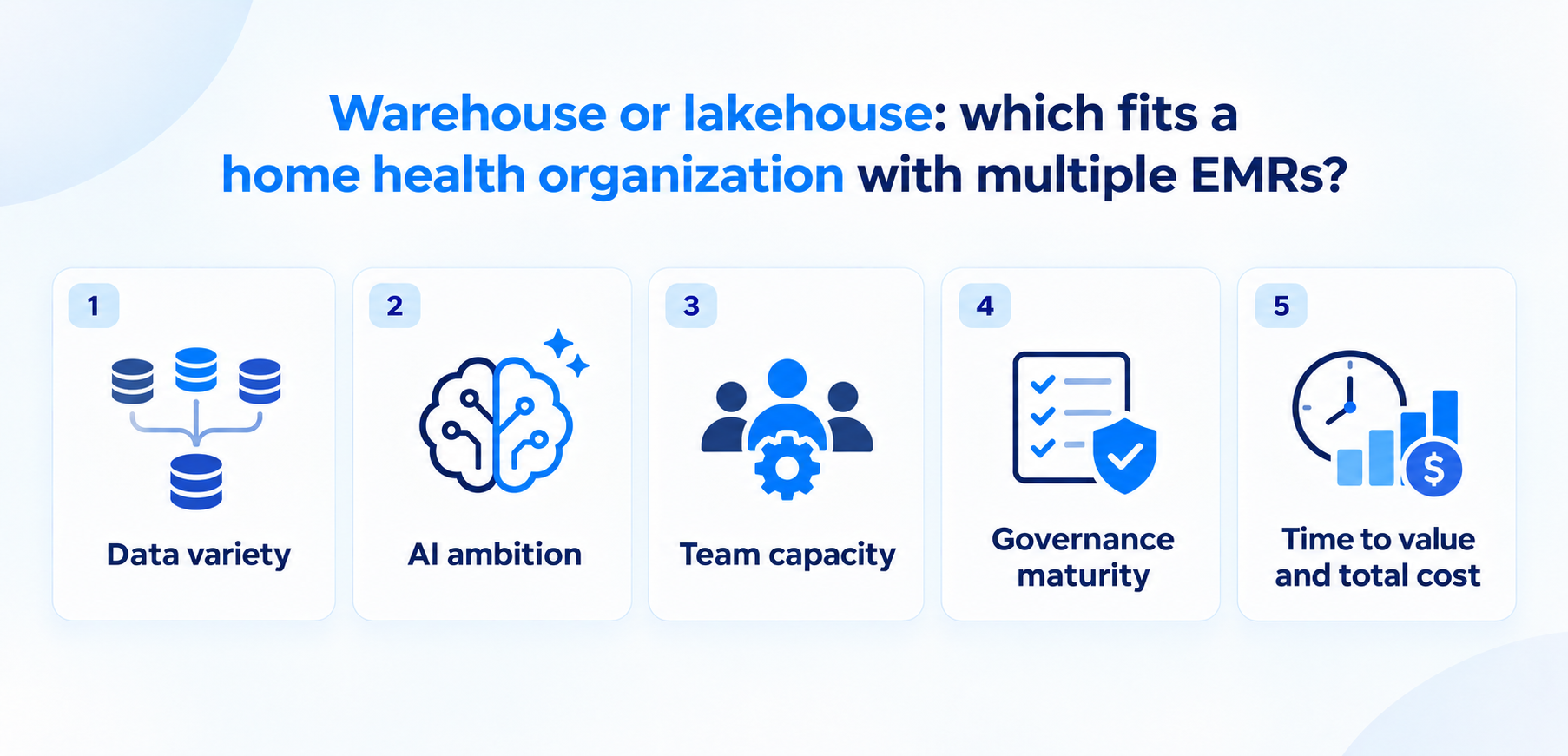
A warehouse fits structured, report-heavy needs, a lakehouse adds room for unstructured data and machine learning, and many home health organizations land on a hybrid warehouse-plus-lake design.
Five factors decide it:
- Data variety. Claims, OASIS and EVV fit a warehouse neatly. Visit notes, call audio, images and remote monitoring feeds call for lake storage.
- AI ambition. Predictive models and agents need feature tables and history, which both designs can supply. Unstructured AI inputs favor a lakehouse.
- Team capacity. A lakehouse asks for more engineering skill. A managed warehouse asks for less.
- Governance maturity. The more flexible the platform, the more discipline it needs to stay clean.
- Time to value and total cost. A warehouse usually reaches the first dashboard sooner. A lakehouse spreads its payoff across more use cases.
The engine matters less than the model. Pick the one your cloud contract and team skills already support, whether that’s Snowflake, Databricks or Microsoft Fabric. Our breakdown of data lake versus data warehouse differences on Snowflake covers the trade-offs in detail.
A warehouse applies structure when data is written (schema-on-write). A lake applies it when data is read (schema-on-read), which is flexible and harder to govern. Open table formats such as Delta and Iceberg keep data readable by more than one engine, which lowers lock-in. Data mesh suits large organizations with mature domain teams, so most home health groups begin with a central platform team and a shared model.
What does a medallion architecture look like inside a home health organization?
A medallion architecture organizes home health data into three layers, bronze for raw source data, silver for cleaned and conformed data, and gold for business-ready data products, and each layer adds trust before data moves forward.
The pattern fits home health because the problems are layer-shaped. Source systems disagree, patients get duplicated and leaders argue about definitions. Our guide to medallion architecture for healthcare data explains the mechanics, and this section applies it to EMR, EVV, billing and CRM data.
Bronze: keep every source exactly as it arrived
Bronze holds data exactly as each source delivered it. Nothing gets fixed, renamed or dropped here. What typically lands in bronze:
- EMR extracts, or FHIR bulk export files (NDJSON) when the vendor supports them
- OASIS assessment exports and visit documentation
- EVV punches, schedules and caregiver assignments
- 837 claims, 835 remittances and payer clearinghouse responses
- Referral documents from fax, portals and CRM, with OCR output
- Payroll, HR and workforce files
Every load carries metadata: source system, extract time and batch ID. That raw copy lets a team prove whether an error started in the source or in a transformation, which is the first question an auditor or a skeptical clinical leader will ask.
Silver: clean, match and conform
Silver is where home health data becomes trustworthy, and most of the hard work lives here.
- Identity resolution. An enterprise master patient index (EMPI) links the same patient across EMRs into one record. See how a master patient index and Patient 360 design resolves duplicates.
- Standard vocabularies. Map visit types, disciplines and statuses to one set, and use standard codes such as ICD-10, LOINC, RxNorm and SNOMED where they apply.
- Match EVV visits to scheduled visits and billed visits so mismatches surface as exceptions.
- Episode logic. Build the 30-day payment period as a conformed entity so PDGM analysis starts from one definition.
- Quality rules. Validate required fields, quarantine rejected records and log the reason.
- PHI controls. Apply access rules and de-identify where analysts don’t need patient identifiers.
Gold: data products tied to decisions and owners
Gold holds the data products leaders use every week, each tied to a named decision and a named owner. Typical gold products for home health:
- HHVBP performance dashboard
- OASIS completeness and timeliness
- Referral-to-admission conversion
- EVV-to-claim reconciliation
- LUPA and rehospitalization risk features
- Staffing capacity and caregiver availability
A semantic layer sits on top with governed metrics, so “admission,” “completed visit” and “episode” mean the same thing in the finance dashboard and the clinical one. That single change settles a lot of meeting-room debates. Once those definitions are governed, leaders can ask questions of the data in plain language and trust the answer.
| Layer | What lands there | Home health example | Controls | Typical owner |
| Bronze | Raw, append-only copies from each source | EMR extracts or FHIR bulk files, OASIS exports, EVV punches, 837 and 835 files, referral documents | Load metadata, retention rules, restricted access | Data engineering |
| Silver | Cleaned, conformed, de-duplicated data mapped to standard codes | One patient record via EMPI, standard visit types, reconciled EVV and schedule data, 30-day periods | Quality rules, quarantined rejects, PHI controls, lineage | Data engineering with domain stewards |
| Gold | Curated data products for named use cases | HHVBP dashboard, OASIS timeliness, referral conversion, EVV-to-claim reconciliation, LUPA risk features | Governed metric definitions, semantic layer, owner sign-off | Business domain owners with analytics |
Where do Caregence workflows read from this design?
Inferenz connects an agency’s data into one system, and the Caregence platform gives stakeholders a place to build custom agents for their own workflows on top of it. The platform connects to any FHIR-supported EHR plus Snowflake, Databricks, Postgres and MySQL, and your warehouse stays the system of record. Caregence reads only what a workflow needs at the moment it asks, and it doesn’t store patient data itself.
Gold tables are what those workflows read. A referral intake workflow reads eligibility and capacity tables. A scheduling workflow reads clinician skill, geography and caseload. A documentation workflow reads OASIS fields from silver. A clean gold layer gives each workflow trustworthy inputs from day one.
Teams can also build agents that act on predictive outputs, such as rehospitalization and LUPA risk scores served from gold. Our Caregence predictive models page describes that layer.
Which decisions should the data platform support: HHVBP, OASIS quality, staffing, referrals and AI?
Start from the decisions leaders make every week, then work backward to the data each decision needs.
- HHVBP performance. Join OASIS, HHCAHPS and claims-based measures at patient level so quality scores trace back to the care behind them.
- Staffing and capacity. Combine visit demand, clinician availability and turnover signals. Our home health staffing analytics playbook shows the metrics.
- OASIS quality. Track completeness, timeliness and accuracy before submission, since the CY 2027 reporting year spans a full calendar year.
- Margin protection. Connect episode cost, LUPA risk and denials. Our PDGM 2027 analysis explains how the final-rule changes affect margin.
- Referral growth. Follow referral source, intake time and conversion to admission.
- AI and automation. Serve feature tables and labeled outcomes to agents built on Caregence.
On HHVBP, CMS finalized no model-specific policy changes for CY 2027 but summarized ways to align the model with the HH QRP, so shared OASIS and HHCAHPS data will likely matter to both programs.
What does a home health data platform really cost beyond the license?
License fees are one line in the total cost of ownership, and people, stewardship, testing and support often cost more over time. Budget for these:
- Cloud storage and compute
- Engineering and analytics talent
- Data stewardship, with a named owner for each domain
- Testing, monitoring and data observability
- EMR and API integration upkeep as vendors change
- BI and semantic layer licenses
- Security and compliance work, including business associate agreements and access reviews
- Change management and training
Then comes the build-versus-buy question. Building in-house gives control and needs scarce engineers. A packaged platform shortens setup and ties you to the vendor’s model. A partner brings delivery capacity while ownership of the model, pipelines and documentation stays with you. Whichever route you pick, a scoped first release inside one quarter keeps cost visible. Inferenz’s data engineering and integration services follow a staged pattern that runs from discovery through pipelines to ongoing monitoring.
How do you keep a data platform from becoming another silo or a data swamp?
Name an owner for every dataset, enforce quality rules at the silver layer and trace every gold metric back to bronze.
Lineage deserves special attention. When a CMS reviewer or a payer questions a number, you should be able to walk it back to the source record. Our piece on audit-ready data lineage shows what that looks like in practice.
Data contracts help too. A contract is a written agreement with each source owner or vendor about fields, formats, freshness and quality, and a broken contract triggers an alert before the damage reaches a dashboard.
Add a metadata catalog with a business glossary, stewardship roles for each domain, PHI classification and observability for freshness, drift and schema changes. Together they keep the platform usable as it grows. Inferenz’s data quality, governance and compliance services cover governance assessment, stewardship models, quality automation and audit readiness.
What does your EMR vendor’s data export or FHIR API actually let you extract?
Ask your EMR vendor for the data dictionary, the bulk export options and the API rate limits in writing before you design anything.
CMS’s voluntary Interoperability Framework shows what good FHIR-based exchange looks like. It asks participating networks to expose data through FHIR APIs built on US Core and USCDI v3 or later, to use standard terminologies such as LOINC, RxNorm and SNOMED, and to use FHIR bulk data exchange to move full records. That gives you the vocabulary for the vendor conversation.
FHIR is a transport and description standard. A FHIR $export lands in bronze, and silver and gold still do the modeling work that analytics needs.
Questions worth putting in writing:
- Which data can we extract: OASIS at item level, visit notes, orders, schedules, audit logs?
- Is there a bulk export, and can we pull incremental changes?
- What are the rate limits and fees for API access?
- Does the contract allow a third-party platform to read our data?
- Is there a sandbox for testing pipelines before production?
- How does the vendor notify us of schema changes?
The wider market is moving the same way. HHS reported in February 2026 that TEFCA had grown to nearly 500 million exchanged health records, up from roughly 10 million in January 2025, and the national coordinator said AI applied to healthcare makes data liquidity a key need, as the HHS announcement describes.
How do you prove ROI to the board before committing to a multi-year build?
Baseline three or four numbers before you start, pick one gold data product that moves them, and report results at 90 days.
Margin pressure frames the board conversation. CMS estimates that Medicare payments to home health agencies will rise about 2.4% in CY 2027, and the rule keeps a 3% temporary adjustment in place, according to the CMS announcement of the final rule. With a payment update of that size, operational data has to carry more of the margin conversation.
- Hard savings: hours spent on manual reporting, revenue leakage from unmatched EVV visits and claims, and denial rework.
- Softer gains: faster onboarding of acquired agencies, quicker answers to referring physicians and leaders who trust the numbers.
One hospice and palliative care provider reported that leadership regained about two hours a day after a Snowflake warehouse and Power BI dashboards replaced a manual spreadsheet audit, according to the Inferenz post-acute data platform case study. Treat that as a vendor-reported example and set your own baseline.
What questions should you ask a data platform vendor or integrator before signing?
Ask eight questions about ownership, skills, security, openness and cost before you sign anything.
- Who owns the data model, pipelines and documentation when the contract ends?
- Which skills must we hire or keep to run this after go-live?
- Does the design use open table formats so another engine can read our data?
- Will you sign a business associate agreement and describe PHI controls at each layer?
- How do you show lineage from a gold metric back to bronze for an auditor?
- Which data quality tests and alerts ship with the first release?
- How many acquisitions or new EMRs can you onboard before the architecture changes, and how fast?
- What does year two cost, including compute, support and stewardship?
Final thoughts
Most home health CIOs don’t need to pick one option forever. The EHR keeps running care. A warehouse built in clean layers gives leaders one set of numbers. A platform grows around it when AI and data variety call for it. Start with the decisions you make every week, build the layers that serve them and keep every definition in one place.
If you’re mapping the bigger picture across EVV, billing and CRM, the single source of truth guide picks up where this one ends.