













Summary
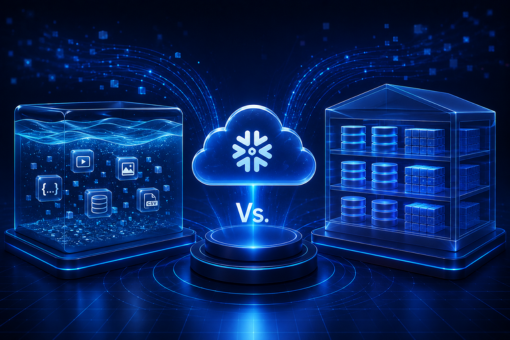
Snowflake data lake and data warehouse solve different storage problems, and choosing the wrong one slows down every analytics project that follows. A data lake stores raw, unprocessed data in any format, while a data warehouse stores clean, structured data ready for reporting. This guide breaks down the architecture, use cases, and decision criteria for both platforms. Enterprises that pair the right storage model with strong Data Strategy Consulting Services consistently get faster insights and lower total storage cost. By the end, you will know exactly which model fits your business, or whether you need both.
Introduction
Most data teams reach a breaking point. Data arrives faster than the warehouse can process it, formats multiply, and reporting queries slow to a crawl. At that point, leadership asks a simple question: should we move to a data lake, stay with a data warehouse, or run both?
The answer matters because it shapes cost, governance, and the speed at which teams can act on data. A data warehouse gives you clean, query-ready data for fast reporting. A data lake gives you flexibility to store any data type at scale, then shape it later. Neither approach is universally better; each solves a different problem.
This guide compares Snowflake data lake and data warehouse architectures in detail. You will see how each platform handles storage, access, and transformation, plus the exact scenarios where one model outperforms the other. For organizations planning a broader shift, this comparison also connects to wider Data and Cloud Modernization Services and Solutions, since storage strategy rarely stands alone from the rest of the data stack.
What Is Snowflake Data Lake?
Snowflake’s cloud-built architecture supports a data lake strategy that adapts to specific business needs. Consequently, teams can store structured, semi-structured, and unstructured data on a single platform without maintaining separate systems for each format.
Snowflake also builds in Role-Based Access Control (RBAC) and Data Access Control (DAC), which together control who can see and query specific data. Because Snowflake transforms data through native SQL, security teams can govern and monitor access without adding external tools.
How Snowflake’s Architecture Powers the Data Lake
Snowflake’s Massively Parallel Processing (MPP) engine splits large workloads across multiple compute nodes at once. As a result, the platform stores and processes data both securely and cost-effectively, even at petabyte scale. This architecture handles diverse data formats within a single SQL query, which removes the need for separate processing pipelines for each format.
Furthermore, a Snowflake data lake transforms structured, semi-structured, and unstructured data from storage without moving it between systems first. This single-architecture approach cuts the engineering overhead that traditional multi-system setups create.
Two Ways to Deploy a Snowflake Data Lake
Businesses generally choose one of two deployment paths:
- Central repository model: Deploy Snowflake as the central data repository to boost performance, security, and query speed in one place.
- External storage model: Store data in Google Cloud Storage, AWS S3, or Azure Data Lake, then use Snowflake to accelerate analytics and transformation on top of that storage.
Both paths work well, so the right choice depends on existing cloud commitments and how much control the team wants over raw storage infrastructure.
What Is Data Warehouse?
A data warehouse is a system built specifically for data analytics and reporting. It acts as a central repository that stores large volumes of data gathered from multiple sources. Unlike a data lake, a data warehouse holds highly transformed, structured data that teams have already pre-processed for a specific purpose.
Understanding the architecture matters before you commit to this model. A typical data warehouse includes five layers:
- Source Layer: The warehouse collects structured, unstructured, and semi-structured data relevant to business needs.
- Staging Area: The system extracts and cleans data, then structures it into a specific format.
- Data Warehouse Layer: A relational database management system stores the clean data along with its metadata.
- Data Marts: The warehouse stores information related to specific business functions in dedicated data marts.
- Analysis Layer: This layer gives analysts access to integrated data, so they can uncover patterns or flag issues that matter to the business.
Why Governance Matters in a Data Warehouse
Because a data warehouse centralizes sensitive, structured data, governance becomes a core requirement rather than an afterthought. Strong Data Quality Governance and Compliance Services ensure that the data entering the warehouse stays accurate, consistent, and compliant with industry regulations. Without this layer, even a well-architected warehouse can produce unreliable reports.
Regardless of which model you choose, understanding the right storage, management, and analysis criteria determines whether the investment pays off. If you want expert input on whether a data lake or data warehouse fits your business, the data team at Inferenz can help you decide.
Key Differences Between Data Lakes and Data Warehouses
According to a GlobeNewswire report, the global data warehouse market will cross USD 9.13 billion by 2030, while the data lake market will cross USD 21.82 billion in the same year. This gap shows that businesses increasingly prefer data lakes for raw, large-scale storage, even as warehouses remain essential for reporting.
The table below summarizes the core differences before the detailed breakdown that follows.
| Factor | Data Lake | Data Warehouse |
|---|---|---|
| Storage | Raw data in native format | Cleaned, transformed data |
| Data Capturing | All formats, real-time | Structured data only |
| Data Timeline | Stored for future analysis | Processed for immediate use |
| Users | Data scientists, engineers | Business and operational users |
| Tasks | Open-ended analytics | Predefined reporting |
| Schema | Schema-on-read | Schema-on-write |
Storage and Data Capturing
A data lake stores raw data in its native format and transforms it only when someone needs to use it. A data warehouse, on the other hand, stores data after extracting it from transactional systems, so every record arrives already clean and transformed to match business needs.
This difference also shapes data capturing. Data lakes collect and store real-time data in raw, unprocessed form, capturing every format regardless of source. Data warehouses, in contrast, capture only structured information and store it within predefined schemas.
Data Timeline and Users
A Snowflake data lake holds raw data that may have no immediate use. Later, data analysts can access and analyze that data to uncover new insights. A data warehouse works differently: it captures, analyzes, and uses data in near real-time to serve a specific, already-defined purpose.
These timeline differences naturally shape who uses each system. Data lakes generally suit users with advanced analytical skills, including data scientists, data engineers, and analytics engineers who work with varied, large-scale datasets. Data warehouses suit operational users instead, since they answer specific business questions quickly without requiring deep technical expertise.
Tasks and Schema Positioning
Because a data lake holds information from many different sources, it works best for open-ended data analytics. Users can access large volumes of data and dig for deep insights without a fixed destination in mind. A data warehouse, in contrast, focuses on predefined business questions and generates specific, repeatable reports.
Finally, the two platforms position schema differently. A data lake follows a schema-on-read strategy, meaning teams define the schema only after storing the data. A data warehouse follows schema-on-write instead, defining the schema before any data enters storage. This distinction alone often decides which platform fits a given workload.
When to Use Each: Data Lake vs Data Warehouse
Choosing between the two models depends on the shape of your data, the skill level of your users, and how quickly you need answers.
When to Use a Data Lake
A data lake fits best when your organization deals with large volumes of unstructured or semi-structured data, such as social media content, sensor data, or log files. It also works well when your team includes data scientists who need raw material for machine learning models, rather than pre-shaped reports.
For example, a social media company generating constant streams of unstructured user data benefits from a data lake’s flexibility far more than from a rigid warehouse schema.
When to Use a Data Warehouse
A data warehouse fits best when business teams need fast, reliable answers to specific, recurring questions. Retail and eCommerce companies with multiple departments often choose a warehouse because it consolidates important data into a single, query-ready location.
In particular, finance, sales, and operations teams benefit from a warehouse’s structured schema, since it supports dashboards and reports without requiring technical transformation work at query time.
When to Use Both Together
Many enterprises do not choose one platform over the other; instead, they combine both to build complete data pipelines. In this model, the data lake captures and stores raw data at scale, while the warehouse holds the cleaned, structured subset that business teams query daily.
This combination lets a business collect, store, transform, and analyze data on a single platform strategy. Organizations pursuing this path often pair it with broader Data and Cloud Modernization Services and Solutions, since integrating a lake and warehouse well requires more than just storage configuration; it requires a coordinated data architecture across the full stack.
Which Is Better: Snowflake Data Lake Vs. Data Warehouse?
There is no universal winner between a Snowflake data lake and a data warehouse. The right choice depends entirely on business needs, data variety, and how fast teams need answers.
An eCommerce company with multiple departments generally benefits more from a data warehouse, since it centralizes important data for fast, structured reporting. A social media company with mostly unstructured data, however, gains more value from a data lake’s flexibility.
Because this decision affects long-term architecture, cost, and governance, many businesses bring in outside expertise before committing. Experienced Data Strategy Consulting Services help map data sources, user needs, and growth plans to the storage model that fits best, rather than defaulting to whichever platform is trending.
Conclusion
Snowflake data lake and data warehouse architectures solve different problems, and the strongest data strategies rarely force a single choice. A data lake gives you flexibility and scale for raw, varied data. A data warehouse gives you speed and structure for business reporting. Together, they let an organization capture everything today and still answer specific questions tomorrow.
The businesses that get the most value are the ones that match platform choice to actual data behavior, not to industry trend. If you are still weighing Snowflake data lake against data warehouse for your organization, the data experts at Inferenz can help you build the right architecture from the ground up.