












Summary
Home care scheduling software keeps every client visit covered, authorized and verified. Caregiver scheduling software keeps availability, shifts and workloads fair for the people delivering care. On Caregence, Inferenz’s HIPAA compliant agentic AI platform, teams can build an AI agent around either priority and run both on the same data, with coordinators approving what the agents recommend.
Why Home Care Scheduling Now Runs on Two Priorities
Home-based care is where healthcare hiring is heading. The Bureau of Labor Statistics projects that services for the elderly and persons with disabilities will add 625,400 jobs between 2025 and 2035, the most of any detailed industry, with rising demand for home-based care cited as a driver.
That demand lands on a workforce under strain. PHI counts nearly 3.5 million home care workers in the country and reports home care turnover of nearly 75 percent in 2024, the latest year it cites. Its research also names heavy workloads and scheduling challenges among the pressures that make direct care jobs hard to keep.
Patients feel the gaps as late arrivals, unfamiliar faces and visits that never happen. Caregivers feel them as long drives, uneven caseloads and calls from the office at short notice. Schedulers sit between the two, trying to protect both. Two kinds of software grew up to help, and choosing between them (or building both) starts with knowing what each one does.
What Is Home Care Scheduling Software?
Home care scheduling software is the system a home care agency uses to plan, assign and verify client visits. Its unit of work is the visit: who needs care, when, under which authorization, and whether the visit happened as planned.
What home care scheduling software typically includes
- Client and visit calendar with recurring visits and care plan details
- Authorization and approved-hours tracking
- Electronic visit verification (EVV) and exception handling for Medicaid-funded visits
- Travel time and geography between visits
- Visit data handed to billing and payroll
- Family and client communication
Its strength is coverage and compliance. Many tools fill an open visit with whoever is free first, which can send a caregiver without the right skills, language or commute to a client who needed all three.
How does EVV fit into home care scheduling?
EVV sits at the center of home care scheduling for agencies serving Medicaid clients. Electronic visit verification records when, where and for whom a visit took place, and a caregiver scheduling app is often where that record starts, through check-in and check-out on the caregiver’s phone. When scheduling and EVV run in separate tools, exceptions can surface after the visit, and supervisors chase them by hand. A Caregence-based home care scheduling agent monitors EVV compliance in real time and flags exceptions to supervisors as they happen. A missed check-in gets a same-day fix before it reaches billing.
What Is Caregiver Scheduling Software?
Caregiver scheduling software is the system built around the person delivering the visit. Its unit of work is the caregiver: availability, time off, shift offers, swaps, hours worked and how evenly the load is shared.
What caregiver scheduling software typically includes
- Availability and time-off requests
- Open shift offers and swaps through a caregiver scheduling app
- Hours and overtime tracking
- Workload balance across caseloads
- Credential and certification awareness
- Messaging between caregivers and the office
Its strength is retention, fairness and flexibility. On its own it knows little about authorizations, care plans or visit verification, so those stay in another system.
Home Care Scheduling Software vs Caregiver Scheduling Software: Side-by-Side Comparison
The table below lays out how the two categories differ on the points agencies ask about most.
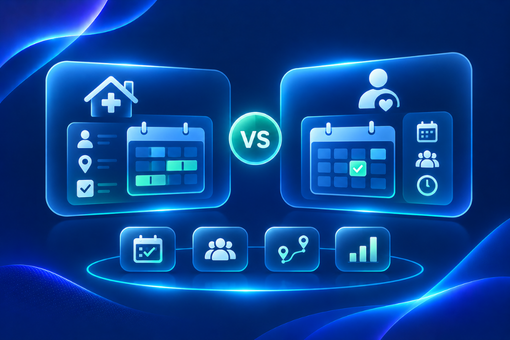
| Feature | Home care scheduling software | Caregiver scheduling software |
| Core question | Is every client visit covered, authorized and verified? | Is every caregiver scheduled fairly, within availability and limits? |
| Unit of work | The client visit | The caregiver and the shift |
| Main users | Schedulers, coordinators, operations and compliance leads | Caregivers, field staff and the schedulers who manage them |
| Typical features | Visit calendar, authorizations, EVV, travel time, billing handoff, family communication | Availability, time off, shift offers and swaps, overtime tracking, mobile app, messaging |
| Strongest at | Coverage, compliance and billing accuracy | Retention, fairness and flexibility |
| Common gap | Fills a slot by availability, so the best-fit caregiver can be missed | Limited view of authorizations, care plans and visit verification |
| Metrics it moves | Fill rate, visit completion, EVV exceptions, authorized hours delivered | Call-outs, overtime hours, shift acceptance time, turnover |
| AI agent priority | Client coverage and compliance | Caregiver fit, fairness and retention |
Where the two overlap
Both tools need the same raw material: caregiver profiles and certifications, availability, client care plans and locations. When that data sits in separate systems, coordinators re-key it by hand. Inferenz has unified more than 40 source systems into a single enterprise data platform for a national home care provider, and that kind of data foundation is what makes either priority workable.
What Does an AI Scheduling Agent Add to Either Tool?
An AI scheduling agent is a software worker that watches the schedule, reads the signals around it and takes the next step: recommending a match, filling a shift or alerting a supervisor. It sits on top of the scheduling, HR and EHR systems an agency already runs.
Research points the same direction. A study in Transportation Research Part E (September 2026) models home health routing and scheduling around caregiver skill level and patient familiarity with the caregiver, alongside routing cost and missed time slots. In practice, fit and continuity belong inside the scheduling decision itself.
How the agent works in five steps
- Data in: patient needs, caregiver skills, availability, geography and workload come from your scheduling, HR and EHR systems.
- Matching analysis: every available caregiver is scored on skill and certification fit, drive time, caseload, patient preference and past performance with similar patients.
- Ranking: caregivers are ranked by overall fit, and ties break on continuity of care and travel efficiency.
- Action: the agent recommends the top match, or auto-assigns the visit if your rules allow, and flags caregivers nearing a burnout threshold.
- Delivery: caregivers get a visit brief through the caregiver scheduling app, coordinators are notified, and the outcome feeds back into the model.
Caregence packages this flow as the Predictive Matching Agent, which reads scheduling data, HR records, EHR/EMR, GPS and travel data, certifications and care plans. It reaches coordinators and caregivers through the scheduler dashboard and the caregiver mobile app.
How Caregence Builds Both Agents with Different Priorities
Caregence is Inferenz’s HIPAA compliant healthcare-native agentic AI platform. Teams build agents and workflows with drag and drop, and the platform runs inside your own environment, so patient data, code and logs stay with you. Three building blocks matter for scheduling: a unified data model, a no-code Workflow Builder that can call agents, predictive models, APIs and human-in-the-loop steps, and an Agent Orchestrator that coordinates agents and hands decisions between them.
Caregence lets teams customize or extend any of its healthcare AI agents to match a workflow. That makes one starting point, the Predictive Matching Agent, adjustable in two directions. The two agents below describe those priorities, and each is configured with your team’s own rules.
The home care scheduling agent: client coverage and compliance first
- Monitors EVV compliance in real time and flags exceptions
- Matches caregivers to clients on acuity, skills, geography and preferences
- Automates scheduling and shift-gap management, with supervisor dashboards
- Handles cancellations and conflicts in real time and flags coverage gaps early
- Tracks caregiver and family communication across every visit
The caregiver scheduling agent: fit, fairness and retention first
- Scores each available caregiver on skill and certification fit, drive time, workload balance, patient preference and performance history
- Flags burnout and overtime risk and moves upcoming visits to another caregiver before the threshold is reached
- Fills shifts through auto-assignment when your rules allow
- Sends visit briefs and patient profiles to the caregiver mobile app
- Automates recruiting and onboarding workflows for new caregivers
The two agents, at a glance
| Dimension | Home care scheduling agent | Caregiver scheduling agent |
| Priority one | Client coverage and compliance | Caregiver fit, fairness and retention |
| Starts when | A referral arrives, a visit opens, a cancellation lands or an EVV exception appears | A shift opens, availability changes or a caregiver nears an overtime or burnout threshold |
| Reads from | Scheduling data, EHR/EMR, care plans, authorizations, EVV data, GPS and travel data | Scheduling data, HR records, certifications, availability, workload and performance history |
| Decides | Which visits need cover and which caregiver fits the client on acuity, skills, geography and preference | Which caregiver should take the next shift and whether caseloads need rebalancing |
| Delivers through | Supervisor dashboards and coordinator routing | Caregiver mobile app, scheduler dashboard and in-app notifications |
| Human control | Coordinators approve; every action is logged | Coordinators approve; every action is logged |
Both agents work under the same controls. PHI stays inside your environment, access is role-based, and every match, reassignment and override is logged. The agent recommends and your coordinators approve, so scheduling authority stays with your team.
Caregence also lists scheduling and patient-caregiver matching as a core use case, with predictive matching across skills, geography, language, training and past success, plus real-time handling of cancellations and conflicts.
Which One Should You Build First?
Build first for the problem that costs the most this quarter. Your own week will point to the answer.
Start with the home care scheduling agent when
- EVV exceptions pile up and supervisors chase them by hand
- Referrals wait for a visit slot while the schedule looks full
- Supervisors reconcile several systems to see who is covered
Start with the caregiver scheduling agent when
- Call-outs are frequent and schedulers spend the day phoning for cover
- Overtime concentrates on a few caregivers
- New hires leave in their first months
Run both when
Home care organizations with several branches usually recognize both lists. Running the two agents on one data model avoids duplicate entry and lets a change in caregiver availability reach visit coverage straight away.
For wider context, read Inferenz’s strategic framework for agentic AI in home care operations.
Inferenz has also covered patient-caregiver matching in home care in its blog.
The Bottom Line
Home care scheduling software and caregiver scheduling software answer different questions. One asks whether every visit is covered, authorized and verified. The other asks whether every caregiver is scheduled fairly and can sustain the work.
Agencies need both answers, and an AI agent on top of the systems they already run can supply them: one tuned for coverage and compliance, one tuned for fit, fairness and retention. Caregence builds either, or both, on a single HIPAA compliant platform with your coordinators in control. Start with the priority that hurts most this quarter, list the data it needs, and bring that list to the first conversation.