













Summary
- Ten post-acute care technology companies are profiled: PointClickCare, Inferenz with its Caregence™ platform for custom AI agents, WellSky, Netsmart, Homecare Homebase, Enzo Health, Basalt Health, Commure, exacare ai and Adaptive Innovations.
- Caregence™ by Inferenz is a platform where providers build custom agents across the stack, and Inferenz says it runs inside the customer’s own environment.
- The post-acute software stack has five layers: clinical EHR, analytics, care coordination, AI intake and managed care.
- Enzo Health announced a $20 million Series A in May 2026, and Basalt Health raised a $20 million Series A led by NEA in September 2026.
- Each company is scored on six criteria, led by layer fit and custom agent flexibility, and most vendor results are company-reported, so verify before you buy.
Introduction
Post-acute care is being rebuilt around software that reads, routes and decides. Venture money has followed: in 2026 alone, several post-acute and home-based care technology companies announced rounds ranging from $17 million to $60 million. Patients feel the difference when a discharge turns into an admission in minutes. Clinicians feel it when documentation stops eating their evenings. This guide profiles ten post-acute care technology companies to watch in 2027, from entrenched platforms to funded newcomers.
A federal freeze on new Medicare enrollment for hospices and home health agencies, which CMS extended through May 12, 2027, means growth has to come from the agencies and facilities already in the system. That makes referral speed, documentation quality and staff capacity the competitive levers.
The market also has a structure worth understanding before you shop. A 2026 post-acute software review from exacare ai describes five layers, from the clinical EHR up to managed care and reimbursement, and notes that the biggest operational gains cluster in intake and managed care.
Use this list as a map. It covers who is building what, what the evidence says and which questions separate a real result from a press release. Inferenz, the publisher, is on the list with its Caregence™ platform and is labeled as such.
Which Post-Acute Care Technology Companies Should You Watch in 2027?
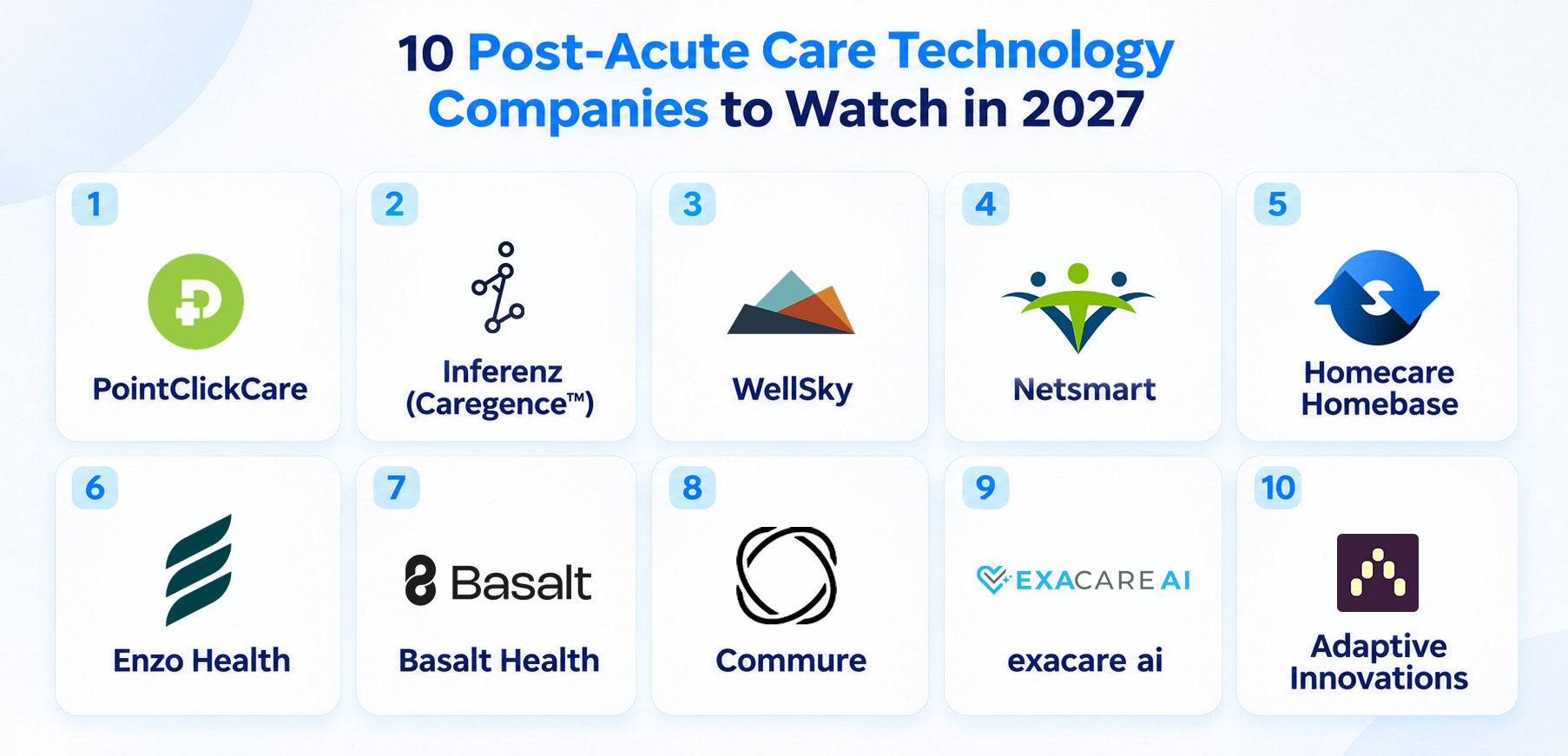
The post-acute care technology companies to watch in 2027 are PointClickCare, Inferenz (Caregence™ by Inferenz), WellSky, Netsmart, Homecare Homebase, Enzo Health, Basalt Health, Commure, exacare ai and Adaptive Innovations. PointClickCare, WellSky, Netsmart and Homecare Homebase anchor the clinical and coordination layers. Inferenz offers a platform for custom agents that reaches across layers. Enzo Health, Basalt Health, Commure and exacare ai sell AI for intake, documentation and admissions, and Adaptive Innovations is a funded care delivery company.
The order groups companies by role, and the criteria below show how we weighed them.
Post-Acute Care Technology Companies at a Glance
| Company | Layer | What to watch | Evidence type |
| PointClickCare | EHR and care coordination | Discharge Intel gives health plans clinical context within 24 hours of discharge | Company release, March 2026 |
| Inferenz (Caregence™) | Custom agent platform | Build custom agents across intake, documentation, authorization and analytics, running in your environment | Inferenz-described, publisher disclosure |
| WellSky | Coordination and referrals | AI referral scoring and routing for home health and hospice | Company release, January 2026 |
| Netsmart | EHR | myUnity and AI-assisted billing across post-acute settings | Company materials, 2025 and 2026 |
| Homecare Homebase | EHR | Curate AI platform, including documentation scribe pilots | Company releases, 2025 and 2026 |
| Enzo Health | AI-native EHR | Agentic EHR for home health, referral intake to billing | Trade press, 2026 |
| Basalt Health | AI intake and admissions | Automates referral review for post-acute facility admissions | Funding coverage, September 2026 |
| Commure | AI referral automation | Orchestrator, co-developed with Compassus | Company release, October 2026 |
| exacare ai | Analytics, intake, managed care | Referral review and prior authorization agents for SNF operators | Company-authored review, 2026 |
| Adaptive Innovations | Care delivery | AI-native home health provider, $60 million raise | Funding coverage, 2026 |
What Is Post-Acute Care Technology?
Post-acute care technology is the software that supports patients after a hospital stay, across skilled nursing facilities, home health, hospice, rehabilitation and long-term care. It covers clinical records, referral and admission workflows, care coordination between hospitals and providers, analytics and reimbursement tools.
The Five Layers of the Post-Acute Software Stack
- Clinical documentation and EHR: charting, care plans, billing and compliance.
- Analytics and business intelligence: census, payer mix and referral performance.
- Care coordination and referral networks: routing between acute and post-acute providers.
- AI-powered intake and admissions: referral review and screening.
- Managed care and reimbursement: prior authorization and level-of-care optimization.
Why 2027 Is a Turning Point
Demand keeps rising. 1.91 million Medicare beneficiaries received hospice care in 2024, up 4.4% from 2023, and 53.1% of Medicare decedents were enrolled in hospice at death, per the Alliance’s 2025 Facts and Figures. Workforce pressure remains: more than 60% of organizations in the Axxess survey named recruitment and retention as their biggest challenge heading into 2026. Software that removes manual steps now has a direct line to the balance sheet.

Our Criteria for Evaluating Post-Acute Care Technology Companies
We reviewed public vendor pages, press releases, funding announcements and trade coverage published through November 2026, and applied six criteria in the order we’d weigh them. Inferenz didn’t demo or test any product. Company-reported results are labeled, and we flag where a release lacks methodology.
- Layer fit: where the company sits in the five-layer stack and how many layers it touches.
- Custom agent flexibility: whether providers can build agents around their own workflows or receive AI as a packaged feature set.
- Integration with existing systems: how the product works beside the EHR and coordination tools you already run.
- Data control and governance: where PHI lives, how AI decisions are traced and where humans review.
- Momentum: funding, partnerships, launches and named deployments in 2026.
- Evidence quality: named customers, baselines and timeframes behind every claim.
Disclosure: Inferenz publishes this guide, and Caregence™ is Inferenz’s own platform. It’s described here from Inferenz’s own pages, with the same evidence labels as every other entry.
Criteria Scorecard
The table maps each company to the first three criteria. “Not applicable” marks a category that doesn’t fit the company, and the entries rely on what each company says publicly.
| Company | Stack layers covered | AI approach | Integration and data (as stated) |
| PointClickCare | EHR and care coordination | Packaged (Discharge Intel) | Network of provider organizations and health plans |
| Inferenz (Caregence™) | Analytics, intake and managed care through agents, plus a unified data model | Custom agents plus ready-made agents | FHIR EHR connectivity; runs in the customer’s environment |
| WellSky | Coordination and referrals | Packaged (SkySense referral AI) | Referral Manager and CarePort network |
| Netsmart | EHR | Packaged (Benny billing assistant) | myUnity record |
| Homecare Homebase | EHR | Packaged (Curate tools) | HCHB platform |
| Enzo Health | AI-native EHR | Built into the EHR | Its own record |
| Basalt Health | AI intake and admissions | Packaged | Parses referrals in any format (company-stated) |
| Commure | AI referral automation | Packaged (Orchestrator) | Fax, portal and email referrals |
| exacare ai | Analytics, intake, managed care | Packaged agents for SNFs | Skilled nursing focus |
| Adaptive Innovations | Care delivery | Not applicable | Care provider, a different category from software |
10 Post-Acute Care Technology Companies to Watch in 2027
1. PointClickCare
PointClickCare announced Discharge Intel on March 4, 2026, an AI-powered solution that gives health plans clinical intelligence within 24 hours of a hospital discharge. The company says its network is trusted by more than 30,000 provider organizations and every major U.S. health plan. Its release cites a University of Maryland Medical System case study showing a 32% reduction in skilled nursing facility readmissions over two years, but that figure relates to redesigned post-acute workflows and not to Discharge Intel itself.
- Best for: skilled nursing operators and health plans that want visibility at the hospital-to-post-acute handoff.
- Watch: how Discharge Intel performs once plans publish usage results.
2. Inferenz (Caregence™ by Inferenz)
Inferenz is a healthcare AI and data engineering company, and it publishes this guide, so this entry draws only on its own pages. Caregence™ by Inferenz is described there as a HIPAA compliant healthcare native agentic AI platform for hospitals, ambulatory providers, home health, hospice and home care organizations. In the five-layer stack it reaches across several layers: a Unified Data Model links clinical, operational and financial systems, and ready-made agents cover hospice eligibility, prior authorization, risk analysis, caregiver matching and leadership questions.
Caregence is a platform for custom agents. Teams build their own agents and workflows through a drag-and-drop interface, and Inferenz says the platform resides inside the customer’s environment and connects to any EHR that supports FHIR. Its own page cites 45% less administrative load and 30% better caregiver allocation without naming customers or sources.
- Best for: post-acute operators that want to build agents around the EHR and coordination tools they already run.
- Standout: custom agents, a data layer and customer-environment deployment on one platform.
- Watch: named customer results, and EHR write-back, which depends on each EHR’s API.
3. WellSky
WellSky added AI workflows to its Enterprise Referral Manager in January 2026 for home health and hospice providers. The tools score each referral, route it with human oversight and summarize key details for clinicians. One unnamed home health provider reported a referral conversion rate that rose from 20.7% to 44.8% in a year. The exacare ai review also credits WellSky CarePort with connecting more than 2,000 hospitals and 130,000 post-acute providers, a figure that review treats as company-reported.
- Best for: organizations that need a large coordination network plus AI-assisted intake.
- Watch: hospice-specific outcomes and CarePort integration depth.
4. Netsmart
Netsmart’s myUnity is an EHR built for post-acute settings, and the company has been adding embedded AI and automation. It describes Benny, an AI billing assistant that monitors claims for potential issues before submission. Netsmart has also been showing the next generation of myUnity at industry events, with some functionality marked as still under development in its own disclosures.
- Best for: providers spanning home health, hospice, personal care and senior living.
- Watch: which AI features reach general availability and when.
5. Homecare Homebase
Homecare Homebase announced Curate: Scribe in March 2026, a native AI documentation tool built with StenoHealth and planned for pilots in the first half of 2026 as part of its broader Curate platform. The company also published a May 2026 report on responsible AI in home health. HCHB says customers reached a 99% compliance rate for HOPE submissions, a company-reported figure from its January 2026 report.
- Best for: home health and hospice agencies that want AI inside the EHR they already use.
- Watch: post-pilot results for Curate: Scribe.
6. Enzo Health
Enzo Health launched Enzo EHR, which it calls an industry-first agentic EHR built specifically for home health. The company says it automates the patient episode from referral intake through billing and supports more than 100 organizations and about 500,000 patients a year. Enzo was founded in 2024 and announced a $20 million Series A in May 2026, bringing total funding to $26 million. It says intake falls from a 70-minute industry average to about five minutes, a company claim.
- Best for: home health agencies open to a new AI-native record.
- Watch: independent customer results and hospice expansion.
7. Basalt Health
Basalt Health is an AI platform that automates patient transitions and admissions into post-acute care facilities. Its $20 million Series A was led by NEA, with Frist Cressey Ventures and 25m Health participating, bringing total capital to $24.5 million. Basalt parses referrals in any format, reviews packets against a facility’s admission criteria, staffing, bed availability and payer authorization rules, and is expanding with Lifepoint Health and ScionHealth. At Lifepoint, the article reports median chart processing time fell 86%, from 8.5 minutes to 1.2 minutes per referral.
- Best for: health systems and facilities that struggle with admission volume.
- Watch: ScionHealth’s rollout to 62 hospitals by December 2026.
8. Commure
Commure and Compassus co-developed Orchestrator, an AI referral platform that gathers referrals from fax, payer portals and email, triages them in real time and matches them to clinical capacity by geography and discipline. Compassus reports it’s live across 79 programs in 19 states and processes more than 500,000 referrals a year, with referral decision time down 64% and admissions up 6%. The release gives no methodology for those figures.
- Best for: multi-site operators with heavy referral volume.
- Watch: independent validation of the reported gains.
9. exacare ai
exacare ai focuses on skilled nursing operators with referral review, analytics and managed care agents. In its own 2026 review, the company says it serves more than 2,500 facilities and has reviewed over three million referrals. It credits AI referral review with cutting review time by more than 37 minutes per referral. The review itself notes that most statistics come from exacare ai or its customers, so they are vendor-reported and unverified.
- Best for: SNF operators that want AI intake and prior authorization support.
- Watch: third-party validation of its performance claims.
10. Adaptive Innovations
Adaptive Innovations raised $60 million to build an AI-native home health provider. It’s a care delivery company, so it sits outside the software category, and that’s why it belongs on a watch list: it tests whether AI-native operations can change the economics of home health itself.
- Best for: investors and operators tracking new care delivery models.
- Watch: patient volumes, outcomes and the pace of market expansion.
How to Evaluate Post-Acute Technology Vendors
Map Vendors to the Five Layers
List the systems you run today for each layer and mark the weakest. Vendors that look similar on a slide often sit in different layers, and a gap in intake costs more than a gap in analytics for most agencies.
Look for Named Results With Baselines
A reported 64% drop in decision time means little without the starting number and the comparison period. Inferenz has written about referral leakage in post-acute care, and the same discipline applies to measuring vendor claims.
Check Integration Before Features
An AI tool that can’t read your EHR or write back to it adds work. Ask how data moves, who owns it and what happens when an interface breaks.
Decide Between Packaged and Custom AI
Packaged AI follows the vendor’s roadmap. A custom agent platform lets your team build for the workflows that make your organization different, and it sits beside the systems you already run. Caregence™ by Inferenz takes the second approach, and many organizations will combine both.
Plan for Governance
Ask where AI output is logged, how clinicians review it and which vendor staff can see PHI. CIOs planning across departments can use Inferenz’s guide to agentic AI implementation.
Questions to ask every vendor
- Can we build our own agents on your platform, or only use packaged features?
- Which layer of the stack do you cover, and which EHRs do you integrate with?
- Which AI features are live in production today?
- Can you share named customers, baselines and timeframes for your headline results?
- How is PHI handled, and what is your audit trail for AI decisions?
- What does the contract cost with interfaces, training and support?
Regulatory Context: What Changes in 2027
The Enrollment Freeze
CMS imposed a nationwide moratorium on new Medicare enrollment for home health agencies and hospices on May 13, 2026, and extended it on November 12, 2026 through May 12, 2027, citing continued concerns about fraud, waste and abuse. The modification lets existing home health agencies add branches and existing hospices add practice locations.
The notice is on the Federal Register public inspection site, where CMS notes it may extend moratoria in further six-month periods.
What It Means for Technology Buyers
New-entrant growth is capped, so incumbents compete for the same patients. Referral conversion, documentation accuracy and staffing efficiency become the main levers, and that’s where most of the AI investment in this guide is aimed.
Custom Agents in the Post-Acute Stack: Where Inferenz Fits
Every post-acute organization has workflows no packaged product fully covers, such as how a facility screens a referral source or how a branch assigns caregivers. A platform for custom agents lets teams build for those steps and keep the EHR and coordination tools they already own. That’s the role Inferenz positions Caregence™ to play.
- Data foundation: Inferenz also offers data engineering and integration services to unify EHR, referral and billing data before agents go live.
- Agents for specific workflows: the Caregence agents library includes hospice eligibility, clinical documentation, prior authorization, risk analysis and caregiver matching agents.
- Governance: Inferenz says each run is traced and that human oversight applies where needed.
See how this maps to your home health operations.
Final Thoughts
Post-acute care is getting a new set of tools, and a lot of money is chasing them. Some of it will fund real gains in speed and capacity. Some of it will fund slide decks.
Keep your eye on the vendors that name customers, publish baselines and plug into the systems you already run. Those are the ones likely to still matter in 2028.