












Summary
Home health data integration works when every patient, visit, authorization, claim and referral has one owner and one definition. Start with identity, reconcile EVV to clinical notes and claims, then govern the metrics, and EHR, EVV, billing and CRM finally tell the same story.
| Quick Summary | What to know |
| The problem | EHR, EVV, billing and CRM each hold a different version of the same patient, visit and referral. |
| The fix | One owner and one definition per data domain, joined in a governed data layer. |
| The sequence | Identity first, visit reconciliation second, shared metrics third. |
| Who owns it | A named executive sponsor, domain owners and data stewards. |
| Where AI fits | Agents act on the unified layer once the underlying systems agree. |
| Proof of value | Fewer EVV and authorization denials, faster clean claims, fewer audit findings, less manual reporting. |
Introduction
Home health organizations create a single source of truth by naming one system of record for every data domain, resolving patient identity first, and connecting EHR, EVV, billing and CRM through a governed data layer. Patients and physicians feel the difference first: cleaner records at the point of care, faster authorizations, and fewer claims stalled by disagreements nobody owns.
That work is getting more urgent. The 2027 home health final rule changes how agencies are paid and how they report quality, and every one of those changes depends on the same patient, visit and claim agreeing across systems. Agencies that can’t prove that agreement will feel it first in margin.
What Is a Single Source of Truth in Home Health?
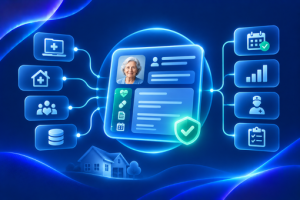
A single source of truth in healthcare is one governed answer to each business question, no matter how many systems capture the underlying records. For a home health agency, that means one patient identity, one visit record, one authorization status, one claim status, one referral status and one caregiver profile. The systems can stay different. The answers can’t.
Two terms keep this clear. A system of record is the application where a fact is created and edited, such as the EHR for a clinical note. A system of insight is the governed data layer where facts from every system are joined, defined and measured. Most agencies need both, and home health data integration works when both are designed on purpose.
Can an EHR alone be the single source of truth? Rarely. Many EMRs now add scheduling, billing and referral modules, and those modules help. EVV aggregators, payer portals, payroll and outside referral sources still hold data the EHR never sees. The EHR is a strong system of record for clinical facts and a partial one for everything else.
Why Do EVV Hours, Clinical Notes and Billed Visits Never Agree?
EVV, clinical notes and claims disagree because each system defines a visit for a different purpose. Each one is accurate about the thing it was built to prove, and each one is blind to what the others know.
| System | What it proves | How it defines a visit | What it can’t see |
| EHR | Skilled care was delivered and documented | A signed clinical note tied to a plan of care | Actual caregiver clock times and payer payment status |
| EVV | A caregiver was at the right place at the right time | A verified check-in and check-out with location | Clinical content and remaining authorization units |
| Billing | A billable unit exists that a payer will pay | A claim line with units, codes and an authorization | Anything upstream systems fail to send |
| CRM | A referral turned into an admission | Rarely tracked; the patient is a referral record | The patient ID the EHR uses |
| Payroll | A caregiver earned wages | Paid hours under a rounding rule | Whether paid hours match verified and billed hours |
Three purposes produce three timestamps, three durations and sometimes three different caregivers. The usual causes are easy to spot once you look for them:
- EVV entries edited after the fact that never sync back to the schedule
- Clinical notes finished after the claim has already dropped
- Authorizations that expire or change units mid-episode
- Duplicate patient or caregiver records across systems
- State aggregator rejections that nobody sees until the claim bounces
- Payroll hours that follow a different rounding rule than billing
The 21st Century Cures Act turned this from an operations headache into a compliance topic. The law requires states to implement EVV for Medicaid personal care services by January 1, 2020 and for home health care services by January 1, 2023, and states that fall short risk reduced federal Medicaid funding.
So, what happens when EVV data doesn’t match a claim? Payers can deny or hold the claim, or pay it and flag it for later review. The outcome depends on the payer and the state. Either way, the agency spends staff time chasing an exception that a shared visit record would have caught before submission.
Which System Should Be the System of Record for Each Home Health Data Domain?
Choose the system where each fact is born, then make every other system read from it. Here’s a practical starting point for most agencies. Adjust it to your stack, but keep one rule: every row gets a named owner.
| Data domain | System of record | Systems that consume it | Typical conflict to resolve |
| Patient identity | Enterprise master patient index (EMPI), fed by EHR registration | CRM, EVV, billing, analytics | Same patient under different IDs or spellings |
| Clinical visit and documentation | EHR | Billing, quality reporting, analytics | Note completed after claim submission |
| Visit presence (time, place, caregiver) | EVV system | EHR, payroll, billing, state aggregator | Edited clock times or missing location |
| Authorization | Authorization workflow tied to payer data | Scheduling, EVV, billing | Units used beyond approved units |
| Claim and payment | Billing or revenue cycle system | Finance, analytics | Claim status invisible to operations |
| Referral and source | CRM until admission, then EHR | Intake, marketing, analytics | Referral never matched to an admitted patient |
| Caregiver profile and credentials | HR or payroll with credentialing | Scheduling, EVV | Expired credentials still scheduled |
The identity row deserves the most attention. An enterprise master patient index (EMPI) resolves duplicate and fragmented records into one reliable patient view. It creates a golden record per patient and applies survivorship rules that decide which source wins when fields conflict. Inferenz’s version uses deterministic, probabilistic and referential matching, with a data steward reviewing the uncertain middle band.
Caregivers need the same treatment. EVV, payroll and scheduling often spell and number one person differently, and an expired credential in one system can slip past the scheduler in another.
Matching rules, survivorship logic, steward queues and registration-time checks all come into play when you build a single patient view across multiple home health systems, and the quality of that work decides whether every later step holds up.
Do You Need One All-in-One System, or Can You Integrate What You Have?
You can integrate what you have, and for most multi-site agencies that’s the faster route. An all-in-one platform cuts the number of seams, but it brings a migration, a retraining cycle and a long vendor commitment, and it still won’t cover every payer portal, state aggregator and referral source.
If you’re still comparing EMR systems for home health, the table below shows how the three common options stack up.
| Option | Best fit | Strengths | Watch-outs |
| All-in-one home health software | Single-state agencies with a simple payer mix, or a planned platform consolidation | Fewer interfaces, one vendor to call, shared screens for staff | Migration effort, gaps in billing or CRM depth, outside systems still need feeds |
| Best-of-breed with point-to-point links | Agencies with a few stable systems | Each team keeps its preferred tool, quick first connection | Every new system multiplies interfaces, definitions drift, nobody owns the combined answer |
| Best-of-breed plus a governed data layer | Multi-site, multi-EMR or acquisitive organizations | Keeps current systems, one home for definitions and lineage, ready for AI and analytics | Needs data ownership and governance discipline |
For multi-site or acquisitive organizations, the third option usually wins on time to value. Connecting existing systems through bidirectional interfaces and middleware costs less than a rip-and-replace, and it keeps the workflows clinicians already know. When you evaluate home health software, ask each vendor how it exposes data to a governed layer, and get the API and event documentation in writing. Whether you build that layer in house or work with an EHR integration services partner, the ownership questions stay the same.
Where Does Each Layer Belong: EHR, Data Warehouse or Data Platform?
Use the EHR for clinical work, a data warehouse for trusted cross-system reporting, and a data platform when you also need identity resolution, lineage and AI on top. Each option answers a different question, and many agencies end up with all three.
| Option | Does well | Runs out when | Fits when |
| EHR reporting | Native to clinical workflow, no extra build, fast answers about one system | You need EVV, CRM, payer or payroll data in the same view, or trends across sites on different EMRs | One EHR covers nearly every workflow and question |
| Data warehouse | Joins structured data from several systems for BI and finance reporting | Identity, quality rules and ownership are missing, or you need unstructured data and event feeds | You need trusted reporting across stable sources |
| Data platform (warehouse or lakehouse plus identity, governance, semantic layer and AI services) | Refines raw feeds in stages, resolves identity, tracks lineage, and feeds analytics and agents | Scope is unclear, or nobody owns governance | You run multiple EMRs or acquire entities, and you plan to use AI |
How a home health CIO should weigh an EHR, a data warehouse and a data platform depends on scale, source count and timeline. A single-site agency with one EMR can reach a long way with the warehouse alone. A multi-state operator with several EMRs and an acquisition pipeline usually needs the platform.
A layered platform works in stages. Raw feeds land first, cleaned and standardized records come next, and a curated layer carries the definitions that dashboards and agents read. Inferenz describes this as bronze, silver and gold layers on a FHIR-enabled foundation, with a real master patient index in the middle.
Cloud choice follows your existing stack. Home care organizations operating at scale commonly build on Snowflake, Databricks, Azure or AWS, and the platform design works the same way on each.
What Does a Single Source of Truth Architecture Look Like End to End?
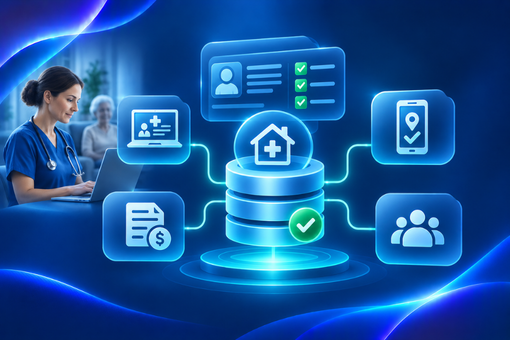
The layers look the same whether an agency runs one EMR or ten. Source systems feed an ingestion layer, identity gets resolved, records map to a canonical model, and a governed layer serves everyone who needs an answer.
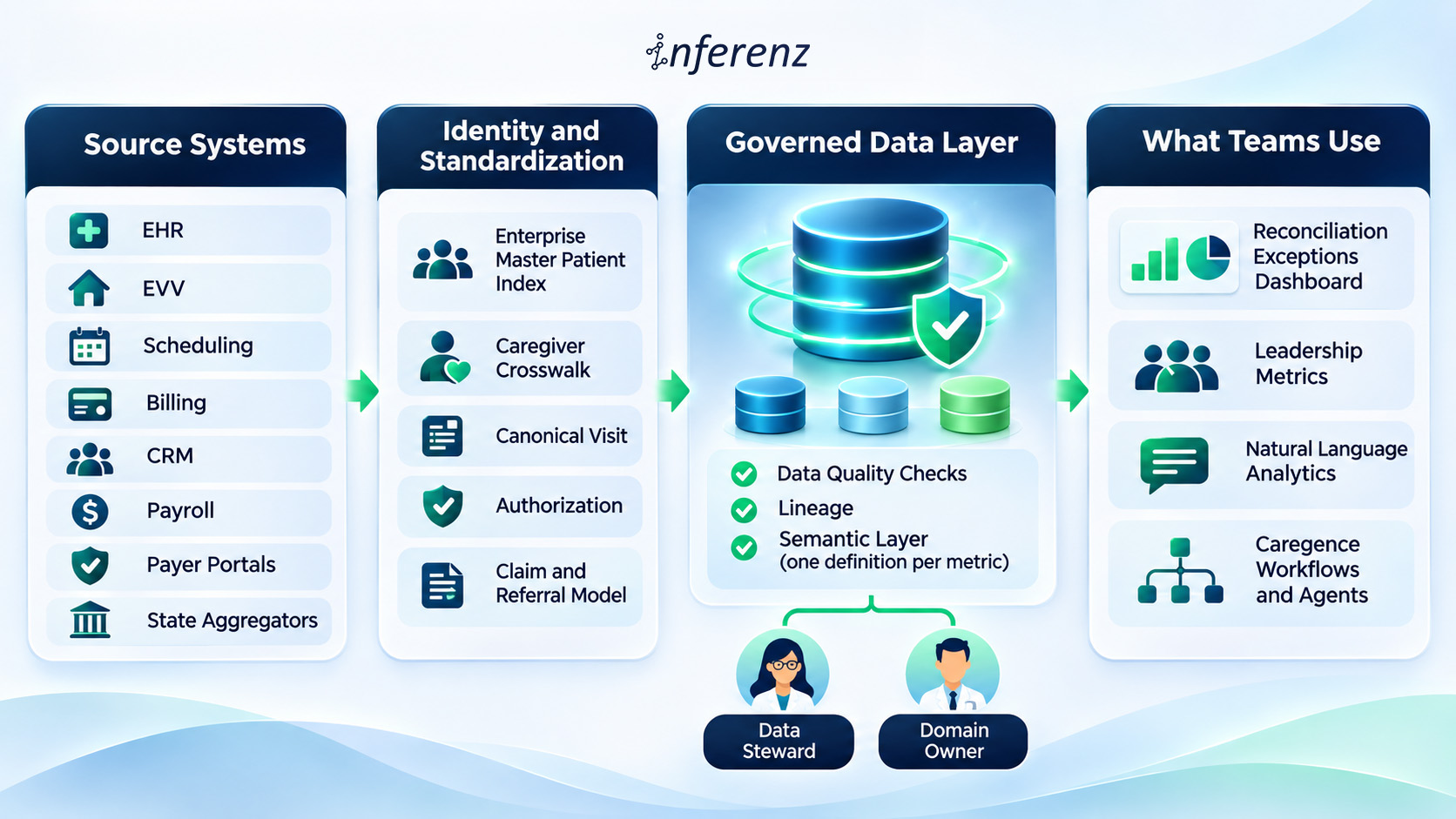
| Layer | What lives here | Who owns it |
| Source systems | EHR, EVV, scheduling, billing, CRM, payroll, payer portals, state aggregators | Domain owners |
| Ingestion | FHIR, HL7, APIs, change data capture and file feeds | Integration lead |
| Identity | Enterprise master patient index, caregiver crosswalk, one enterprise ID | Data stewards |
| Canonical model and quality | Standard visit, authorization, claim and referral entities with validation rules | Integration lead and domain owners |
| Governed warehouse or lakehouse | Staged refinement, lineage, semantic layer with published metric definitions | Data governance lead |
| Consumers | Dashboards, exception queues, natural language analytics, workflows and agents | Business leaders |
Records stay where they are born. The governed layer reads what each workflow needs, and every originating system keeps its job. That design protects clinical workflows while giving leaders one place to ask questions.
What Is the Right Sequence: Fix Identity, Reconcile Visits, Then Build Metrics?
Fix identity first, reconcile visits second, and build metrics third. Each step depends on the one before it. Metrics built on duplicate patients are wrong from the start, and reconciliation run on unmatched identities produces false exceptions that teach staff to ignore the alerts.
Step 1: Resolve patient and caregiver identity
Load patient and caregiver records from every system, standardize names, dates of birth, addresses and identifiers, and match them with weighted rules. Send uncertain matches to a data steward. Publish one enterprise ID and a crosswalk back to every source ID, so each system keeps working while the shared answer stays consistent.
Step 2: Reconcile the authorization-to-visit-to-claim chain
Link each authorization to the scheduled visit, the EVV record, the clinical note and the claim line. Once the chain exists, you can see where it breaks: visits delivered past approved units, notes still unsigned, claims waiting on a missing EVV match.
Step 3: Publish governed metrics
Only after identity and visits agree should leaders see dashboards. Put definitions in a semantic layer, apply data quality, governance and compliance controls such as automated validation and lineage from source to report, and let every dashboard read from the same definitions.
How Can You Integrate and Reconcile EVV, Scheduling and Billing Data Automatically?
Once identity is stable, you can integrate EVV, scheduling and billing data without disrupting daily operations by giving every visit a shared key and comparing what each system says about it before the claim is released. Change data capture pipelines pull events from the EHR, EVV system, scheduling tool and billing platform. A canonical data model maps them to one visit record, and rules flag the differences. Some teams model that record as a FHIR Encounter, so EVV, clinical and billing data all point to the same visit.
Scheduling is where authorizations meet caregivers, so a schedule change is the earliest signal of a future mismatch. Home care scheduling software and caregiver scheduling software capture different fields, so confirm which events your tool exposes before you design the pipeline.
The checks below cover most mismatches. The examples are illustrative.
| Check | What gets compared | Example exception | Typical owner |
| Time and duration | EVV clock times, note time and billed units | Billed 60 minutes, EVV verified 38 | Billing lead |
| Location and caregiver | EVV location and caregiver ID against schedule and note author | Visit verified under a different caregiver | Scheduling manager |
| Authorization | Units approved against units delivered and billed | Fourth week of visits exceeds approved units | Intake or authorization lead |
| Documentation status | Note signed and complete against claim ready | Claim queued with an unsigned note | Clinical manager |
| Aggregator acceptance | Record sent to the state aggregator against record accepted | Rejected record with no alert | Compliance or EVV administrator |
| Payroll alignment | Hours paid, hours verified and hours billed | Payroll rounds up, billing rounds down | Payroll and finance |
Route every exception to a named owner with a due date, and show open exceptions on a reconciliation dashboard that operations and finance both read. State rules add another wrinkle. Some states run a state-selected EVV system or aggregator, while others let agencies use their own vendor and send records to an aggregator. A separate point-to-point feed for each state multiplies upkeep, so map to each state’s format once, at the edge, from the canonical visit record.
Caregence includes real-time EVV compliance monitoring and exception flagging among its home care capabilities, which suits teams that want exceptions surfaced inside a workflow the day they occur.
How Do You Connect CRM Referral Data to Admissions and Outcomes?
Connect CRM referral data to admissions by carrying one referral ID from the first inquiry into the EHR admission record, and by matching on the resolved patient identity from your master patient index. When both are in place, marketing and operations use the same numbers. A home health CRM and EHR integration should carry these fields at minimum:
- Referral ID and received date
- Referral source organization and referring physician
- Acceptance decision and reason
- Start-of-care date and admission status
- Outcome status, such as discharge or transfer
With those fields connected, referral leakage shows up as a funnel: referrals received, accepted, scheduled and admitted. A drop between any two stages points to a workflow gap you can fix. Clear stage definitions also stop the CRM and the EHR from reporting different conversion rates for the same month.
How Do You Define Key Metrics Once for Everyone?
Define each key metric once, in a semantic layer, and make every dashboard read from it. Without that step, finance, operations and marketing each build their own version of admission, completed visit and referral conversion, and leadership meetings turn into debates about whose number is right.
Write the definitions in plain language and test them against real records. A completed visit might mean EVV verified, note signed and no open exception. A referral conversion might count referrals with a resolved patient identity and a start-of-care date, divided by referrals received in the same period. Your definitions may differ. What matters is that there’s one set, it’s published, and a named owner approves changes.
Pair lagging results with leading signals so problems surface early:
- Lagging: denial rate, days in accounts receivable, referral conversion rate, audit findings.
- Leading: open reconciliation exceptions and their age, authorization units burned against approved, unsigned notes at claim cutoff, duplicate identity queue size.
Data contracts between systems back this up. A contract states which fields a system must send, in which format and how often, and it raises an alert when a vendor update changes them. Combined with lineage, it also supports audit-ready dashboards when a reviewer asks where a number came from.
How Does a Single Source of Truth Work With Multiple EMRs and After an Acquisition?
A single source of truth works across multiple EMRs when identity, definitions and onboarding are shared services that sit above any one EMR. Master data management for home health agencies gives each patient and caregiver one enterprise ID, whichever EMR created the record.
Acquisitions test this hardest, and the way you approach data integration after an acquisition decides how fast the new entity shows up in enterprise numbers. The sequence below keeps leaders informed during the transition.
| # | Step | What happens | Why it matters |
| 1 | Connect without disrupting | Pull the acquired entity’s data into the shared layer while its staff keep working in their own systems | Leaders get early visibility and clinicians keep their workflows |
| 2 | Match identities across entities | Run the EMPI on patients and caregivers and send uncertain matches to stewards | Prevents double counting of census and duplicate outreach |
| 3 | Map to the canonical model | Translate each source’s codes, statuses and visit types to your definitions | Makes reports comparable across entities |
| 4 | Reconcile the revenue chain | Apply authorization, EVV, note and claim checks to the new entity | Finds billing gaps before they become write-offs |
| 5 | Retire legacy systems on purpose | Preserve historical records in the warehouse before decommissioning an EMR | History stays available for audits and clinical continuity |
One national home care provider shows the pattern at scale. Years of acquisitions had left it with 40+ source systems, no shared data model and duplicate patient and caregiver records across EMRs. Inferenz unified EMR, payroll, workforce, finance and recruitment data in one governed warehouse, added an AI de-duplication layer that creates a single golden record per patient and caregiver, and set up a repeatable path for onboarding acquired entities. The case study reports that a newly acquired entity becomes analytics-ready in 8 to 10 weeks.
Which Governance Roles Keep a Single Source of Truth from Decaying After Launch?
Home care data governance keeps a single source of truth healthy by giving every domain an owner, every definition an approver and every exception a deadline. Without those roles, accuracy slips as vendors change fields and staff create workarounds. Five roles cover most agencies:
- Executive sponsor: usually the COO or CIO, who settles disputes over definitions.
- Domain owners: one leader per data domain, such as the revenue cycle lead for claims and the intake lead for authorizations.
- Data stewards: the people who review uncertain identity matches and clear data quality alerts.
- Integration lead: owns data contracts, pipelines and vendor changes.
- Compliance liaison: confirms that lineage and retention support audits.
Strong programs also keep a lineage record that shows which source produced each field on a claim, so an auditor’s question about a number gets answered in minutes. Data quality and governance practices like these let growth stay sustainable as the organization adds sites and systems.
Can AI Agents Work Reliably When Your Systems Disagree?
Teams exploring AI in home care often pick the agent first and meet the data problem second. AI agents work reliably only on data that agrees with itself. When EVV, EHR, billing and CRM disagree, an agent has to guess which system to believe, and every guess is a risk in a regulated workflow.
That’s why the order matters for AI in home health care. Inferenz connects an agency’s data into one system, and the Caregence platform lets stakeholders build custom agents for the workflows they own, integrating with MCP tools and the systems already in use.
Teams commonly start with a workflow such as an authorization check, a visit-to-claim exception queue, caregiver matching or a conversational assistant for leaders. Each gets simpler when the patient, visit and referral records underneath already agree.
Start small. Pick one workflow, confirm the data it reads is reconciled, run it with human review, and expand as exception rates fall. That’s how agentic AI in home care operations moves from pilot to production, and how AI in healthcare earns trust in a home health setting.
What Have Home Care and Hospice Organizations Achieved With This Approach?
Three Inferenz engagements show the pattern from different angles. All figures below are Inferenz-reported.
| Client | Starting point | What Inferenz built | Reported outcome |
| National home care provider (60,000+ patients, 50,000+ caregivers) | 40+ source systems from acquisitions, no shared data model, duplicate records | Unified warehouse for EMR, payroll, workforce, finance and recruitment data, AI de-duplication, repeatable onboarding for acquired entities | 40+ sources to one governed warehouse; acquired entities analytics-ready in 8 to 10 weeks |
| Hospice and palliative care provider (600+ patients in active care daily) | EMRs, triage platform, state HIE and HR data running separately, hand-built reports | Snowflake warehouse, Azure Data Factory pipelines, master patient index, real-time quality checks, KPI dashboards across 7 domains | About 2 hours a day freed from manual audits; KPIs automated across 7 domains |
| National home care provider (60,000+ patients) | Thousands of weekly manual registrations on a government compliance portal, about 12 minutes each | UiPath bot with retry logic, exception handling and step-level logging | About 75% less manual effort per registration, about $1M estimated annual savings, 20,800+ hours recovered |
The hospice engagement shows the identity layer at work. Inferenz built an enterprise data warehouse with a master patient index that resolves conflicting patient identities across EMRs into one clinical record, replaced manual extracts with documented pipelines, and added real-time data quality checks and automated alerting.
Each engagement started by removing a manual step between systems and putting one governed record at the end of it. The pattern holds whether the manual step is a spreadsheet audit or a portal entry.
The portal automation project makes the same point from the workflow side. Re-keying data between systems creates the discrepancies that reconciliation later has to find, and RPA that replaced manual portal entry removed that step while logging every bot run for audit. The case study doesn’t name EVV, payroll or billing systems, so treat it as evidence for removing manual re-keying only.
How Do You Prove the ROI of Unifying Home Health Data?
Prove ROI by tracking a short list of before-and-after measures: EVV and authorization-related denial rate, days from visit to clean claim, open reconciliation exceptions and their age, audit findings, and hours spent assembling reports by hand. Baseline them before the work begins.
No public figure says what EVV mismatches cost a typical agency, so size your own exposure. Count monthly reconciliation exceptions, multiply by the average claim value at risk and your historical denial or rework rate, and compare the result with the cost of the integration work.
External benchmarks show why documentation discipline pays. CMS reported that insufficient documentation accounted for 51.4% of home health improper payments in its 2024 reporting period, and the overall home health improper payment rate was 6.7%, a projected $1.1 billion.
Those are Medicare figures, while EVV rules sit in Medicaid. The lesson carries across both: when a visit, a note and a claim can’t be traced to each other, payers and auditors read the gap as risk.
Audits show the same pattern at agency level. In a March 2026 review, OIG found that 16 of 100 sampled claims from one large agency didn’t meet Medicare billing requirements, including 12 with billing and coding errors and 4 that lacked a compliant face-to-face encounter, and it estimated overpayments of at least $2,965,484.
What Does a Realistic Rollout Look Like?
Most agencies move through five phases. Timing varies with the number of systems and the state of your data, so treat the exit criteria as the milestones that matter.
| # | Phase | Focus | Done when |
| 1 | Baseline and ownership | Inventory systems and data domains, name owners, record denial rate, days to bill and exception volume | Every domain has an owner and a baseline number |
| 2 | Identity | Stand up the EMPI for patients and caregivers with a crosswalk to source IDs | Duplicate rate is measured and falling, and the steward queue is running |
| 3 | Visit chain | Join authorization, schedule, EVV, note and claim for your largest payers first | Exceptions route to owners before claim release |
| 4 | Metrics | Build the semantic layer, publish definitions and launch one dashboard set | Finance, operations and clinical leaders quote the same numbers |
| 5 | Scale and automate | Add payers, states, sites and acquired entities, then build agents on reconciled workflows | New entity onboarding follows a repeatable path |
Final Thoughts
A single source of truth is an agreement you build, document and keep, and the systems carry it out. Start with identity. Reconcile the visit chain next. Publish one set of definitions, and give every domain an owner. Agencies that do this find that audits, acquisitions and AI projects all get easier, because everyone is working from the same record.