












Summary
Agentic AI is no longer a future consideration for home care. It is an operational necessity. This framework covers the highest-impact use cases, governance requirements, and deployment principles that separate AI initiatives that deliver from ones that stall.
Introduction
Home care is entering a period of structural pressure. Aging populations, workforce shortages, rising cost of care delivery, payer complexity, and documentation overload are all converging at once. At the same time, expectations from hospitals, families, and payers continue to rise.
This is not a short-term cycle. It is a permanent shift in how care must be delivered, measured, and proven.
Artificial Intelligence is now moving from automation support to operational backbone. The focus is shifting from isolated AI tools to a comprehensive HIPAA-Compliant Agentic AI Platform for Healthcare that integrates and coordinates workflows, removes friction, and supports real-time decision making across the care continuum.
As one home care executive recently noted:
“The future of care delivery depends on how well we can scale limited human resources without reducing care quality.”
For home care leaders, the question is no longer if AI should be adopted. The real question is how to deploy it safely, measurably, and in ways that strengthen care delivery outcomes.
The Strategic Shift: From Task Automation to Care Operations Intelligence
Home care success now depends on how efficiently organizations can convert referrals into care delivery, manage staff capacity, and demonstrate measurable performance to payers and partners.
Agentic AI supports this shift by acting as an operational co-pilot, not a replacement for clinical teams.
The core philosophy is simple:
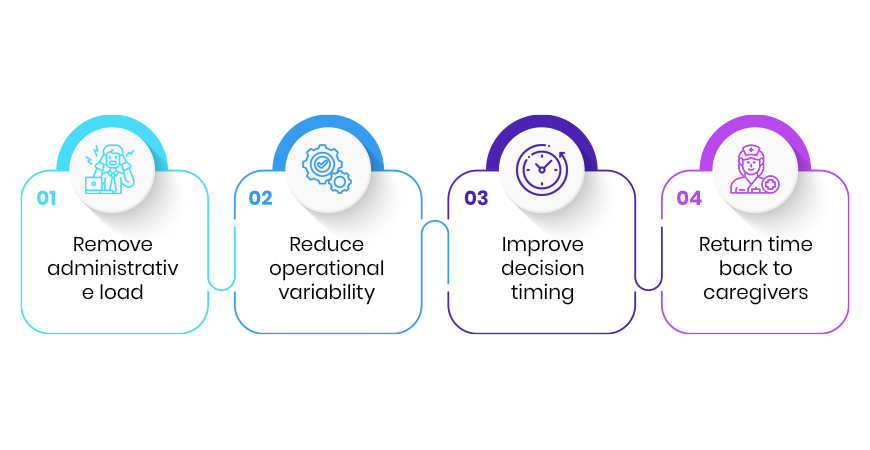
This is especially important as workforce shortages become structural.
AI is not replacing human care. It is protecting it.
High-Impact Agentic AI Use Cases in Home Care
Home care presents some of the most operationally complex and high-stakes opportunities for agentic AI. The following AI Use Case in Healthcare represent where the impact is clearest and the ROI most measurable.
Documentation Intelligence and Clinical Time Recovery
Documentation remains one of the biggest drivers of caregiver fatigue and operational delay.
Agentic AI can:
- Capture visit conversations through ambient listening
- Auto-generate structured visit notes
- Support coding and compliance checks
- Flag missing documentation in real time
The result is simple but powerful:
More time with patients. Less time finishing paperwork after shifts.
As one care leader summarized:
“Technology should remove friction, not add another system to manage.”
Intake, Referral, and Start-of-Care Acceleration
Start-of-care delays directly impact revenue cycle timing, patient outcomes, and referral relationships.
Agentic AI can:
- Validate insurance eligibility automatically
- Initiate prior authorizations
- Clean and normalize referral data
- Route cases to the right teams instantly
This reduces:
- Manual follow-ups
- Lost referrals
- Intake backlog risk
For agencies operating under value-based contracts, faster start-of-care directly improves performance metrics.
Workforce Optimization and Caregiver Matching
Workforce strain is no longer episodic. It is structural.
Agentic AI can support:
- Patient-caregiver matching based on skill, location, acuity, and preferences
- Smart schedule balancing
- Travel optimization
- Burnout risk signals based on workload patterns
This directly impacts:
- Staff retention
- Care continuity
- Visit reliability
- Patient satisfaction
Care Coordination and Medication Safety
Home care often operates across fragmented systems.
Agentic AI can unify:
- Clinical data
- Medication lists
- Risk alerts
- Care plan updates
AI-supported medication reconciliation alone can reduce safety risk and save hours of manual reconciliation work weekly.
Governance: Making AI Safe, Trusted, and Clinically Aligned
AI adoption in home care requires strict governance and clinical control.
Key principles include:
Cross-Functional AI Governance
- Clinical leadership
- Compliance and legal leadership
- Technology leadership
- Operations leadership
Human-in-the-Loop Oversight
AI supports decisions. Clinicians always make final care decisions.
Data Security and Private AI Environments
Healthcare AI must operate in protected environments where patient data is never exposed to public model training.
Partnership Models That Deliver Measurable Outcomes
The strongest AI partnerships in home care follow shared outcome accountability.
Best practice includes:
- KPI-linked vendor accountability
- Measurable operational improvements
- Pilot-first validation
- Phased deployment
If a vendor cannot align to measurable outcomes, long-term value risk increases.
The Next Phase: Predictive and Experience-Led Home Care
Home care has always been about what happens between visits. The check-ins that didn’t happen. The risk that wasn’t caught. The family that didn’t know what to ask.
The next phase of intelligent home care is not about doing more. It is about seeing more, earlier, and acting before the moment passes.
Family Experience Intelligence
Families don’t read care plans. They read worry into every unanswered question, every missed call, every term they don’t understand. AI changes that equation.
AI can:
- Translate care plans into plain language
- Support family education
- Provide non-clinical support and reminders
- Identify caregiver or family stress signals
Predictive Risk Intelligence
By the time a home care patient is hospitalized, the signals were already there. Agentic AI finds them before they become crises.
Agentic AI can identify:
- Hospitalization risk
- Fall risk
- Care gap patterns
- Staffing mismatch signals
Predictive Modeling in Healthcare shifts home care from reactive response to proactive intervention in care workflows.
The Inferenz + Agentic AI Model for Home Care
At Inferenz, the focus is not on deploying AI tools.
It is on building Agentic AI operating layers across home care workflows.
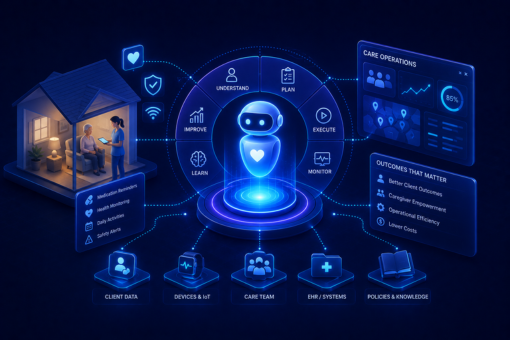
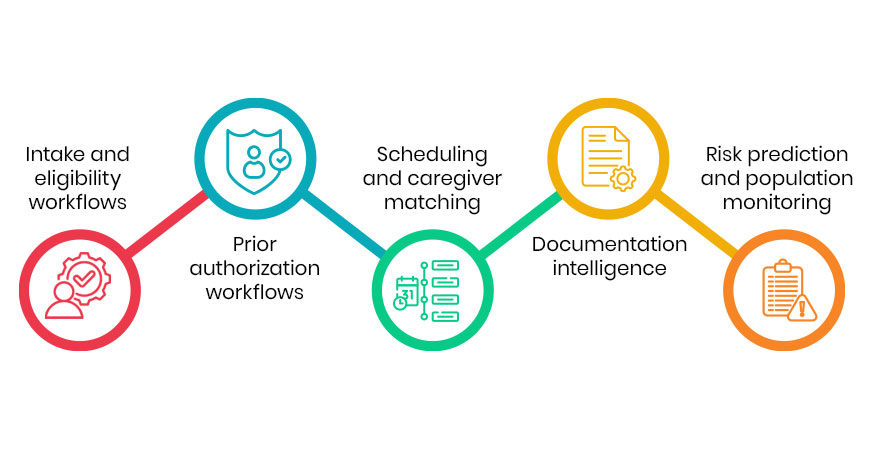
Through platforms like Caregence, organizations can deploy agents across:
The goal is consistent:
Reduce operational noise so care teams can focus on care delivery.
Conclusion: The Invisible AI Standard in Home Care
The highest performing AI in home care should feel invisible.
When it works well:
- Caregivers feel supported
- Operations feel smoother
- Compliance feels easier
- Patients experience consistent care
Agentic AI should work quietly in the background, coordinating care operations while humans focus on compassion, connection, and clinical excellence.