













Summary
Post-acute referral leakage quietly costs the average health system millions in margin every year, and CMS’s mandatory bundled payment model (TEAM) just turned that leakage into a direct financial and quality risk. This piece shows hospital COOs and CFOs how to measure referral leakage, build a preferred post-acute network, and close the loop with real-time data and agentic AI before the next board review turns up a number nobody can explain.
Introduction
Your discharge planner just placed a patient at a skilled nursing facility eleven miles outside your network. Nobody flagged it. Nobody will, either, not until your CFO’s quarterly review turns up a margin gap that takes three meetings to trace back to its source.
That gap has a name: referral leakage to post-acute care. It rarely shows up as a clean line item. It shows up as a slow erosion across margin, readmission data, and quality scores, and by the time finance connects the dots, the patient has already been discharged, readmitted, or lost to follow-up for months.
For a hospital COO or CFO in 2026, this stopped being a someday fix the day CMS made bundled payments mandatory. Under the Transforming Episode Accountability Model (TEAM), your organization now owns the cost and quality outcome for 30 days after a covered surgical discharge, regardless of which skilled nursing facility, home health agency, or rehab center the patient actually ends up at. Referral leakage used to be a marketing problem. It’s a balance sheet problem now.
What Referral Leakage Actually Means (and Why It Isn’t the Same as Patient Choice)
Post-acute care is the bridge between hospital discharge and full recovery: skilled nursing, inpatient rehabilitation, home health, and hospice services that pick up where the inpatient stay leaves off. Referral leakage happens when a patient who was a good fit for one of your preferred, high-performing post-acute partners ends up somewhere else instead, at a facility your system has no data-sharing agreement with, no outcomes visibility into, and often no quality track record on at all.
That’s a different problem from patient choice, and the distinction matters for compliance as much as for strategy. Federal discharge planning rules require hospitals to give every Medicare patient a list of certified home health agencies and skilled nursing facilities, along with relevant performance data, and to respect whichever provider the patient or family ultimately picks. You cannot, and should not, try to engineer that choice away.
What you can influence is which option looks easiest, fastest, and clearest on that list. A predictive matching AI agent can help discharge teams identify suitable post-acute providers based on patient needs, provider capabilities, availability, location, and relevant quality indicators. Most leakage isn’t patients actively rejecting your preferred partners. It’s a discharge planner on a Friday afternoon defaulting to whoever picks up the phone first, because nobody built a faster path to the provider who’s actually good.
The Real Number: How Much Revenue Is Leaking to Post-Acute Care, and How Do You Measure It
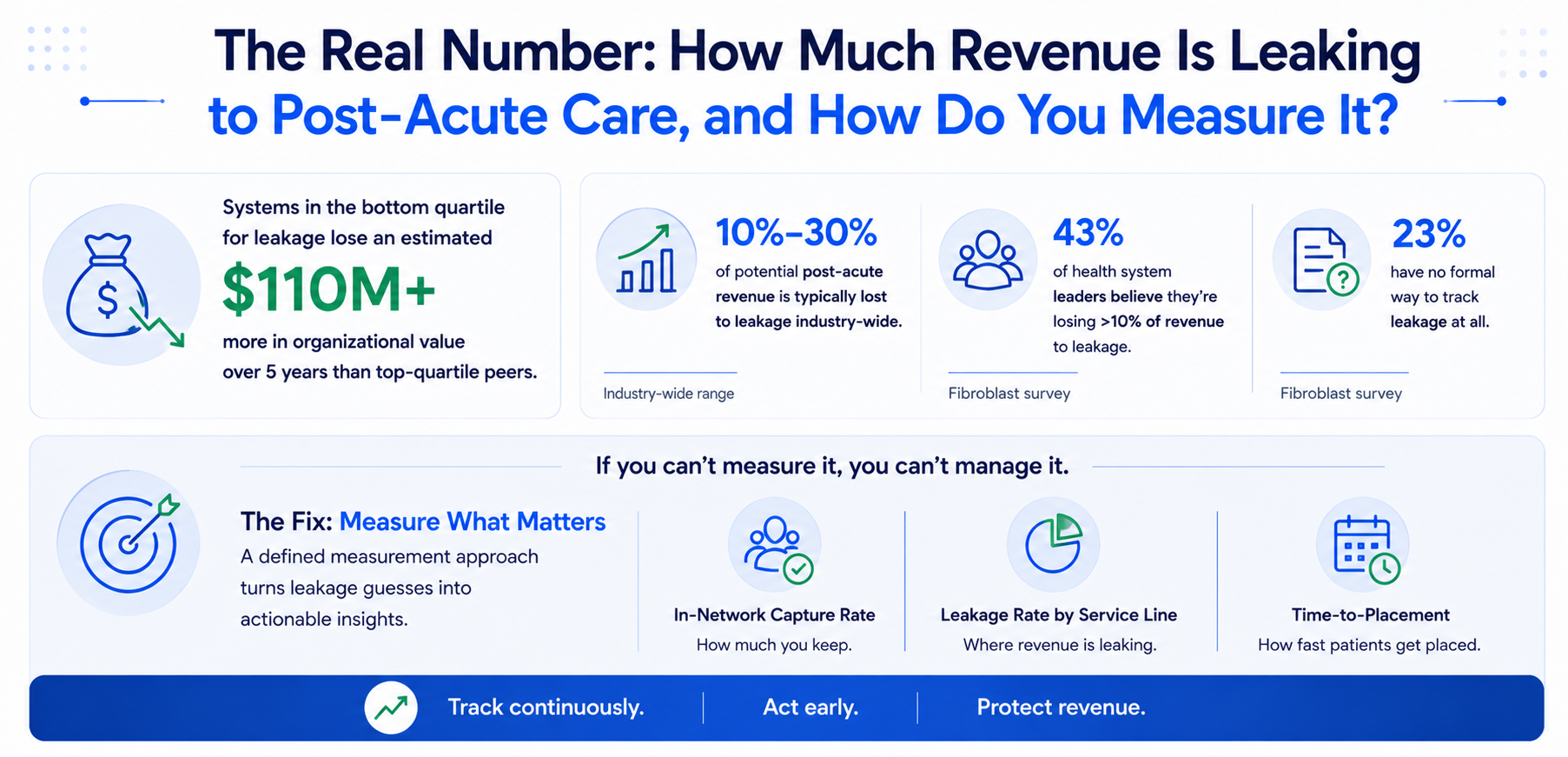 Ask five people on your leadership team how much revenue leaks to out-of-network post-acute providers every year, and you’ll likely get five different guesses. That uncertainty is itself the finding, and it’s showing up at a moment when hospitals can least afford it.
Fitch Ratings forecasts nonprofit hospital operating margins between just 1% and 2% for 2026, with the sector splitting into three tiers: the top 20% of systems using strong balance sheets to grow, the middle 65% expected to stagnate, and the bottom 15% losing ground.
Against margins that thin, and that unevenly distributed, recaptured referral volume, care you’re already equipped to deliver, at reimbursement you’re already contracted for, is one of the few growth levers that can move the needle inside the same fiscal year.
The mismatch shows up in the data wherever researchers have looked for it.
The Medicare Payment Advisory Commission’s March 2026 report to Congress cites a peer-reviewed study finding that the discharging hospital itself had a measurably large effect on whether stroke patients were referred to an inpatient rehabilitation facility or a skilled nursing facility. The same report notes that industry stakeholders have told the Commission that inpatient rehabilitation facilities admit fewer than 40% of the patients referred to them in the first place, a gap that has little to do with network status and everything to do with a referral process that doesn’t reliably match patients to a setting that will actually take them.
None of that variation is random, and none of it means the fix requires guessing better. It means the process determining where a patient lands, runs on hospital habits and default behavior. It is not connected to a system built to route patients to the best available fit and confirmed placement.
If your organization doesn’t have a defined measurement approach in place, in-network capture rate, leakage rate by service line, and time-to-placement, tracked continuously through business intelligence & data visualization services instead of reconstructed after the fact once claims data finally surfaces the problem, you’re not managing referral leakage. You’re guessing at it.

Where the Leakage Actually Happens: The Discharge Planning Breakdown Points
Ask a discharge planner why a patient ended up at Facility B instead of your preferred Facility A, and the honest answer is rarely “the patient chose it.” More often, it’s one of a handful of operational failure points that repeat across nearly every health system, on nearly every shift.
| Breakdown Point | What It Looks Like on the Floor | Why It Drives Leakage |
| No real-time bed or capacity visibility | Planner manually calls four or five facilities to check for an open bed | Whoever answers first gets the patient, not whoever performs best |
| Fragmented scheduling workflows | Referral sent by fax, confirmed by phone, tracked in a spreadsheet | The loop closes late, or doesn’t close at all |
| Insurance and prior-auth friction | Planner isn’t sure which post-acute partners the plan actually covers | Default becomes convenience, not network fit |
| No closed-loop confirmation | Once the discharge order is signed, no one confirms the placement happened | Leakage stays invisible until claims data surfaces it months later |
| Weekend and after-hours coverage gaps | Discharge happens Friday afternoon; preferred partners don’t answer | Patient goes wherever is reachable, network status aside |
Table 1. Five recurring breakdown points across the post-acute referral process.
None of these are exotic problems. They’re the same five or six friction points, repeating on every shift, invisible until someone finally adds up the cost.
The Downstream Hit: Readmissions, Quality Scores, and the Beds You Can’t Turn Over
Once a patient leaves your network for post-acute care, you lose more than the placement. You lose visibility. There’s no shared data feed telling you whether that skilled nursing facility caught a medication issue early, whether the home health agency showed up for the first visit, or whether the patient is trending toward a readmission you could have prevented.
That matters more than it used to. Hospitals nationwide are now watching Medicare Advantage patients wait nearly twice as long to be discharged to post-acute care as traditional Medicare patients, a gap that has doubled since 2019, even as MA reimbursement to hospitals fell 8.8% over the same period. Hospitals are absorbing that mismatch directly: longer stays, no matching payment, and beds tied up by patients who are medically ready to leave but have nowhere confirmed to go.
Referral leakage and bed-turnover delay come from the same root cause: discharge planners without real-time visibility into which post-acute partner has capacity, takes the patient’s plan, and actually performs well on outcomes. Fix the visibility problem and both numbers move together.
The ROI Case: What a Preferred Post-Acute Network Actually Buys You
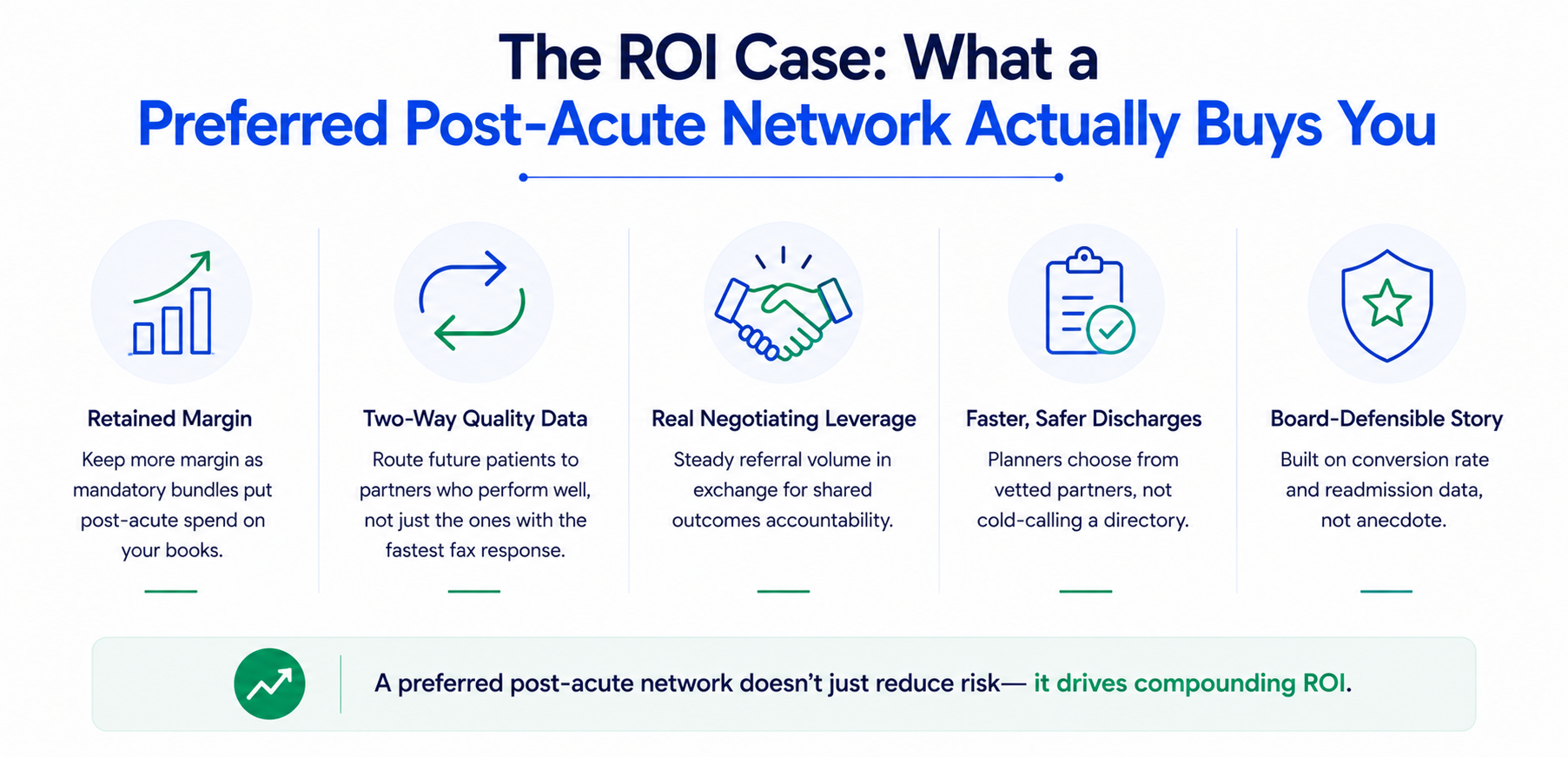 Building a genuinely high-performing, in-network post-acute panel, and steering referrals toward it, isn’t just a defensive move. It compounds.
- Retained margin, at a moment when mandatory bundled payments put post-acute spend directly on your books.
- Two-way quality data, so you can route future patients to partners who actually perform well, not just the ones with the fastest fax response.
- Real negotiating leverage with skilled nursing facilities and home health agencies who want steady referral volume in exchange for shared outcomes accountability.
- Faster, safer discharges, because planners choose from a short list of vetted partners instead of cold-calling down a directory.
- A board-defensible measurement story, built on conversion rate and readmission data instead of anecdote.
CMS’s Mandatory Bundled Payments Just Raised the Stakes
If you’ve been treating post-acute referral strategy as a someday project, TEAM changed the timeline. The model has been mandatory since January 1, 2026, for more than 700 acute care hospitals across 188 geographic markets, covering five surgical episodes: lower extremity joint replacement, surgical hip and femur fracture treatment, spinal fusion, coronary artery bypass graft, and major bowel procedures.
Here’s the part that should change how your team thinks about referrals. Each episode includes 30 days of post-acute care bundled under a single target price, covering skilled nursing, home health, and hospice. Come in under that target while hitting quality benchmarks, and the hospital shares in the savings. Let a patient leak to an out-of-network, uncoordinated, or lower-performing post-acute provider during that same window, and the hospital still owns the cost and the outcome, even though it lost control of where the patient went.
Medicare Advantage plans add another layer of pressure, often steering patients toward their own narrow post-acute networks regardless of clinical fit or your existing partnerships. Between TEAM’s mandatory risk and MA’s narrowing networks, referral leakage has quietly become one of the more direct financial exposures on your books. Addressing that exposure requires data strategy consulting services that bring referral, payer, provider, network, and post-acute data together to give hospital leaders the visibility they need to make better-informed decisions.
Real-Time Data and Interoperability: What Actually Closes the Loop
Most referral leakage isn’t a strategy failure. It’s a data-timing failure. The discharge planner needs to know, in the moment, which preferred partners have an open bed, accept the patient’s insurance, and have a real track record on readmissions and length of stay. Instead, that information usually lives in three different systems, none of which talk to each other, updated on three different schedules.
Closing the loop takes three things working together:
- A live feed of bed and capacity availability from your preferred partners
- Care transitions data that flows both directions between your EHR and the post-acute provider
- Closed-loop referral tracking that confirms a placement actually happened instead of assuming it did once the discharge order is signed.
Without that third piece, leakage stays invisible until claims data surfaces it, long after the decision that caused it.
Is Agentic AI for Referral Management Ready, or Still Overhyped?
Reasonable question, and worth a direct answer instead of a sales pitch.
Fully autonomous AI making clinical placement decisions on its own: not ready, and not something most compliance or clinical governance teams should sign off on yet. What is ready, and already deployed at scale in some health systems, is much narrower. AI agents that check real-time bed availability across your preferred network, verify insurance and prior-authorization fit, surface the best matching in-network option to the discharge planner within seconds, and automate the caregiver matching and scheduling steps that used to eat an entire afternoon.
The useful test for a COO or CFO evaluating vendors: does the AI make the decision, or does it hand the discharge planner a faster, better-informed decision to make themselves? The second version is mature technology, deployable now. The first version, mostly, is still a demo.
KPIs to Track (and How to Build Accountability Without Adding Headcount)
| KPI | What It Tells You | Target Direction |
| In-network capture rate | Share of eligible referrals placed with preferred, high-performing partners | Higher |
| Referral conversion rate | Share of referrals that result in a confirmed, completed placement | Higher, and faster |
| Time-to-placement | Hours from discharge order to confirmed bed | Lower |
| Readmission rate by post-acute partner | Which partners actually perform once the patient leaves | Track continuously, route accordingly |
| Leakage rate by service line | Where leakage concentrates, prioritized by TEAM-covered episodes | Lower, starting with highest-volume episodes |
Table 2. Core KPIs for benchmarking post-acute referral performance.
You don’t need a bigger team to close this gap. You need visibility that already exists somewhere in your systems, surfaced at the moment a discharge decision gets made, with the friction stripped out. Automate the checking, the matching, and the confirming. Leave the judgment calls, and the relationships, to your discharge planners.
Where This Fits in Your Throughput Strategy
Referral leakage and bed-turnover delay are two symptoms of the same disease: discharge decisions made without real-time visibility into where a patient can actually go, safely and well.
- If your organization is measuring leakage for the first time, start narrow.
- Pick your highest-volume TEAM-covered episode and build a preferred panel of three to five post-acute partners with real outcomes data behind them.
- Track conversion rate for ninety days before scaling further.
Your board doesn’t need a hundred-page strategy. It needs a number that moves, and proof of why it moved. Data engineering and integration services can connect referral, partner, placement, and outcomes data across disconnected systems, giving teams the visibility they need to identify leakage and improve throughput.