














Summary
Nurses at HCA and UNC Health rejected AI nurse scheduling tools, and the causes sit in design and governance. This guide turns six months of headlines into a playbook: hard constraints, local override, explainable assignments, trust metrics and a staged autonomy ladder.
Introduction
Over four months, a Florida critical care nurse asked her hospital’s AI nurse scheduler for 50 specific shifts. More than half the time, she told WIRED, it put her somewhere else, often on three days in a row. Her one-line verdict on her employer: it is “letting AI dictate.”
In North Carolina that summer, UNC Health invited the 4,000 nurses in its Chapel Hill hospitals onto a shift-bidding platform called BidShift, where they would bid against each other for extra shifts. The first shifts posted on 22 July 2026. By 7 August, after the plan went viral, the medical center’s president called the hospital’s own description of it a mistake and apologised to staff.
Neither system crashed. Both were rejected. That is the most important pattern in healthcare AI right now, and it traces back to governance and design choices. This post reads six months of headlines on AI nurse scheduling as an implementation guide: what nurses are actually objecting to, what it reveals about how scheduling AI is being designed, and the playbook that separates a tool staff adopt from one they organise against.
What is an AI nurse scheduler, and what does it promise?
An AI nurse scheduler, also called nurse scheduling software, forecasts demand, matches staff to it, and keeps re-planning as conditions change. The most-watched example today is Timpani, built by HCA Healthcare with Palantir and deployed in roughly 130 of HCA’s 190 hospitals, according to the AI Now Institute report published on 18 November 2026.
Based on public HCA and Palantir presentations summarised in that report, the tool works in four layers:
- Talent profile: each nurse self-reports competencies, proficiency level, tenure and scheduling preferences.
- Volume prediction: historic hospital data plus outside signals, such as local flu trends, forecast patient demand up to 30 days ahead.
- Intelligent staffing: the system continuously recommends staffing changes and swaps, and can text staff to act on them, with or without a nurse leader approving first.
- Business rules: cost data and other rules shape the final schedule.
The promise is real and specific. HCA executive Michael Schlosser has written that Timpani cut the hours managers spend on scheduling, reduced reliance on costly contract nurses, and improved retention, as reported by WIRED. HCA also says final scheduling decisions rest with nurse leaders. Timpani is not unusual either: the report lists Clairvia, Epic’s scheduling tools, M7 Health and others in the same category.
Scheduling is one of the most visible AI use cases in healthcare, because it touches every nurse, every shift and every labor budget at once. In workflow terms, it is healthcare workflow automation applied to one of the most sensitive rosters in the building. Tools like these belong to a wider family of predictive staffing models that forecast census, acuity and skill mix before a single shift is built. Timpani, Clairvia and M7 Health are all healthcare staffing software systems of that kind, and each one raises the same question: who gets the final say?
Six months of AI nurse scheduling headlines, read as implementation lessons
Every story below is a different failure mode, and each one was avoidable at design time.
| Date | Source | What happened | The lesson for implementors |
| 18 Nov 2026 | AI Now Institute | Report built on focus groups with 16 union nurses describes six-shift streaks, ignored days off and a three-nurse ICU shift. HCA replied that 16 union members cannot judge the tool. | If you have no published outcome data of your own, the smallest critical sample sets the narrative. |
| 2 Oct 2026 | WIRED | HCA nurses say local managers lost the ability to edit schedules; appeals now go to a central team. One union’s grievance is likely headed to arbitration, and an ex-data manager’s lawsuit alleges scheduling data was deleted, blocking audits. | Centralized overrides and missing audit trails convert everyday complaints into legal disputes. |
| 17 Sep 2026 | The Assembly | UNC Health dropped shift bidding about two weeks after launch. The replacement program removes bidding and pays the same or more, per an internal memo. | Never let pricing logic ride inside a scheduling tool without consent. Staff without bargaining rights still stopped this one. |
| 28 Aug 2026 | KQED | National Nurses United protested in eight cities. The same day, California lawmakers sent the governor a bill barring AI from functions that require a professional license. | Regulation is moving toward license-holder control. Design for it before it is required. |
| 17 Jul 2026 | Bloomberg Law | The New York State Nurses Association filed a grievance at Montefiore, citing a contract technology clause that requires the hospital to meet the union when AI reduces staffing. | AI clauses already exist in labor contracts. Read them before you write the project charter. |
Read together, the stories say one thing: the technical quality of the optimiser was never the deciding variable. Governance was.
Why do nurses push back on AI nurse scheduling?
Nurses push back on AI scheduling because of five concrete failures that they describe again and again, in the AI Now focus groups (16 unionized nurses across six states) and in WIRED’s interviews with HCA nurses.
Craig Cedotal, pediatric nurse, at the Palo Alto protest (KQED): “A machine should not make decisions about how we take care of each other.”
- Preferences that seem to vanish. A Florida critical care nurse told WIRED she requested 50 specific shifts over four months and was placed elsewhere more than half the time, often on three days in a row. HCA says Timpani schedules nurses on only about 1 percent of their requested days off. Nurses answer that, before the tool, being scheduled on a requested day off at their facility simply did not happen. A small average still lands on real people’s medical appointments and family duties.
- Clinically unsafe mixes. Nurses report shifts staffed entirely by junior nurses, charge nurses pulled onto the floor, people scheduled six shifts in a row, and in one account an ICU shift with three nurses. HCA counters that over 98 percent of initial schedules include a mix of skill and experience. Both can be true, and the failures that matter most live in the tail.
- No one local can fix it. Some managers could edit schedules at first. Nurses now say appeals go to a central team in Nashville, through the app, with no conversation. One nurse in the report put it plainly: nobody in the building controls the posted schedule. When the human in the loop is far away, nurses experience the loop as closed.
- A black box that also scores you. Nurses do not know which inputs drive their schedule. One discovered by browsing the app that it gave him an attendance score, with a half-point penalty for clocking in too early. A tool sold as scheduling help is felt as algorithmic management.
Alfredo Romero, economist, North Carolina A&T, on the UNC case (The Assembly): “If I don’t know how these shifts are being allocated, then the outcome is unfair.”
That sentence is the whole explainability argument in one line. People judge fairness by the process they can see, even when you can prove the outcome.
- Who carries the blame. Nurses fear becoming the “moral crumple zone”, a term the report borrows from researcher Madeleine Clare Elish: when the automated system fails, blame falls on the nearest human. HCA’s spokesperson says nurse leaders make final decisions; nurses ask how that is meaningful if they cannot change the output.
Underneath all five sits distrust about purpose. The report argues the real problem is lean, cost-driven staffing, and that scheduling AI can become cover for it. HCA rejects that framing and says the report’s sample of 16 union members cannot judge the tool. For an implementor, who is right matters less than this: if users believe your system exists to cut their hours, every scheduling error reads as intent.
The tension is now public. National Nurses United held protests in eight cities on 27 August 2026, an HCA psychiatric centre union filed a grievance over Timpani that WIRED reports is likely headed to arbitration, and a former HCA data science manager has sued alleging retaliation for raising concerns about the tool (HCA had not responded in court when WIRED reported it).
What it means for AI implementors
Each failure above maps to a design decision you make before go-live, long before change management begins.
CIOs and COOs planning AI implementation across departments will recognize the pattern. A sound model still stalls when governance is missing, and scheduling makes the stakes personal because every nurse feels the output in their own week.
| Nurse pushback | Root cause in the system design | What to build instead |
| “It ignores my days off” | Preferences are soft weights traded against cost; the user cannot see the trade | Hard constraints for protected time; show each nurse which requests were honoured and why any were not |
| Unsafe skill mix | Optimising averages; no floor on experience per shift | Clinical guardrails as non-negotiable rules (minimum senior nurses, credential match, max consecutive shifts) owned by nurse leaders |
| No one can fix it | Override authority centralised away from the unit | Local override with a logged reason; the override log becomes training signal |
| Black box | No explanation surface for the worker; hidden scoring | Plain language “why this shift” for every assignment; disclose every metric the system computes about a person |
| Blame lands on nurses | Human in the loop has accountability but no real control | Define the decision owner per action; never let the system act autonomously where a human carries the liability |
| “It exists to cut us” | Objective function set by finance, invisible to staff | Publish the objective and its weights; co-design them with frontline staff and, where relevant, the union |
Three principles sit behind the table.
- Measure acceptance alongside accuracy. Coverage and overtime are system metrics. Override rate, swap volume, appeal turnaround, call-outs and turnover are trust metrics. If the optimiser looks great while swaps and call-outs climb, the schedule is being rebuilt by hand off-system.
- Design for the tail. One percent of red days violated sounds small until it is your mother’s surgery. In healthcare, the rare bad schedule is the one that reaches a patient. Set hard limits where harm concentrates, and report tail outcomes alongside means.
- Keep the loop close to work. A human in the loop only counts if that human sits near the floor, can change the output quickly, and is expected to. Remote approval queues turn oversight into rubber-stamping.
HCA’s own leadership has said it expects the tool to act autonomously in future, according to the AI Now report; that roadmap is exactly what makes staff wary today.

The playbook: make the AI earn its autonomy
The HCA story shows the reverse path: managers could edit schedules early on, then lose that control, while leadership publicly anticipates the tool acting on its own. Trust flows the other way. Autonomy should be granted one stage at a time, against gates staff can see.
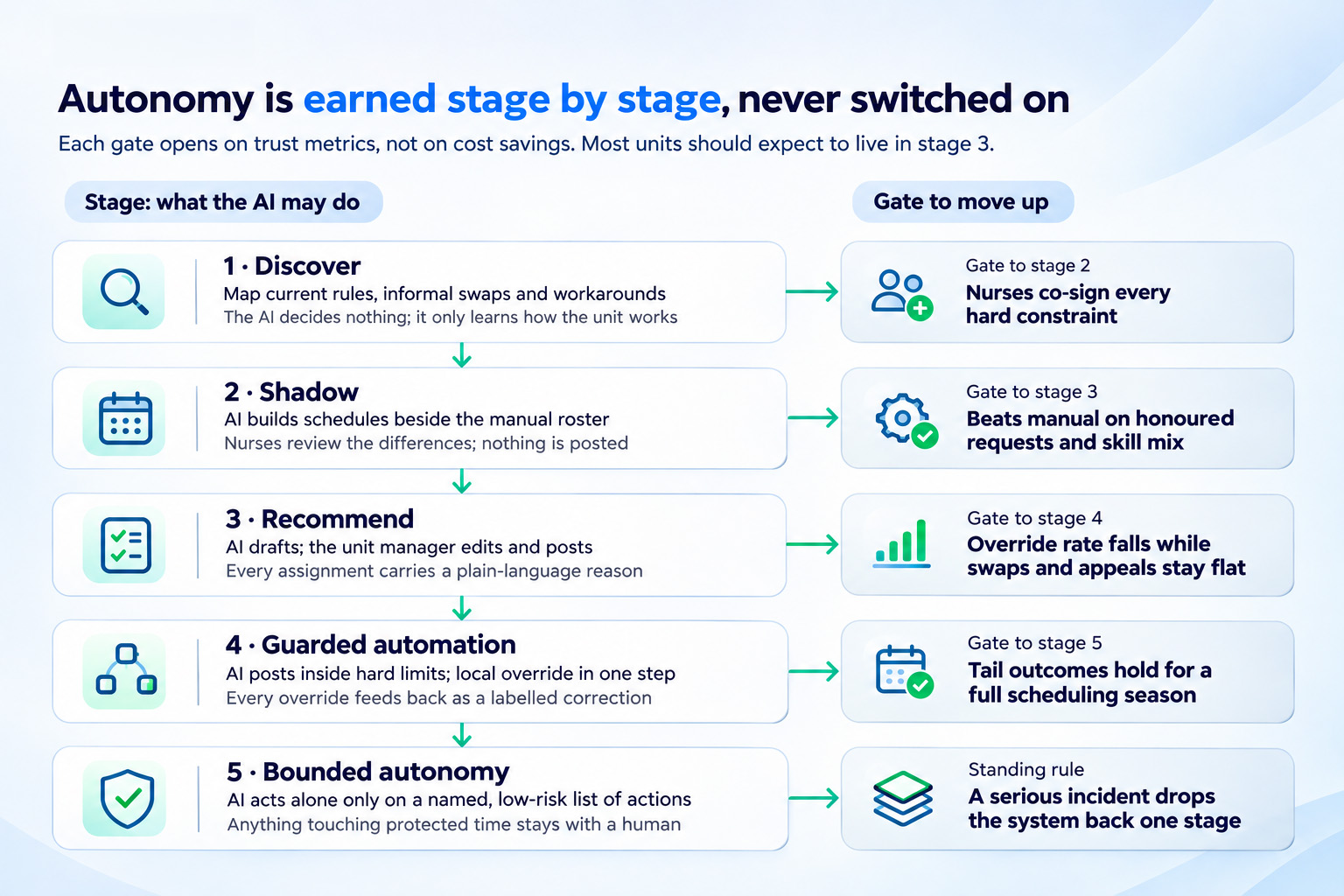
Each stage widens what the AI may do only after the previous gate is passed on trust metrics; any serious incident moves it back one stage.
Healthcare AI governance guidance describes the same idea as autonomy tiers, running from recommend-only to monitor-and-alert, with a short list of actions that always need a person. Add least privilege access and an audit trail for every agent action, and the ladder above becomes something a safety committee can sign off. Agentic AI applications in healthcare, scheduling agents included, earn their place the same way: one verified stage at a time.
Five positions for implementation leaders
“Human in the loop” is a staffing decision. An approver in another city with hundreds of schedules and no unit context is a rubber stamp. Budget the approver’s time and proximity like a clinical role or stop claiming the loop exists.
The override log is your best training data. Every manual fix is a labelled example of what the model got wrong. Organizations that treat overrides as non-compliance throw away the cheapest improvement signal, they will ever get.
Your real competitor is the group chat. If texting a colleague is easier than using the official tool, staff will route around it. Your dashboards will look healthy while the real schedule lives off system.
Keep pay out of the scheduler. UNC’s backlash centered on a price that fell as nurses competed. Bundle compensation logic into a scheduling AI and you inherit every grievance about pay.
Treat labor as a design partner. Montefiore shows AI clauses already sit in contracts. UNC shows staff without bargaining rights can still stop a rollout in about two weeks. Either way, the people being scheduled hold a veto; the only question is whether you invite it early or meet it late.
A practical rollout checklist for AI nurse scheduling
Use this before any AI scheduling or staffing agent touches a live roster.
☐ Nurses and charge nurses co-wrote the hard constraints, and nurse leaders’ own changes to them
☐ The objective function and its weights are written down and shared with staff
☐ Every assignment has a plain-language reason a nurse can see in the app
☐ Unit-level managers can override any schedule, with a logged reason
☐ Every metric computed about an individual (attendance, reliability) is disclosed to that individual
☐ Autonomous actions are listed explicitly; everything else needs local human approval
☐ A shadow period runs the AI schedule beside the manual one before cutover, with nurses reviewing the differences
☐ Trust metrics (override rate, swaps, appeals, callouts, turnover) are on the launch dashboard next to coverage and cost
☐ Scheduling data and model decisions are retained long enough to audit outcomes
☐ Staff are told which AI tools are in their workplace, what data they use, and who to contact when one is wrong
☐ Where staff are represented, the union saw the design before go-live, well ahead of the first grievance
Final thoughts: AI nurse scheduling is a trust problem first.
Nurses welcome help with scheduling. Several in the AI Now focus groups said a tool like this could take real burden off managers. What they reject is a system that decides their lives, cannot explain itself, cannot be corrected locally, and may be serving a goal they never agreed to.
For anyone building agentic AI for frontline healthcare workers, that is the design brief. Build the explanation, the override and the shared objective first. Then optimize. A schedule nobody trusts will be rebuilt by hand, in text threads and swap requests, and your efficiency gains will disappear into work you never see.