













Summary
Hospital staffing and demand forecasting uses AI predictive staffing models to match nurse capacity to real-time patient flow, forecasting census, acuity, and skill-mix before shifts are built instead of filling gaps after they appear. This approach cuts agency staffing costs and reduces nurse burnout by pairing EHR-integrated staffing analytics with census-based demand forecasting and delivers measurable ROI. Governance guardrails for union rules, fatigue limits, and compliance, presents a clear solution to hospital staffing shortage.
Introduction
Most nurse staffing shortages are not surprises. They are forecasting failures that surface weeks after the warning signs first appeared, buried in a census trend nobody tracked or a schedule built on instinct instead of evidence. By the time a unit is short two nurses on a Tuesday afternoon, the real failure already happened three weeks earlier.
The math behind that isn’t going away on its own. The Health Resources and Services Administration’s most recent national workforce projections put the country roughly 8 to 10 percent short of the registered nurses hospitals will need through the back half of this decade, worse in rural areas, worse in behavioral health and long-term care. The Bureau of Labor Statistics still projects steady growth in RN demand, roughly 180,800 openings a year through 2035, largely because an aging population needs more care, not less. Put those two numbers side by side and the conclusion is blunt: hospitals cannot hire their way out of this gap. They have to get sharper about matching the staff they already have to the patients who are actually coming.
This is the third piece in our series of articles related to the hospital throughput crisis, and it sits closer to the ground than bed capacity and discharge delays. Staffing decides whether a unit can actually absorb the patients those beds are holding. If your census forecast and your staffing plan get built separately, on different timelines, by different teams, you will always be reacting to demand instead of meeting it.
For a transformation leader trying to prove AI can solve a defined operational problem rather than just look impressive in a demo, staffing and demand forecasting is one of the cleanest use cases in the hospital. The data already exists somewhere in your systems.
The KPI is obvious:
- Fewer shifts filled by agency staff
- Fewer forced overtime hours
- Fewer nurse-to-patient ratios pushed past safe limits
The failure mode is visible fast if you get it wrong. Real data is a measurable outcome combined with fast feedback. That combination is exactly what makes this a sound place to spend one of the one or two agentic AI initiatives a board could fund this year.
How much can hospitals really cut from agency staffing spend with AI forecasting?
Ask a vendor this question and you’ll get a round number, usually 20 percent, delivered with total confidence. You know it as much as I do that the trail usually goes cold when you try to point out a recent study to back it up.
Here’s a number worth trusting instead.
Researchers at Columbia Business School, working with Stanford and clinicians at Hackensack University Medical Center, built and tested a prediction-driven nurse staffing model for a real emergency department.
The result: hourly nursing labor costs dropped by more than $160, which worked out to roughly $1.4 million in annual savings for a single ED, while wait times, treatment duration, and patient flow held steady.
No quality trade-off buried in the fine print. A measured cost reduction sitting right next to stable clinical performance.
That’s the standard to hold any staffing forecasting tool, or any AI initiative, to in a hospital. Whether you choose a vendor offering predictive analytics services or build the capability internally, insist on seeing cost and quality numbers together before you fund a rollout past a single unit.
The data you need before an AI predictive staffing model will work
This is where most staffing AI pilots quietly die, and it happens before a single algorithm runs.
An AI predictive staffing model in healthcare needs clean history. Here are some other basic requirements:
| Data Input | What It Includes | Why It Matters |
| ADT data | 12–24 months of admission, discharge, and transfer records, by unit | Gives the model enough history to learn real patterns, not just recent noise |
| Staffing ratios & skill mix | Nurse-to-patient ratios and skill mix by shift, not just headcount | Headcount alone hides whether the right staff were on the floor |
| Patient acuity scores | Acuity data tied to the actual staffing decisions made at the time | Lets the model learn what drove a decision, instead of guessing from census alone |
| Payroll & scheduling history | Overtime patterns and agency/travel nurse fill history | Shows where reactive staffing has been masking a forecasting gap |
| External demand signals | Local flu surveillance data, school calendars, elective surgery schedules | Captures predictable volume swings the model would otherwise miss |
Most hospitals have pieces of this scattered across the EHR, a separate scheduling platform, and payroll, with no shared identifier connecting them. That’s a data strategy problem before it’s a modeling problem. Our data strategy consulting services ensure that our experts map what you have, fix the identifiers that don’t match across systems, and build the pipeline before anyone talks about algorithms. Skip any of these steps and you get a model that falls apart the first week it meets real hospital data.
 Forecasting Patient Volume and Staffing Together, Not in Sequence
A common mistake: build a patient volume forecast, hand it to workforce planning, and let them build a staffing plan on top of it a week later. By the time the staffing plan is ready, the volume forecast is already stale.
Census-based staffing models that actually work run both forecasts on the same clock, ideally the same data pipeline. Emergency department demand forecasting, seasonal patient volume prediction, and unit-level staffing recommendations need to update together, on a rolling basis, not as two separate reports reconciled manually every Friday.
This is closer to what predictive modeling in healthcare should mean in practice: one model, or a tightly linked pair of models, producing a staffing recommendation that already accounts for tomorrow’s expected census, not last month’s average.
The payoff shows up in surge planning. A hospital forecasting volume and staffing on the same cycle can flex float pools and agency requests days ahead of a predictable surge, flu season being the obvious example, instead of scrambling once volume spikes.
Differences between scheduling software and true predictive demand forecasting
Both scheduling software and predictive demand forecasting solutions get sold as the same thing. They are not.
A nurse scheduling optimization software takes a staffing template you already decided on and fills it efficiently. The nurse scheduling solution matches nurse preferences, certifications, and fatigue rules against open shifts. It’s a reactive staffing model wearing a modern interface. It usually answers “who works Tuesday” well. It doesn’t answer “how many nurses does Tuesday actually need” which could be addressed through a predictive nurse scheduling solution.
Predictive demand forecasting answers that second question first. It reads historical and real-time signals, census trends, ED arrival rates, discharge velocity, seasonal patterns, to estimate the staffing level a unit will need before the shift is built, then hands that number to the scheduling layer. One tool optimizes a plan. The other decides what the plan should be. Hospitals that only buy the first one are still staffing reactively, just with better software.
To explain this, here is a comparison table
| Reactive Staffing | Predictive Staffing | |
| Trigger | An open shift or a census spike that’s already happened | A forecasted census or acuity shift, days to weeks out |
| Primary tool | Scheduling optimization software | Demand forecasting model + scheduling layer |
| Typical fix | Overtime or last-minute agency nurse | Float pool or pre-arranged coverage |
| Cost pattern | Spikes unpredictably with agency premiums | Smooths out, budgeted in advance |
| Burnout impact | High, driven by last-minute callouts | Lower, staff get advance notice |
| What it answers | “Who works Tuesday?” | “How many nurses does Tuesday need?” |
How accurate are AI staffing forecasts compared to a spreadsheet?
Don’t accept an accuracy claim without asking how it was measured. “95 percent accurate” means very little without knowing the forecast window, the unit type, and what counts as a miss.
The honest way to evaluate this: backtest the model against 6 to 12 months of your own historical census and staffing data before go-live, then track forecast error on a rolling basis afterward, comparing predicted versus actual need by unit and shift. A model that’s directionally reliable two to three weeks out, and tightens as the shift approaches, is far more useful than one claiming impossible precision a month in advance.
Spreadsheet-based forecasting, by comparison, is usually built on last month’s average and a scheduler’s memory of what felt busy. It has no error tracking at all, which is exactly why it feels accurate right up until the week it isn’t.
Why skill-mix and acuity matter more than headcount
A unit staffed to the right headcount with the wrong skill mix is still understaffed. This is the gap pure census-based models miss.
Patient acuity-based staffing accounts for the fact that ten stable post-op patients and ten high-acuity step-downs are not the same staffing problem, even at identical census. Skill-mix forecasting for hospitals needs to layer certification level, specialty competency, and acuity trends on top of raw patient counts, or it will recommend the right number of bodies and the wrong capability. A lot of “AI staffing” tools fall short here. They optimize headcount because headcount is the easy number to forecast. Acuity and skill mix are harder, which is exactly why they matter more.
What it takes to connect a forecasting tool to your EHR and payroll systems
This is the question that should come before a vendor demo, not after a contract is signed.
Real-time bed occupancy forecasting and EHR-integrated staffing analytics depend on live or near-live feeds from your EHR’s ADT stream, your scheduling platform, and your payroll or HR system, each very likely built by a different vendor, on a different data model, at a different point in your hospital’s history.
Integration effort here typically breaks into three buckets: pulling clean, structured data out of each source system; reconciling identifiers so a patient or a shift means the same thing across all three; and building the feedback loop that lets the model learn from what actually happened, not just what was scheduled.
Vendor Evaluation Checklist
| Ask the vendor | Why it matters |
| What’s your forecast error rate, backtested on our own data? | Vendor-claimed accuracy without your data means nothing |
| Which of the three integration buckets (data pull, identifier match, feedback loop) do you own? | Tells you what becomes your team’s job |
| Can you show cost savings and stable quality metrics together? | One without the other isn’t proof |
| Are union rules, fatigue limits, and audit trails built in or bolted on? | Determines whether it survives a labor dispute |
Evaluate vendors to walk through exactly these questions and what is expected from your team. Get the answers and you’re sorted.
Building guardrails: union rules, fatigue limits, and compliance in an AI staffing model
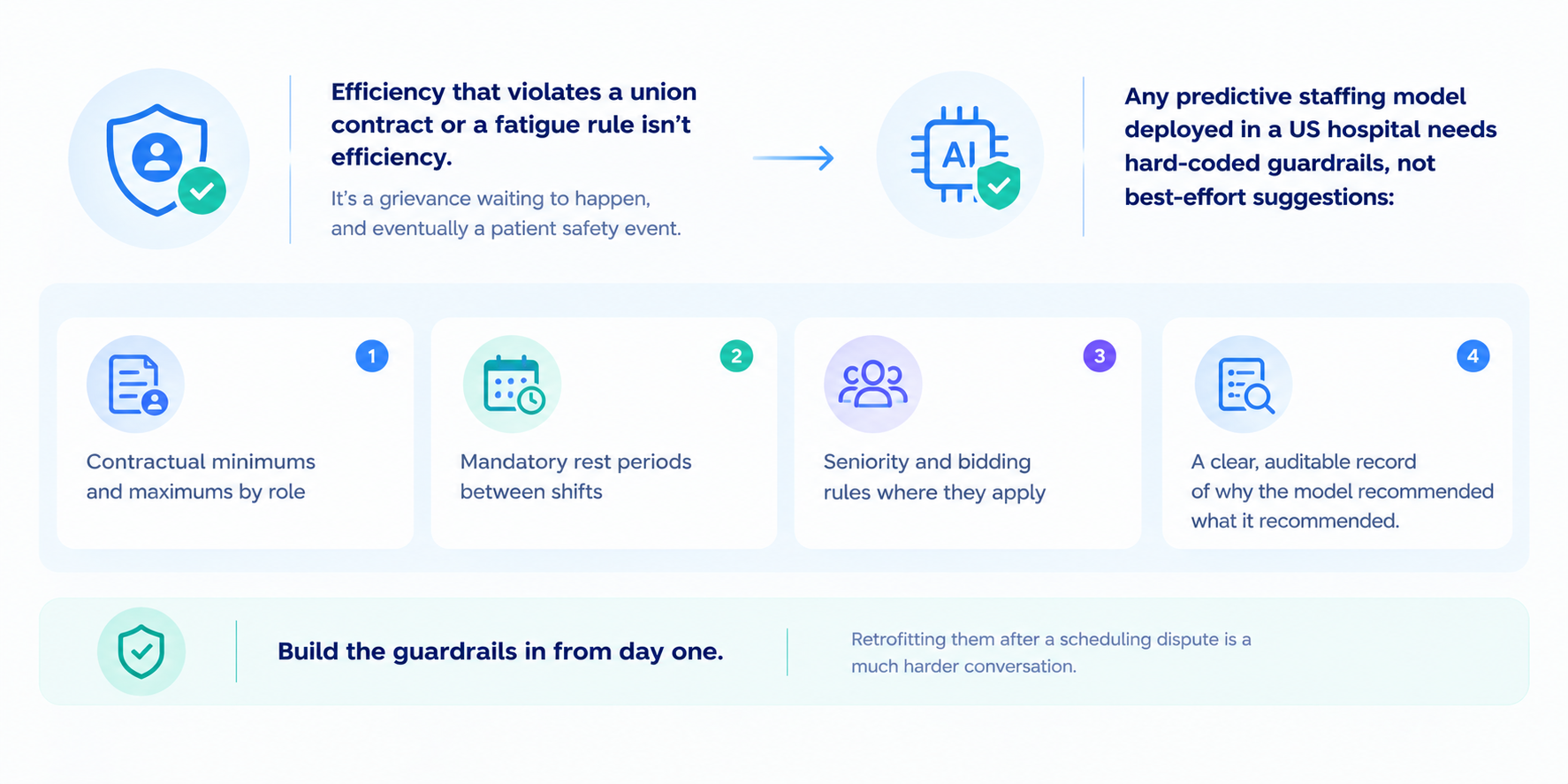 Efficiency that violates a union contract or a fatigue rule isn’t efficiency. It’s a grievance waiting to happen, and eventually a patient safety event.
Any predictive staffing model deployed in a US hospital needs hard-coded guardrails, not best-effort suggestions:
- Contractual minimums and maximums by role
- Mandatory rest periods between shifts
- Seniority and bidding rules where they apply, and
- A clear, auditable record of why the model recommended what it recommended.
This is the governance work that turns a staffing forecast from a black box into something you can defend to a labor relations team, a compliance officer, and a board that just finished asking hard questions about your last AI pilot. Build the guardrails in from day one. Retrofitting them after a scheduling dispute is a much harder conversation.
The Bottom Line
None of this requires betting the budget on a hospital-wide platform. Pick one unit, ideally the one with the worst agency spend or the most unpredictable census, and run the forecast against real data for one quarter before scaling anything. If the numbers hold, and they hold alongside stable quality metrics, that’s exactly what a board wants to see: a defined problem, a measured result, and a repeatable model for what comes next.