






Summary
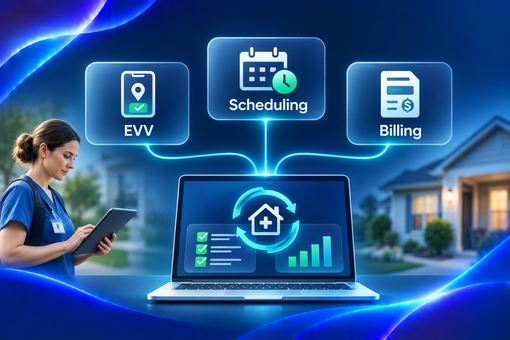
EVV billing integration in home health works when the schedule, the EVV record and the claim share the same client, caregiver, service, payer and authorization keys. Send visits to the state aggregator automatically, review exceptions before billing, and track first-pass acceptance to prove it.
| Quick Summary | What to know |
| The problem | Claims get denied when the visit held by the state aggregator doesn’t match the claim. |
| The fix | One visit key shared by schedule, EVV and billing, plus a pre-bill review. |
| The pattern | Build one canonical visit record and map it to each state’s format at the edge. |
| Who owns it | An EVV administrator, billing lead and scheduling manager, backed by one executive sponsor. |
| The proof | First-pass claim acceptance, exception rate and days from visit to claim. |
Introduction
Home health agencies integrate EVV, scheduling and billing data by giving every visit one shared key, sending verified visits to the state aggregator automatically, and matching schedule, EVV record and claim before submission. Several states now deny claims that lack a matching visit, so clean integration protects revenue and keeps clinicians focused on patients and referring physicians.
This article covers the integration path itself. The wider question of building a single source of truth across EHR, EVV, billing and CRM sits one level up, and the steps below plug straight into it.
Why Does EVV and Billing Integration Matter More for Home Health in 2026?
EVV integration matters more in 2026 because states now check claims against visit records before they pay. The 21st Century Cures Act requires states to use electronic visit verification for Medicaid personal care and home health services delivered in the home. KFF’s October 2026 brief reports that 48 states cross-check billed claims against EVV data, and 47 analyze EVV data to flag unusual billing patterns.
Enforcement has moved from after-the-fact review to claim adjudication. A claim without a matching verified visit gets denied at the edit, and the agency spends the next several weeks proving a visit that already happened. Patients and referring physicians feel that indirectly, because every hour a coordinator spends chasing a rejected visit is an hour away from scheduling care or returning a physician’s call.
Missouri shows how this plays out. Its Medicaid agency began denying personal care, homemaker and respite claims without a matching visit on April 1, 2026, with home health care providers due in later phases. The state lists four denial reasons: a verified visit not found, a participant number mismatch, a provider ID mismatch and unmatched units.
What Is EVV, and What Do Open, Closed and Hybrid Models Change?
Electronic visit verification (EVV) confirms that a home visit happened by capturing the service type, who received it, who delivered it, the date, the location and the start and end times. The state decides where that data goes. Your state’s model decides how much integration work lands on your side.
| Model | How visit data reaches the state | What it means for integration |
| Open | The agency picks an EVV vendor, and that vendor sends visits to a state aggregator | You own the interface from vendor to aggregator, and you link schedule and billing to the same visit record |
| Closed | The state requires one EVV system for the program | You integrate scheduling and billing with that system and treat it as the verification source |
| Hybrid | A state system plus a provider-choice route, or different rules by program or payer | You map both paths and tag each visit with the rule that applies to it |
Rules can differ by state, program and managed care plan, so one agency can sit in two models at once. Start with your Medicaid agency’s EVV page and each plan’s provider manual. In open and hybrid models the state aggregator acts as the validation layer, and a closed model’s state system plays the same role. Missouri’s EVV Aggregator Solution and MassHealth’s Sandata aggregator both receive visits and compare them with claims at adjudication.
Which Data Fields Must Match Across the Schedule, EVV Record and Claim?
Six fields do most of the work in EVV claim matching: client, provider, service code, date, units and visit status. A mismatch in any one can turn a delivered visit into a denial.
| Field | Schedule | EVV record | Claim | Typical mismatch |
| Client | Client ID from intake | Client or state ID on the visit | Medicaid ID billed | Same client under two IDs |
| Provider | Agency and branch | Provider ID registered with the aggregator | Billing provider ID | Billing ID missing from the aggregator |
| Service code | Authorized service | Code logged on the visit | Procedure code | Visit logged under a different code |
| Date | Scheduled date | Verified visit date | Date or date range billed | Overnight or split visits |
| Units | Authorized units | Verified minutes or units | Billed units | Billed units exceed visit units |
| Status | Scheduled | Verified, with payer, employee and location | Ready to bill | Visit unverified or incomplete |
MassHealth’s training on claim-to-visit matching rules spells out the logic. Billed units must be less than or equal to visit units, and the visit must reach Verified status, with payer, employee and location, before it can match.
Add the authorization number and caregiver credential status to your own visit key, since both catch problems before the aggregator does. A workable key combines client ID, caregiver ID, service code, payer ID and authorization number.
Scheduling is where authorizations meet caregivers, so the schedule is the natural place to create that key. Home care scheduling software and caregiver scheduling software capture different fields, so confirm which events your tool exposes, such as shift created, changed and canceled, before you design the feed.
Should You Integrate Point-to-Point, Through Middleware or on a Data Platform?
Use point-to-point links for a few stable systems, an integration engine as you add states and vendors, and a governed data platform when you want analytics and AI on the same visit record.
| Pattern | Best fit | Strengths | Watch-outs |
| Point-to-point | One state, one EVV vendor, one billing system | Fast to start, low cost at first | Every new system adds interfaces, and a state format change ripples everywhere |
| Integration engine or middleware | Several states, vendors or payers | One place for mapping, routing and retries, reusable across states | Needs an owner, monitoring and version control |
| Event-driven data platform | Multi-site or acquisitive organizations planning analytics and AI | Visit events reach every consumer with lineage and shared definitions | Highest effort, and governance has to start on day one |
Ask every EVV and scheduling vendor whether a change in one system reaches the other without a manual export. Bidirectional interfaces through a middleware hub hold up better than one-way exports and pairwise links as you add systems.
Count the interfaces you’ll need in three years. A single-state agency with one EVV vendor can stay simple. A multi-state operator that adds an acquisition every year usually can’t.
How a CIO weighs an EHR, a data warehouse and a data platform as the foundation is its own decision, and it shapes how much of this integration you build once and reuse.
How Do You Send EVV Visit Data to the State Aggregator Automatically?
Send EVV visits to the state aggregator automatically by building one canonical visit record and mapping it to each state’s format at the edge. The sequence looks like this:
- Capture the visit once, with client, caregiver, service, location and times.
- Enrich it from the schedule with payer, authorization and units.
- Transform it through an adapter built for that state’s aggregator format.
- Transmit it when the visit closes, and log every acknowledgment.
- Alert the owner the moment the aggregator rejects a record, with the reason.
- Write acceptance back to scheduling and billing so claims release only afterward.
Missouri’s “Verified Visit not found” denial shows why the last step matters. It appears when the vendor never sent the visit, or sent it after the claim. Teams that wait for someone to notice often find out weeks later. Event-driven pipelines with built-in retry logic and monitoring make a failed EVV aggregator transmission visible the same day.
Missouri expects providers to log into the aggregator at least weekly to check recorded visits. Automate that check and run it daily. For multi-state EVV aggregator management, keep the canonical record identical everywhere and swap only the adapter. A separate point-to-point feed per state multiplies upkeep fast.
How Do You Build a Pre-Bill Review for EVV Exceptions?
Build a pre-bill review as a three-way match: hold any claim whose schedule, EVV record and claim lines disagree, and route the exception to a named owner before submission.
Timing matters as much as content. MassHealth’s claims system looks for a matching visit in real time, doesn’t hold a claim waiting for one, and leaves a denial in place if the visit arrives later. Missouri lists a claim submitted before the vendor sent the visit as a denial cause. Release claims only after the aggregator has accepted the visit.
| Exception | What gets compared | Example | Owner |
| Visit not in aggregator | EVV vendor record against aggregator acknowledgment | Transmission failed or delayed | EVV administrator |
| Unit overrun | Billed, verified and authorized units | Billed units exceed visit units | Billing lead |
| Identity mismatch | Client and provider IDs across all three records | Client number differs on the claim | Intake lead or data steward |
| Service code mismatch | Authorized, logged and billed codes | Visit logged under the wrong code | Scheduling manager |
| Unverified visit | Visit status and required elements | Missing location or caregiver | Field supervisor |
Good EVV exception queue management comes down to four rules: every exception gets an owner, a due date, an age counter and a hard stop on the claim until it clears. MassHealth ran soft edits before hard edits, and that soft period works as a dress rehearsal. Log every mismatch then, fix the top causes, and you’ll enter hard enforcement with a short list.
Inferenz’s Caregence agents page lists real-time EVV compliance monitoring and exception flagging among its home care workflows, which suits teams that want exceptions in a queue the day they occur.
How Do You Reduce Manual EVV Edits and Keep an Audit Trail?
Reduce manual EVV edits by fixing their causes upstream, and require a reason code, an approver and a timestamp for every edit that remains. Typical causes are missed clock-outs, wrong service codes, schedule changes that never reached the EVV vendor and location capture failures.
A defensible EVV manual edit audit trail keeps the original capture intact and stores each edit as a layered event. Record these fields every time:
- Original value and edited value
- Who made the change, who approved it and when
- A reason code from a short, fixed list
- The claim and aggregator record the edit affected
Data quality rules can flag edits that cluster by caregiver, branch or hour. That matters because KFF reports that states analyze EVV data for unusual billing patterns. With lineage from source to consumption, a reviewer’s question about one visit gets answered in minutes.
How Do You Handle Personal Care and Skilled Home Health Lines, and Payroll Alignment?
Handle both lines with one canonical visit record, and apply payer-specific rules at the edge. The Cures Act mandate covers Medicaid services. Medicare fee-for-service claims don’t go through the state EVV match, yet the same schedule and visit data still supports Medicare’s 30-day PDGM periods and the visit counts behind LUPA awareness.
Agencies that bill several payers also need a platform that connects to several EVV systems. HHAeXchange, Sandata and Tellus are among the EVV systems it connects to, along with state-mandated aggregators.
EVV payroll billing alignment follows the same logic. If payroll rounds up and billing rounds down, the totals drift apart and nobody can say which one is right. Pick one rounding rule and one source for verified minutes, then reconcile paid, verified and billed hours every week.
Client and caregiver identity cause many of the remaining mismatches. Resolving duplicate records across systems is a discipline of its own, covered in how to create a single patient view across multiple home health systems.
Which KPIs Show the Integration Is Working, and How Does It Feed AI?
Track first-pass claim acceptance, exception rate and days from visit to claim, and baseline all three before you start. Add these to the dashboard:
- First-pass acceptance by payer and by state
- Open EVV exceptions and their average age
- Aggregator rejection rate and time to fix
- Manual edit rate by branch and reason code
- Denials by reason, such as unmatched units or visit not found
Scale shows what’s possible. One national home care provider with 40+ source systems after years of acquisitions now runs one governed warehouse, and Inferenz reports that acquired entities become analytics-ready in 8 to 10 weeks. The case study names payroll among its sources and leaves EVV and billing unnamed, so it evidences the integration pattern only.
AI in home care depends on this same groundwork. An agent that reads schedules, visits and claims has to know which one to believe, and every guess is a risk in a regulated workflow.
Inferenz connects an agency’s data into one system, and the Caregence platform helps stakeholders build custom agents for the workflows they own, integrating with MCP tools and the systems already in use. Once visits, schedules and claims agree, AI in healthcare becomes practical for billing teams too.
Final Thoughts
EVV integration pays off when one visit record serves the schedule, the aggregator and the claim. Map your state’s model and matching fields first. Add a pre-bill review next, then track first-pass acceptance for a quarter. Together those steps cut the weeks agencies spend proving visits that already happened.