










Summary
Data engineering has grown from back-office plumbing into the foundation of every analytics and AI program, and US providers now compete on platform depth, migration speed and data quality.
The work done by the top 10 data engineering companies spans ingestion, integration, observability and cloud migration. Prospects match a partner to their platform and test it on their messiest source system before going ahead with them.
Introduction
For most of the last decade, data teams got judged on how much they could store. That has changed. The question in boardrooms now is how quickly a clean, trusted record can reach a dashboard, a model or an AI agent, and who answers when it can’t. Buyers have adjusted how they shop, and the phrase “data engineering companies” now covers everything from Snowflake specialists to global consultancies. Many of those buyers want a partner who’ll handle data engineering and integration from the first pipeline to the last monitoring alert.
The stakes are practical. Pipelines break, source systems disagree, and nobody enjoys explaining to a CFO why two reports show different revenue. A good partner takes that pain away. A weak one adds to it. This guide profiles ten US-based firms worth a place on your shortlist, explains how we picked them and shows how to match one to your stack.
Cost is the reason the choice matters. Gartner puts the average price of poor data quality at $12.9 million a year per organization, a figure it published in 2021 that planners still lean on.
Full disclosure: We kept the field to US-headquartered firms which are dynamic and futuristic in the data engineering domain and highly relevant to American buyers. We ranked every company on the criteria below.
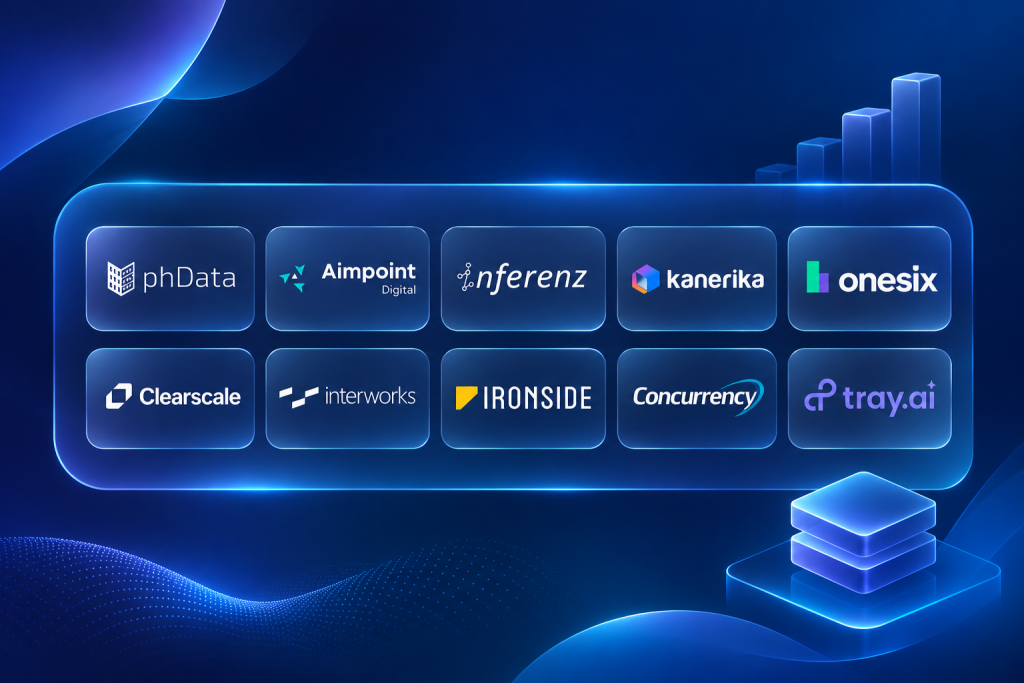
Top 10 data engineering companies at a glance
| # | Company | Best for | Headquarters and proof points |
| 1 | phData | Snowflake-centred programs that also need dbt and AWS depth | Minneapolis, founded 2014, Snowflake Elite Services Partner, AWS Premier Partner |
| 2 | Aimpoint Digital | Analytics and data engineering on Snowflake or Databricks | Atlanta, founded 2017, Databricks Digital Native Partner of the Year in 2024, 2025 and 2026 |
| 3 | Inferenz | Healthcare, insurance and hi-tech teams with fragmented sources | Round Rock, Texas, Founded in 2019, Snowflake, Databricks and AWS partner, 30+ accelerators |
| 4 | Kanerika | Microsoft Fabric and Azure data modernization | Austin, founded 2015, Microsoft Top 1% partner (2024), Snowflake Select Tier Partner |
| 5 | OneSix | Snowflake-first data platforms for mid-market and enterprise teams | Chicago, founded 2013, Snowflake Elite Partner |
| 6 | ClearScale | Cloud-native data platforms and application modernization | San Francisco, founded 2011 |
| 7 | InterWorks | Analytics strategy with managed services behind it | Stillwater, Oklahoma, founded 1996 |
| 8 | Ironside | Enterprise data and analytics on IBM technology | Lexington, Massachusetts, founded 1999, 25+ years with IBM data and analytics products |
| 9 | Concurrency | Established consultancy for data and analytics modernization | Brookfield, Wisconsin, founded 1989 |
| 10 | Tray.ai | Low-code integration and automation across SaaS applications | San Francisco, founded 2012 |
What do data engineering companies do?
Data engineering companies design, build and run the systems that move data from source applications into a form that analysts, models and AI agents can trust. The work usually covers five jobs:
- Ingestion: pulling data from databases, SaaS tools, files and event streams on a schedule or in real time.
- Transformation: cleaning, joining and modeling that data in a warehouse or lakehouse.
- Integration: connecting systems so a change in one shows up in the others.
- Quality and observability: testing data as it flows and alerting someone when it drifts.
- Operations: running the pipelines, fixing failures and controlling cloud cost after launch.
The demand behind this work is easy to see. McKinsey’s 2026 State of AI survey found that nearly nine in ten organizations report regular AI use, and 37% of respondents attribute at least some EBIT impact to it. Every one of those systems runs on pipelines that somebody had to build.
How we ranked these data engineering companies
Dozens of firms claim data engineering as a specialty. We shortlisted US-headquartered companies of comparable scale with public evidence you can check, and each one met most of these six criteria:
- Platform depth: named partner status with Snowflake, Databricks, AWS, Azure or Google Cloud, or a long record on a specific stack.
- Integration reach: experience with legacy databases, SaaS tools, streaming sources and the awkward systems in between.
- Built-in data quality: testing, deduplication and governance delivered with the pipelines.
- Evidence: dated awards, named customers or published outcomes on the company’s own site.
- Operating model: DataOps, observability and managed support after go-live.
- Regulated-industry fit: controls that stand up to the HIPAA Security Rule and similar standards when your data includes patient or financial records.
We kept a firm on the list only when at least two independent sources agreed on its headquarters and founding year. Companies that have been acquired, or whose records conflicted, were left out. The ranking reflects editorial judgment and carries no numeric scores, and confirming every number in a pilot remains your job.
The 10 data engineering companies to know in 2027
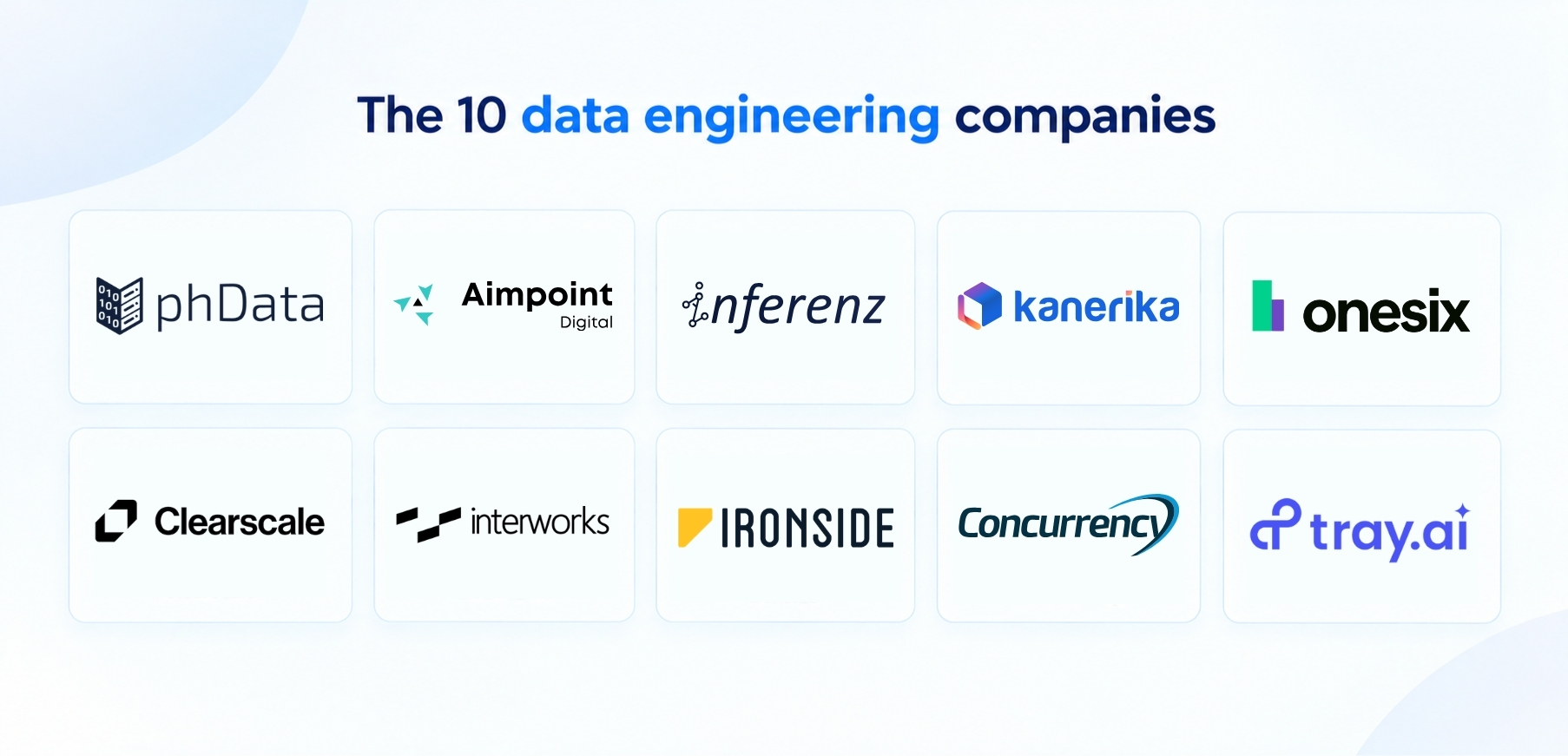
1. phData
Best for: Snowflake-centred programs that also need dbt, Fivetran and AWS depth.
phData was founded in 2014 and is headquartered in Minneapolis, with flagship offices in Uruguay and India. Its site lists data engineering, data migrations, analytics and generative AI among its services, and it carries Snowflake Elite Services Partner and AWS Premier Partner status. The company reports winning dbt Partner of the Year for the fourth year in a row in 2026.
Worth asking: how its team handles a legacy on-premises source that can’t move to the cloud yet.
2. Aimpoint Digital
Best for: analytics and data engineering programs on Snowflake or Databricks.
Aimpoint Digital was founded in 2017 and is headquartered in Atlanta. It describes itself as an analytics, data engineering and operations research firm, and lists Snowflake, Databricks, AWS, dbt Labs and Sigma among its partners. It reports Databricks Digital Native Partner of the Year awards in 2024, 2025 and 2026.
Worth asking: where its operations research work could add forecasting or optimization on top of the pipelines.
3. Inferenz
Best for: healthcare, insurance and hi-tech enterprises that need pipelines, integration and data quality delivered in one program.
Inferenz is a data and AI engineering company with US operations in Round Rock, Texas, and a team of 200+ specialists that also works from Ahmedabad and Pune. Its data engineering practice runs in five stages: discovery, architecture, pipeline development, integration and automation, and continuous operations under a DataOps model. Inferenz lists partnerships with Snowflake, Databricks and AWS.
Six reusable accelerators cover ingestion, pipeline automation, deduplication, observability, cloud integration and data quality. That toolkit keeps data quality, governance and compliance work inside the same engagement and shortens the path from raw feeds to reports people trust.
Worth asking: Inferenz reports a 96% client retention rate and 99% data accuracy and completeness across its work. Which accelerators apply to your sources, and what each one saves?
4. Kanerika
Best for: Microsoft Fabric and Azure data modernization.
Kanerika was founded in 2015 and is headquartered in Austin, Texas, with offices in India and Singapore. Its services span data platform migration, integration, governance and architecture, and it offers migration accelerators for Informatica, Tableau and Alteryx workloads. It reports joining Microsoft’s Top 1% partners in 2024 and holds Snowflake Select Tier status.
Worth asking: which migration accelerators apply to your current tools, and what manual work remains.
5. OneSix
Best for: Snowflake-first data platforms for mid-market and enterprise teams.
OneSix is a Chicago firm founded in 2013 and holds Snowflake Elite Partner status. It broadened its data engineering bench by acquiring CTI Data, so ask who from each team would staff your project. The firm focuses on modern data platforms, analytics and AI work for organizations that want a hands-on delivery partner.
Worth asking: how the CTI Data team and the original OneSix team share delivery on a new engagement.
6. ClearScale
Best for: cloud-native data platforms and application modernization.
ClearScale is headquartered in San Francisco and was founded in 2011. It is a cloud engineering firm, and its work often pairs data platform builds with application modernization. That pairing suits teams that need new pipelines and modernized applications at the same time.
Worth asking: how it divides work between platform engineers and data engineers on a joint project.
7. InterWorks
Best for: analytics strategy with managed services behind it.
InterWorks is headquartered in Stillwater, Oklahoma, and was founded in 1996. Its services include analytics strategy, data preparation, cloud migration, security and managed services. It lists Tableau, Microsoft, Sigma, AWS, Snowflake and Databricks among its partners.
Worth asking: how its managed services model handles incident response and cost reviews.
8. Ironside
Best for: enterprise data and analytics programs that run on IBM technology.
Ironside was founded in 1999 and is headquartered in Lexington, Massachusetts. It is an enterprise data and analytics firm and system integrator, and it points to more than 25 years of experience across IBM data, analytics and automation products. That history suits large organizations that run IBM stacks and want a partner who knows them well.
Worth asking: how its IBM-centred team approaches a move to a cloud-native warehouse.
9. Concurrency
Best for: an established consultancy for data and analytics modernization.
Concurrency is based in Brookfield, Wisconsin, and was founded in 1989, which gives it more than three decades of delivery history. It suits organizations that prefer a Midwest-based consultancy with deep experience in enterprise systems and a stable team.
Worth asking: which modern data platforms its current engineers have delivered in production.
10. Tray.ai
Best for: low-code integration and automation across SaaS applications.
Tray.ai is an AI orchestration and integration platform headquartered in San Francisco and founded in 2012. Its low-code tools let teams design workflows and manage integrations across IT, HR, support and other functions. It is a platform you operate, so compare it with a services partner on who maintains the workflows once they go live.
Worth asking: which connectors you need are native and which require custom work.
How to choose a data engineering company
Start with your platform, then look at your sources. That order removes more names from the list than any other filter.
- Define the outcome first. Write down the report, decision or AI use case the data has to serve, and the date it matters. A clear target shows which pipelines are urgent and which can wait, and it gives every vendor the same brief to answer.
- Map your platforms and sources. List the warehouse or lakehouse, the cloud, and every system that feeds it, including the awkward ones such as legacy databases, flat files and spreadsheets. Platform fit removes more names from a shortlist than any other filter, and the source list shows where the hard work will sit.
- Size the data quality problem. Profile a sample of your own data before the first call. Count duplicates, missing fields and conflicting definitions of the same metric. A partner who sees real numbers will scope the work more honestly than one who sees a slide.
- Shortlist on evidence. Look for dated proof on each firm’s own site, such as named partner tiers, awards and customer examples from your industry or stack. Confirm it with a second source, then ask for a reference from a client with a similar mix of systems and data volumes.
- Test with a pilot on your hardest source. Agree a short, fixed scope that takes one messy source to one trusted output, with acceptance criteria written in advance. Judge the team on how it handles surprises, how much testing and documentation comes with the pipeline, and how clearly, it communicates when something slips.
- Check the operating model before you sign. Pipelines need owners after go-live. Settle who monitors them, how fast incidents get a response, how cloud spend is forecast and capped, and who owns the code and documentation at handover.
- Contract in phases. Tie payment to milestones, show cloud costs separately from services, and build in knowledge transfer and a clean exit point so your own engineers can take over.
Most organizations end up with one lead partner and a smaller specialist for a single platform, and that’s fine. If a migration is on the roadmap, the Inferenz guide to data migration best practices is a useful companion to the questions below.
Questions to ask every data engineering vendor
- Platform: Which of our target platforms does your team certify on, and who’ll do the work?
- Sources: Which of our systems have you integrated before, and which will be new to you?
- Quality: What tests, deduplication and reconciliation rules ship with each pipeline?
- Observability: How will we know a pipeline broke before a business user does?
- Security: What controls cover protected data, and will you sign the agreements our regulators expect?
- Ownership: Who owns the code and documentation at the end, and can our engineers run it?
- Cost: How do you forecast and cap cloud spend, and what does support cost after go-live?
Data engineering trends to watch in 2027
- The lakehouse keeps absorbing the stack. Databricks’ latest summit pushed in that direction, and the Inferenz recap of the Databricks Data and AI Summit 2026 shows what that means for architects.
- AI-ready data becomes a procurement term. Buyers now ask whether pipelines can feed models and agents with governed, current records.
- Observability moves from nice-to-have to contract clause. Expect service levels for data freshness and quality.
- Migration accelerators shrink timelines. Vendors that automate code conversion win bids on speed.
- Cost control gets its own workstream. Cloud data bills now draw the same scrutiny as headcount.
Final thoughts
The best data engineering companies in 2027 share a few habits. They name their platforms, they show dated proof, and they treat data quality as part of the build. Pick the partner whose strengths match your stack, pilot on your hardest source system, and keep one eye on who’ll run the pipelines when the project team leaves.
If your data sits across healthcare, insurance or hi-tech systems that rarely agree, Inferenz is a good place to start the conversation.