












Summary: What Hospice Leaders Need to Know
- The pressure is real. About 1.72 million Medicare beneficiaries used hospice in 2022, and 49.1% of Medicare decedents were enrolled at death, according to NHPCO Facts and Figures.
- Compliance got heavier. CMS replaced the Hospice Item Set with the HOPE assessment on October 1, 2025, adding update visits and new data points.
- AI works best on operations first. Referral intake, eligibility screening, HOPE documentation, IDG prep and billing checks are the highest-return starting points.
- Clinicians keep the decisions. Agentic AI drafts, flags and routes. People review and sign.
- Data readiness decides success. Agencies that unify EMR, referral and billing data first see faster results. Our guide on why hospice AI projects fail without data readiness explains why.
Introduction
A referral lands eleven days before a patient dies. The family had been managing symptoms alone for months. Nobody flagged the eligibility signals sooner, because nobody had the hours to look.
That story plays out in hospice agencies every week, and it rarely traces back to clinical skill. It traces back to paperwork, scattered systems and a workforce stretched thin. AI in hospice care is starting to change that, and the agencies moving first are using it on the administrative load, leaving the bedside to people.
This guide walks through where AI earns its place in hospice and palliative care, which workflows to automate first, how HOPE reporting changes the compliance picture, and what to ask before you buy anything. It closes with answers to the questions families and administrators ask most.
What Is AI in Hospice Care?
AI in hospice care means using machine learning, intelligent automation and data analytics to support the work around end-of-life care. Think intake forms read automatically, eligibility signals surfaced early, visit notes turned into audit-ready drafts, and denials caught before they happen.
It does not diagnose, and it does not decide who receives comfort care. It handles the repetitive tasks that eat clinician hours, so nurses, social workers and chaplains spend those hours with patients and families.
A newer wave, agentic AI, goes a step further. An agent plans and carries out a multi-step task, such as collecting referral documents, checking coverage and scheduling the first visit, and escalates to a person when judgment is needed. Our generative and agentic AI services are built around exactly that model, with human oversight designed in from day one.
Why hospice agencies feel the strain first
Ask a program leader what keeps them up at night and clinical care rarely tops the list. The list looks more like this:
- Late referrals that shrink a patient’s time on service to a handful of days
- Eligibility documentation that has to hold up under a targeted-probe audit
- HOPE assessments that raised the compliance bar in October 2025
- Interdisciplinary group (IDG) meetings prepared by hand, hours before they start
- Cap exposure and live-discharge risk tracked in spreadsheets
Every one of these is a data and workflow problem. That makes them solvable.
7 Hospice Workflows Where AI Delivers Value Today
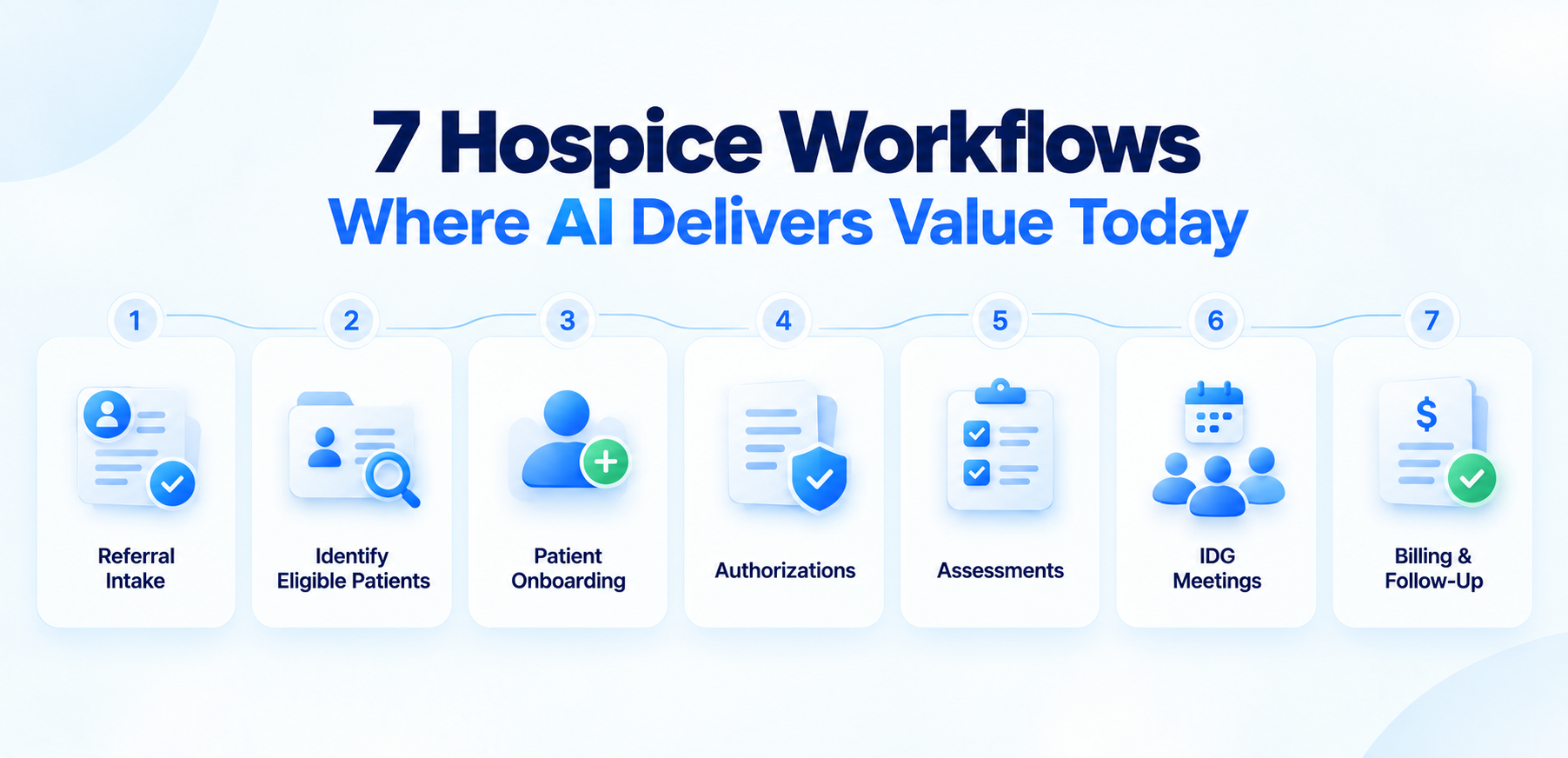
Start with the workflows that sit closest to revenue and compliance. The order below mirrors how a patient moves through an agency, from first referral to family follow-up.
1. Referral Intake and Eligibility Verification
Referrals still arrive by fax, portal, phone and hospital discharge feeds. Staff re-key details into the EMR, then log in to payer portals to confirm coverage. Hours disappear before a nurse ever visits.
What AI changes
- Reads referral packets and insurance cards with OCR and machine learning
- Checks Medicare and Medicare Advantage eligibility automatically
- Writes verified details back to the EMR and alerts the intake team
Where Caregence fits
The Front Door Agent in Caregence™ Agents automates referral intake, eligibility screening and family outreach, and escalates to a person only when it has to. For a deeper look at the plumbing underneath, read our piece on hospice EMR and referral data integration.
2. Earlier Identification of Hospice-Eligible Patients
Medicare hospice coverage starts when a physician certifies a prognosis of six months or less if the illness runs its normal course. Many eligible patients are identified too late. Predictive models can scan clinical and claims data for hospice-eligible signals around the clock, so the first flag no longer depends on someone noticing.
The Start of Care and Intake Prediction model in Caregence™ Predictive Models flags eligibility complexity and referral urgency so patients enter hospice while there is still time to benefit. It also ties into the wider challenge of referral leakage in post-acute care.
3. Patient Onboarding and Admission
Admission touches scheduling, charting, consents, coding and care-team assignment. Each handoff is a chance for a delay or a data-entry error, and in hospice every day counts.
With AI, the intake team enters diagnoses, demographics and insurance details once. The system then identifies follow-up admission tasks, assigns the right care team by location and acuity, prepares the record and drafts initial notes for clinician review. Inferenz has written about the same pattern in AI-powered patient onboarding, and the Matching and Scheduling Agent applies it to interdisciplinary team assignment.
4. Authorizations and Election Documentation
Notices of election, level-of-care changes and related authorizations all depend on clean clinical and eligibility data. An Authorization Agent retrieves that data, completes the paperwork and tracks status end to end, so nothing sits in a queue unnoticed.
5. HOPE Assessment and Clinical Documentation
HOPE replaced the Hospice Item Set on October 1, 2025. CMS built it to capture patient and family needs in real time and at additional timepoints, and it introduced HOPE Update Visits during the first 30 days after election. Records now flow through iQIES. The full specifications sit on the CMS HOPE technical information page.
More timepoints mean more documentation, and documentation that looks complete can still fail review. We unpacked that risk in when AI documentation looks perfect and still fails a hospice audit.
What AI changes
- Drafts HOPE documentation from visit notes for the nurse to confirm
- Flags coding variance and documentation gaps before submission
- Keeps every suggestion explainable and traceable for surveyors
6. IDG Meeting Preparation
The IDG meeting is a Conditions of Participation requirement, and preparing a defensible one takes hours. An Operational Summarization Agent turns visit notes, prior IDG discussions and family communications into a structured pre-meeting summary, then flags gaps. Prep time drops, and the meeting itself gets sharper.
7. Billing, Cap Management and Family Follow-Up
On the revenue side, a Billing and Claims Agent submits claims, tracks cap-related exposure and flags denials early. Predictive models forecast cap and reimbursement risk tied to level-of-care changes, so revenue-threatening shifts surface before they hit the books.
After a patient dies, the work continues. Bereavement outreach and family follow-up can be timed and triggered automatically through digital patient engagement, so no family slips through a gap during the hardest weeks of their lives.
Manual vs AI-Driven Hospice Operations
| Hospice process | Manual approach | AI-driven approach |
| Referral intake | Fax, re-keying, phone follow-ups | Automated extraction, routing and family outreach |
| Eligibility checks | Multiple portal logins per patient | Automated verification written back to the EMR |
| Admission and team assignment | Manual coordination across departments | Task orchestration and acuity-based matching |
| HOPE documentation | Retrospective chart review | Drafted from visit notes, gaps flagged early |
| IDG preparation | Hours of live chart review | Auto-generated summaries and gap alerts |
| Billing and cap tracking | Spreadsheets and denial rework | Predictive exposure alerts and proactive claim checks |
Benefits of AI in Hospice and In-Home Hospice Care
For patients and families
- Faster access to hospice services, at home or in a facility
- Symptom concerns reach the care team sooner
- More consistent support, including bereavement follow-up
For hospice care teams
- Less documentation and re-keying
- Sharper IDG meetings with less prep
- More hours for direct patient and family time
For hospice organizations
- Fewer claim errors and avoidable denials
- Earlier warning on cap exposure and audit risk
- Room to grow census without adding administrative headcount
Across healthcare deployments, Inferenz reports 45% less administrative load, 5x faster onboarding and 30% better caregiver allocation on Caregence™. Results vary by organization and starting data quality.
The Future of AI in Hospice and End-of-Life Care
Automation is the opening chapter. Over the next few years, expect four shifts.
Predictive care planning
Models that read symptom progression and visit patterns will help teams anticipate pain escalation and level-of-care changes days earlier. Our take on predicting readmission risk before it happens shows the same closed-loop thinking in action.
Agentic workflows with human oversight
Agents will run onboarding, authorization and follow-up sequences end to end. Clinicians stay in control of every clinical decision, and every agent action leaves an audit trail.
Outcome-based measurement
Agencies will judge AI by admission speed, comfort outcomes and clinician time reclaimed. Adoption for its own sake loses appeal.
Governed, human-centered design
Transparency, consent and alignment with patient values will decide which tools earn trust. See how we approach this in building trusted agentic AI beyond HIPAA compliance.
How to Start: A Practical Path for Hospice Agencies
Step 1: Fix the data foundation
AI can only work with what it can see. Agencies running separate EMR, pharmacy, referral and billing systems need a unified layer first. Our data engineering and integration services and MPI and Patient 360 solution connect those sources without forcing a migration.
Step 2: Pick one high-friction workflow
Referral intake or HOPE documentation makes a strong pilot. Both are measurable, and both touch revenue and compliance. A 90-day pilot beats a twelve-month roadmap nobody finishes.
Step 3: Build governance in from day one
Role-based access, encryption and audit trails are baseline requirements for PHI. Review our data quality, governance and compliance services and the guide to PII and PHI protection in healthcare before any agent touches patient data.
Step 4: Measure and expand
Track days from referral to admission, HOPE completion rates, IDG prep time and denial rates. Once the first workflow proves out, extend to the next. Our AI strategy team can help sequence the roadmap.
Our Perspective: Where Caregence™ Fits
Caregence™ is Inferenz’s healthcare-native agentic AI platform. It connects to the EMR, hospice pharmacy, referral network and analytics tools an agency already runs, and turns them into one data layer. On top of that layer sit ready-to-use agents, predictive models and a no-code workflow builder that clinical and compliance leaders can adjust without waiting on a developer.
- Works with your stack: integrates with platforms such as HCHB, WellSky and MatrixCare, with no forced migration
- Governed by design: HIPAA-aligned pipelines, explainable outputs and full traceability
- Purpose-built: designed around hospice and palliative workflows, then extended across home health, home care and hospitals
Explore the full set of Caregence™ use cases or browse all healthcare solutions from Inferenz.
Final Thoughts
Hospice teams already give everything they have. The agencies pulling ahead are the ones giving that effort back its time: fewer forms, earlier referrals, cleaner audits, calmer IDG meetings.
If you are weighing where to begin, start with the data, pick one workflow, and keep a clinician in the loop. Then talk to people who have built it. Our team is ready when you are, and you can browse our case studies or contact us to plan a first step.