













Summary
GPT-6 Astra and Claude Fable 5.1 are the two frontier agentic AI models setting the pace for computer use, agentic coding, and enterprise AI automation heading into 2027. Astra leads on computer-use accuracy, CAD and 3D reconstruction, and cybersecurity benchmarks; Fable 5.1 holds its own on output speed and blended cost. The right fit comes down to which tools, workflows, and governance model your team needs.
At a Glance
GPT-6 Astra, OpenAI’s flagship model released on September 3, 2026, and Claude Fable 5.1, Anthropic’s parallel release this quarter, are both built to finish work, not just answer questions. Astra pulls ahead on computer use, design and CAD reconstruction, and cybersecurity benchmarks. Fable 5.1 answers back with faster raw output and a lower blended cost. Here’s what each one does well, tool by tool, before we get into the numbers.
Where Each Model Actually Wins
Skip the leaderboard for a second. In practice, the two models split along clean lines.
Astra is the stronger pick for anything that touches a screen: filling out forms, running QA on a live frontend, reconstructing a 3D object from photos, or laying out a circuit board. It’s also the one OpenAI trusts, cautiously, with real offensive security work, since it’s the first model to cross the “Critical” threshold on the company’s Preparedness Framework.
Claude Fable 5.1 answers with efficiency. Teams already inside the Anthropic ecosystem get comparable agentic coding results, a broader library of MCP Apps, and content-provenance features (a statistical watermark plus signed C2PA credentials) that Astra doesn’t publicly document yet.
Both ship a genuinely broad toolkit rather than a single chat window. That’s the part most coverage skips, and it’s the part that actually decides whether a model fits your stack.
What This Launch Is Really About
Most of the public conversation about GPT-6 Astra collapses it into one number: a benchmark score, a context-window size, a price tag. That misses the point. What OpenAI actually built Astra to do sits somewhere else: computer use, software engineering, design and CAD, legal work, business documents, and scientific research. https://openai.com/index/gpt-6-astra This piece covers the features, use cases, and built-in tooling that matter most across those six areas, holding the same head-to-head discipline against Claude Fable 5.1 throughout.
Four numbers frame the launch outside pure chat benchmarks:
- 95.9% on BenchCAD (3D reconstruction to CAD code)
- 72.6% on OSWorld 2.0 (roughly 47% less time per task)
- 100% on ExploitBench (“Critical” cyber tier)
- 10+ built-in tool types via the Responses API.
| GPT-6 Astra | Claude Fable 5.1 | |
| Launched | September 3, 2026 | Same launch window, 2026 |
| Strongest at | Computer use, CAD/3D reconstruction, cybersecurity review | Output speed, blended cost efficiency |
| Headline benchmark | 95.9% BenchCAD; 100% ExploitBench | 84.3% BenchCAD; 30.4% ExploitGym |
| Cybersecurity tier | “Critical” (OpenAI Preparedness Framework) | Not publicly documented at this tier |
Computer Use: The Biggest Single Capability Jump
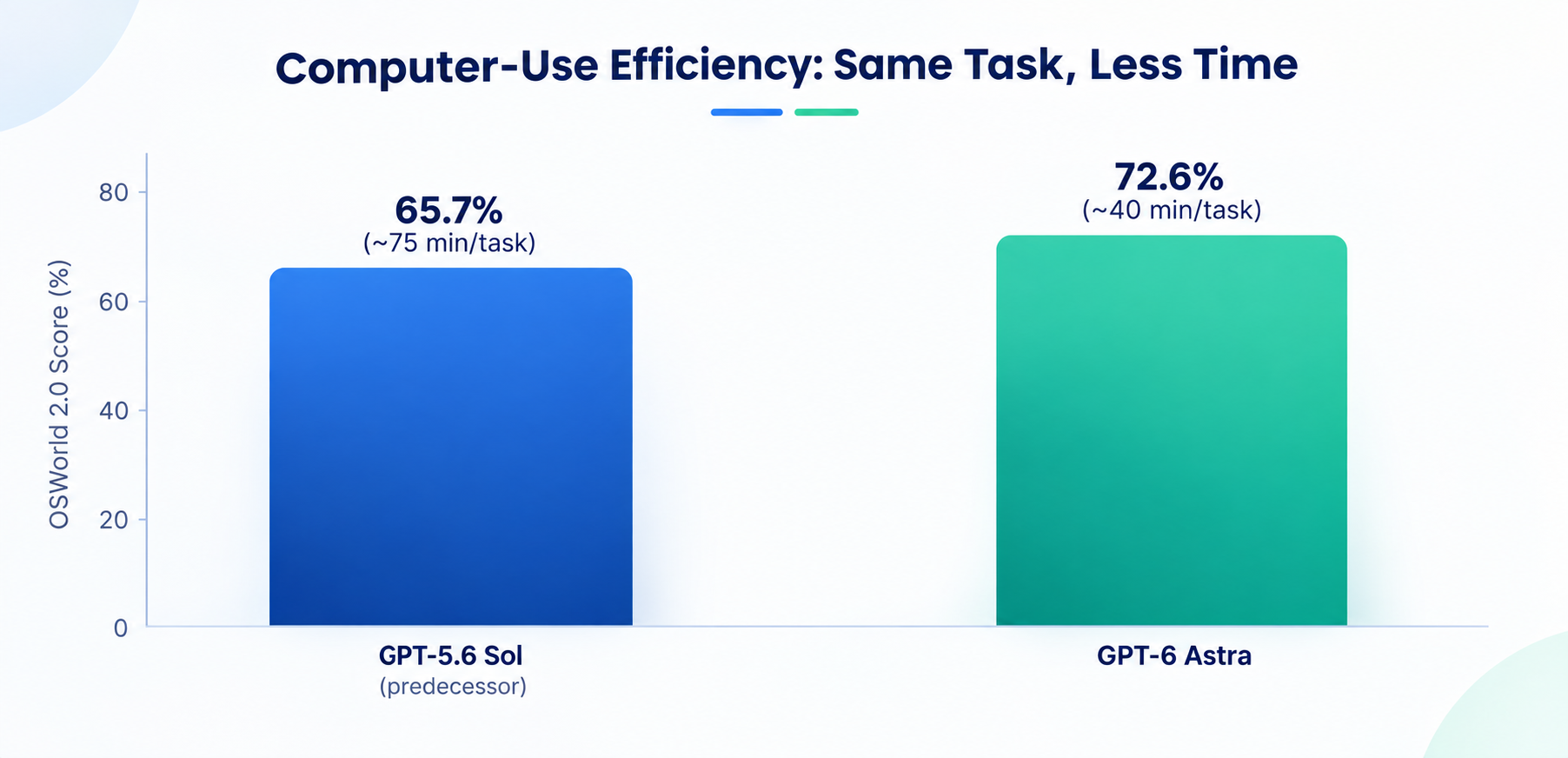 Astra marks what OpenAI calls a new frontier in the speed, accuracy, and safety of computer use: filling out online forms, updating CRM records, organizing a calendar, drafting research summaries inside an email or document editor, and running frontend QA checks.
In latency testing on OSWorld 2.0, Astra hit 72.6% in roughly 40 minutes per task, against 65.7% in about 75 minutes for GPT-5.6 Sol, its predecessor, a 47% cut in time for a higher score.
Paired with an updated Codex harness, OpenAI reports 1.9x faster task completion on Mind2Web versus the prior GPT-5.6 Sol experience. For any business built around repetitive screen work (data entry, back-office operations, QA testing, research summarization), this is the feature with the widest reach across industries. It goes well beyond any single vertical.
Agentic Coding: Long Sessions, Not Just Better Code
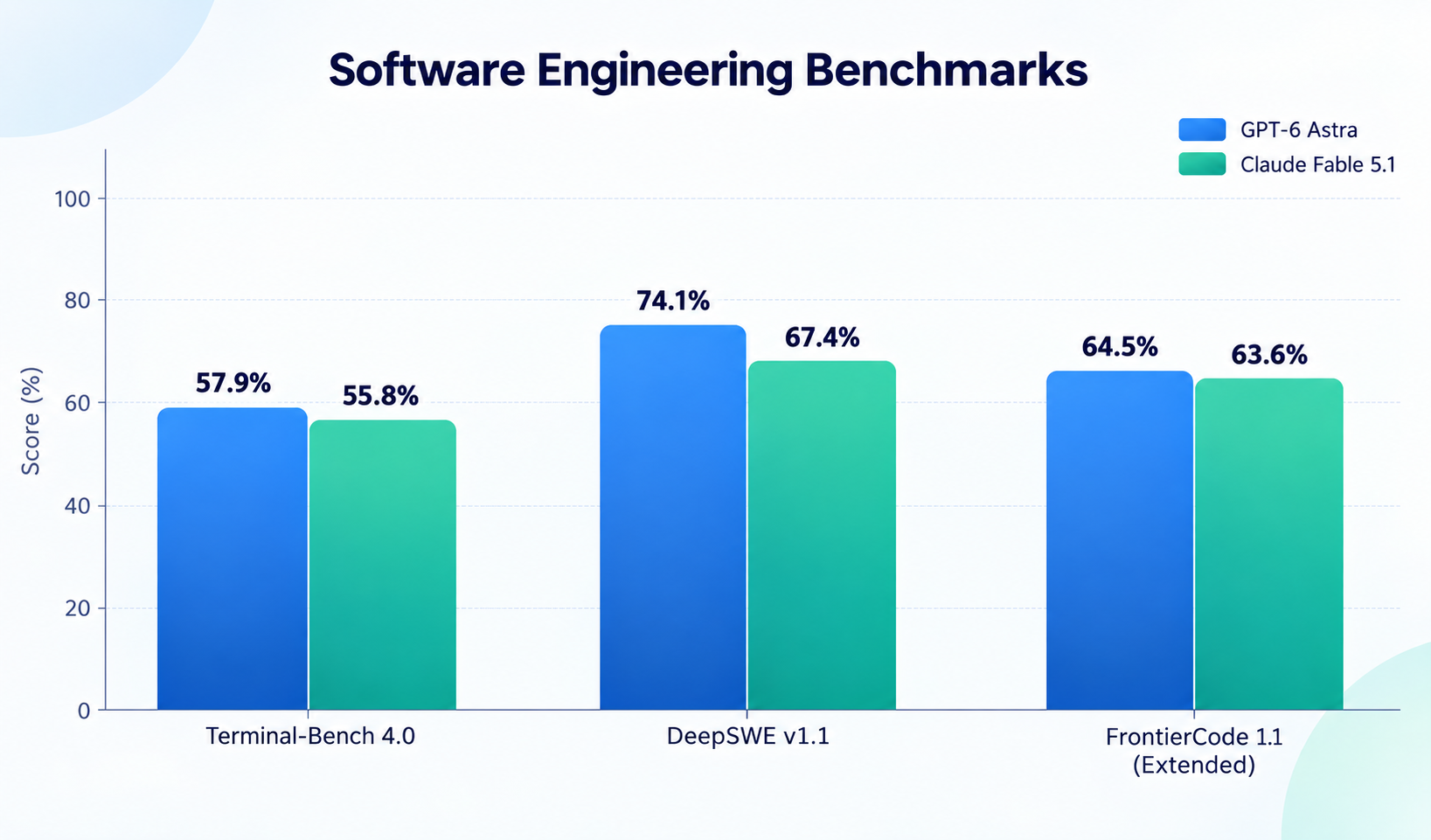 Astra posts real gains on agentic coding benchmarks against Claude Fable 5.1. Terminal-Bench 4.0, DeepSWE, and FrontierCode all favor Astra by several points.
Two features matter more than the raw scores.
Persistent notes across context windows. Rather than summarizing away detail every time a long coding session fills its context, Astra can keep searchable notes across windows in Codex. It can find a requirement or test result from an earlier message even if that detail never made it into a compacted summary. This is opt-in today and becomes the default in the coming weeks.
Async tool calls. Astra can ask a clarifying question and keep working on an independent part of the task while it waits for a reply, instead of blocking entirely. If nobody responds, it proceeds on sensible assumptions for routine gaps but waits on consequential decisions, useful for any long-running automation where blocking on every ambiguity kills throughput.
Design, CAD and 3D: A Genuinely New Application Area
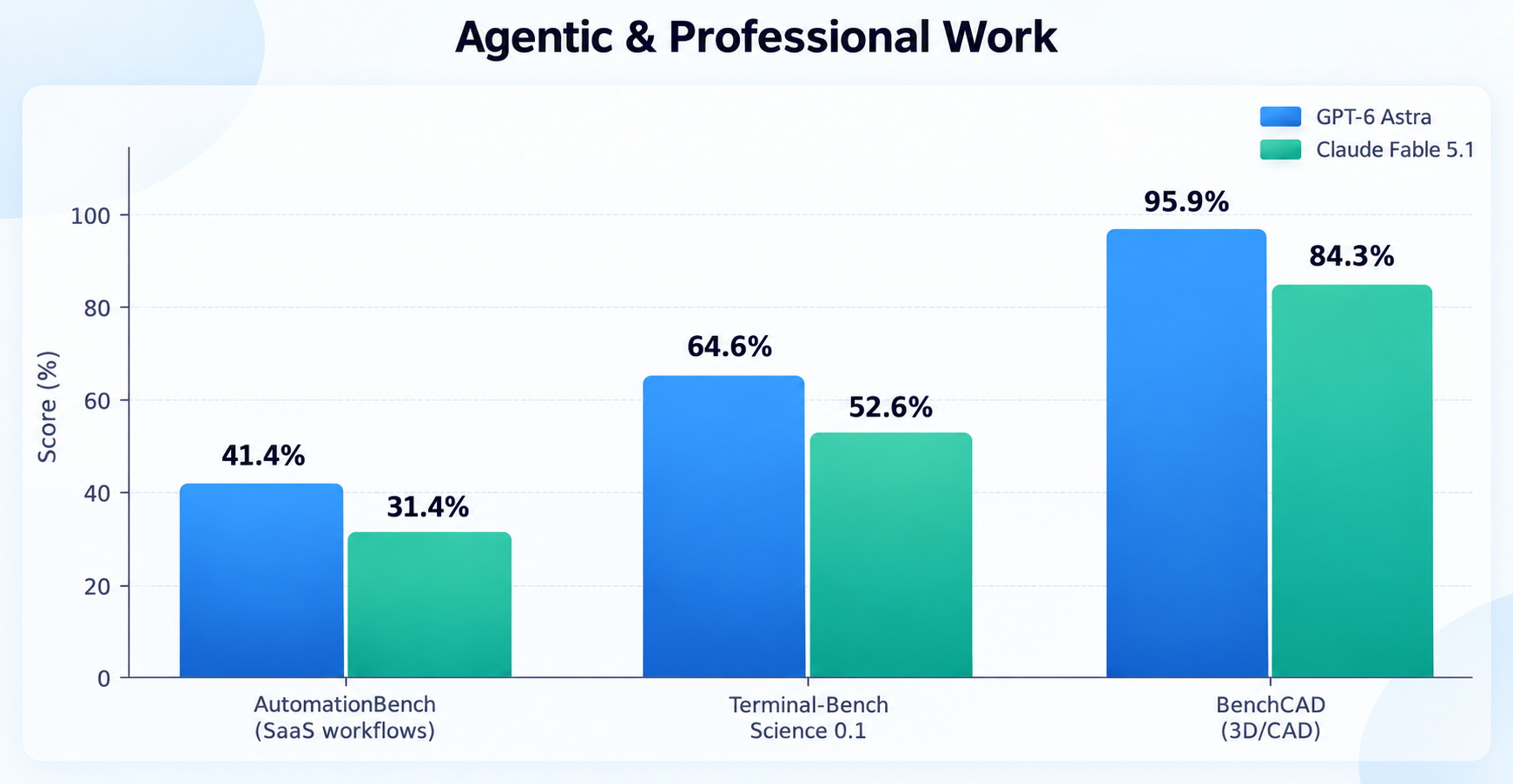 BenchCAD tests whether a model can reconstruct 3D objects from multi-view renders by generating CAD code. Astra scores 95.9% with tools, well ahead of Claude Fable 5.1’s 84.3%, though Anthropic’s own system card notes that score reflects three modifications to the evaluation, worth keeping in view.
OpenAI’s own demonstrations extend this into practical engineering and design work: laying out a printed circuit board in KiCad from a schematic, modeling a house in Blender and turning it into a walkable Unreal Engine 5 scene, and building playable games with accurate motion and graphics.
 Business Documents, Legal Work and Scientific Research
Astra is trained to match a business’s existing templates rather than produce generic output: slides, spreadsheets, and analyses that fit an organization’s writing and visual style, pulling only the context that matters into the final artifact. Executing complex creative workflows in videos used up to 20% fewer tokens than other models tested, which translates directly into higher-quality output for end customers.
In early legal testing, Astra approached legal work “the way a discerning lawyer does”: distinguishing documents from established records, surfacing unsupported assumptions, and converting gaps into concrete drafting positions. On the scientific side, Astra contributed to two new results on prime-number gaps, improving a bound that had stood for more than 80 years, and it pairs scientific reasoning with computer use to inspect sequencing data and genetic variation directly inside specialized research software.
Cybersecurity: A Capability Jump with Guardrails Attached
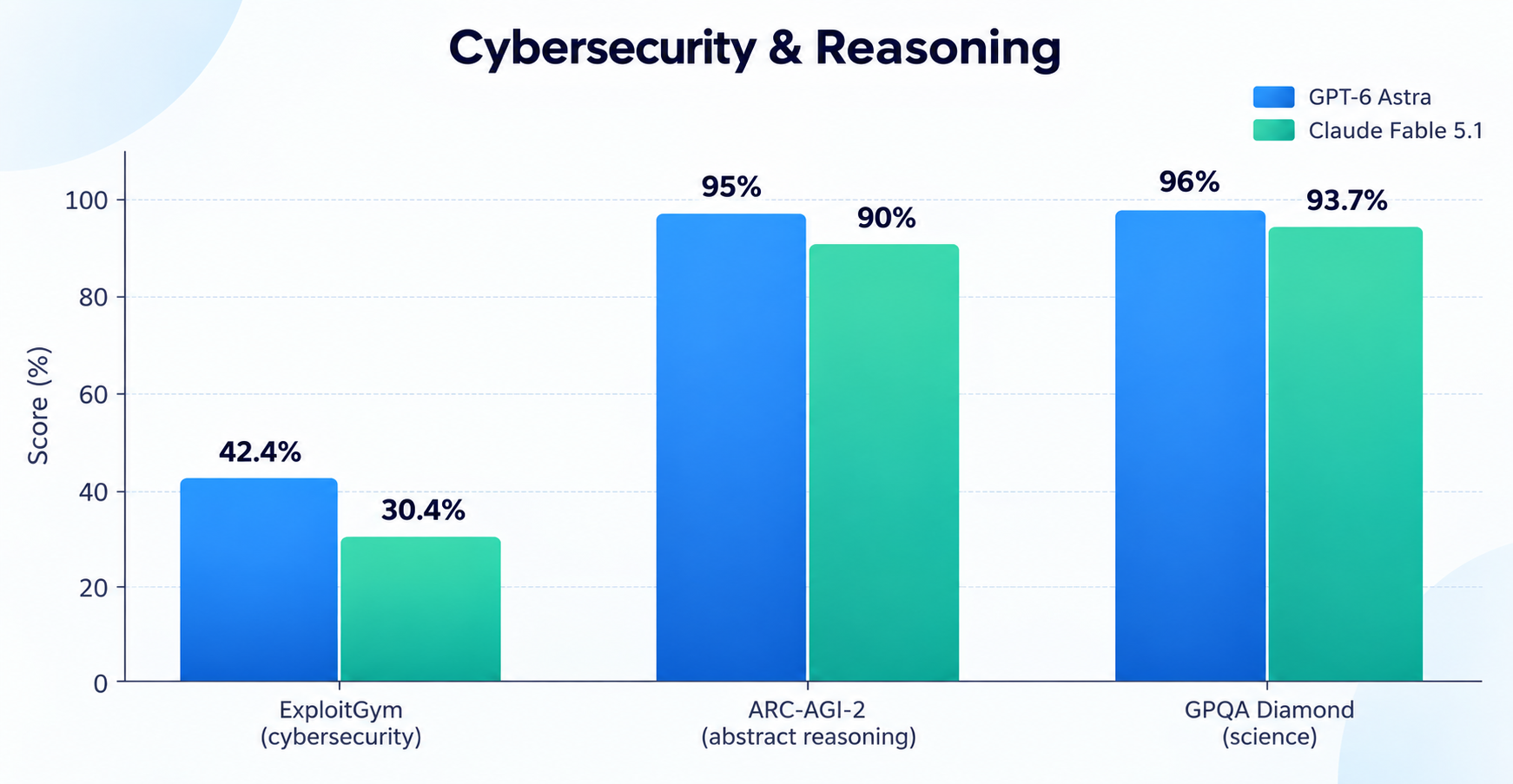 Astra is the first OpenAI model to meet the “Critical” threshold for cybersecurity capability under the company’s Preparedness Framework. With the right tooling, it can independently identify and develop exploits for previously unknown vulnerabilities across hardened systems. https://openai.com/index/gpt-6-astra On ExploitBench it scored 100% versus 78.5% for GPT-5.6 Sol; on ExploitGym, a harder benchmark, it scored 42.4% against Claude Fable 5.1’s 30.4%.
Because of that jump, OpenAI is keeping the most advanced cybersecurity capability restricted to a limited group of testers through its Daybreak program rather than opening it broadly. The model is designed to refuse tasks like generating proof-of-concept exploits under standard deployment. For security teams, the more immediately usable value is defensive: secure code review, patching, and, with expanded access, vulnerability validation and malware analysis.
Built-In Tools, Side by Side
Neither lab ships a single chat endpoint. Both ship a broad agentic toolkit. The table below lines up what’s documented for each as of this launch window; where a capability isn’t publicly documented for a model, that’s noted rather than assumed absent.
| Built-in tool | GPT-6 Astra | Claude Fable 5.1 |
| Web search | Yes, native tool | Yes, togglable feature |
| File search / retrieval | Yes, dedicated File search tool | Via Files API + code execution |
| Code execution / interpreter | Yes, Code interpreter tool | Yes, code execution tool |
| Computer use (GUI control) | Yes, native Computer use tool | Yes, native computer-use tool |
| MCP / external connectors | Yes, MCP & Connectors, Secure MCP Tunnel | Yes, MCP Apps |
| Hosted / local shell | Yes, Shell and Local shell tools | Bash tool via agentic harness |
| Image generation | Yes, gpt-image-2 | Via code execution tool |
| Deep research (specialized mode) | Yes, separate Deep research model | Yes, Deep research feature |
| Persistent output canvas | Sites in ChatGPT | Artifacts |
| Output content provenance | Not specifically documented on launch page | Statistical watermark + signed C2PA credentials |
Where This Shows Up Across Industries
- Engineering & Manufacturing: Reconstructs 3D CAD models from multi-view renders and lays out PCBs in KiCad from a schematic.
- Software Engineering: Runs long agentic coding sessions with persistent notes across context windows instead of lossy compaction, the same discipline behind Inferenz’s generative and agentic AI development services.
- Legal: Distinguishes established records from unsupported assumptions and converts gaps into concrete drafting positions.
- Finance & Consulting: Produces slides, spreadsheets, and analyses that match a firm’s own templates and visual style.
- Web, App & Game Dev: Creates, hosts, and shares a website, web app, or game directly from a prompt.
- Scientific Research: Combines scientific reasoning with computer use to inspect data in specialized software; contributed to two new results on prime-number gaps.
- Healthcare Operations: The same computer-use and document-matching skills above are exactly what HIPAA compliant healthcare native agentic AI platform like Caregence apply to referrals, prior authorization, and care coordination in production.
How the Two Models Actually Compare
On general intelligence parameters, the two are close. Astra is genuinely ahead on agentic coding, design and CAD, and cybersecurity benchmarks. Fable 5.1 stays ahead on raw output speed and blended cost.
Both ship comparably broad tool ecosystems. Astra’s toolkit is more granular and explicitly named (tool search, async tool calling, apply patch as distinct primitives), while Fable 5.1 folds similar capability into fewer, broader features. Which one fits a given team depends far more on existing cloud commitments, tool-by-tool fit, and cost profile than on any single leaderboard position.