












Summary
Artificial intelligence in healthcare is reshaping clinical decision-making, patient engagement, diagnostics, and hospital operations at scale. From AI-powered imaging analysis to conversational AI in healthcare that supports patients around the clock, the technology delivers measurable improvements in accuracy, efficiency, and outcomes. Healthcare organizations that strategically adopt AI gain a clear operational edge, reduce diagnostic errors, and improve patient satisfaction. This blog examines the most impactful AI use cases in healthcare, the core benefits, and what decision-makers need to know before investing.
Introduction: A Sector Under Pressure Needs Smarter Solutions
Healthcare systems worldwide face a compounding set of challenges: aging populations, clinician burnout, rising treatment costs, and an explosion of patient data that no human team can process manually at speed. Misdiagnosis rates remain stubbornly high. Administrative burdens consume up to 30% of a clinician’s working time. Meanwhile, patients expect faster, more personalized care than ever before.
The role of artificial intelligence in modern healthcare is not simply to digitize existing processes. Instead, AI fundamentally transforms how providers identify disease, coordinate care, and interact with patients. Machine learning models surface patterns in data that human review would miss. Natural language processing accelerates documentation and coding. Robotic systems assist surgeons with precision that reduces complication rates.
For healthcare executives, CIOs, and clinical leaders evaluating AI adoption, the central question is no longer whether AI delivers value. The evidence is clear. The question is where to deploy it first, and how to govern it responsibly.
The Importance of Artificial Intelligence in Healthcare
The importance of artificial intelligence in healthcare becomes evident when examining the volume and complexity of data the sector generates. Electronic health records, imaging files, genomic data, wearable sensor outputs, and clinical notes represent a dataset far too large for manual analysis.
AI systems process this data in real time, identify clinically relevant patterns, and support faster, more accurate decisions. According to research from EIT Health and McKinsey, AI-powered systems can improve patient care quality, drive operational efficiency, and help professionals achieve better outcomes consistently.
Furthermore, the global AI in healthcare market continues to grow rapidly, projected to reach over USD 187 billion by 2030. This growth reflects not just technology optimism but demonstrated clinical and financial returns across early adopters.
Why Healthcare Organizations Are Prioritizing AI Investment
Several converging forces drive AI adoption across healthcare systems:
- Diagnostic complexity: Conditions like cancer, rare diseases, and neurological disorders benefit significantly from AI-assisted pattern recognition in imaging and genomics.
- Workforce constraints: Clinician shortages in radiology, pathology, and primary care make AI augmentation a practical necessity, not a luxury.
- Regulatory evolution: Regulators in the US, EU, and other markets now provide clearer frameworks for AI-based clinical decision support, reducing adoption risk.
- Cost pressure: Hospitals and health systems face margin compression that demands operational efficiency at every level.
Together, these factors make AI adoption a strategic priority rather than an exploratory experiment.
Key Applications of AI in Healthcare
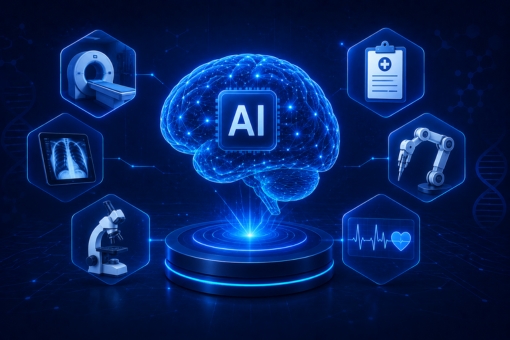
The applications of AI in healthcare span the entire care continuum, from early detection and diagnosis to treatment planning, post-discharge follow-up, and administrative management. Below are the areas delivering the most significant impact.
Medical Imaging and Diagnostic Analysis
Medical imaging represents one of the most mature and validated applications of AI in clinical care. AI algorithms trained on millions of annotated images detect anomalies in CT scans, MRIs, X-rays, and mammograms with accuracy that matches or, in specific conditions, exceeds specialist performance.
For example, AI tools detect early-stage breast cancer in mammography screenings with greater sensitivity than radiologists reviewing the same images independently. This capability reduces false negatives, supports earlier intervention, and improves survival outcomes.
In ophthalmology, AI systems analyze retinal images to detect diabetic retinopathy, macular degeneration, and glaucoma at population scale. This matters particularly in regions where specialist access is limited, as AI enables community-level screening without requiring an ophthalmologist present at every site.
Predictive Analytics and Early Warning Systems
Hospitals increasingly deploy AI models that predict patient deterioration before clinical signs become obvious. These early warning systems analyze vital sign trends, lab results, and nursing observations to flag patients at high risk of sepsis, cardiac events, or respiratory failure.
Because of this early detection capability, clinical teams can intervene hours before a crisis develops, reducing ICU admissions and improving outcomes. Studies in high-volume hospitals show that AI-powered early warning systems reduce sepsis mortality by 20% or more in deployments with proper workflow integration.
Administrative Automation and Workflow Optimization
How AI is used in healthcare extends well beyond clinical care. Administrative functions represent a significant share of healthcare operating costs, and AI automation delivers measurable savings.
Specifically, AI handles the following administrative tasks effectively:
- Healthcare claims processing and prior authorization review
- Patient record management and clinical documentation coding
- Appointment scheduling, rescheduling, and automated reminders
- Insurance eligibility verification and billing reconciliation
Natural language processing (NLP) tools transcribe physician-patient conversations in real time and populate electronic health record fields automatically. As a result, clinicians spend less time on documentation and more time on direct patient interaction. In practices where AI scribing tools are deployed, physicians report saving 1.5 to 2 hours per shift on average.
Drug Discovery and Pharmaceutical Research
AI use cases in healthcare extend into pharmaceutical R&D, where the cost and time required to bring a new drug to market have long been prohibitive. AI platforms analyze molecular structures, predict protein folding, identify candidate compounds, and model clinical trial designs at speeds no traditional research approach matches.
For instance, Inferenz collaborated with a pharmaceutical company in Germany to deploy AI and ML tools that predict health outcomes from patient data. By analyzing vital health parameters, the AI models helped clinicians diagnose and treat patients with greater precision, reducing time to treatment and supporting better drug-outcome matching.
Moreover, AI reduces the failure rate of clinical trials by improving patient selection, identifying biomarker-based inclusion criteria, and predicting adverse events before they occur in large-scale testing.
Benefits of AI in Healthcare: A Structured View
The benefits of AI in healthcare span clinical quality, operational performance, and patient experience. Each dimension matters when building the business case for AI investment.
More Accurate Diagnosis, Fewer Errors
Misdiagnosis remains one of the most serious patient safety risks in healthcare. AI-powered diagnostic tools reduce error rates in radiology, pathology, dermatology, and cardiology by providing a consistent, data-driven second opinion that does not suffer from cognitive fatigue or confirmation bias.
Specifically, computer vision models analyze MRI reports, CT scans, and mammograms with a level of consistency that human reviewers cannot sustain across an entire shift. The result is a measurable reduction in missed diagnoses and a shorter time to treatment for patients whose conditions are identified earlier.
Improved Patient Engagement and Communication
Poor communication between providers and patients reduces medication adherence, increases no-show rates, and lowers overall care quality. Conversational AI in healthcare addresses this gap directly.
AI-powered virtual assistants and chatbots handle appointment scheduling, send medication reminders, answer common clinical questions, and triage patient concerns before a clinician needs to engage. Patients receive timely responses around the clock, without placing additional demand on front-desk staff or nursing teams.
Furthermore, conversational AI platforms support patients with chronic conditions by checking in regularly, collecting self-reported symptom data, and alerting care teams when a patient’s condition appears to be changing. This continuous engagement model improves chronic disease management at scale.
Safer, More Precise Surgical Procedures
AI-assisted robotic surgery systems give surgeons enhanced precision, real-time visual guidance, and motion stabilization that reduces surgical trauma. Patients who undergo robotic-assisted procedures consistently report shorter recovery times, lower post-operative pain scores, and fewer complications compared to traditional open surgery.
In addition, AI systems can analyze intraoperative data streams to flag potential risks during a procedure, providing the surgical team with decision support in real time rather than retrospectively.
Operational Efficiency and Cost Reduction
Beyond clinical impact, AI delivers material operational value. Automated prior authorization workflows reduce claim denials and accelerate reimbursement cycles. Predictive scheduling tools reduce appointment no-shows and optimize clinic throughput. Supply chain AI models improve inventory management and reduce medication waste.
Consequently, healthcare organizations that deploy AI across both clinical and administrative functions report reductions in operating costs alongside improvements in patient satisfaction scores. These two outcomes, typically in tension, become simultaneously achievable with well-implemented AI.
Conversational AI in Healthcare: A Closer Look
Conversational AI in healthcare deserves particular attention because its adoption has accelerated sharply since 2023. These systems use large language models and NLP to understand and respond to patient queries in natural language, across text and voice interfaces.
Use cases include:
- Pre-visit triage: Patients describe symptoms through a chat interface; the AI collects structured clinical history and routes the patient to the appropriate care level.
- Post-discharge follow-up: AI contacts discharged patients by text or voice to check on recovery progress and flag concerns to the care team.
- Mental health support: AI-powered tools provide evidence-based conversational support for mild anxiety and depression, extending the reach of behavioral health services.
- Patient education: Conversational AI explains diagnoses, treatment plans, and medication instructions in plain language, improving comprehension and adherence.
However, organizations must govern conversational AI deployments carefully. Clear escalation pathways to human clinicians, transparent AI disclosure to patients, and robust audit logging are non-negotiable requirements for responsible deployment.
Limitations and Responsible Deployment Considerations
No honest assessment of AI in healthcare can overlook its current limitations. AI models perform best on data distributions that closely match their training data. Demographic gaps in training datasets can introduce bias, leading to reduced accuracy for underrepresented patient populations.
Additionally, AI systems require ongoing monitoring after deployment. Model drift, where performance degrades as patient populations or clinical workflows change, is a real operational risk that governance frameworks must address.
Therefore, healthcare organizations should treat AI adoption as a continuous program, not a one-time implementation. Clear ownership of model performance, structured validation protocols, and clinician training on AI tool limitations are essential components of a responsible deployment strategy.
Conclusion: AI as a Strategic Imperative, Not an Optional Add-On
The evidence for AI’s value in healthcare is no longer theoretical. Across diagnostics, surgical assistance, patient engagement, administrative automation, and pharmaceutical research, AI delivers outcomes that improve care quality and reduce costs simultaneously.
The organizations that benefit most are those that approach AI adoption strategically: identifying high-value use cases, investing in data quality, building governance frameworks, and treating clinicians as partners in deployment rather than passive recipients of new tools.
For healthcare leaders evaluating where to begin, the practical advice is straightforward. Start with use cases where AI augments rather than replaces clinical judgment, where data quality is high, and where measurable outcomes allow rapid validation. Build from there.
The role of artificial intelligence in modern healthcare will only expand as models become more capable and data infrastructure matures. The question is not whether your organization will operate in an AI-enabled environment. It is whether you will lead that transition or follow it.