












Summary
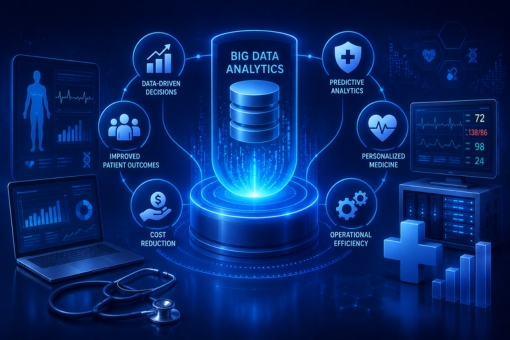
Big data analytics in healthcare is transforming how organizations deliver care, manage costs, and prevent disease at scale. From predictive diagnostics and revenue cycle optimization to population health management, healthcare leaders who treat data as a strategic asset gain measurable advantages in both clinical outcomes and operational performance. The global healthcare analytics market is projected to exceed $84 billion by 2027, signaling a structural shift rather than a passing trend. This blog examines the core benefits, real-world applications, key challenges, and emerging technologies that define where big data analytics in the healthcare industry is headed in 2026 and beyond.
Introduction
Healthcare organizations sit on one of the richest data reserves of any industry. Electronic health records, medical imaging archives, genomic sequences, insurance claims, and wearable device telemetry generate an estimated 2.5 exabytes of data every single day. However, for most organizations, that data remains fragmented across legacy systems, siloed clinical workflows, and disconnected administrative platforms.
The result is a costly paradox: organizations drowning in data yet starved for insight.
The consequences are real. Late-stage disease detection accounts for an estimated 40 percent of avoidable healthcare costs. Administrative waste consumes between 25 and 30 percent of total US healthcare expenditure. Medication errors contribute to over 250,000 preventable deaths annually in the US alone, according to Johns Hopkins research.
Furthermore, the organizations actively closing this data gap are gaining demonstrable advantages. They achieve faster diagnoses, lower readmission rates, leaner supply chains, and stronger financial performance. Those that delay are increasingly visible in outcome benchmarks and regulatory scrutiny.
This blog breaks down exactly what big data analytics in healthcare delivers, where it creates the most value, and how forward-looking health systems are building the infrastructure to capitalize on it.
What Is Big Data Analytics in Healthcare?
Big data analytics in healthcare refers to the process of collecting, processing, and interpreting large volumes of structured and unstructured data across clinical, operational, and financial domains to support evidence-based decisions.
Data sources include:
- Electronic Health Records (EHRs): Patient histories, diagnoses, medications, lab results, and care plans
- Medical Imaging: Radiology scans, pathology slides, and diagnostic images
- Genomic Data: DNA sequencing outputs that support precision medicine programs
- IoT and Wearables: Continuous biometric data from connected devices
- Insurance Claims: Billing records, procedure codes, and reimbursement histories
- Patient-Generated Data: Symptom logs, app-based check-ins, and remote monitoring feeds
The discipline spans four analytical modes that leading health systems use together:
- Descriptive Analytics: What happened? (e.g., monthly readmission rates)
- Diagnostic Analytics: Why did it happen? (e.g., root causes of claim denials)
- Predictive Analytics: What is likely to happen? (e.g., patient deterioration risk scores)
- Prescriptive Analytics: What action should be taken? (e.g., optimized staffing recommendations)
Together, these four modes form a complete decision intelligence framework for healthcare operations and clinical care.
Understanding the 4 Vs of Big Data Analytics in Healthcare
Healthcare data is not just large. It is complex in ways that standard data management tools cannot handle. The “4 Vs” framework captures the core dimensions of this complexity.
Volume
Healthcare systems generate enormous quantities of data continuously. A single hospital network can accumulate petabytes of imaging, genomic, and operational data annually. Consequently, storing, organizing, and retrieving this data requires scalable cloud and distributed storage infrastructure.
Velocity
Patient data streams in real time from ICU monitors, wearables, and emergency triage systems. For clinical decision support, velocity matters as much as volume. Moreover, batch-processing approaches are no longer sufficient for time-sensitive interventions.
Variety
Healthcare data is inherently multi-modal: structured fields in EHR databases, unstructured clinical notes in free text, image files, audio recordings from telehealth sessions, and genomic sequences. As a result, analytics platforms must handle diverse data types within a unified processing environment.
Veracity
Data quality in healthcare is inconsistent. Coding errors, incomplete records, duplicate entries, and interoperability gaps all reduce the trustworthiness of raw data. Therefore, data governance and cleansing pipelines form the non-negotiable foundation of any analytics investment.
Importance of Big Data Analytics in Healthcare
The importance of big data analytics in healthcare extends well beyond operational efficiency. It fundamentally changes what healthcare organizations can know, predict, and act on.
Shifting from Reactive to Proactive Care
Traditionally, clinical decisions relied on symptoms that were already present. Predictive models now allow clinicians to identify high-risk patients before acute episodes occur. For example, sepsis prediction algorithms trained on vital signs, lab values, and nursing notes can trigger early intervention protocols hours before a patient meets clinical sepsis criteria.
Enabling Precision Medicine
No two patients respond identically to the same treatment. Big data analytics in healthcare makes personalized medicine operationally viable by integrating genetic profiles, biomarker data, and treatment response histories at scale. This is particularly relevant in oncology, where multi-omics data analysis supports individualized therapy selection.
Supporting Public Health at Scale
Population-level analytics enables health systems and governments to detect disease clusters, identify at-risk demographic groups, and deploy targeted interventions before conditions reach epidemic thresholds. During recent COVID variant waves, organizations with mature population health analytics activated outreach campaigns weeks ahead of peers using conventional surveillance methods.
Role of Big Data Analytics in Healthcare
Beyond the clinical environment, big data analytics plays a foundational role across every layer of healthcare delivery.
Clinical Decision Support
Clinicians process an extraordinary volume of information during every patient encounter. Analytics platforms that surface relevant risk scores, drug interaction alerts, and evidence-based treatment recommendations directly within clinical workflows reduce cognitive load and improve decision quality.
Operational Performance Management
Hospital operations involve hundreds of interdependent variables: patient throughput, bed availability, surgical scheduling, and staff deployment. Analytics tools that model these interdependencies in real time allow operations teams to make adjustments before bottlenecks form rather than after delays occur.
Financial Performance and Revenue Integrity
Claims management, reimbursement optimization, and cost accounting all depend on accurate, timely data. Additionally, analytics platforms that monitor billing patterns, flag anomalies, and model payer behavior help finance teams protect revenue and reduce compliance exposure.
Research and Innovation
Health systems with robust data infrastructure contribute more effectively to clinical research. Specifically, de-identified patient cohorts, longitudinal outcome data, and real-world evidence repositories accelerate trial design, drug development, and protocol validation.
Benefits of Big Data Analytics in the Healthcare Industry
The measurable benefits of big data analytics in the healthcare industry span clinical, operational, and financial dimensions. Each benefit area below reflects outcomes documented across health systems, not theoretical projections.
Improved Patient Outcomes Through Predictive Diagnostics
Predictive analytics models trained on longitudinal patient records identify risk markers for sepsis, cardiac events, and chronic disease progression significantly earlier than traditional clinical assessments. Mayo Clinic and Mass General Brigham have published evidence showing machine learning-assisted early warning systems reduced ICU mortality rates by 10 to 20 percent in controlled deployments.
Earlier identification of high-risk patients allows clinicians to intervene before conditions deteriorate into costly emergency episodes. This single capability justifies significant analytics investment for most acute care organizations.
Reduction of Medical Errors and Adverse Events
A 2024 JAMA study found that AI-assisted prescription review flagged clinically significant drug interactions in 7 percent of discharge orders that had passed standard pharmacist checks. Billing analytics tools have similarly reduced claim rejection rates in large health systems by detecting coding anomalies before submission.
These are not marginal gains. Because medication errors alone contribute to over 250,000 preventable deaths annually in the US, data tools that reduce error rates even incrementally carry significant patient safety and liability implications.
Operational Cost Reduction
Administrative waste accounts for an estimated 25 to 30 percent of total US healthcare expenditure. Analytics platforms that optimize staff scheduling, patient throughput modeling, and claims processing workflows deliver consistent cost reductions in the 12 to 18 percent range for mid-size hospital systems.
The mechanism is not headcount reduction. Instead, it is eliminating unplanned overtime, discharge delays, and avoidable inventory stockouts through continuous monitoring rather than reactive management.
Precision Resource Allocation and Staffing
Workforce shortages remain acute across nursing and specialist disciplines globally. Analytics platforms that integrate historical admission data, seasonal disease patterns, and local demographic trends enable hospitals to forecast staffing requirements 30 to 60 days in advance with measurable accuracy improvements over manual planning.
As a result, organizations reduce reliance on agency staff, which typically costs 30 to 50 percent more per hour than employed staff, while maintaining care quality benchmarks.
Supply Chain Visibility and Waste Reduction
Medical supply chains became a critical vulnerability during the COVID-19 pandemic. Analytics tools that provide real-time inventory tracking, expiration monitoring, and demand forecasting have since become priority investments. For instance, the NHS and Kaiser Permanente both documented inventory waste reductions exceeding 20 percent following analytics integration.
Population Health and Disease Prevention
Aggregated and de-identified patient data, analyzed at scale, allows public health systems to identify disease clusters, at-risk demographic cohorts, and intervention gaps before conditions escalate. This capability represents one of the highest-ROI applications of data analytics in the healthcare industry at the systems level.
How Healthcare Organizations Use Big Data
Healthcare organizations apply big data across three primary operational layers: clinical, administrative, and strategic.
At the Clinical Layer
Clinicians use analytics for risk stratification, treatment protocol selection, early warning scoring, and medication safety review. Furthermore, radiology teams apply machine learning models to imaging pipelines, reducing interpretation time and flagging findings that warrant immediate attention.
At the Administrative Layer
Operations and finance teams use analytics for scheduling optimization, revenue cycle management, fraud detection, and compliance monitoring. In particular, claims analytics platforms reduce denial rates by identifying coding errors and missing documentation before submission.
At the Strategic Layer
Executive and population health teams use aggregated analytics for network planning, service line strategy, value-based contract modeling, and community health investment. These use cases depend on Data and Cloud Modernization Services and Solutions to consolidate data from disparate sources into unified analytical environments.
Applications of Big Data Analytics in Healthcare
The following represent the highest-value application areas across the sector in 2026.
Electronic Health Records Optimization
Centralized patient histories enable cross-team coordination, reduce duplicate testing, and feed predictive model training pipelines. EHR analytics tools also surface documentation gaps that affect coding accuracy and reimbursement rates.
Remote Patient Monitoring
IoT-connected devices and wearables transmit continuous biometric data, enabling real-time alerts for deviations in cardiac, respiratory, or metabolic markers. Remote monitoring programs have demonstrated 25 to 40 percent reductions in preventable hospital admissions for high-risk chronic disease populations.
Clinical Trial Optimization
Machine learning accelerates patient cohort matching for trials, cutting enrollment timelines by up to 30 percent in pharma applications. Additionally, real-world evidence generated from EHR and claims data increasingly supplements traditional trial endpoints.
Fraud Detection and Compliance
Anomaly detection across billing and claims data identifies fraudulent patterns that rule-based systems routinely miss. This protects both revenue integrity and regulatory standing, particularly as CMS enforcement activity has intensified in recent years.
Genomics and Precision Medicine
Multi-omics data analysis enables treatment protocols tailored to individual patient genetic profiles. This approach is most advanced in oncology, where genomic sequencing has shifted chemotherapy selection from population-level protocols to individual tumor profiles.
Mental Health and Behavioral Analytics
Natural language processing applied to patient communications and clinical notes flags deterioration in behavioral health conditions between appointments. Moreover, predictive models trained on social determinants of health data identify at-risk populations for proactive outreach.
Popular Examples and Real-World Use Cases of Big Data Analytics in Healthcare
Mayo Clinic: Predictive ICU Monitoring
Mayo Clinic deployed a machine learning-based early warning system that continuously analyzes vital signs, lab values, and nursing observations to generate patient deterioration risk scores. The system contributed to ICU mortality rate reductions of 10 to 20 percent in published evaluations.
Kaiser Permanente: Supply Chain Optimization
Kaiser Permanente integrated real-time inventory analytics across its hospital network, achieving over 20 percent reduction in medical supply waste and significantly improving readiness during supply disruptions.
NHS England: Population Health Management
NHS England’s population health analytics programs have enabled targeted outreach to high-risk patient cohorts, reducing emergency admissions among monitored populations and supporting earlier intervention in chronic disease management.
Mass General Brigham: AI-Assisted Diagnostics
Mass General Brigham implemented AI-powered imaging analysis tools for radiology workflows. The system now assists radiologists in flagging findings with a level of consistency that reduces both interpretation time and inter-reader variability.
Large US Health System: Fraud Detection
A large US health system deployed anomaly detection models across its claims data, identifying over $30 million in fraudulent billing patterns within the first 12 months of deployment. Traditional rule-based systems had missed the majority of flagged cases.
Big Data Analytics in Healthcare Revenue Cycle Management
Revenue cycle management (RCM) is one of the most financially significant applications of big data analytics in the healthcare industry. Every year, US hospitals lose billions of dollars to claim denials, coding errors, underpayments, and missed charge capture.
How Analytics Transforms RCM
Analytics platforms embedded in RCM workflows deliver value across the full revenue cycle:
- Pre-Authorization Verification: Automated checks confirm coverage eligibility before services are delivered, reducing denial rates at the source.
- Coding Accuracy: Natural language processing tools analyze clinical documentation and suggest accurate procedure and diagnosis codes, reducing human coding errors.
- Denial Pattern Analysis: Analytics models identify the specific claim types, payers, and clinical departments that generate the highest denial rates, enabling targeted process improvement.
- Underpayment Detection: Systematic comparison of expected versus actual reimbursement rates flags underpayments across payer contracts for recovery and renegotiation.
- Fraud and Abuse Monitoring: Anomaly detection across billing data identifies patterns inconsistent with legitimate care delivery, protecting organizations from regulatory penalties.
Measured Impact
Mid-to-large health systems that implement analytics-driven RCM programs consistently report denial rate reductions of 15 to 25 percent and net revenue improvements of 2 to 5 percent of total collections. For a health system processing $1 billion in annual claims, a 3 percent improvement represents $30 million in recovered revenue.
Technologies Powering Big Data Analytics in Healthcare
The analytics capabilities described throughout this blog rely on a converging set of technologies. Understanding these layers is essential for healthcare leaders evaluating infrastructure investments.
Cloud Data Platforms
Modern cloud data platforms such as Snowflake, Databricks, and Google BigQuery provide the scalable storage, compute separation, and governed access control that healthcare analytics requires. These platforms enable Data and Cloud Modernization Services and Solutions that consolidate previously siloed data environments into unified analytical foundations.
Machine Learning and AI Frameworks
Machine learning frameworks, including TensorFlow, PyTorch, and Azure ML, power the predictive and prescriptive models that underpin clinical decision support, imaging analysis, and operational forecasting. Furthermore, large language models (LLMs) are increasingly applied to unstructured clinical note analysis and patient communication processing.
Interoperability Standards
HL7 FHIR (Fast Healthcare Interoperability Resources) has become the dominant standard for healthcare data exchange. FHIR-compliant APIs enable EHR systems, payer platforms, and analytics tools to share data in a structured, standardized format, which significantly reduces integration complexity.
Federated Learning
Federated learning enables multiple healthcare organizations to collaboratively train AI models without sharing raw patient data. Each organization trains a local model on its own data, and only model parameters are shared and aggregated. This approach resolves a major compliance bottleneck and is increasingly used for multi-site clinical research.
Real-Time Data Streaming
Platforms such as Apache Kafka and Azure Event Hubs enable real-time event-driven data pipelines that replace traditional batch processing. For clinical applications, real-time streaming means analytics systems can support same-encounter decision making rather than retrospective review.
Synthetic Data Generation
Synthetic data tools generate statistically representative patient datasets without using real patient records. Consequently, development and testing environments for clinical AI models no longer require access to sensitive patient data, reducing both compliance risk and development cycle time.
Challenges of Big Data in Healthcare
Despite its clear benefits, big data analytics in healthcare presents a set of structural and operational challenges that organizations must address directly rather than minimize.
Data Fragmentation and Interoperability
Most healthcare organizations operate across multiple EHR systems, billing platforms, and departmental applications that do not communicate natively. Integrating these sources into a unified analytical environment requires sustained investment in data engineering and interoperability infrastructure.
Regulatory Compliance Complexity
Healthcare analytics operates in a uniquely constrained regulatory environment. In the US, HIPAA sets strict boundaries around patient data use and sharing. In Europe, GDPR and the EU AI Act, which took effect in 2024, impose additional requirements, including transparency obligations for high-risk AI systems in clinical settings. Compliance quality varies significantly across organizations and geographies.
Algorithmic Bias and Model Fairness
AI models trained on historically biased datasets have demonstrated differential performance across racial and socioeconomic patient groups in peer-reviewed studies. Organizations deploying clinical AI need model validation frameworks that account for sub-population performance, not just aggregate accuracy metrics.
Talent Scarcity
The intersection of healthcare domain expertise and data science capability remains rare. Most health systems lack sufficient internal talent to govern, build, and maintain advanced analytics programs. As a result, strategic partnerships with specialized data and analytics service providers have become a common approach to bridging the gap.
Change Management and Clinical Adoption
Even well-designed analytics tools fail when clinicians do not trust or use them. Change management, clinical co-design, and workflow integration are as important to successful outcomes as the underlying technology. Tools that augment rather than replace clinical judgment consistently achieve higher adoption rates.
Data Quality and Governance
Analytics outputs are only as reliable as the data feeding them. Coding inconsistencies, duplicate records, missing values, and outdated patient information all degrade model performance. Therefore, a clean, governed data layer is not optional infrastructure. It is the foundation on which every downstream analytics investment depends.
Future of Big Data Analytics in Healthcare
The trajectory of big data analytics in healthcare points toward greater integration, automation, and personalization. Several developments are reshaping the landscape in 2026 and beyond.
Real-Time Clinical Intelligence
The shift from batch processing to real-time, event-driven data pipelines is accelerating. Health systems that complete this transition will support same-encounter clinical decision support that aligns with care delivery in real time, not hours or days after the fact.
Ambient AI and Voice Analytics
Ambient clinical intelligence tools that passively capture and structure patient-provider conversations are entering mainstream deployment. These tools reduce documentation burden for clinicians, improve note accuracy, and generate richer data for downstream analytics.
Integration of Social Determinants of Health (SDOH)
Leading organizations increasingly integrate SDOH data, including housing, employment, food security, and transportation status, into risk stratification models. This moves analytics beyond purely clinical predictors toward whole-person risk assessment, which improves both prediction accuracy and intervention targeting.
AI Governance and Responsible Deployment
Regulatory scrutiny of clinical AI is increasing globally. Health systems are building formal AI governance frameworks that include pre-deployment validation, ongoing performance monitoring, bias auditing, and clinician feedback loops. This governance infrastructure is becoming a competitive differentiator, not just a compliance requirement.
Interoperability at the Ecosystem Level
Beyond individual organizations, the next frontier is ecosystem-level data sharing: health information exchanges, payer-provider data collaboratives, and cross-border research networks. Federated learning and privacy-preserving analytics are making this technically feasible in ways that were not viable three years ago.
Personalized Medicine at Scale
The convergence of genomics, proteomics, and longitudinal clinical data is making true precision medicine operationally scalable. In oncology specifically, AI models that integrate tumor genomics with treatment response databases are already influencing therapy selection for individual patients at leading cancer centers.
Conclusion
The case for big data analytics in healthcare is no longer speculative. Measurable outcomes across reduced readmissions, lower medication error rates, optimized supply chains, and earlier disease detection are documented at scale across health systems globally.
The strategic question for healthcare leaders is not whether to invest in analytics. It is where to invest first, with what governance structures, and against which clinical and operational priorities.
Organizations that lead in this space share a common characteristic: they treat data quality, clinical validation, and responsible AI deployment with the same rigor they apply to patient safety protocols. In that context, analytics is not a technology initiative. It is a clinical and operational strategy with measurable, auditable outcomes.
Furthermore, partnerships with providers of Data and Cloud Modernization Services and Solutions are increasingly central to this strategy, particularly for organizations that lack the internal infrastructure to consolidate fragmented data environments at the pace the market demands.
The organizations that invest now in governance, infrastructure, and talent will define the performance benchmarks that others will spend the following decade trying to match.