













Summary
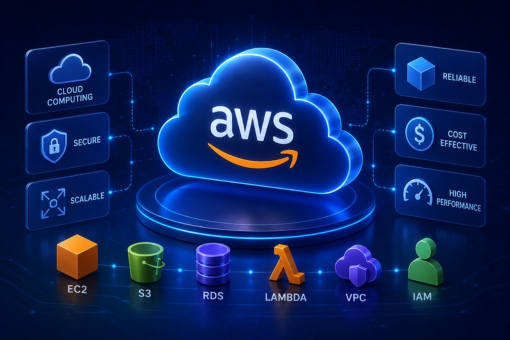
Amazon Web Services (AWS) is the world’s most comprehensive cloud computing platform, offering over 200 fully managed services across compute, storage, networking, databases, analytics, and security. Enterprises across healthcare, finance, media, and retail rely on AWS to scale infrastructure without managing physical hardware. AWS operates on a pay-as-you-go model, reducing capital expenditure while enabling global deployment. For organizations evaluating cloud migration, AWS remains the benchmark against which all other platforms are measured.
Introduction: Why Cloud Infrastructure Decisions Are Now Business-Critical
Most organizations today do not struggle to understand what cloud computing is. They struggle to decide which platform to trust with their most critical workloads, and why the choice matters more than ever.
AWS sits at the center of that decision. However, with over 200 services, multiple pricing models, and a global infrastructure spanning dozens of regions, understanding AWS thoroughly before committing to a migration is essential.
Whether your team is evaluating AWS for the first time or looking to consolidate workloads from a hybrid environment, this guide gives you a clear, structured view of what AWS is, how its core services work, and whether it fits your organization’s goals.
What Is Amazon Web Services (AWS)?
Amazon Web Services is a cloud computing platform built and operated by Amazon. It delivers on-demand access to computing power, storage, databases, machine learning tools, analytics, and application services over the internet. Instead of purchasing and maintaining physical servers, businesses pay only for the resources they consume.
AWS launched commercially in 2006 and has since grown into the dominant global cloud provider. According to Synergy Research Group, AWS consistently holds the largest share of the global cloud infrastructure market, ahead of Microsoft Azure and Google Cloud Platform.
How AWS Is Structured
AWS organizes its global infrastructure into Regions and Availability Zones (AZs). A Region is a distinct geographic area, such as US East (N. Virginia) or Asia Pacific (Singapore). Each Region contains multiple AZs, which are physically isolated data centers connected by high-bandwidth, low-latency networking.
This structure serves two purposes. First, it allows organizations to deploy workloads close to their end users, reducing latency. Second, it enables high availability: if one AZ experiences an outage, workloads automatically fail over to another AZ within the same Region.
AWS currently operates in more than 30 geographic Regions globally, with additional local zones and edge locations that extend its reach further.
Core AWS Services: What Each Layer Does
AWS groups its services into functional categories. Understanding these categories helps organizations identify which services apply to their specific use cases.
Compute Services
Compute is the foundation of any cloud platform. AWS offers three primary compute options.
Amazon EC2 (Elastic Compute Cloud) provides virtual servers in the cloud. Organizations configure EC2 instances to match their workload requirements, choosing from a wide range of CPU, memory, and storage combinations. EC2 supports auto-scaling, meaning the platform automatically adds or removes instances based on traffic demand.
AWS Lambda is a serverless compute service. Instead of managing servers, developers write functions that execute in response to events. Lambda charges only for the milliseconds a function runs, making it cost-efficient for event-driven workloads.
Elastic Load Balancing (ELB) distributes incoming traffic across multiple EC2 instances or containers, ensuring no single resource becomes a bottleneck. Together, these three services give organizations flexible, scalable compute infrastructure without the overhead of physical hardware management.
Storage Services
AWS provides several storage options, each designed for specific data access patterns.
Amazon S3 (Simple Storage Service) is object storage designed for durability, scalability, and cost efficiency. Organizations use S3 for data backups, log storage, static website hosting, and data lake architectures. S3 stores data across multiple AZs by default, providing 99.999999999% durability.
Amazon EBS (Elastic Block Store) provides block-level storage volumes that attach to EC2 instances. EBS is suitable for databases and applications that require low-latency access to persistent data.
Amazon EFS (Elastic File System) offers a managed file storage service that multiple EC2 instances can access simultaneously. It scales automatically as files are added or removed.
AWS Snowball addresses large-scale data migration. For organizations moving petabytes of data to the cloud, Snowball provides physical storage devices that AWS ships directly, bypassing the time and cost of transferring data over the internet.
Database Services
AWS supports both relational and non-relational database workloads through managed services that handle provisioning, patching, backups, and scaling automatically.
Amazon RDS (Relational Database Service) manages popular relational databases including MySQL, PostgreSQL, Oracle, SQL Server, and MariaDB. RDS handles routine maintenance tasks, freeing database administrators to focus on query optimization and schema design.
Amazon DynamoDB is a fully managed NoSQL database built for high-throughput, low-latency workloads at any scale. DynamoDB suits applications that require single-digit millisecond response times, such as gaming leaderboards, real-time bidding platforms, and session management systems.
Amazon Redshift is a cloud data warehouse designed for large-scale analytical queries. Organizations use Redshift to run complex SQL queries across billions of rows, supporting business intelligence and reporting workloads.
Networking Services
AWS networking services connect cloud resources to each other and to on-premises infrastructure securely and efficiently.
Amazon VPC (Virtual Private Cloud) allows organizations to provision an isolated section of the AWS cloud where they define IP address ranges, subnets, route tables, and network gateways. VPC gives teams full control over their network topology while leveraging AWS’s global backbone.
AWS Direct Connect establishes a dedicated private network connection between an organization’s data center and AWS, bypassing the public internet. This reduces latency, improves throughput, and provides more consistent network performance for latency-sensitive workloads.
Amazon CloudFront is a content delivery network (CDN) that caches content at edge locations around the world, reducing load times for end users regardless of their geographic location.
Security and Identity Services
Security on AWS follows a shared responsibility model. The platform itself secures the underlying physical infrastructure, hypervisor, and core managed services. Customers, however, take ownership of securing the applications, data, and configurations they build on top of it.
AWS IAM (Identity and Access Management) controls who can access which AWS resources and under what conditions. IAM supports role-based access control, multi-factor authentication, and fine-grained permission policies.
AWS CloudTrail records API calls made across an AWS account, creating an audit log of all actions taken by users, roles, and services. CloudTrail is essential for compliance, forensic investigation, and operational troubleshooting.
Amazon GuardDuty uses machine learning to continuously analyze AWS account activity and identify suspicious behavior, such as unauthorized access attempts or unusual data transfer patterns.
Analytics and Machine Learning Services
AWS offers a comprehensive analytics stack that covers data ingestion, transformation, querying, and visualization.
Amazon EMR (Elastic MapReduce) manages big data frameworks such as Apache Hadoop, Spark, and Hive. EMR processes large datasets at scale, reducing the time and cost of complex analytical workloads.
AWS Glue is a serverless data integration service. It discovers, catalogs, and transforms data from various sources, making it ready for analysis without manual ETL (Extract, Transform, Load) scripting.
Amazon SageMaker provides a fully managed environment for building, training, and deploying machine learning models. Data science teams use SageMaker to accelerate the model development lifecycle, from data preparation through production deployment.
Key Applications of AWS Across Industries
AWS serves as the infrastructure backbone for some of the world’s most demanding workloads. Understanding real-world use cases clarifies which AWS services deliver the most value in specific contexts.
Media and Streaming
Netflix runs its global streaming platform on AWS, using EC2 for transcoding, S3 for content storage, and CloudFront for delivery to hundreds of millions of viewers. AWS’s auto-scaling capabilities allow Netflix to handle unpredictable traffic spikes during high-demand releases without overprovisioning capacity.
Healthcare and Life Sciences
Healthcare organizations use AWS to store and analyze large volumes of patient data in compliance with HIPAA regulations. AWS provides a Business Associate Agreement (BAA) and a suite of HIPAA-eligible services, including EC2, S3, RDS, and Lambda, enabling healthcare providers to build compliant applications without building compliance infrastructure from scratch.
Financial Services
Banks and fintech companies rely on AWS for real-time transaction processing, fraud detection, and regulatory reporting. AWS’s global Regions allow financial institutions to meet data residency requirements by keeping specific data within designated geographic boundaries.
Retail and E-Commerce
Retailers use AWS to manage seasonal traffic peaks, power recommendation engines, and analyze customer behavior. Amazon’s own retail operations validate the platform’s ability to handle extremely high transaction volumes with high availability.
AWS Advantages: What Makes It the Market Leader
AWS earns its market leadership position through a combination of service breadth, global infrastructure, and operational maturity. However, understanding the specific advantages helps organizations make informed decisions rather than defaulting to brand recognition.
Breadth of Services
AWS offers more than 200 services, covering virtually every aspect of modern application infrastructure. This breadth reduces the need for third-party integrations and allows organizations to consolidate their technology stack within a single platform. Furthermore, new services launch frequently, keeping the platform aligned with emerging technology trends.
Pay-As-You-Go Pricing
AWS charges based on actual consumption, with no upfront capital expenditure required. Additionally, organizations can reduce costs further by committing to Reserved Instances (1-year or 3-year terms), which offer discounts of up to 75% compared to on-demand pricing. Spot Instances provide another cost reduction option, offering spare AWS capacity at significantly lower rates for flexible workloads.
Global Infrastructure and Reliability
AWS operates in more than 30 Regions worldwide, each designed for 99.99% availability. Consequently, organizations can architect multi-Region deployments that remain operational even if an entire geographic area experiences disruption. This level of resilience is difficult to achieve cost-effectively with on-premises infrastructure.
Security and Compliance
AWS maintains compliance certifications across more than 140 security standards and regulations, including ISO 27001, SOC 2, PCI DSS, HIPAA, and FedRAMP. As a result, regulated industries can deploy on AWS with confidence that the underlying infrastructure meets their compliance requirements.
AWS Limitations: What to Evaluate Before Committing
No platform is without trade-offs. Evaluating AWS honestly means acknowledging where it presents challenges.
Cost Complexity
AWS’s pricing model is flexible but complex. Organizations without dedicated cloud financial management practices often experience unexpected cost overruns, particularly when EC2 instances run continuously without auto-scaling policies. Data egress charges, specifically the cost of transferring data out of AWS, can also add significant expense at scale.
Learning Curve
The breadth of AWS services is also a challenge. Teams migrating from on-premises environments often require significant upskilling before they can use AWS effectively. However, AWS addresses this through AWS Training and Certification programs, an extensive documentation library, and a global partner network.
Vendor Lock-In Risk
Building applications that rely heavily on AWS-specific services, such as DynamoDB, Lambda, or SageMaker, creates dependencies that make future migrations to other platforms more complex and costly. Organizations should evaluate their long-term cloud strategy before committing to deeply integrated architectures.
AWS vs. Azure vs. Google Cloud: A Practical Comparison
For organizations comparing cloud platforms, each has distinct strengths.
AWS leads in service breadth, global infrastructure, and market maturity. It suits organizations that need the widest range of services and the most extensive partner ecosystem.
Microsoft Azure integrates deeply with Microsoft enterprise tools, including Active Directory, Office 365, and Teams. Azure suits organizations already invested in the Microsoft ecosystem and those with significant Windows Server or SQL Server workloads.
Google Cloud Platform (GCP) excels in data analytics, machine learning, and Kubernetes-native workloads. GCP suits data-intensive organizations and those building cloud-native applications from the ground up.
For a structured evaluation of the best AWS competitors and alternatives, including pricing, service depth, and workload fit, see our detailed platform comparison guide before finalizing your cloud strategy.
In practice, many large enterprises adopt a multi-cloud strategy, using AWS as their primary platform while leveraging Azure or GCP for specific workloads where those platforms offer a competitive advantage.
Conclusion: AWS as a Strategic Infrastructure Decision
AWS is not simply a place to store data or run servers. It is a strategic infrastructure platform that enables organizations to build, scale, and operate software products that would require enormous capital investment to replicate on-premises.
The platform’s maturity, global reach, and breadth of managed services make it the default choice for organizations prioritizing reliability, compliance, and ecosystem depth. Nevertheless, realizing that value requires deliberate architecture decisions, cost governance practices, and the right internal or partner expertise.
For organizations evaluating AWS migration or looking to optimize existing cloud workloads, the decision should be driven by specific workload requirements, compliance obligations, and long-term technology strategy rather than platform reputation alone.