













Summary
On-premise to cloud migration is the structured process of moving applications, data, and IT workloads from local data centers to cloud-based infrastructure. Organizations that execute a well-defined cloud migration strategy reduce operational costs, improve scalability, and accelerate digital transformation. The process involves six proven migration strategies, each suited to different business needs. Furthermore, successful migration depends on careful planning, phased execution, and continuous performance monitoring. This guide delivers a complete, decision-ready framework for enterprise cloud migration in 2026.
Introduction
Most enterprise IT environments carry significant technical debt. Legacy infrastructure demands constant maintenance, limits scalability, and creates costly operational overhead. As business demands grow more dynamic, on-premise systems struggle to keep pace.
The challenge is not simply moving data. Enterprises face real risks: downtime, security vulnerabilities, compliance exposure, and cost overruns. Without a clear cloud migration strategy, even well-resourced organizations stall.
This guide addresses those concerns directly. It outlines what on-premise to cloud migration involves, why it matters, and how to execute it with confidence. Whether you are evaluating options or ready to migrate, this resource provides the structured approach your team needs.
What Is On-Premise to Cloud Migration?
On-premise to cloud migration refers to the process of transferring an organization’s IT assets, including applications, databases, storage, and workloads, from physical, in-house data centers to cloud-based environments hosted by providers such as AWS, Microsoft Azure, or Google Cloud.
Unlike a simple data transfer, cloud infrastructure migration involves rethinking how systems interact, how data flows, and how teams access resources. Additionally, it requires aligning technology decisions with business objectives.
Why the Definition Matters for Planning
Understanding what migration truly involves prevents costly miscalculations. Many organizations underestimate the scope by treating it as a lift-and-shift exercise. In reality, a robust cloud migration process addresses architecture, security, governance, compliance, and workforce readiness simultaneously.
For enterprises managing complex, multi-system environments, Data and Cloud Modernization Services and Solutions provide the strategic foundation needed to approach this transition systematically.
Why Businesses Are Moving to the Cloud
The business case for cloud adoption has strengthened considerably. According to GlobalData, the global cloud computing market is projected to reach $1.3 trillion by 2026, driven by enterprise demand for agility, resilience, and cost efficiency.
Several factors are accelerating the decision to migrate from on-premise to cloud:
- Cost structure shift: Cloud eliminates capital expenditure on hardware and reduces maintenance overhead through a pay-as-you-use model.
- Remote workforce requirements: Cloud-native infrastructure supports distributed teams with secure, always-available access to applications and data.
- Competitive pressure: Organizations that modernize infrastructure respond faster to market changes and deploy new capabilities more quickly.
- Vendor support cycles: Many enterprise software vendors are deprecating on-premise versions, making migration a business continuity decision.
Moreover, regulatory requirements around data residency and disaster recovery are increasingly easier to manage in cloud environments, where providers offer built-in compliance certifications.
Key Benefits of Cloud Migration
A well-executed enterprise cloud migration delivers measurable, lasting advantages across operations, finance, and technology.
Operational Scalability
Cloud platforms scale on demand. Consequently, organizations avoid over-provisioning hardware and can handle traffic spikes without performance degradation.
Reduced Total Cost of Ownership
On-premise infrastructure requires ongoing investment in hardware refresh, facilities, and dedicated IT staff. In contrast, cloud environments shift those costs to a predictable, consumption-based model. As a result, finance teams gain greater visibility and control.
Enhanced Security and Compliance
Leading cloud providers invest heavily in security infrastructure, including encryption at rest and in transit, identity and access management, and compliance frameworks such as SOC 2, ISO 27001, and HIPAA. Therefore, organizations often achieve stronger security posture post-migration than before.
Business Continuity and Resilience
Cloud environments support automated backups, geographic redundancy, and rapid recovery. For instance, recovery time objectives that previously took days can reduce to hours or minutes.
Accelerated Innovation
With infrastructure concerns offloaded to the cloud provider, internal teams shift focus from maintenance to product development. Additionally, cloud-native services, including machine learning APIs, serverless computing, and managed databases, accelerate feature delivery.
Common Challenges in Cloud Migration
Understanding migration risks is as important as recognizing the benefits. Several challenges consistently affect enterprise cloud migration programs.
Legacy System Complexity
Many on-premise applications have deep interdependencies, custom integrations, or undocumented configurations. As a result, migrating them without proper discovery and mapping introduces significant risk.
Data Security During Transfer
Moving sensitive data across networks creates exposure windows. Therefore, organizations must enforce encryption, access controls, and monitoring throughout the migration period. Deploying a cloud firewall-as-a-service (FWaaS) solution reduces breach risk during transition.
Cost Management
Without careful governance, cloud costs can exceed projections. Idle resources, over-provisioned instances, and shadow IT consumption are common contributors. Consequently, cost modeling before migration prevents post-migration budget shock.
Skill Gaps
Cloud migration services require expertise in cloud architecture, DevOps practices, security configuration, and data engineering. Organizations without these capabilities in-house benefit from partnering with experienced migration specialists.
Change Management
Technology transitions affect workflows, team structures, and user habits. In addition to technical execution, successful migration programs invest in communication, training, and stakeholder alignment.
Types of Cloud Migration Strategies
The six Rs of cloud migration provide a structured decision framework. Each strategy suits different application profiles, risk tolerances, and business objectives.
Rehosting (Lift and Shift)
Rehosting transfers applications to the cloud without modifying architecture or code. It is the fastest and most straightforward approach. Organizations that prioritize speed and need to exit aging data centers quickly typically choose this strategy. However, it does not leverage cloud-native capabilities.
Replatforming (Lift, Tinker, and Shift)
Replatforming applies targeted optimizations without changing the application’s core architecture. For example, migrating a database to a managed cloud database service improves performance and reduces administration without a full refactor.
Refactoring (Re-architecting)
Refactoring involves rewriting or significantly restructuring applications to take full advantage of cloud-native features such as serverless functions, auto-scaling, and microservices. Although it demands the most effort and investment, it delivers the greatest long-term benefit for applications central to business operations.
Repurchasing
Repurchasing replaces existing on-premise applications with cloud-native SaaS alternatives. For instance, replacing a self-hosted CRM with Salesforce eliminates infrastructure management entirely. This strategy works best when commercial SaaS products meet business requirements and reduce the overhead of custom development.
Retiring
Some applications no longer deliver sufficient business value to justify migration. Retiring them reduces complexity and cuts ongoing licensing and maintenance costs. Before finalizing the migration scope, conducting a portfolio rationalization exercise identifies candidates for retirement.
Retaining (Revisiting)
Certain applications, especially those handling highly sensitive data or governing critical internal processes, may not be ready for cloud migration. Retaining them temporarily is a deliberate, risk-informed decision. Organizations can revisit these applications as cloud security maturity, risk tolerance, and planning capacity improve.
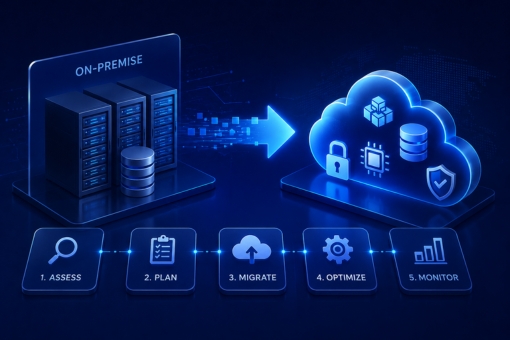
Step-by-Step On-Premise to Cloud Migration Process
No two migrations are identical. Nevertheless, a structured, phased approach consistently produces better outcomes than ad hoc execution.
Step 1: Discovery and Planning
Effective planning begins with a comprehensive inventory of all applications, data sources, dependencies, and infrastructure components. The planning phase should answer three core questions:
- What assets require migration?
- What business objectives does migration serve?
- How complex is each workload to migrate?
Furthermore, define success metrics upfront, including performance benchmarks, cost targets, and service level agreements. A migration without defined outcomes is difficult to govern and nearly impossible to declare successful.
Step 2: Strategy Selection and Assessment
After completing discovery, assign a migration strategy (one of the six Rs) to each workload based on business criticality, technical complexity, and cost. Additionally, assess dependencies between systems to sequence migrations in an order that minimizes disruption.
Cloud migration services providers use automated assessment tools to accelerate this phase and reduce the risk of missing hidden dependencies.
Step 3: Cloud Environment Design and Optimization
Before migrating any workload, design the target cloud environment. This includes selecting the appropriate cloud provider and service model (IaaS, PaaS, or SaaS), configuring network architecture, defining identity and access management policies, and establishing cost governance guardrails.
Evaluate multiple vendors and model the total cost of ownership (TCO) for each option. Optimizing resource configurations before migration prevents overspending post-launch.
Step 4: Secure Migration Execution
Security cannot be an afterthought. Specifically, encrypt data in transit and at rest, enforce least-privilege access controls, and deploy monitoring to detect anomalies during migration. Establish a clear rollback plan before executing each migration wave.
Organizations handling regulated data, such as healthcare records or financial information, must also validate compliance requirements for the target cloud environment before migrating.
Step 5: Phased Migration and Testing
Migrate workloads incrementally rather than all at once. Start with lower-risk, less critical systems to build team confidence and surface unforeseen issues early. After each migration wave, conduct thorough functional testing, performance validation, and user acceptance testing.
Phased migration also limits business disruption. In contrast to a big-bang cutover, incremental migration preserves continuity and creates natural checkpoints for course correction.
Step 6: Measure, Monitor, and Optimize
Migration completion is not the endpoint. Post-migration, establish continuous monitoring across performance, cost, security, and availability. Use cloud-native observability tools to track application behavior and identify optimization opportunities.
Additionally, review cloud spending regularly. Many organizations discover opportunities to right-size instances, consolidate services, and eliminate unused resources in the months following migration. Ongoing cloud infrastructure migration optimization is a discipline, not a one-time activity.
On-Premise vs Cloud Comparison
| Dimension | On-Premise | Cloud |
|---|---|---|
| Capital Expenditure | High (hardware, facilities) | Low (consumption-based) |
| Scalability | Limited by physical capacity | On-demand, elastic |
| Maintenance | Internal IT responsibility | Shared with cloud provider |
| Security Control | Full internal control | Shared responsibility model |
| Disaster Recovery | Complex, costly | Built-in, automated options |
| Time to Deploy | Weeks to months | Hours to days |
| Innovation Speed | Constrained by infrastructure | Accelerated via managed services |
| Compliance | Fully internal | Provider certifications available |
This comparison illustrates why the shift from on-premise to cloud migration has become a strategic priority rather than a technical option for most enterprises.
Best Practices for Successful Cloud Migration
Organizations that execute cloud migration successfully share a set of disciplined practices that separate effective programs from costly ones.
Align Migration to Business Outcomes
Every migration decision should connect to a specific business objective, whether that is cost reduction, application performance, workforce mobility, or regulatory compliance. Without this alignment, migration teams optimize for technical metrics that may not reflect business value.
Invest in a Proof of Concept
Before committing to a full migration, run a controlled proof of concept with a representative workload. This approach surfaces real-world challenges and validates architecture decisions at low risk. Moreover, it builds team capability before the scale of execution increases.
Establish Cloud Governance Early
Define policies for cost management, access control, tagging standards, and compliance reporting before the first workload migrates. Retroactively applying governance after migration is significantly more difficult.
Train and Enable Internal Teams
Cloud operating models differ fundamentally from on-premise IT management. Therefore, invest in training for infrastructure, development, and operations teams concurrently with the migration program. Capability building accelerates post-migration optimization.
Partner with Experienced Cloud Migration Services
For organizations navigating complex environments, external cloud migration services provide architectural expertise, tooling, and delivery experience that accelerates timelines and reduces risk. In particular, this matters when internal teams are simultaneously managing day-to-day operations and a major transformation.
Future of Cloud Migration
The cloud migration landscape continues to evolve rapidly. Several trends are shaping how organizations approach migration in 2026 and beyond.
Multi-cloud and hybrid strategies are gaining traction. Rather than committing to a single provider, many enterprises distribute workloads across two or more clouds to optimize cost, performance, and resilience. Consequently, cloud infrastructure migration now increasingly involves designing cross-cloud connectivity and governance.
AI-assisted migration tooling is reducing manual effort. Automated discovery, dependency mapping, and code analysis tools now handle work that previously required weeks of manual assessment.
FinOps as a discipline is maturing. Organizations are embedding cloud financial management practices into their operating models, treating cost optimization as an ongoing function rather than a post-migration project.
Edge computing integration is expanding the migration scope. As workloads move closer to users and devices, cloud migration strategies must account for edge nodes alongside central cloud environments.
Finally, sustainability considerations are influencing provider selection. Cloud providers increasingly publish energy efficiency and carbon metrics, and organizations are incorporating these into procurement decisions as part of broader ESG commitments.
Conclusion
On-premise to cloud migration is one of the highest-leverage investments an enterprise can make in its technology foundation. The decision is no longer whether to migrate, but how to do so with precision, speed, and minimal disruption.
A structured cloud migration process, grounded in the six Rs framework and executed in disciplined phases, gives organizations the best probability of success. Furthermore, migration is not a destination. It is the beginning of a continuous improvement cycle that unlocks cloud-native capabilities, accelerates innovation, and positions the enterprise for long-term competitive advantage.
Organizations that treat cloud migration as a strategic program, not a technical project, consistently deliver better outcomes. With the right cloud migration strategy, the right partners, and a commitment to governance, the transition from legacy infrastructure to cloud is entirely achievable, regardless of complexity.