












Summary
Predictive analytics has moved out of the data science notebook and into the daily decisions of finance, healthcare, retail and operations, and US providers now compete on models in production, monitoring discipline and domain depth. The work done by the top 10 data science and predictive analytics companies spans model development, feature engineering, deployment and ongoing monitoring. Prospects match a partner to their data and domain and ask to see a model running in production before going ahead with them.
Introduction
Predictive models have left the lab. Retailers forecast demand every week, insurers score claims at intake, and care teams flag patients at risk before a discharge goes wrong. The firms that build those models now get compared the way agencies once were, on track record and fit. Anyone typing “data science companies” into a search bar meets a wall of look-alike lists, so we built one with the evidence attached. If your goal is data science and predictive analytics that runs inside daily operations, this shortlist is where you’ll want to start.
Talent scarcity is part of the story. Few mid-sized companies can hire modelers fast enough to match demand, so external partners carry a large share of the work. The question is which partner suits which problem.
The labor numbers show why. The U.S. Bureau of Labor Statistics projects employment of data scientists to grow 35% from 2025 to 2035, with about 24,800 openings a year and a median wage of $120,230 as of May 2025.
Full disclosure: We kept the field to US-headquartered firms which are dynamic and futuristic in the data science and predictive analytics domain and highly relevant to American buyers. We ranked every company on the criteria below.
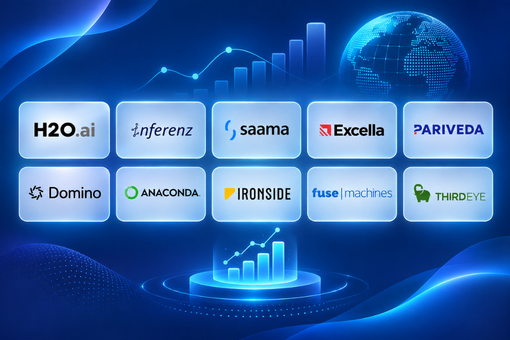
Top 10 data science and predictive analytics companies at a glance
| # | Company | Best for | Headquarters and signals |
| 1 | H2O.ai | Machine learning platform with predictive and generative AI | Mountain View, California, open-source roots |
| 2 | Inferenz | Predictive models inside CRM, ERP and EHR for healthcare, insurance and hi-tech | Round Rock, Texas, seven-step model lifecycle, Caregence predictive models, 30+ accelerators |
| 3 | Saama | Clinical analytics and AI for life sciences | Campbell, California |
| 4 | Excella | Data science and analytics for public and commercial teams | Arlington, Virginia, founded 2002 |
| 5 | Pariveda | Strategy and technology programs that include analytics and AI | Dallas, founded 2003, employee-owned |
| 6 | Domino Data Lab | Governed platform for building and running enterprise models | San Francisco, founded 2013, Visionary in the 2026 Gartner Magic Quadrant |
| 7 | Anaconda | Python-based data science foundation for teams and enterprises | Austin, founded 2012 |
| 8 | Ironside | Enterprise data and analytics integration, with an IBM heritage | Lexington, Massachusetts, founded 1999 |
| 9 | Fusemachines | Enterprise AI products and services with talent programs | New York, founded 2013, Nasdaq-listed |
| 10 | ThirdEye Data | Custom AI and analytics systems taken to production | San Jose, California |
What do data science and predictive analytics companies do?
Data science and predictive analytics companies build statistical and machine learning models that forecast outcomes such as demand, churn, price response, fraud and patient risk, then connect those models to the systems where people act on them. Good ones cover the whole lifecycle:
- Opportunity mapping: picking the decisions worth modeling and defining success in business terms.
- Feature engineering: turning raw records into the signals a model can learn from.
- Model development: testing regression, classification, forecasting and deep learning approaches.
- Operationalization: pushing scores into the CRM, ERP, EHR or order system.
- Monitoring: tracking accuracy, drift and stability after launch.
That last step trips up more projects than any other, and it’s rarely in the pitch. A model that scored well in March can quietly degrade by September, which is why the far-reaching impact of model drift deserves a line in every contract.
How we ranked these data science companies
Hundreds of firms use “data science” as a label. We kept US-headquartered companies of comparable scale with public evidence you can check, and each met most of these six criteria:
- Models in production: customer examples where predictions feed a live workflow.
- MLOps discipline: pipelines, versioning and drift monitoring that continue after launch.
- Domain depth: repeat work in a named industry, such as retail, insurance or life sciences.
- Data readiness: capacity to fix feature and quality problems before modeling starts.
- Responsible AI: documented practices aligned with the NIST AI Risk Management Framework.
- Evidence: dated awards, analyst recognition or named customers on the company’s own site.
We kept a firm on the list only when at least two independent sources agreed on its headquarters, and we state a founding year only where the sources matched. Companies that have been acquired by an operating company were left out. Order reflects editorial judgment, and no numeric scores sit behind it. Test every number in a pilot before it goes into a business case.
The 10 data science and predictive analytics companies to know in 2027
1. H2O.ai
Best for: teams that want a machine learning platform covering predictive and generative AI.
H2O.ai is headquartered in Mountain View, California, and is known for its open-source machine learning roots. It now describes itself as a sovereign AI platform with software and expertise to run predictive, generative and agentic workloads, and it published its 2026 AI 100 honorees list in October. On the data science side, it supports predictive analytics and machine learning for use cases such as fraud detection, and it points to a bench that includes Kaggle Grandmasters It suits buyers who want to own a platform and keep their own team in the driver’s seat.
Worth asking: which parts of the platform your own data scientists would run and which need vendor services.
2. Inferenz
Best for: enterprises that want predictive models operating inside the CRM, ERP, EHR or order system they already run.
Inferenz is a data and AI engineering company, 200-plus specialists strong, with US operations in Round Rock, Texas, and teams in Ahmedabad and Pune. Its data science practice follows a seven-part lifecycle: opportunity mapping, model development across regression, classification, forecasting and deep learning, feature engineering, MLOps pipelines, scenario modeling for risk scoring and what-if analysis, integration into enterprise systems, and monitoring for accuracy, drift and stability.
Accelerators back each stage, including a synthetic data generation engine, a responsible AI accelerator and data quality and observability frameworks. Healthcare teams can start from the Caregence predictive models, which apply the same lifecycle to patient risk and care operations.
Worth asking: which of the top use cases match your data, and what the monitoring plan looks like in month six.
3. Saama
Best for: clinical analytics and AI for life sciences.
Saama is headquartered in Campbell, California, and builds AI-driven software that helps pharma and biotech sponsors run faster, cleaner clinical trials. Its platform covers data management, patient insights, safety review and regulatory submissions, and its agentic tools automate statistical programming deliverables. Everest Group named it a Luminary in its April 2026 report on AI in clinical development, and it won “AI-based Life Sciences Solution of the Year” at the 2026 AI Breakthrough Awards, its third straight year of recognition from that program.
Worth asking: how its agents keep a human reviewer in control of regulated deliverables.
4. Excella
Best for: data science and analytics for public sector and commercial teams.
Excella was founded in 2002 and is headquartered in Arlington, Virginia. It calls itself an Agile technology firm and has won recognition for its data science and analytics work. Its profile suits teams that want modelers working inside an Agile delivery process. Its data science services cover data analytics, machine learning and AI development.
Worth asking: how it staffs a mixed team of data scientists and engineers on a commercial engagement.
5. Pariveda
Best for: strategy and technology programs that include analytics and AI.
Pariveda is an employee-owned professional services firm founded in 2003 and headquartered in Dallas, with offices across North America and ~500 employees worldwide. It provides strategy and technology services across industries, so analytics work usually sits inside a wider transformation program. Its data science and analytics work centers on AI strategy and on connecting data, people and workflows into one system.
Worth asking: how much of the analytics bench is dedicated to predictive modeling versus general consulting.
6. Domino Data Lab
Best for: a governed platform for building and running enterprise models.
Domino Data Lab was founded in 2013 and is headquartered in San Francisco. It provides a unified platform to build, scale and govern enterprise AI, and it was named a Visionary for the third consecutive year in the 2026 Gartner Magic Quadrant for data science and machine learning platforms. The platform supports the full model lifecycle, from data science and machine learning development to model deployment, MLOps and governance. In September 2026 it announced a partnership with EPAM to speed AI adoption in life sciences.
Worth asking: how its governance features map to your model risk review process.
7. Anaconda
Best for: a Python-based data science foundation for teams and enterprises.
Anaconda was founded in 2012 and is headquartered in Austin, Texas. It is best known for its Python distribution and describes itself as a foundation for AI-native development. It also supports open-source tooling, vetted packages and models, and training courses for machine learning development. In 2026 it announced acquisitions including Outerbounds, the company behind the Metaflow orchestration framework, and the AI security startup Enkrypt AI.
Worth asking: how its tooling fits next to the notebooks and pipelines your team already uses.
8. Ironside
Best for: enterprise data and analytics integration, with an IBM heritage.
Ironside was founded in 1999 and is headquartered in Lexington, Massachusetts, with regional offices in several US cities. Its data science practice sits alongside business analytics and data management, and its Ascent solutions for AWS bring machine learning and cloud analytics to customers in modules. It describes itself as an enterprise data and analytics firm and system integrator, and it lists more than 25 years of experience with the IBM data, analytics and automation portfolio.
Worth asking: how much modeling work it does beyond reporting and integration.
9. Fusemachines
Best for: enterprise AI products and services combined with talent programs.
Fusemachines was founded in 2013 and is headquartered in New York. It trades on Nasdaq under the ticker FUSE. Its data science work includes demand forecasting and price elasticity models for retailers, consumer brands and manufacturers. The company describes itself as a provider of enterprise AI products and services, and in 2026 it announced an agentic AI suite for talent acquisition.
Worth asking: which of its products are ready to deploy and which are custom services.
10. ThirdEye Data
Best for: custom AI and analytics systems taken to production.
ThirdEye Data is headquartered in San Jose, California, and says it builds custom AI and data analytics systems for enterprises and takes them to production. Its data science services include custom machine learning models, predictive maintenance from sensor data and forecasting solutions. The site lists more than 35 case studies across industries.
Worth asking: how it covers support and monitoring once the original team moves on.
How to choose a data science company
Predictive analytics projects succeed when the buying process follows the same logic as the model: start with the decision, test against real data and keep checking after launch. Each step below narrows the field and sharpens the next conversation.
- Step 1: Name the decision you want to improve. Fraud scoring, demand forecasting, churn and patient risk each call for different skills. Write down the decision, who acts on the prediction and which number should move if the model works.
- Step 2: Check the data you hold today. Review how much history you have, how many records carry reliable labels and where the gaps sit. A model can only be as good as its inputs, and this is where many programs lose their first quarter.
- Step 3: Decide who will run the model. Some teams want a platform their own data scientists operate. Others want a partner to build, deploy and maintain the work. The answer shapes the skills you need to hire and the partner profile you should look for.
- Step 4: Shortlist on evidence. Ask for models running in production, named examples from your industry and a reference you can call. Check public sources for dated proof, and ask how long each model has been live.
- Step 5: Pilot one decision against a baseline. Record how the current method performs, set a success threshold in advance and test on data the model has never seen. Judge the result on business impact as well as accuracy scores.
- Step 6: Plan for monitoring and retraining. Models drift as customers, markets and source systems change. Agree who watches performance, which thresholds trigger a retrain and how bias, explainability and documentation will be handled.
- Step 7: Contract for a clean handover. Settle ownership of the models and code, documentation standards and training for your team. Tie payments to milestones that include production release.
Most programs reach value one decision at a time. Begin with a single use case, prove it in production and widen the scope once the first model has earned its place.
Questions to ask every data science vendor
- Production record: Which models of this type are live today, and who owns them?
- Baselines: What is the current process worth, and how will you prove the model beats it?
- Monitoring: How do you detect drift, and who retrains the model?
- Explainability: Can a business user see why a score fired?
- Data needs: Which fields do you need, and what do you do when they’re missing?
- Governance: How do your practices map to the NIST AI Risk Management Framework?
- Handover: Can our team retrain and redeploy the model without you?
Predictive analytics trends to watch in 2027
- From dashboards to decisions. Scores now flow straight into the workflow, with a recommended next step attached.
- Agents consume predictions. AI agents increasingly act on risk scores, so model quality drives automation quality.
- Synthetic data fills gaps. Teams use generated records to test models where real data is scarce or sensitive.
- Responsible AI moves into procurement. Expect scorecards that ask for bias testing and audit trails.
- Payback gets measured. McKinsey’s 2026 survey found 37% of respondents attribute some EBIT impact to AI, so leaders want proof.
Final thoughts
The strongest data science companies in 2027 make a habit of naming the decision a model will change and the number that proves it. They show dated recognition, they staff monitoring after launch, and they hand over code you can run. Choose the partner whose strengths match your use case, start with one model that carries a clear before-and-after, and fix the data before you add a second.
If your models need to live inside healthcare, insurance or hi-tech systems, Inferenz is worth a conversation.