










Summary
Data science in healthcare has moved past dashboards and retrospective reporting. Hospitals now use predictive models to flag patient deterioration hours before a crisis, prevent readmissions, and close revenue leaks that quietly drain margins. This guide covers eight practical use cases most vendors don’t discuss, the benefits and challenges of adoption, and how agentic AI is reshaping healthcare data science heading into 2026 and beyond. Whether you run clinical operations or manage the P&L, the goal is the same: turn scattered healthcare data into decisions that protect patients and revenue.
Introduction: The Changing Role of Data Science in Healthcare
A single mid-sized hospital generates more data in a week than most enterprises generate in a year. Vitals, claims, lab results, imaging files, scheduling logs, and clinician notes pile up across disconnected systems. However, most of that data sits idle. Clinical teams still make high-stakes decisions on incomplete information, and finance teams still discover billing errors months after the damage is done.
This is the real problem data science in healthcare exists to solve. It is not about adding another dashboard. It is about converting fragmented, messy healthcare data into predictions and decisions that arrive before the outcome, not after it. Consequently, organizations that treat data science as a reporting exercise get reports. Organizations that treat it as a decision-support system get results.
This article breaks down what data science in healthcare actually means, the eight highest-impact use cases that rarely make it into vendor pitch decks, and how healthcare data science consulting services help organizations move from pilot projects to production systems.
What Is Data Science in Healthcare?
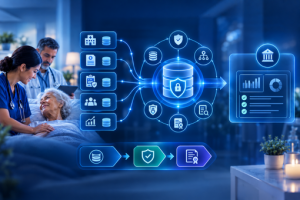
Data science in healthcare is the discipline of applying statistics, machine learning, and structured analytics to clinical, operational, and financial healthcare data to improve outcomes and reduce cost. It sits at the intersection of three domains: clinical knowledge, computer science, and healthcare data analytics.
In practice, healthcare data science does three things:
- Collects and cleans data from EHRs, claims systems, wearables, and lab feeds
- Applies statistical models and machine learning to detect patterns humans would miss
- Delivers predictions in a form clinicians and administrators can act on immediately
Because healthcare data is fragmented across payers, providers, and devices, most organizations need a data science consulting partner to unify these sources before any model can be trusted. Without that foundation, even the most advanced algorithm produces unreliable output.
How This Differs From General Data Science
General data science optimizes for engagement, conversion, or efficiency. Healthcare data science optimizes for something harder to measure and higher stakes: patient safety. A false positive in retail analytics costs a wasted ad. A false negative in patient deterioration prediction can cost a life. This is why data science consulting services built specifically for healthcare emphasize explainability, HIPAA compliance, and clinical validation far more than a generic analytics vendor would.
Key Applications of Data Science in Healthcare
Before diving into the specific use cases, it helps to understand the broad categories where data science and analytics are already active in healthcare organizations:
- Medical imaging analysis — detecting anomalies in X-rays, CT scans, and MRIs faster and more consistently than manual review alone
- Genomics and precision medicine — correlating genetic markers with disease risk to personalize treatment
- Drug discovery — modeling molecular interactions to shorten research cycles
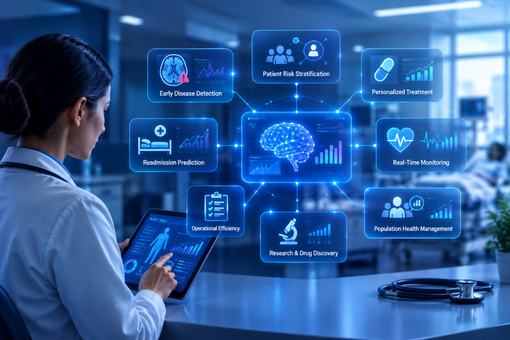
- Predictive analytics — forecasting patient risk, staffing needs, and resource demand
- Remote patient monitoring — using IoT devices and continuous data streams to catch problems early
- Clinical operations optimization — reducing wait times, improving scheduling, and cutting waste
These categories set the stage. The next section gets specific, covering eight use cases that deliver measurable ROI but rarely appear in generic healthcare AI marketing.
8 Data Science Use Cases in Healthcare No One Will Tell You
Most articles on data science in healthcare repeat the same four examples: imaging, genomics, drug discovery, and wearables. Those matter, but they are not where most healthcare organizations are actually losing money or missing early warning signs. The following eight use cases are less discussed, more operationally relevant, and often deliver faster ROI.
Use Case #1: Predicting Patient Deterioration
Early warning scores based on static vitals thresholds miss subtle deterioration patterns. Machine learning models trained on continuous vitals, lab trends, and nursing notes can flag at-risk patients six to twelve hours before a rapid response event. As a result, clinical teams intervene earlier, and ICU transfer rates drop.
This is one of the clearest applications of Healthcare Data Science, because the underlying data (vitals, labs, notes) already exists inside most EHRs. The barrier is rarely data availability. It is almost always data fragmentation and model validation.
Use Case #2: Predicting Hospital Readmissions
Readmission penalties under value-based care models make this a financial as well as clinical priority. Predictive models combine discharge diagnosis, social determinants of health, medication adherence history, and follow-up appointment data to score readmission risk at discharge.
Hospitals that act on these scores, by scheduling earlier follow-ups or adding home health visits for high-risk patients, consistently reduce 30-day readmission rates. This is a textbook case for data science for healthcare teams pairing clinical logic with statistical modeling.
Use Case #3: Predicting Patient No-Shows
No-shows quietly cost outpatient clinics significant revenue every month. Predictive models using appointment history, distance to facility, weather, and communication preferences can flag high no-show-risk appointments in advance. Clinics then double-book strategically or send targeted reminders through the patient’s preferred channel.
Because this use case ties directly to revenue rather than clinical outcomes, it is often the easiest entry point for organizations exploring data science consulting for the first time.
Use Case #4: Detecting Revenue Leakage and Billing Anomalies
Coding errors, missed charges, and denied claims drain millions from healthcare organizations every year. Anomaly detection models flag billing patterns that deviate from historical norms, whether that is an unusual denial spike from a specific payer or a coding pattern that consistently under-bills a procedure.
This is where a healthcare data analytics company delivers immediate, measurable financial impact. Unlike clinical use cases that require long validation cycles, billing anomaly detection can show ROI within the first quarter of deployment.
Use Case #5: Predicting Staffing Needs
Overstaffing wastes budget. Understaffing burns out clinical teams and increases error rates. Predictive staffing models combine historical census data, seasonal illness trends, local event calendars, and even weather forecasts to project patient volume days or weeks in advance.
Organizations using this approach report more stable nurse-to-patient ratios and meaningfully lower agency staffing costs, which are often the single largest controllable expense in a hospital budget.
Use Case #6: Identifying Referral Leakage
Referral leakage happens when patients referred to a specialist within a health system instead go outside the network, taking that revenue with them. Data science models track referral patterns, identify where leakage concentrates by specialty or geography, and surface the drivers, whether that is scheduling delays or network gaps.
This use case sits at the intersection of data science consulting services and network strategy, and it is rarely discussed publicly because health systems consider referral data commercially sensitive.
Use Case #7: Accelerating Clinical Documentation
Clinicians spend a disproportionate share of their day on documentation instead of patient care. Natural language processing models, increasingly powered by Conversational AI in Healthcare, now summarize clinical encounters, auto-populate structured fields, and flag missing documentation required for accurate billing.
This directly improves clinician satisfaction and reduces burnout, while also improving downstream data quality for every other model built on top of that documentation.
Use Case #8: Predicting Hospice and Palliative Care Eligibility
Identifying patients who would benefit from palliative or hospice care earlier improves quality of life and reduces unnecessary aggressive interventions near end of life. Predictive models analyze diagnosis trajectories, functional decline indicators, and utilization patterns to flag eligible patients for care team review.
Because this use case touches sensitive clinical judgment, it is typically deployed as a decision-support flag for physician review rather than an automated trigger, which keeps the human in the loop where it matters most.
Benefits of Data Science in Healthcare
Bringing these use cases together, the benefits of Data Science in Healthcare span three areas:
Clinical benefits
- Earlier detection of patient deterioration
- More personalized treatment plans through genomics and predictive modeling
- Reduced diagnostic error rates
Operational benefits
- Better staffing predictions and resource allocation
- Reduced no-show rates and improved scheduling efficiency
- Faster clinical documentation
Financial benefits
- Reduced readmission penalties
- Detection of billing anomalies and revenue leakage
- Lower agency staffing costs
Together, these benefits explain why data science services in healthcare have moved from innovation-lab pilots to core operational infrastructure at leading health systems.
How Data Science Turns Healthcare Data Into Actionable Intelligence
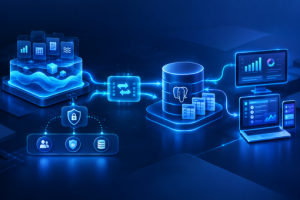
Raw healthcare data, on its own, has no value. The transformation from raw data to actionable intelligence follows a consistent pipeline.
Step 1: Data Collection and Integration
Healthcare data lives in EHRs, claims systems, lab platforms, imaging archives, and increasingly, wearable devices. A data consulting services partner typically starts here, because fragmented data undermines every model built afterward.
Step 2: Cleaning and Standardization
Healthcare data is notoriously messy. Different providers code the same condition differently, timestamps drift across systems, and manual entry introduces errors. Standardizing this data is unglamorous work, but it determines whether downstream models are trustworthy.
Step 3: Model Development and Validation
Data scientists build models specific to the use case, whether that is a readmission risk score or a billing anomaly detector, and validate them against historical outcomes before any clinical or financial decision relies on them.
Step 4: Deployment Into Clinical or Operational Workflows
A model that lives in a data science notebook delivers zero value. The final step embeds predictions directly into the tools clinicians and administrators already use, so the insight arrives at the point of decision, not buried in a separate report.
Challenges of Implementing Data Science in Healthcare
Despite the clear benefits, healthcare data science projects fail more often than they succeed. The common obstacles include:
- Data fragmentation across EHRs, payers, and legacy systems that don’t communicate
- Regulatory complexity, particularly HIPAA compliance and state-level privacy rules
- Clinician trust, since models without explainability get ignored regardless of accuracy
- Data quality issues inherited from decades of inconsistent manual entry
- Change management, because a model is only useful if workflows actually change around it
Overcoming these challenges typically requires more than an internal data team. It requires a partner with both technical depth and healthcare domain experience, which is exactly the gap data science consulting firms with healthcare specialization are built to close.
The Role of AI and Agentic AI in Healthcare Data Science
Traditional predictive models answer narrow questions: will this patient be readmitted, will this claim be denied. Agentic AI extends this further by taking action, not just producing a prediction.
A HIPAA compliant healthcare native agentic AI platform can, for example, flag a deterioration risk, automatically notify the appropriate care team member, and schedule the follow-up, all within a compliant, auditable workflow. This shifts data science in healthcare from passive reporting to active intervention.
Platforms like Meta Muse Spark in Healthcare and GPT-6 Astra in Healthcare represent the direction this space is heading: multimodal systems capable of reasoning across imaging, structured records, and clinical notes simultaneously, rather than analyzing each data type in isolation. Meanwhile, AI in health data science and analytics increasingly blends generative reasoning with the statistical rigor of traditional predictive modeling, giving clinicians both a prediction and a plain-language explanation of why the model reached that conclusion.
Future of Data Science in Healthcare
Looking toward 2026 and beyond, several trends are converging:
- Agentic AI moving from pilot to production, handling routine clinical and administrative workflows end to end
- Multimodal models that reason across imaging, genomics, and text simultaneously instead of requiring separate systems for each
- Real-time monitoring becoming standard rather than a premium feature, as wearable and IoT data volumes grow
- Stronger regulatory frameworks around AI explainability in clinical decision-making, pushing vendors toward more transparent models
Organizations that wait for these trends to fully mature will find themselves competing against health systems that already built the data infrastructure to support them.
How Healthcare Organizations Can Prepare for the Future
Preparation does not start with buying an AI platform. It starts with the data foundation underneath it.
- Audit data infrastructure to identify fragmentation across EHRs, claims, and departmental systems
- Prioritize one or two use cases with clear ROI, such as no-show prediction or billing anomaly detection, rather than attempting an enterprise-wide rollout immediately
- Build in compliance from day one, since retrofitting HIPAA compliance into an existing system is far more expensive than designing for it upfront
- Partner with a specialized team offering Data Science & Predictive Analytics Services built specifically for healthcare workflows, not adapted from generic enterprise analytics
Organizations that follow this sequence typically see faster time to value and fewer stalled AI initiatives than those that jump straight to platform selection.
Conclusion: From Healthcare Data to Better Outcomes
Data science in healthcare has outgrown the era of static dashboards and quarterly reports. The organizations seeing real returns are the ones using predictive models to act before an outcome happens, not after. From predicting patient deterioration to closing revenue leaks in billing, the eight use cases outlined here represent where the practical value is concentrated right now.
The path forward is not complicated, but it does require discipline: fix the data foundation, prioritize high-ROI use cases, and build compliance in from the start. Healthcare organizations that treat data science as core infrastructure, rather than an experimental add-on, will be the ones setting the pace as agentic AI reshapes what is possible in clinical and operational decision-making.
At Inferenz, we help healthcare organizations turn fragmented data into trusted intelligence and actionable AI solutions, connecting data modernization, analytics, and AI to measurable business and patient outcomes. Learn more about how Inferenz approaches data and AI transformation for healthcare organizations.