











Summary
Data engineering services cover discovery, pipeline development, data integration, quality and observability, cloud platform migration and ongoing operations. Ten data engineering firms from US, each with a different strength but similar build and traction, from Microsoft-led migrations to real-time pipelines to healthcare compliance are listed here. Inferenz comes first for healthcare, insurance and hi-tech buyers who want data engineering consulting and a route to AI from one team.
Introduction
A hospital CFO asks for one number: how many patients the system served last quarter. Finance says 41,200. Operations says 43,900. Both teams are right, because the data sits in different systems, loads on different schedules and follows different definitions. Nobody is lying. The pipes are broken.
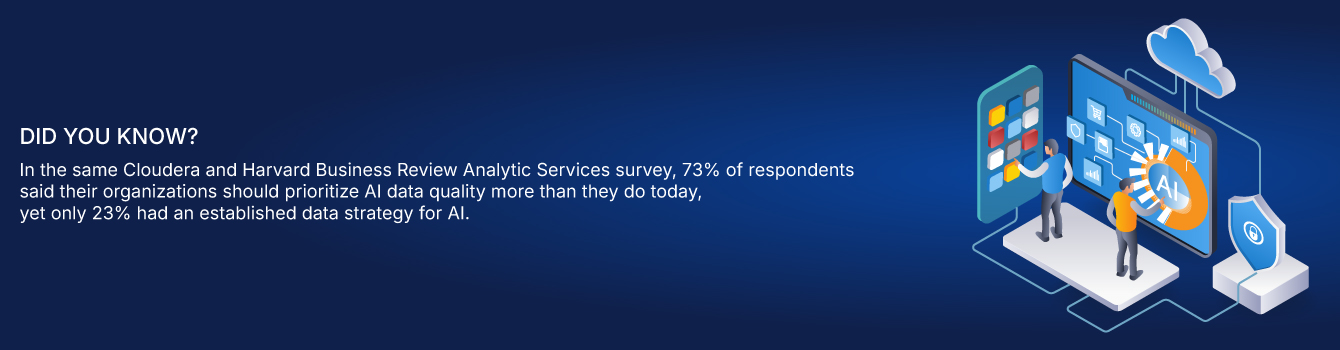
Data readiness is the bottleneck for AI. In a 2026 Cloudera and Harvard Business Review Analytic Services survey, only 7% of respondents said their data is completely ready for AI, and 56% named siloed data as a top obstacle.
Closing that gap is the daily work of a data engineering company. These firms build the pipelines, storage layers and quality controls that turn scattered source systems into data a business can trust, and every dashboard, forecast and AI model depends on what they deliver.
This guide profiles ten of the top data engineering companies in the USA for 2026: Inferenz plus Analytics8, Aimpoint Digital, Kanerika, RTS Labs, ThirdEye Data, Algoscale, Zuar, Ironside Group and Elder Research. All are specialist or mid-sized firms, so you usually work with the engineers who build your platform. You’ll also find what data engineering services and solutions include, how a consultant improves your data infrastructure, which tools matter and how to pick a partner.
Key Benefits of Data Engineering Services for Your Business
The payoff from data engineering services shows up in six places. Each one is measurable, which makes it easier to build a business case. Governance builds trust. In the 2026 Precisely and Drexel LeBow study, 71% of organizations with a governance program reported high data trust, against 50% of those without one.
Here are the key benefits of data engineering services for your organization.
One Version of the Truth
The CFO example above ends when finance and operations read from the same governed layer with shared metric definitions. Conflicting counts stop consuming meeting time, and analysts stop rebuilding the same logic in separate spreadsheets.
Faster, Fresher Reporting
Automated pipelines replace manual extracts and overnight batch jobs. Reports that once landed the next morning can refresh hourly or continuously, and teams act on current numbers.
Lower Operating Cost
Duplicate pipelines, forgotten data marts and oversized compute quietly inflate cloud bills. A good engagement retires them, sizes compute to real workloads and frees engineers from nightly firefighting.
Reliable Inputs for AI
Models, retrieval systems and agents act on whatever the pipeline delivers. Late, duplicated or mismatched records turn into wrong predictions and wrong automated actions, which is why AI programs lean on the data layer more than on the model.
Compliance and Audit Readiness
Regulated teams must show where a number came from and who touched it. Lineage, access controls and PII or PHI classification built into the platform turn an audit request into a routine query.
Scale Without Rework
Modular pipelines with schema handling built in let you add a source in days. Without them, every new system or acquisition triggers another rebuild.
What Do Data Engineering Companies Actually Do?
A data engineering company designs, builds and runs the systems that move data from where it’s created to where it gets used. Data engineering solutions usually break into six workstreams, and most projects touch at least four.
Discovery and Architecture Design
Work starts with an inventory of source systems, data volumes, refresh needs and known quality problems. Engineers trace lineage, decide where batch is enough and where streaming is justified, and choose a warehouse, lake or lakehouse pattern. The output is a target architecture and a phased roadmap tied to a data strategy that names the first use cases to deliver.
Data Integration Consulting and Pipeline Development
This is the core of data integration services. A data integration consultant builds connectors for databases, APIs, SaaS applications and event streams, then makes them dependable with incremental loads, change data capture, idempotent reruns, retries and schema evolution. The same engineers decide where business logic should live so each rule lives in one place.
Data Quality, Observability and Governance
A pipeline can run green for weeks while delivering wrong numbers. Data engineering firms add tests for row counts, null rates, referential integrity and freshness, then alerts that reach a named owner. Governance layers on ownership, access rules, lineage and classification of sensitive fields.
Cloud Platform Modernization and Migration
Most programs move legacy warehouses and on-premise databases to a cloud platform. A careful migration includes schema mapping, a parallel run that reconciles old and new outputs, a cutover plan and cost controls from day one. Big data engineering services for high-volume sources also tune partitioning and compute so costs stay predictable. Inferenz groups this work under its data and cloud modernization practice.
Modeling and the Serving Layer
Raw data becomes useful once it’s modeled. Many teams use a bronze, silver and gold structure that moves data from raw to cleaned to business-ready tables, with certified metric definitions on top so every dashboard computes the same number.
AI-Ready Data, MLOps and Managed Operations
Machine learning and agentic AI need versioned datasets, reliable features and monitoring for drift. After launch, many buyers also want a partner to run the platform. Data engineering as a service covers monitoring, performance tuning, incident response and cost management under agreed service levels, and it feeds generative and agentic AI programs that need dependable data underneath.
How a Data Engineering Consultant Improves Your Data Infrastructure
Good consultants diagnose before they build. The table maps common symptoms to the fix and to a metric you can check afterward.
| Symptom | What the consultant changes | Metric to watch |
| Reports disagree across teams | Defines shared metric definitions and a governed serving layer | Conflicting definitions in use; time to reconcile a number |
| Nightly jobs fail without anyone noticing | Adds tests, alerting and retries; makes loads safe to rerun | Failure rate; mean time to detect and recover |
| Data arrives a day late | Moves full reloads to incremental loads or change data capture | Freshness against the agreed SLA |
| The cloud bill climbs faster than usage | Right-sizes compute, fixes partitioning, retires duplicate pipelines | Cost per pipeline run or per query |
| Each new source takes months | Builds reusable ingestion templates with schema handling | Days to onboard a new source |
| Auditors can’t trace a number to its source | Adds lineage, ownership records and access logs | Share of key metrics with documented lineage |
The sequence is usually the same. Assess the current state, stabilize what breaks most often, rebuild the highest-value flows on the target architecture, then hand over runbooks or take over operations. Ask any firm to show where it would start in your environment and which metric it expects to move first.
How We Selected the Top Data Engineering Companies in the USA
Dozens of data engineering firms compete for enterprise work, so we applied a consistent screen. Each company below is a specialist or mid-sized firm that met most of these criteria.
- Data engineering depth: hands-on delivery of pipelines, storage platforms and integrations in production.
- Platform and tool fluency: working experience across the major clouds and tools such as dbt, Airflow and Kafka.
- Quality and governance: built-in testing, lineage, observability and compliance practices.
- Industry experience: depth in sectors such as healthcare, insurance, financial services or manufacturing.
- Delivery scale: a team large enough to run an enterprise program and small enough to keep senior engineers close to the work.
- Credibility signals: partnerships, certifications, awards and client references that can be checked against public sources.
- US presence: a US headquarters or a substantial US delivery team.
Profiles draw on each company’s public website and third-party business listings as of October 2026. Team sizes and offices change, so confirm current details directly before you build a shortlist.
Top 10 Data Engineering Companies in the USA Worth Watching in 2026
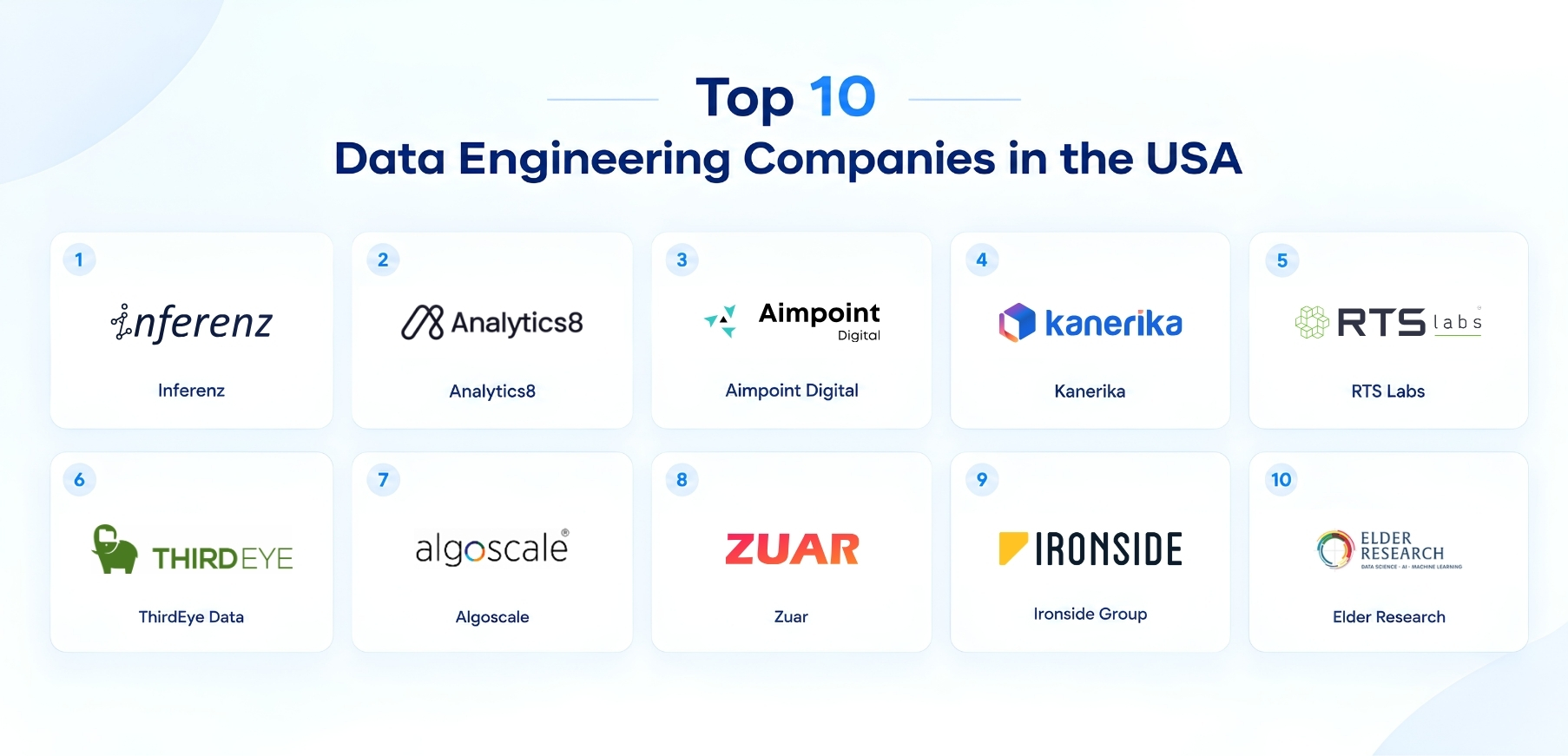
The ten firms below differ in size, platform focus and industry depth. That variety is useful, because the right data engineering company is the one whose strengths match your stack and your sector. Each profile ends with a question worth asking on a first call.
1. Inferenz
Company overview: Inferenz is a data and AI engineering company for healthcare, insurance and hi-tech enterprises, with a US office in Round Rock, Texas and delivery teams in Ahmedabad and Pune. Most client work sits in healthcare, including home care, home health and hospice operators. Its iDAR methodology moves clients from fragmented data to a governed foundation and then to AI, so analytics and automation sit on data the business already trusts.
Data engineering services and accelerators
The practice covers data engineering and integration, data and cloud modernization, data quality, governance and compliance, data strategy, and business intelligence. Reusable accelerators shorten build time: an ingestion engine for batch and streaming sources with schema evolution and retry logic, pipeline templates built on Airflow, dbt and Kafka, AI-assisted deduplication that produces golden records, observability dashboards for freshness, drift and lineage, and quality checks that run inside every pipeline execution.
Platforms and partnerships: Inferenz works across AWS and Azure and holds platform partnerships with AWS, Snowflake and Databricks, along with membership in NVIDIA Inception and the Microsoft for Startups Founders Hub.
Where Inferenz has delivered
Published case studies include unifying more than 40 source systems into one enterprise data platform for a national home care provider, automating ingestion across 12 source systems for a nationwide entertainment operator and building a zero-loss, real-time IoT event streaming pipeline for a video surveillance company. Each pairs integration work with built-in quality controls.
Why it stands out: many data engineering firms deliver a platform and stop there. At Inferenz, the engineers who build the pipelines also build the predictive models and agentic workflows that depend on them, including Caregence, its HIPAA-compliant agentic AI platform for healthcare. Healthcare clients also get a team that already understands EHR, billing and CMS reporting feeds.
Best suited for: healthcare systems, post-acute and home care providers, insurers and hi-tech companies that want data engineering consulting and a clear route to AI from one partner.
2. Analytics8
Company overview: founded in 2002 and based in Chicago, Analytics8 is a data and analytics consultancy with roughly 150 to 200 staff and offices in Chicago, Dallas and Raleigh. It reports serving more than 1,000 clients over two decades across many industries.
Services and credentials: services run from data and AI strategy through platform modernization, data engineering and integration, advanced analytics and BI, to data monetization. It partners with dbt, Sigma, ThoughtSpot and the major cloud vendors, and won a 2026 AI Breakthrough Award for data management innovation with its Accelr8 delivery approach, which combines reusable accelerators with automation.
Why it stands out: the firm describes its teams as senior-led and accountable for outcomes, and two decades of repeatable patterns can shorten discovery on modernization programs with fixed deadlines.
Best suited for: mid-market and enterprise teams that want strategy, engineering and analytics from one partner across several platforms.
Worth asking: which Accelr8 components apply to your stack, and who the named senior leads will be.
3. Aimpoint Digital
Company overview: founded in 2017 and headquartered in Atlanta, Aimpoint Digital has more than 200 employees and offices in London, Boston and Medellín. It serves healthcare, logistics, financial services, manufacturing and enterprise technology clients.
Services and credentials: platform engineering, AI, analytics, strategy, and optimization and simulation. It was named Databricks Digital Native Business Partner of the Year in 2024, 2025 and 2026, holds Snowflake Elite Services Partner status, partners with dbt Labs, AWS, Alteryx, Dataiku and Anthropic, and reports SOC 2 certification.
Why it stands out: repeated partner recognition suggests a team that has shipped on its chosen platforms many times, and the optimization and simulation practice suits operations-heavy problems such as routing and scheduling.
Best suited for: teams standardizing on a modern cloud data stack that need production engineering and applied AI from the same group.
Worth asking: which of its partner specialties your project would lean on, and how the team is staffed for your sector.
4. Kanerika
Company overview: founded in 2015 and headquartered in Austin, Texas, Kanerika operates offices across the US, India and Singapore. It serves manufacturing, healthcare, pharma, banking, insurance, logistics, automotive and retail clients.
Services and credentials: data engineering and analytics, data integration and modernization, data governance and strategy, agentic and generative AI, and intelligent automation. It is a Microsoft Fabric Featured Partner with an Azure data warehouse migration specialization, and reports CMMI certification. Its FLIP platform bundles workflow automation, AI agents and migration accelerators.
Why it stands out: the Microsoft credentials are extensive, and its migration accelerators target one of the most common projects in the market, moving legacy warehouses to modern platforms.
Best suited for: Microsoft-centric enterprises planning a Fabric or Azure data platform build.
Worth asking: whether its Microsoft-first accelerators fit your target platform if you’re building elsewhere.
5. RTS Labs
Company overview: founded in 2010 and based in Richmond, Virginia, RTS Labs is a boutique applied AI and data engineering firm with more than 100 employees, all in the United States. It remains founder-led, with no private equity ownership.
Services and credentials: a Data and AI Foundation practice covering data engineering and data science, alongside AI consulting and software and platform engineering. Its listed industries are financial services, insurance, logistics and transportation, real estate and construction, and private equity.
Why it stands out: a US-only team simplifies security reviews for financial services and insurance buyers, and founder-led governance tends to speed up decisions.
Best suited for: mid-market financial services, insurance and logistics firms that want a lean team and a straight line from pilot to production.
Worth asking: its listed industries center on financial services and logistics, so healthcare buyers should request comparable references.
6. ThirdEye Data
Company overview: founded in 2010 and based in San Jose, California, ThirdEye Data is led by CEO Dj Das, and business listings estimate its team at under 100 people. It serves manufacturing, energy and utilities, adtech, telecommunications, healthcare, and banking, finance and insurance.
Services and credentials: data engineering and analytics, data governance and master data management, data science, generative AI, AI agents and computer vision. Its website lists clients such as Southern California Edison, Stryker, Amgen and BP, cites a Microsoft relationship of more than 15 years, and says pre-built models can put solutions live within 120 to 180 days.
Why it stands out: Silicon Valley engineering roots and a long operating history carry weight with enterprises that have complicated, entrenched data estates.
Best suited for: manufacturing, energy and telecom organizations that need legacy data cleaned up and connected before AI work begins.
Worth asking: its service menu spans several AI disciplines, so request references that isolate its data engineering delivery.
7. Algoscale
Company overview: Algoscale describes itself as a boutique data science and big data analytics firm. Founded in 2014, it is listed with a Newark, New Jersey base and about 100 employees, and reports more than 300 completed projects across healthcare, banking, retail, SaaS, manufacturing and education.
Services and credentials: data strategy, cloud-native data architecture, real-time pipeline engineering, and AI and machine learning. Its stack includes Apache Kafka, Spark and Python on the three major clouds, with Power BI and Tableau for reporting. It reports a 99.9% pipeline success rate and 92% client retention, holds ISO 27001:2013 certification and earned Clutch Global Leader recognition in fall 2025.
Why it stands out: the firm treats most AI problems as data architecture problems first, which is usually the right instinct, and its real-time pipeline work suits streaming-heavy use cases.
Best suited for: enterprises with siloed data that need governed foundations and streaming pipelines across more than one cloud.
Worth asking: its delivery metrics are self-reported, so ask for client references that confirm them.
8. Zuar
Company overview: founded in 2018 and based in Austin, Texas, Zuar has appeared among Inc. magazine’s fastest-growing private companies and sells both software and services. Client logos on its website include MD Anderson Cancer Center, Everlywell and Universal Studios.
Services and credentials: automated data pipelines through Zuar Runner, analytics portals through Zuar Portal, and strategy, implementation and visualization work through Zuar Labs. It is a Tableau Premier Tech Partner and integrates with Salesforce, the major clouds, Power BI, ThoughtSpot and dbt.
Why it stands out: clients get a pipeline product and the consultants who built it, which shortens the path from raw sources to a working analytics experience.
Best suited for: analytics teams, particularly Tableau users, that want automated pipelines and customer-facing data portals without a long custom build.
Worth asking: because Runner is Zuar’s own product, confirm that it fits your standards and what migration would look like if you switched tools later.
9. Ironside Group
Company overview: founded in 1999 and based in Lexington, Massachusetts, in the Boston area, Ironside Group has earned multiple Inc. 5000 honors. It serves financial services, property and casualty insurance, retail and wholesale distribution, manufacturing, higher education, and healthcare payers and providers.
Services and credentials: data strategy and architecture, data integration and management, business intelligence and analytics, AI and machine learning, and managed services. It lists partner relationships with AWS, IBM and Microsoft and has been an AWS Advanced Consulting Partner since 2020.
Why it stands out: more than two decades in data and analytics produce a long list of repeatable patterns, and its managed services practice supports platforms after launch.
Best suited for: insurers, distributors and higher education institutions that want an experienced partner for integration, analytics and ongoing platform support.
Worth asking: how its managed services are staffed and priced after go-live.
10. Elder Research
Company overview: founded in 1995 by Dr. John Elder and headquartered in Charlottesville, Virginia, Elder Research has more than 150 employees, offices in the Washington DC area and Raleigh, and joined ManTech in 2025. It serves consumer goods, hospitality, energy and utilities, healthcare, financial services, insurance, government, and defense and intelligence clients.
Services and credentials: data strategy, analytics delivery and training, with production solutions for fraud detection, threat identification and demand forecasting. It counts federal agencies and Fortune 500 companies among its clients.
Why it stands out: three decades of applied data science bring statistical rigor, which matters in fraud and risk work where a weak model carries real cost.
Best suited for: regulated and public-sector organizations that need advanced analytics built on well-prepared data.
Worth asking: its published services emphasize analytics delivery, so confirm the data engineering scope on your project, or pair it with a pipeline specialist if integration work is heavy.
Data Engineering Companies in the USA: Comparison Table
Use this table to compare data engineering services and solutions at a glance, then read the profiles for the details behind each row.
| Company | Headquarters | Core data engineering strengths | Industries | Partners and stack | Team size |
| Inferenz | Round Rock, TX | Data engineering and integration, cloud modernization, governance | Healthcare, insurance, hi-tech | AWS, Azure, Airflow, dbt, Kafka | Under 200 |
| Analytics8 | Chicago, IL | Strategy, modernization, data engineering, BI | Cross-industry | dbt, Sigma, ThoughtSpot, major clouds | 150 to 200 |
| Aimpoint Digital | Atlanta, GA | Platform engineering, AI, analytics | Healthcare, logistics, financial services, manufacturing | dbt Labs, AWS, Alteryx, Dataiku | 200+ |
| Kanerika | Austin, TX | Data engineering, integration, governance, AI | Manufacturing, healthcare, pharma, banking, insurance | Microsoft Fabric, Azure | Not published |
| RTS Labs | Richmond, VA | Data engineering, data science, applied AI | Financial services, insurance, logistics | Not published | 100+ |
| ThirdEye Data | San Jose, CA | Data engineering, governance, MDM, generative AI | Manufacturing, energy, telecom, healthcare | Microsoft, AWS, Google Cloud | Under 100 (est.) |
| Algoscale | Newark, NJ | Real-time pipelines, cloud data architecture | Healthcare, banking, retail, SaaS | Kafka, Spark, Python, major clouds | About 100 |
| Zuar | Austin, TX | Pipeline automation, analytics portals | Healthcare, entertainment, professional services | Tableau, Power BI, dbt, ThoughtSpot | Not published |
| Ironside Group | Lexington, MA | Data strategy, integration, BI, managed services | Financial services, insurance, retail, healthcare | AWS, IBM, Microsoft | Not published |
| Elder Research | Charlottesville, VA | Data strategy, analytics delivery | Government, healthcare, insurance, energy | Not published | 150+ |
Which Data Engineering Companies Suit Large-Scale Projects?
Scale means different things: many source systems, high data volume, strict compliance or heavy change management. This table matches common scenarios to the firms most likely to fit, based on the public evidence in the profiles above.
| Project scenario | Evaluate first | Why |
| Many source systems in a regulated healthcare estate | Inferenz, Ironside Group | Inferenz unified 40+ source systems for a national home care provider; Ironside lists payer and provider clients. |
| Enterprise-wide platform modernization needing a senior bench | Analytics8, Aimpoint Digital | Both are mid-sized firms with 150 to 200+ staff and broad partner credentials. |
| Microsoft Fabric or Azure migration | Kanerika | Microsoft Fabric Featured Partner with an Azure migration specialization. |
| High-volume, real-time pipelines | Algoscale, Inferenz | Algoscale lists real-time pipeline engineering; Inferenz built a zero-loss IoT streaming pipeline. |
| Legacy data in manufacturing, energy or telecom | ThirdEye Data | Named utility and manufacturing clients and long data engineering history. |
| Lean US-only team for financial services or logistics | RTS Labs | More than 100 employees, all US-based, with a pilot-to-production model. |
| Fraud, risk and forecasting on prepared data | Elder Research | Production work in fraud detection, threat identification and demand forecasting. |
| Automated pipelines plus analytics portals | Zuar | Pairs Runner pipelines with Portal analytics apps. |
Programs that span many countries or thousands of engineers can outgrow any firm on this list. For AI-led programs with a wider scope, our guide to the top AI consulting companies in the USA covers that side of the market.
Essential Tools for Modern Data Engineering
Tool choice matters less than whether a team can explain why each tool earns its place in your stack. Most modern stacks cover six layers, and our roundup of data engineering tools from practitioners goes deeper on each one.
| Layer | What it does | Common tools | Question to ask a consultant |
| Ingestion and integration | Moves data from databases, APIs, SaaS apps and event streams | Fivetran, Apache Kafka, custom connectors | How do you handle schema changes and late data? |
| Orchestration | Schedules pipeline runs and tracks dependencies | Apache Airflow | Where do retries, alerts and backfills live? |
| Transformation | Cleans, joins and models data | dbt, Apache Spark | How are transformations tested and versioned? |
| Storage and compute | Holds data in a warehouse, lake or lakehouse | Cloud warehouses and lakehouse platforms | How do you keep cost in check as volume grows? |
| Quality and observability | Tests data and watches freshness, volume and drift | Acceldata, test suites inside pipelines | Who is alerted, and how fast? |
| Catalog and governance | Documents lineage, ownership and access | Collibra, Alation, Atlan | How do you classify PII or PHI? |
What to Consider When Choosing a Data Engineering Service Provider
Choosing among data engineering service providers comes down to fit. Size and brand name matter far less than whether the team has solved your type of problem before.
Define the Outcome and the Constraints
Write down the result you want, the number of source systems, how fresh the data must be and which regulations apply. A statement such as “unify 25 systems into one patient record with hourly refresh and HIPAA controls” lets a firm scope honestly and lets you compare quotes.
Check Platform and Tool Depth
Ask which platforms and tools the team has delivered on in the last 12 months. Then ask for a whiteboard session: how would they build the pipeline for your top use case, and what would break first? Specific answers beat slide decks.
Test Industry and Compliance Experience
A generalist may understand the technology and still miss the rule that decides success. Providers should show how they handle lineage, access control, PII and PHI classification and audit evidence, which is the scope of a data quality, governance and compliance practice.
Skills Every Data Engineering Consultant Should Show
A strong data engineering consultant combines several skills in one person or one small team. Look for these:
- SQL and data modeling: dimensional and normalized designs, plus the judgment to choose between them.
- Python and a distributed engine: Spark or similar for large transformations.
- Orchestration and CI/CD for data: version control, automated tests and separate environments.
- Streaming and change data capture: the patterns behind near-real-time pipelines.
- Cloud architecture and cost control: storage, compute and security design that scales without surprises.
- Data quality, security and governance: testing, lineage, access control and handling of sensitive fields.
- Communication: turning vague business questions into precise definitions and data contracts.
Ask for Production References and Metrics
Request examples of pipelines running today. Ask for freshness against SLA, pipeline failure rate, mean time to recovery and cost trend. A firm with shipped work can tell you what broke, what it fixed and how the system performs now.
Understand the Engagement Model and What Drives Cost
Pricing for data engineering consulting varies widely, and any single number online is a guess without your scope behind it. These factors move a quote the most:
- Number and complexity of sources: a few clean databases cost far less to integrate than dozens of legacy and SaaS systems.
- Latency requirements: streaming pipelines need more design and testing than nightly batch loads.
- Compliance load: HIPAA, SOC 2 and similar requirements add controls, documentation and review time.
- Data condition: duplicate records, missing keys and undocumented fields can consume more effort than the pipelines.
- Delivery model: a fixed project, a staffed team and a managed service price differently.
A short, paid discovery phase produces a scoped estimate grounded in your real systems and exposes surprises while they’re still cheap to fix.
Watch for Red Flags
- A fixed quote with no discovery phase.
- Testing saved for a final phase.
- Senior engineers in the pitch and junior staff on the project.
- No plan for documentation, runbooks or knowledge transfer.
- One tool recommended for every problem.
- Reluctance to share references.
Data Engineering Trends to Watch in the USA in 2026
Five shifts are shaping the data engineering USA market this year, and each one changes what buyers should ask for.
AI-Ready Data Becomes the Buying Criterion
Buyers now ask partners to show how data gets AI-ready. In the Cloudera and Harvard Business Review Analytic Services survey, 56% of respondents cited siloed data as an obstacle to preparing data for AI, and 44% cited the lack of a clear data strategy.
Governance and Lineage Move Into the Pipeline
Teams are building access rules, classification and lineage into the platform from the first sprint. The Precisely and Drexel LeBow findings point the same way, with governance linked to higher trust in data. In healthcare, that includes audit-ready data lineage that survives a regulatory review.
Governed Metrics Become the Interface for AI
Natural-language analytics gives consistent answers only when metric definitions and permissions are certified underneath. Our write-up of Databricks Genie One shows how an agentic analytics layer depends on that foundation.
Real-Time Data Becomes Routine
Change data capture and streaming have moved from premium add-ons to standard requirements for operational use cases such as fraud checks, bed management and pricing. The trade-off is cost and complexity, so firms that can justify latency targets with a business reason deliver better value.
Agentic AI Raises the Bar on Data Context
Agents act on the records they can see, so missing or conflicting data turns into wrong actions. The same Cloudera survey found 65% of respondents expect agentic AI to augment or replace business processes within two years, which puts pressure on every upstream pipeline.
Final Thoughts
Every AI ambition eventually lands on a plain question: can the business trust its data? The ten firms above answer it in different ways, from Microsoft-led migrations to real-time pipelines to fraud analytics. Match the firm to your stack, your industry and your timeline, and press hard on how it tests and monitors what it builds.
If healthcare, insurance or hi-tech is your world, Inferenz is a good place to start the conversation. Bring your messiest source systems to the first call. That’s where a data engineering company shows what it can do.