












Summary
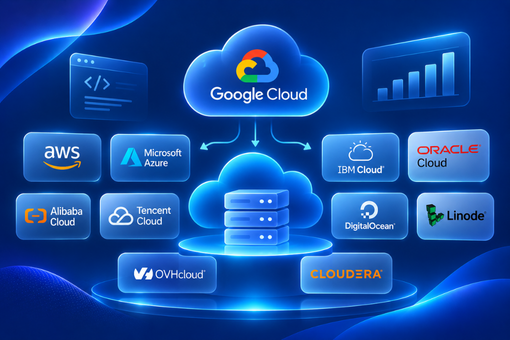
Google Cloud Platform alternatives matter when cost, ecosystem fit, compliance, or regional reach no longer match your business needs. In 2027, AWS, Microsoft Azure, and Oracle Cloud Infrastructure lead for enterprise scale, while IBM Cloud serves regulated industries well. DigitalOcean, Akamai Cloud, Vultr, OVHcloud, and Hetzner suit teams that want simpler pricing and lighter operations. Alibaba Cloud remains the strongest choice for Asia-Pacific reach. This guide compares all ten providers, explains how to choose, and outlines a practical migration path.
Introduction
Google Cloud Platform (GCP) is a strong cloud, yet it does not fit every workload. Many teams hit the same friction points. Their engineers already work inside the Microsoft stack, their finance team wants more predictable bills, or their customers sit in regions where Google has a thinner footprint.
Therefore, the search for Google Cloud Platform alternatives rarely signals a failed platform. Instead, it signals a business question: which cloud gives us the best return for the workloads we actually run?
This guide answers that question with a decision-focused view. First, it defines GCP and explains why businesses look elsewhere. Next, it profiles ten competitors, compares them side by side, and lists the factors that matter most. Finally, it walks through a migration plan so you can move with confidence.
What Is Google Cloud Platform (GCP)?
Google Cloud Platform is a suite of public cloud services from Google. It gives businesses on-demand computing, storage, databases, analytics, networking, security, and AI tools through a pay-as-you-go model. Google launched its first cloud offering in 2008 and has since grown GCP into one of the three largest cloud providers worldwide, alongside AWS and Azure.
Core Services of GCP
GCP organizes its portfolio around a few flagship services:
- Compute Engine: virtual machines for Infrastructure as a Service (IaaS) workloads.
- Google Kubernetes Engine (GKE): managed container orchestration, which means it automates how containers run and scale.
- Cloud Storage, Cloud SQL, and Spanner: object storage and managed relational databases.
- BigQuery: a serverless data warehouse for large-scale analytics.
- Vertex AI: a platform for building, tuning, and deploying machine learning and generative AI models.
Where GCP Performs Best
GCP stands out in data analytics, Kubernetes, and AI. In particular, BigQuery and Vertex AI attract data-heavy teams. Furthermore, Google’s global network gives customers low-latency performance for web and media workloads. However, strength in these areas does not guarantee a fit for every business, which leads to the next question.
Why Do Businesses Look for Google Cloud Platform Alternatives?
Businesses look for Google Cloud Platform alternatives because of cost control, service breadth, ecosystem alignment, compliance needs, and regional coverage. No single reason applies to everyone. Most teams cite a mix of the factors below.
Pricing Complexity and Cost Control
Cloud bills grow quickly when usage scales. For example, data transfer, storage tiers, and premium support can add costs that teams overlook during planning. As a result, finance leaders often compare discount structures, egress fees, and commitment models across providers before they renew a contract.
Ecosystem and Enterprise Fit
Many enterprises run Microsoft 365, Active Directory, or Oracle databases. In these cases, Azure or Oracle Cloud Infrastructure integrates more naturally than GCP. Similarly, companies with deep AWS skills often prefer to keep one primary cloud and avoid retraining.
Regional Reach, Compliance, and Support
Data residency rules vary by country and industry. Consequently, European firms may favor providers with strong sovereignty credentials, while healthcare and financial teams may prioritize providers with mature compliance programs. Additionally, some customers want a broader partner network and more local support than Google provides in their market.
Service Breadth and Specialization
AWS and Azure offer larger service catalogs, which helps teams that need niche tools. On the other hand, smaller providers such as Hetzner or DigitalOcean offer simplicity that GCP’s large catalog sometimes lacks. Therefore, the right move depends on whether you need more breadth or less complexity.
Top 10 Google Cloud Platform (GCP) Alternatives in 2027
The providers below cover hyperscalers, which are the largest cloud platforms, and developer-focused clouds that prioritize simplicity and price. Each profile covers strengths, limitations, and the best-fit use case.
1. Amazon Web Services (AWS)
AWS is the largest cloud provider and the default benchmark for the industry. Amazon launched it in 2006, and it now offers the broadest catalog of services, from EC2 compute and S3 storage to Lambda, Redshift, SageMaker, and Bedrock for generative AI.
Strengths:
- Deepest service portfolio and the largest partner and talent ecosystem.
- Mature global infrastructure with many regions and availability zones.
- Flexible pricing through on-demand, Savings Plans, and Spot capacity.
Limitations: The catalog overwhelms new teams, and costs require active governance.
Best for: Enterprises that need maximum service breadth, global scale, and a large hiring pool.
2. Microsoft Azure
Microsoft launched Azure in 2010, and it ranks as the second-largest cloud provider. It integrates tightly with Microsoft 365, Entra ID, Dynamics, and Windows Server. In addition, Azure OpenAI Service and Microsoft Fabric give enterprises a clear path into AI and unified analytics.
Strengths:
- Seamless identity, security, and licensing alignment for Microsoft-centric organizations.
- Strong hybrid support through Azure Arc and Azure Stack.
- Extensive compliance coverage, including healthcare and government programs.
Limitations: Pricing and licensing models can confuse buyers, and some services trail AWS in maturity.
Best for: Enterprises that already rely on Microsoft tools or need strong hybrid cloud capabilities.
3. Oracle Cloud Infrastructure (OCI)
OCI targets enterprise workloads, especially those that depend on Oracle Database. Autonomous Database, Exadata Cloud Service, and high-performance GPU clusters set it apart. Moreover, Oracle uses a simple pricing model with low data egress costs, which appeals to cost-conscious enterprises.
Strengths:
- Best-in-class environment for Oracle databases and applications.
- Predictable, competitive pricing for compute and networking.
- Strong bare metal and AI training infrastructure.
Limitations: Its ecosystem and community remain smaller than those of AWS and Azure.
Best for: Organizations that run Oracle databases, ERP systems, or demanding performance workloads.
4. IBM Cloud
IBM Cloud focuses on hybrid cloud and regulated industries. Red Hat OpenShift sits at the center of its strategy, and watsonx provides enterprise AI tooling. Furthermore, IBM Cloud for Financial Services gives banks a framework designed around strict risk and compliance requirements.
Strengths:
- Strong hybrid and multicloud story through OpenShift.
- Deep expertise in finance, healthcare, and government.
- Enterprise-grade security and consulting support.
Limitations: It offers a narrower public cloud catalog and a smaller developer community.
Best for: Regulated enterprises that modernize legacy systems across hybrid environments.
5. DigitalOcean
DigitalOcean serves developers, startups, and small businesses that want straightforward infrastructure. Droplets (virtual machines), managed Kubernetes, managed databases, and App Platform cover most common application needs. In addition, flat and transparent pricing makes budgeting easy.
Strengths:
- Clean interface and a short learning curve.
- Predictable pricing with generous bandwidth allowances.
- Strong documentation and community tutorials.
Limitations: It lacks the advanced analytics, AI, and compliance depth of the hyperscalers.
Best for: Startups, SaaS teams, and agencies that value speed and simplicity.
6. Alibaba Cloud
Alibaba Cloud leads in China and holds a strong position across Asia-Pacific. It offers elastic compute, ApsaraDB databases, content delivery, and security tools such as Anti-DDoS and Web Application Firewall. As a result, e-commerce and consumer internet companies often choose it for regional growth.
Strengths:
- Strong network presence and compliance coverage in China and Southeast Asia.
- Mature tools for high-traffic retail and digital commerce.
- Competitive pricing in its core markets.
Limitations: Western enterprises may face governance concerns, and its footprint outside Asia is smaller.
Best for: Companies that expand into or operate within China and Asia-Pacific.
7. Akamai Cloud (Linode)
Akamai acquired Linode in 2022 and has since built Akamai Cloud around it. The platform combines straightforward compute with Akamai’s global edge network. Consequently, it suits latency-sensitive applications, media delivery, and distributed workloads that benefit from running close to users.
Strengths:
- Simple pricing with generous transfer allowances.
- Edge integration for performance and security.
- Reliable Linux virtual machines and managed Kubernetes.
Limitations: The managed service catalog stays narrow compared with hyperscalers.
Best for: Performance-sensitive web, media, and edge applications.
8. Vultr
Vultr offers cloud compute, bare metal, managed Kubernetes, and GPU instances across dozens of global locations. Hourly billing and a wide location footprint give teams flexibility. Moreover, its GPU offerings attract AI teams that want capacity without hyperscaler pricing.
Strengths:
- Broad global footprint for an independent provider.
- Bare metal and GPU options at competitive rates.
- Simple, usage-based billing.
Limitations: It provides fewer managed data and analytics services.
Best for: Developers and AI teams that need flexible infrastructure in many locations.
9. OVHcloud
OVHcloud is a European provider that emphasizes data sovereignty, open standards, and predictable costs. It operates its own data centers and network, and it includes anti-DDoS protection in its standard offerings. Therefore, European organizations with strict residency requirements often shortlist it.
Strengths:
- Strong alignment with European data protection and sovereignty expectations.
- Transparent pricing with low or no traffic charges on many services.
- Public cloud, private cloud, and bare metal options.
Limitations: Its AI and analytics ecosystem trails the major hyperscalers.
Best for: European businesses that prioritize sovereignty and cost predictability.
10. Hetzner Cloud
Hetzner Cloud is a German provider known for very low prices and strong hardware value. It offers virtual servers, dedicated servers, load balancers, and block storage with straightforward billing. However, it intentionally keeps its service catalog small.
Strengths:
- Exceptional price-to-performance ratio.
- Simple interface and clear billing.
- Strong choice for technically skilled teams.
Limitations: It offers limited managed services, fewer compliance certifications, and fewer regions than larger providers.
Best for: Cost-focused teams that manage their own infrastructure.
Google Cloud Platform vs. Alternatives: Feature and Pricing Comparison
The table below summarizes how each provider compares. Pricing labels are relative and reflect general market positioning. Costs change often, so always confirm current rates with each provider’s pricing calculator.
| Provider | Best For | Key Strength | Relative Pricing | Main Limitation |
|---|---|---|---|---|
| Google Cloud Platform | Data, AI, Kubernetes | BigQuery and Vertex AI | Mid to high | Smaller enterprise ecosystem |
| AWS | Broad enterprise workloads | Largest service catalog | Mid to high | Cost governance complexity |
| Microsoft Azure | Microsoft-centric enterprises | Hybrid and identity integration | Mid to high | Licensing complexity |
| Oracle Cloud Infrastructure | Oracle databases, performance | Predictable pricing, low egress | Low to mid | Smaller ecosystem |
| IBM Cloud | Regulated hybrid environments | OpenShift and compliance | Mid to high | Narrower catalog |
| DigitalOcean | Startups and SaaS | Simplicity | Low to mid | Limited advanced services |
| Alibaba Cloud | China and Asia-Pacific | Regional scale | Low to mid | Footprint outside Asia |
| Akamai Cloud (Linode) | Edge and media workloads | Global edge network | Low to mid | Narrow managed services |
| Vultr | GPU and bare metal | Global locations | Low to mid | Fewer managed data services |
| OVHcloud | European sovereignty | Predictable cost, EU focus | Low to mid | Smaller AI ecosystem |
| Hetzner Cloud | Cost-focused engineering teams | Price-to-performance | Low | Limited managed services |
How to Read the Comparison
The hyperscalers (AWS, Azure, and GCP) win on breadth, compliance, and AI services. In contrast, the independent providers win on price clarity and simplicity. Therefore, large enterprises typically shortlist the first group, while startups and engineering-led teams often favor the second.
Key Factors to Consider When Choosing a GCP Alternative
A structured evaluation prevents expensive mistakes. Score each provider against the factors below, and weigh them by business priority.
Workload and Technical Fit
Start with what you run. For example, a data science team that depends on BigQuery needs an equivalent warehouse such as Amazon Redshift, Azure Synapse, or Microsoft Fabric. Likewise, Oracle-heavy shops gain the most from OCI. Map each critical service to its closest equivalent before you shortlist a provider.
Total Cost of Ownership
Look beyond list prices. Compare egress fees, support plans, commitment discounts, and the engineering effort that each platform requires. In addition, include migration costs and the time your team needs to learn new tools.
Security, Compliance, and Data Residency
Confirm that the provider holds the certifications your industry requires, such as HIPAA support, SOC 2, ISO 27001, or regional sovereignty standards. Healthcare and financial organizations should also verify business associate agreements and audit capabilities. Furthermore, check where the provider stores and processes your data.
Scalability, Support, and Talent
Consider how quickly the platform scales and how well the provider supports your team. Additionally, check the local talent pool. Skills for AWS and Azure are easier to hire than skills for smaller platforms.
Expert Guidance
Most teams benefit from an independent assessment before they commit. Inferenz delivers Data and Cloud Modernization Services and Solutions that help enterprises assess workload fit, compare provider economics, and design a migration roadmap before they sign a new contract.
Which Google Cloud Alternative Is Best for Your Business?
No single provider wins in every category. Instead, match the platform to your profile.
- Large enterprise with broad needs: Choose AWS for maximum breadth and ecosystem depth.
- Microsoft-centric organization: Choose Azure for identity, hybrid, and licensing alignment.
- Oracle database workloads: Choose OCI for performance and cost efficiency.
- Regulated hybrid environment: Choose IBM Cloud for OpenShift and compliance depth.
- Startup or SaaS team: Choose DigitalOcean or Akamai Cloud for simplicity and speed.
- GPU or AI training on a budget: Consider Vultr or OCI for flexible capacity.
- Europe with sovereignty needs: Choose OVHcloud or Hetzner.
- China and Asia-Pacific growth: Choose Alibaba Cloud.
Consider a Multicloud Approach
Some businesses do not need to leave GCP entirely. Instead, they keep GCP for analytics and AI while they move other workloads elsewhere. As a result, they reduce vendor lock-in and match each workload to the best-fit provider. However, multicloud adds operational complexity, so plan governance carefully.
How to Migrate from Google Cloud Platform to Another Cloud Provider
A clear cloud migration strategy keeps cost, risk, and downtime under control. Follow these seven steps.
Step 1: Assess and Inventory Workloads
Catalog every application, database, data pipeline, and dependency that runs on GCP. Then classify each workload by business criticality, complexity, and compliance needs. This inventory shapes every later decision.
Step 2: Choose Your Target Platform and Migration Pattern
Select the provider based on the factors above. Next, choose a pattern for each workload: rehost (move as is), replatform (make small changes), or refactor (redesign for the new cloud). For example, teams often rehost virtual machines but refactor BigQuery pipelines.
Step 3: Build the Landing Zone
A landing zone is a secure, pre-configured cloud environment that includes identity, networking, and governance. Inferenz offers Cloud, IoT and Platform Engineering Services that build this foundation, along with the networking and automation that migrated workloads need.
Step 4: Migrate Data First
Move data before applications. Use native tools such as AWS Application Migration Service, AWS Database Migration Service, Azure Migrate, or Google’s Storage Transfer Service. Moreover, plan for egress costs. Google announced in January 2024 that it waives data transfer fees for customers who fully exit GCP, so confirm the current terms before you start.
Step 5: Migrate Applications and Test
Move applications in waves, beginning with low-risk workloads. Run performance, security, and integration tests in the new environment. In addition, run both environments in parallel for critical systems so you can roll back quickly if problems appear.
Step 6: Cut Over and Decommission
Switch traffic after testing succeeds. Then monitor closely for several weeks. Finally, shut down GCP resources and close unused projects to stop unnecessary charges.
Step 7: Optimize After Migration
Migration does not end at cutover. Rightsize resources, tune performance, and enforce cost policies from day one. Our CloudOps Consulting Services help teams monitor spend, enforce policies, and improve reliability after the move.
Conclusion
The best Google Cloud Platform alternative depends on workload, budget, compliance, and skills rather than brand size. AWS and Azure give most enterprises the broadest options. OCI and IBM Cloud win in specific enterprise scenarios. Meanwhile, DigitalOcean, Akamai Cloud, Vultr, OVHcloud, and Hetzner reward teams that value simplicity and predictable cost.
The strategic insight is simple. Treat cloud selection as a portfolio decision, not a one-time vendor choice. Map each workload to the provider that serves it best, calculate total cost of ownership honestly, and migrate in controlled phases. Teams that follow this approach gain flexibility, lower risk, and stronger returns from every cloud dollar.
If you want an expert view on your options, connect with the Inferenz team to design a cloud strategy built around your workloads.