




Patient Caregiver Matching: The AI-Powered Caregiver Connect Solution is Transforming Home Care

Overtime overruns alone threaten to siphon $1.05 billion from U.S. home- and community-care budgets this year, says Avalere Health—proof that shaky patient-caregiver matching is no longer just an operational headache but a bottom-line crisis. 

Schedulers still juggle phone calls, spreadsheets, and rule-based software that crumbles when a caregiver calls in sick. A comprehensive caregiver connect solution powered by agentic AI can flip that script. It watches every shift, learns from each match, and plugs gaps in minutes. No frantic dial-around, no client left waiting. Expect all efficiency with AI in healthcare. 

Problems Faced by the Homecare Industry in Scheduling Appointments

 

Modern EMR and AMS platforms capture plenty of data, yet most still fail at turning that data into fast, smart schedules. When we ask schedulers and field staff where things fall apart, three patterns rise to the top. 

Manual firefighting 

A single caregiver call-out often touches four or five tools: phone, text thread, spreadsheet, agency software, and finally an “all-staff” blast message. In practice, the rescue takes two to four hours, during which the client risks a missed visit. Home care organizations call this weekend scramble “unsustainable” and link it to high office burnout. 

Every unfilled hour can cost $25–$40 in lost billing. Late or missed wound-care checks raise hospital readmit odds by up to 15% (Loving Home Care study). Schedulers report after-hours stress as a top quit trigger; when one quits, five caregivers follow. 

Data silos 

Most schedulers never see real-time clinical flags. A recent report mentions that only about one in three U.S. home-care agencies have a point-of-care EHR that talks to their patient scheduling tool. The rest rely on notes or phone calls.  

Result: 

  • A wound-care alert sits in the EHR while the AMS assigns a basic aide. 
  • Medication-change notices arrive hours after the caregiver has left. 
  • Coordinators must cross-check two or three systems before offering a shift, slowing coverage. And there is the issue of duplicate patient records that create more chaos and confusion in scheduling. Check out our AI data duplication solution here. 

Without unified data, matches ignore skills that matter most—like current wound-vac certs, language fit, or post-surgery protocols. 

Burnout churn 

Shift imbalance drives turnover faster than pay issues. The 2024 Activated Insights Benchmarking Report put caregiver turnover at 79%—the highest in six years. Schedulers themselves are leaving too; agencies that lose a scheduler often see a linked caregiver exodus.  
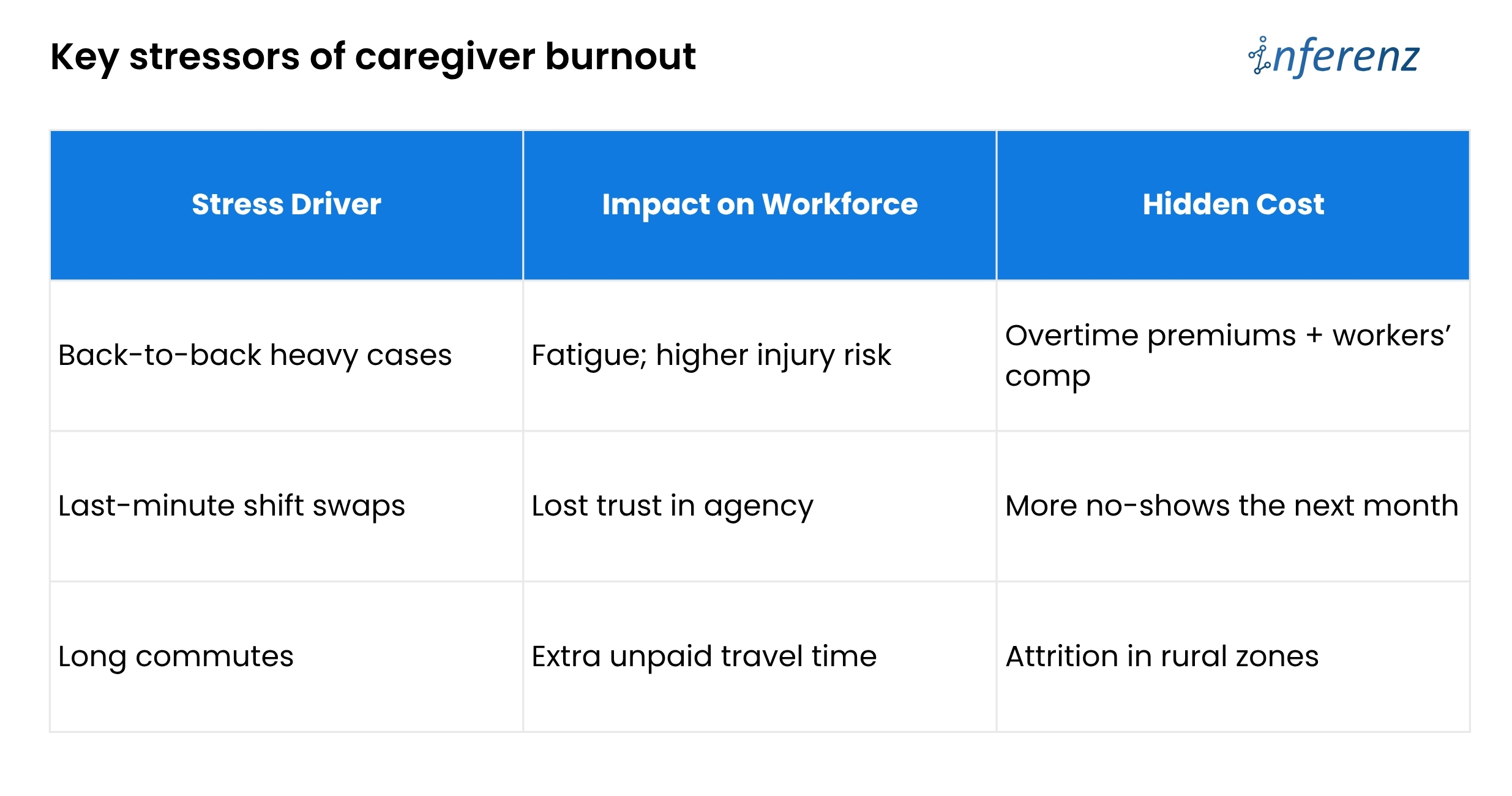
Poor balance means good aides get overbooked, newer aides sit idle, and both groups start scanning job boards. Until schedules pull live clinical data, automate call-out recovery, and watch workload signals, agencies will keep paying for empty visits and exit interviews.  

The article now chalks out how predictive care in Patient Caregiver Matching solution fixes those three weak spots. 

What Is Agentic AI? 

Think of it as a digital care coordinator that can perceive, decide, and act without waiting for humans. Unlike first-gen AI healthcare companies that graft models onto old software, a true agentic layer: 

  1. Learns from every shift – Outcome scores, travel times, and client feedback loop back into the model. 
  2. Optimises on many goals at once – It balances continuity, cost, and worker well-being instead of chasing only fill rate. 
  3. Acts in real time – If traffic halts Nurse Maya, the agent reroutes someone closer and messages all parties automatically. 

The result is a living schedule that keeps adapting—no stale rule set, no bias from tired staff. 

Traditional AMS vs. Agentic AI 
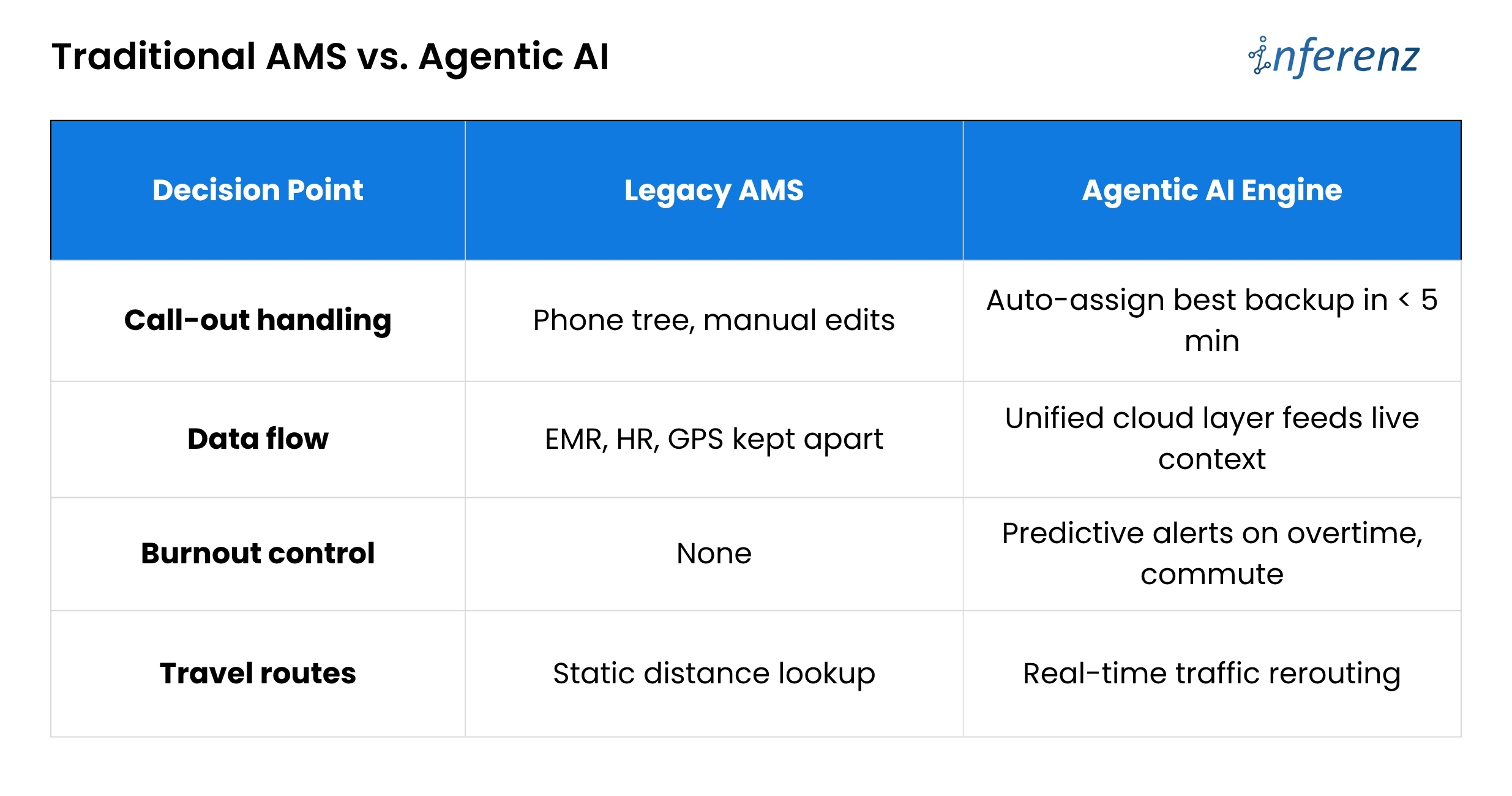
Bottom line: Outdated tools act like a notebook. An AI engine acts like a live dispatcher. 

PCM: the heart of smart scheduling

Patient Caregiver Matching (PCM) sits at the core of the agentic engine. It blends hard data that includes skills, licenses, and shift history with soft cues like language, pet comfort, and even commute stress.  

Each visit logged, each survey filled, feeds a feedback loop that sharpens the next match. 

AI extracts relevant details and binds them in a single narrative. This narrative helps caregivers walk in fully prepared and better informed about their assigned patients.  

How the patient-caregiver matching solution builds the perfect match 
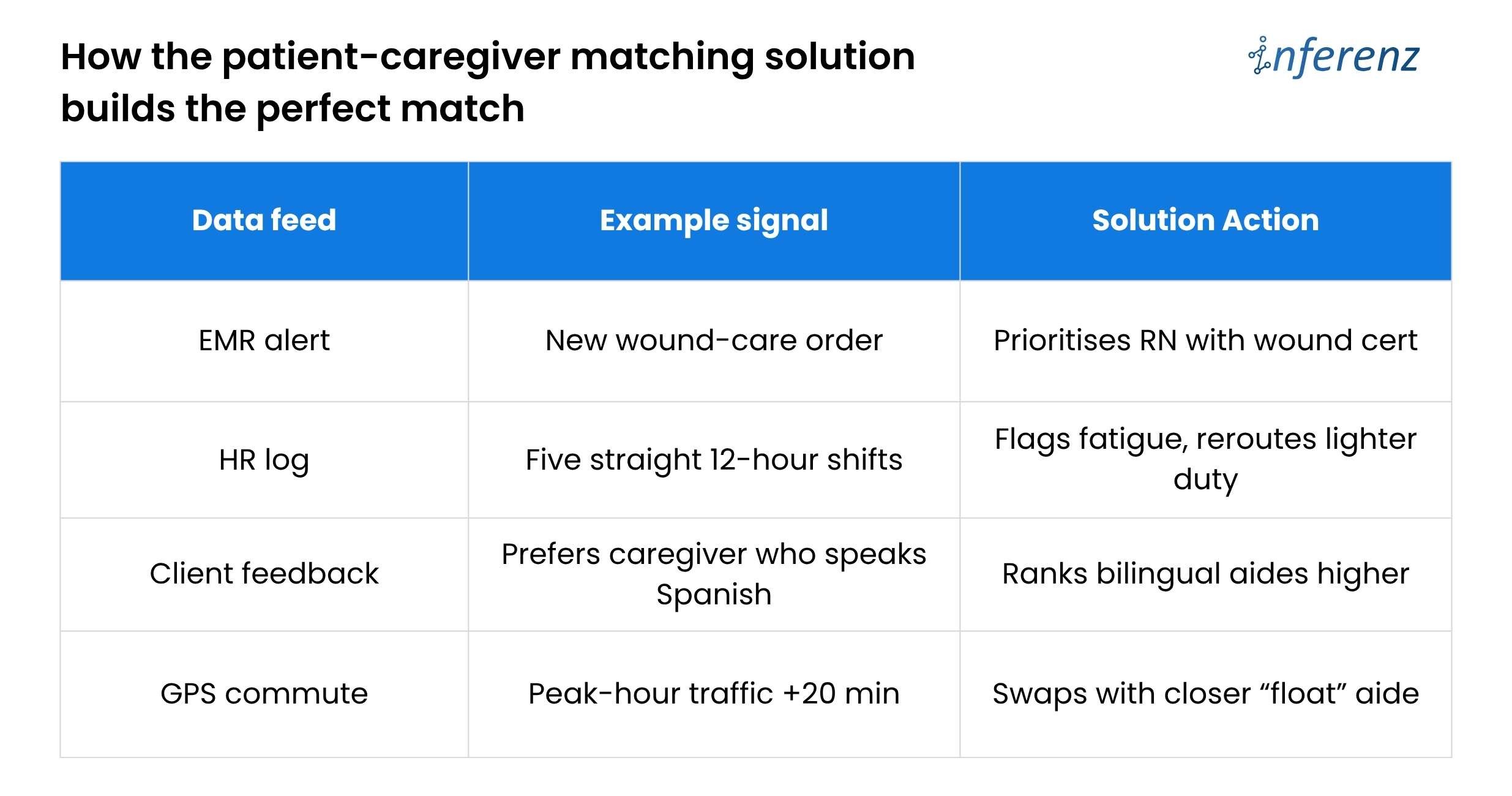
PCM makes thousands of micro-decisions that a human scheduler simply cannot track in real time.  

Caregiver Connect and Smart Scheduling in Homecare – Three Phases 

Phase 1 – Assist 

  • Role of AI:
    The system watches current openings, checks skill, location, and past ratings, then lists the best caregiver for each visit. It also sends and tracks shift texts for you. 
  • Why it matters:
    Speed is life in home care. By moving the “who is free and right for this client” search to an AI engine, booking time drops by half. A spot that once took twenty calls now locks in minutes. 
  • Effort change:
    Coordinators still approve picks, yet their keyboard time falls about 50%. That freed hour can go to client follow-ups or staff coaching. 

Phase 2 – Co-pilot 

  • Role of AI:
    The tool no longer waits for you to act when a callout hits. It finds the next best caregiver, confirms the shift, and pushes a note into the EMR so nurses see the new name. 
  • Why it matters:
    Missed visits tumble toward zero. Clients stay safe, and the agency avoids fines or angry phone calls on Friday night. 
  • Effort change:
    Because the AI covers most last-minute gaps, schedulers work on harder tasks and see about 70% less day-to-day scramble. 

Phase 3 – Autonomous 

  • Role of AI:
    The agent drafts the full weekly rota, juggles swaps, and even alerts HR when future demand will outrun supply. It chats with caregivers to shift times if traffic or family issues pop up. 
  • Why it matters:
    Fill rate climbs to 98% and holds steady. Fewer gaps mean higher revenue, better reviews, and calmer staff. 
  • Effort change:
    Coordinators shift to oversight. They scan dashboards, spot edge cases, and mentor teams. Routine scheduling work is now background noise handled by the system. 

During Phase 1, a coordinator still approves matches, building trust. By Phase 3, the agent posts a full weekly roster, flags any legal or pay exceptions for quick sign-off, and frees leaders to focus on quality and growth. 

A CXO-level Path to Patient–Caregiver Matching that Actually Works

Home-care agencies lose time and money because scheduling lives in silos. Skills sit in one system, vitals in another, PTO in a third.  

When a caregiver calls out, coordinators must sift through them all. The fix is a Patient Caregiver Matching (PCM) engine that learns and acts in real time—but only if leaders roll it out with equal focus on data, change control, and trust.  

Here is how to move from today’s chaos to tomorrow’s self-tuning roster, without hiring a small army of project managers. 

Start with clean data, not clever code. 

Feed every AMS, EMR, and HR stream into one secure lake through FHIR or other HIPAA-ready APIs. A single source of truth stops double entry and lets the AI see the full picture: licenses, wound alerts, commute times, even overtime risk. Until that lake is live, smart matching cannot begin. 

Prove value in a 90-day branch pilot. 

Switch PCM on for one location and track three simple numbers: shift fill rate, overtime hours, and coordinator minutes per booking. A branch-level test gives hard evidence, keeps risk low, and shows frontline staff that the tool helps rather than replaces them. 

Move to “co-pilot” across the agency. 

Once the pilot hits its marks, let PCM auto-cover call-outs everywhere. Keep one senior scheduler in an “air-traffic control” role to handle edge cases and to reassure teams that humans still guide policy. The daily scramble fades; missed visits trend toward zero. 

Let the AI look three months ahead. 

With real-time cover in place, turn on the forecasting lens. PCM scans referral trends, PTO calendars, and skill gaps, then warns HR before shortages hit. Growth continues without surprise overtime or rushed hiring. 

Build trust into every decision. 

A live roster run by AI only sticks if people believe it is fair and safe.  

Each match stores a plain-language reason such as “Carla assigned for dementia skill, four-mile commute.” Hard caps on weekly hours, license scope, and labor law live inside the rule set, so the engine cannot overstep. Monthly bias scans compare assignments across age, gender, and minority status while retraining drift triggers. The cloud zones keep scheduling live even if one data center fails. 

The payoff 

Weekend duty spreads evenly, time-off requests stick, and early fatigue signs rise to the surface before they become burnout. CXOs gain tighter control over cost and care quality without adding layers of back-office staff. Coordinators finally go home on time. 

“Caregivers who gain more autonomy over their schedule report lower stress.” — Cleveland Clinic flexible scheduling study 

Future-ready edge tapping the private caregiver pool 

Growth pressures will not spare preferred home health care brands. The patient-caregiver matching solution can open an on-demand bench of vetted private caregivers when internal staff hit capacity. The agent weighs cost, compliance, and continuity, then fills gaps without overtime blowouts. 

This “elastic staffing” positions agencies as connected care hubs, not just schedule brokers. It also sidesteps the narrow talent funnel that hammers many healthcare AI companies today. 

 

FAQs about Patient Caregiver Matching solution by Inferenz 

  1. What problem does Patient Caregiver Matching (PCM) solution fix in home-care scheduling?
    It cuts the costly overtime overruns that pile up when staff call out or shifts go unfilled. By learning from every visit, it matches the right aide in minutes and keeps clients from missing care. 
  2. How does Predictive Care Matching feature choose the best caregiver?
    The feature weighs skills, licenses, client feedback, travel time, and live clinical alerts, then ranks caregivers by overall fit in real time. 
  3. Will the system lower my agency’s overtime cost?
    Yes. Agencies in pilot tests saw overtime hours fall because open shifts got covered early, not at the last second when rates spike. 
  4. Can it handle a call-out at 7 p.m. on Friday?
    It can. The tool auto-selects the next best caregiver, sends the shift offer, and updates your EMR and AMS without manual intervention. 
  5. How does it guard against caregiver burnout churn?
    The engine flags heavy caseloads, long commutes, and back-to-back double shifts, then spreads work more evenly to keep staff fresh. 
  6. What data feeds the matching engine?
    It pulls live inputs from EMR, AMS, HR, and GPS tools, ending the data silos that slow most schedulers. 
  7. How soon will we see a higher shift fill rate?
    Most branches notice smoother coverage inside 30 days, with clear fill-rate gains by the end of a 90-day pilot. 
  8. Does it plug into our current EMR and AMS?
    Yes. A unified data layer links to standard FHIR or vendor APIs, so you keep your existing systems while adding smarter matching. 
  9. Is patient data secure and HIPAA-ready?
    Data stays in an encrypted, cloud-based lake with strict access controls and full audit logs that meet HIPAA standards. 
 

Databricks Data+AI Summit 2025: Announcements & Insights

Databricks just dropped a wave of updates at Data + AI Summit 2025 —and it’s safe to say, they’re doing more than just adding features. They’re rebuilding the modern data and AI stack from the ground up.  

Databricks Summit 2024 now feels like the dress rehearsal for these announcements! 

Whether you’re an engineer, analyst, or decision-maker, here are the 10 biggest product announcements that will shape how you work with data this year and beyond. 

1- Lakebase 

A Postgres-like metadata engine built for the Lakehouse
Lakebase brings transactional consistency, fast queries, and metadata performance to your lakehouse architecture. It’s the glue layer that makes structured access possible across massive data volumes—without sacrificing openness or scale. 

2- Agent Bricks 

Your enterprise AI agents, now production-grade
Agent Bricks is a new framework that makes it easy to build, evaluate, and deploy AI agents that use your organization’s data via Retrieval-Augmented Generation (RAG). Expect faster time-to-value and lower GenAI experimentation risk. 

3- Spark Declarative Pipelines 

Define your data logic. Let Spark figure out the rest.
With a new declarative syntax, Spark pipelines become cleaner and easier to manage. Think configuration over code. Now your intent would meet automation seamlessly and the pipeline building process gets simplified. 

4- Lakeflow 

Managed orchestration for your data workloads
Databricks Lakeflow helps you build, schedule, and monitor complex data workflows without managing infra. Built to scale with your team’s needs, it replaces scattered DAGs with one consistent orchestration layer. 

5- Lakeflow Designer 

Drag. Drop. Deliver.
A visual canvas for creating ETL pipelines without code. Lakeflow Designer makes pipeline building intuitive for analysts and operators, while still producing production-grade Databricks workflows. 

6- Unity Catalog Metrics 

Governance meets observability
Unity Catalog now offers live metrics for data quality, usage, freshness, and access lineage. This tightens control and makes compliance and trust easier to prove—no more data blind spots. 

7- Lakebridge 

Free, AI-powered data migration into Databricks SQL
Move from Snowflake, Redshift, or legacy warehouses without friction. Lakebridge is a no-cost, open-source migration tool that helps you modernize your stack on your terms. 

8- Databricks AI/BI (formerly Genie) 

BI without the query language
Business users can now ask natural-language questions and get dashboards, metrics, and insights—powered by GenAI and structured on trusted data. It’s self-service analytics, evolved. 

9- Databricks Apps 

Build internal apps on Databricks—securely and scalably
Now you can create and run interactive applications directly on the Databricks platform with enterprise-grade identity control and data governance baked in, for the benefit of the Databricks community. 

10- Databricks Free Edition 

Get started with Databricks—forever free
No credit card. No setup cost. The Free Edition is perfect for developers, learners, and small teams to explore the full power of Databricks. 

What This Means for Databricks users? 

The common thread in all these announcements are 

  • Better Access.  
  • Adherence to Simplicity.  
  • Streamlined Governance.  
  • Prompt AI-readiness. 

Databricks is now no longer just for engineers. With tools like Agent Bricks, Lakeflow Designer, and AI/BI, business teams now can impose their objectives with a front row seat in the data conversation. 

Quick recap 

Inferenz, an official Databricks partner, is already applying the latest updates to power its agentic AI solutions in healthcare. From real-time patient-caregiver matching to workforce analytics and natural language-based insights, our tools are built to act on fresh, unified data.  

Expect faster decisions, earlier risk detection, and zero extra tech layers. As AI in healthcare accelerates, the Databricks ecosystem is setting the pace, and we’re already building caregiver connect solutions with it. 

Want to see it in action? Contact us soon. 


FAQs on the 2025 Databricks Summit Highlights 

  1. What makes the new Lakehouse engine different from a classic warehouse?
    Lakebase brings a transactional layer to the Databricks Lakehouse model, giving you ACID reliability without leaving open-format storage. 
  2. How will the new metrics improve governance?
    The live metrics inside Unity catalog in Databricks give instant views on data quality, freshness, and usage—crucial for audit and compliance teams. 
  3. Where can I monitor pipeline runs built in Lakeflow?
    Every run appears in the new Databricks workflow job dashboard, offering status, lineage, and error details in one place. 
  4. Is there a no-code entry point for building workflows?
    Yes—Lakeflow Designer lets analysts drag and drop tasks, then schedules the flow using the same engine that powers Databricks workspace and its automation. 
  5. What’s new for model tracking and deployment?
    The summit added tighter hooks between Databricks MLflow and Agent Bricks; you can now call models through a unified Databricks API during agent execution. 
  6. Will third-party tools integrate more smoothly?
    Yes—expect richer SDK support through Databricks connect and a growing Databricks marketplace of certified partner solutions. 


Snowflake Summit 2025: Key Highlights and Announcements

Snowflake Summit 2025 was unlike any other summit that happened before. It was a like a magnificent product launchpad, and it did full justice to the action-packed four days as part of the event schedule.  

The data-cloud giant showed how it plans to cut query costs, add trusted AI, and open its platform to every format from Iceberg to Postgres. Leaders teased faster warehouses, live FinOps alerts, and chat-style analytics that turn plain English into charts. They also sealed a $250 million Postgres deal and signed on as the data engine for the LA 28 Olympics. Staggering, isn’t it? 

Why does this matter though, you may ask?  

Because teams everywhere still wrestle with slow reports, rising bills, and security gaps. Snowflake’s new moves promise hands-off tuning, real-time guardrails, and AI tools that stay inside the same secure walls.  

The highlights below break down what shipped, what’s in preview, and how each change could move the needle on cost, speed, and trust. 

Compute that runs faster and costs less 

Gen2 Standard Warehouses hit general availability and already show about 2.1× faster query time in live customer tests. Pair that with Snowflake Adaptive Compute (private preview) and the platform now picks cluster size, parks idle nodes, and pools resources across jobs without manual tuning. 

  • To keep Snowflake pricing in check, the FinOps console adds Cost-Based Anomaly Detection (public preview) and Tag-Based Budgets (GA soon). Both alert teams to cost spikes before month-end surprises.  
  • Workspaces now bundle inline Copilot help, Git sync, and a GA Terraform provider, so builders can code, test, and ship inside one browser tab. 
  • Python 3.9 is live in Notebooks, plus custom Git URLs for smoother CI/CD. 

Take-away:  Faster analytics with less knob-twisting and clearer bills. 

Stronger governance and security 

Horizon Catalog gains an AI Copilot for natural-language search plus Iceberg catalog-linked databases, so data stewards can find and govern tables sitting outside the core warehouse.  

On access control, Snowflake now supports passkeys, authenticator apps, and programmatic tokens, moving the service toward a full MFA-only stance before November 2025.  

For backups, new Immutable Snapshots (preview) keep point-in-time copies that cannot be altered—extra insurance against ransomware. Here are some more updates: 

  • Horizon Catalog adds external-data discovery, letting stewards govern dashboards and other cloud stores from one pane. 
  • Trust Center picks up passkeys, new MFA choices, and leaked-password shielding—tightening the lock before year-end. 
  • Snowflake Trail widens coverage, and Openflow now emits pipeline telemetry for faster root-cause checks. 

Data engineering and the open Lakehouse 

Snowflake Openflow (GA on AWS) is a multimodal ingestion service powered by Apache NiFi. Teams can pull data from hundreds of sources into Snowflake or keep it in place and still query it. 

Lakehouse fans got welcome news: Iceberg queries are now up to 2.4× quicker, and catalog-linked databases let Iceberg tables live under the same roof as native Snowflake tables. 

  • Native dbt Projects and Pandas on Snowflake (both previews) shorten the “extract-transform-load” cycle by letting engineers work inside the platform. 
  • Openflow ships an Oracle-to-Snowflake CDC path, easing the biggest on-prem migration ask we hear from clients. 
  • Iceberg gains VARIANT support and Merge-on-Read, closing format gaps while keeping those 2.4× speed gains. 

AI & analytics for every role 

Here are some updates relevant to AI and analytics from the summit: 

  • Snowflake Intelligence (public preview) turns the familiar ai.snowflake.com chat bar into a way to ask, “Why did sales dip in Q3?” and get charts back in seconds. 
  • Cortex AISQL folds AI operators into normal SQL so analysts can label images or sum up PDFs without leaving the warehouse. Document AI lifts tables straight out of PDFs, while Cortex Search scans it all in seconds—no helper scripts. 
  • Data Science Agent builds data sets, trains models, and sets up pipelines on demand—handy for teams that lack ML engineers.  
  • SnowConvert AI speeds “lift-and-shift” moves off legacy warehouses.  
  • Built-in AI observability traces every LLM call inside Cortex Apps, satisfying audit teams. 
  • Semantic Views hit GA, turning raw tables into shared business logic that both SQL and AI tools can read. 

Together these moves push AI deeper into the Snowflake data cloud while keeping the SQL surface that users already know. 

Apps, marketplace, and collaboration 

The Snowflake Marketplace now lists Agentic Native Apps and Cortex Knowledge Extensions so buyers can install third-party AI helpers inside their own account—no extra data pipes.  

  • Cortex Knowledge Extensions pull curated news and research into agent answers—helpful for care-trend insights. 
  • Teams can now share full Semantic Models with partners, keeping metrics in sync across firms. 
  • Snowflake native apps depend on a framework that picks up versioning, runtime stats, and a compliance badge, meeting release rules. 

Clean-room upgrades and an Egress Cost Optimizer make cross-company sharing cheaper and privacy-aware. 

Acquisitions and partnerships 

  • Postgres joins the party. Snowflake is buying Crunchy Data for roughly $250 million and will offer Snowflake Postgres, a managed enterprise Postgres service that sits right beside Unistore. 
  • Olympic-scale data. Snowflake became the official data collaboration provider for LA 28 Olympics and Team USA, proving that the platform can handle real-time, high-profile workloads. 
  • Ecosystem bet. Snowflake Ventures backed Sema4.ai, whose Team Edition agent will ship as a Snowflake Native App, reinforcing the agentic theme across the marketplace. 

What this means for your stack 

  1. Less handholding, more insight. Automatic compute plus FinOps alerts free engineers to focus on models, not knobs. 
  1. Trusted AI without new silos. Cortex tools and agentic apps stay inside the Snowflake security perimeter, so data governance rules still apply. 
  1. Freedom of choice. With Iceberg support and Postgres on deck, Snowflake no longer forces a single storage format or engine. Use what suits each workload. 

Quick recap 

Snowflake Summit 2025 moved from vision to shipped code: faster compute, visible spend controls, built-in AI agents, and an open stance on formats, from Iceberg to Postgres. The result is a data platform that lets teams ask bigger questions without breaking a sweat. In short, Snowflake just made data work simpler, cheaper, and safer.  

Inferenz, an official Snowflake Select partner, is already wiring these gains into its agentic AI tools for caregiver connect including patient-caregiver matching, workforce analytics, and conversational AI reporting through natural language. The upshot is that healthcare teams can spot risks sooner and act faster, without piling on new tech debt. Expect Healthcare AI companies to follow suit soon enough! 

Connect with us today to know more. 

FAQs on Snowflake Summit 2025 

  1. What were the headline launches at Snowflake Summit 2025?
    Snowflake unveiled Gen2 Standard Warehouses, Adaptive Compute, Horizon Catalog Copilot, Cortex AI SQL, and the managed Snowflake Postgres service—all aimed at faster analytics, lower costs, and broader data-format support.
  2. How will Adaptive Compute affect Snowflake pricing for day-to-day workloads?
    Adaptive Compute auto-sizes clusters and suspends idle nodes, so teams pay only for the minutes they use, reducing surprise bills and smoothing monthly budgets.
  3. What new capabilities arrived in Snowflake Cortex during the summit?
    Cortex gained AI SQL operators for text, image, and audio analysis; built-in LLM observability; and Data Science Agent for no-code model pipelines, making advanced AI tasks accessible by plain SQL.
  4. How does the updated Snowflake Marketplace help developers after these releases?
    The marketplace now features Agentic Native Apps and Cortex Knowledge Extensions, letting users install third-party AI helpers and shared Semantic Models directly inside their Snowflake account with a single click.
  5. Do I need to change anything at snowflake login to test the new features?
    No. Once your account admin enables the relevant previews, the new tools appear in Snowsight under the same secure login, with no extra setup.
  6. Will the summit changes impact snowflake certification paths such as SnowPro Core?
    Yes. The exam guides will add sections on Adaptive Compute, Cortex AI SQL, and Horizon Catalog Copilot. Snowflake recommends reviewing the updated study outline before scheduling an exam.
  7. How do these releases strengthen the overall Snowflake data cloud story?
    They tighten cost control, expand open-format support, embed AI in every layer, and add governance safeguards, reinforcing Snowflake’s position as a one-stop data and AI platform for enterprises.