Summary
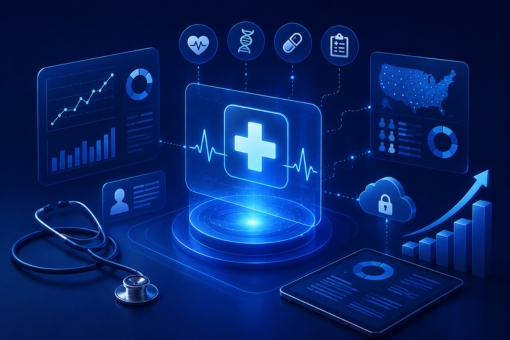
Data analytics in healthcare is reshaping how providers diagnose, treat, and manage patient populations. From predictive risk modeling to revenue cycle optimization, healthcare organizations now rely on data to drive clinical and operational decisions. The global healthcare analytics market is set to reach $96.90 billion by 2030, growing at a 15.3% CAGR. This blog examines what data analytics means for healthcare, why it matters, its core types, and the real-world applications that define its impact. It also addresses key challenges and emerging trends shaping the future of the field.
Introduction
Healthcare organizations generate enormous volumes of data every day. Electronic health records, lab results, imaging files, insurance claims, and wearable device outputs collectively form a data landscape that no human team can process manually at scale. Yet most of that data historically sat underused, stored in siloed systems that rarely communicated with one another.
The core problem is not a shortage of data. It is the inability to turn raw, fragmented data into timely, actionable intelligence. Clinicians need accurate risk assessments before a condition becomes critical. Administrators need visibility into billing cycles to reduce revenue leakage. Health systems need population-level insights to allocate resources responsibly. Data analytics solves each of these problems, but only when applied with the right tools, governance, and expertise.
Furthermore, the stakes are unusually high. In most industries, a delayed insight costs revenue. In healthcare, it can cost a life. This guide explores how data analytics in the healthcare industry is closing that gap, and what decision-makers need to know to lead the transformation effectively.
What Is Data Analytics in Healthcare?
Data analytics in healthcare refers to the systematic process of collecting, organizing, and interpreting structured and unstructured data to improve clinical outcomes, operational performance, and financial results. It encompasses everything from basic reporting dashboards to advanced machine learning models that predict patient deterioration hours before symptoms escalate.
At its core, healthcare analytics converts raw data from clinical, financial, and administrative sources into insights that support better decisions. Specifically, it integrates data from sources such as electronic health records (EHRs), medical imaging systems, insurance claims, genomic databases, remote monitoring devices, and patient-reported outcomes.
In contrast to traditional business analytics, healthcare analytics must account for clinical nuance, regulatory compliance (HIPAA, GDPR), and the ethical weight of decisions that directly affect patient health. Therefore, deploying analytics in this domain requires both technical depth and domain expertise.
Importance of Data Analytics in Healthcare
The importance of data analytics in healthcare extends well beyond operational efficiency. It fundamentally changes the quality of care that providers can offer, and the speed at which they can offer it.
Enabling Evidence-Based Clinical Decisions
Doctors traditionally relied on clinical guidelines, personal experience, and available test results. Analytics augments that foundation with population-level evidence, real-time risk scores, and treatment outcome comparisons. As a result, clinicians make decisions informed by far more data than any individual encounter can provide.
Improving Patient Safety and Reducing Errors
Medication errors, misdiagnoses, and care protocol deviations remain persistent problems in healthcare. Analytics systems flag anomalies in prescribing patterns, alert clinicians to potential drug interactions, and identify patients whose vitals deviate from expected ranges. Consequently, clinical teams can intervene before an error becomes irreversible.
Supporting Administrative and Strategic Planning
Beyond bedside care, healthcare executives use analytics to plan capacity, manage workforce scheduling, evaluate supplier contracts, and benchmark performance against industry standards. Moreover, data-driven strategic planning reduces the reliance on intuition-based decisions that often misallocate resources.
According to Allied Market Research, the global healthcare analytics market reflects this growing recognition. Its projected growth to $96.90 billion by 2030 signals that organizations across the industry understand the strategic value analytics delivers.
Types of Data Analytics in Healthcare
Healthcare analytics is not a single capability. Instead, it spans four distinct types, each addressing a different layer of insight.
Descriptive Analytics
Descriptive analytics answers the question: what happened? It aggregates historical data into dashboards, reports, and scorecards. For example, a hospital might use descriptive analytics to track monthly readmission rates by department or compare bed utilization trends across quarters. This type forms the foundation of most healthcare reporting environments.
Diagnostic Analytics
Diagnostic analytics answers: why did it happen? It uses drill-down analysis, data mining, and correlation techniques to identify root causes. For instance, if readmission rates spike, diagnostic analytics can isolate whether the cause is early discharge, inadequate post-care instructions, or specific condition types.
Predictive Analytics
Predictive analytics answers: what is likely to happen? It applies statistical models and machine learning algorithms to historical data to forecast future events. In healthcare, predictive models help identify patients at high risk of sepsis, readmission, or chronic disease progression. Additionally, they support demand forecasting for hospital capacity planning.
Prescriptive Analytics
Prescriptive analytics answers: what should we do? It goes beyond prediction to recommend specific actions. A prescriptive model might suggest the optimal treatment protocol for a given patient profile or flag which intervention reduces 30-day readmission risk most effectively for a specific population segment. This represents the most advanced level of healthcare analytics capability.
How Data Analytics Is Transforming the Healthcare Industry
Big data analytics in healthcare is shifting the industry from reactive care to proactive, personalized medicine. The transformation touches every functional area, from the clinical floor to the executive boardroom.
Advancing Diagnostic Accuracy
Data analytics enables healthcare professionals to cross-reference a patient’s current symptoms against vast datasets of clinical history, lab patterns, and imaging results. This significantly improves diagnostic accuracy, particularly for rare conditions or complex presentations where standard protocols may fall short. Moreover, AI-assisted diagnostic tools now help radiologists detect anomalies in medical images with greater speed and consistency.
Identifying High-Risk Patients Early
Predictive models continuously analyze patient data to flag individuals at elevated risk of deterioration, hospital-acquired infections, or chronic disease complications. Clinicians can then prioritize those patients for proactive interventions rather than waiting for an acute episode. This shift from reactive to preventive care is one of the most significant impacts of data analytics in healthcare.
Eliminating Clinical and Operational Errors
Business intelligence tools cross-check prescriptions against patient histories, flag dosage inconsistencies, and alert teams to contraindicated treatment combinations. As a result, error rates decrease substantially without adding burden to already stretched clinical staff.
Enabling Personalized Treatment Pathways
Healthcare organizations now integrate genomic data, lifestyle indicators, and environmental factors alongside traditional clinical records. This approach supports treatment plans tailored to the individual rather than the average patient. Consequently, patients benefit from therapies more likely to work for their specific biology and circumstances, while providers avoid costly treatments with low probability of success.
Enhancing Remote Patient Monitoring
Wearable devices and connected health platforms generate continuous streams of patient data outside clinical settings. Analytics platforms process these streams in real time, enabling clinicians to track patients with chronic conditions between visits. This capability is particularly valuable for managing diabetes, cardiac conditions, and post-surgical recovery, where early intervention can prevent hospitalizations.
Benefits of Data Analytics in Healthcare
The benefits of data analytics in healthcare are measurable across clinical, operational, and financial dimensions.
- Improved patient outcomes through early identification and personalized treatment
- Reduced hospital readmission rates via risk-stratified care management
- Faster and more accurate diagnoses supported by data-driven clinical decision tools
- Lower operational costs through workflow automation and resource optimization
- Higher staff productivity by eliminating manual data tasks and streamlining reporting
- Stronger regulatory compliance through automated audit trails and documentation
- Enhanced patient engagement via mobile health platforms and personalized communications
- Better financial performance through improved revenue cycle visibility and billing accuracy
Additionally, healthcare organizations that invest in analytics consistently outperform peers in quality metrics. In particular, those leveraging predictive models for population health management report measurable reductions in preventable hospitalizations and emergency department overutilization.
How Is Data Analytics Used in Healthcare?
How is data analytics used in healthcare across real-world clinical and administrative settings? The applications are broad and deeply integrated into daily operations at leading health systems.
Clinical Decision Support
Analytics platforms provide clinicians with real-time alerts, risk scores, and treatment recommendations at the point of care. These tools pull from patient history, current vitals, and evidence-based protocols to guide decisions. For example, a sepsis prediction model might alert a nurse when a patient’s early-warning score crosses a threshold, triggering a rapid-response protocol.
Population Health Management
Health systems use analytics to segment patient populations by risk level, condition prevalence, or care gaps. This segmentation allows care teams to focus outreach, preventive services, and chronic disease management programs on the patients who need them most. Moreover, payers use population analytics to design benefit structures that encourage preventive care utilization.
Appointment Scheduling and Capacity Management
Predictive scheduling models analyze historical demand patterns to optimize appointment availability, reduce no-show rates, and minimize patient wait times. Administrative staff can use these insights to balance provider workloads and ensure adequate staffing during peak periods.
Quality Measurement and Reporting
Healthcare organizations must report on dozens of quality metrics to accreditors, payers, and regulators. Analytics automates the extraction, calculation, and submission of these measures, reducing manual effort and improving reporting accuracy. Furthermore, dashboards surface performance gaps in near-real time, enabling faster improvement cycles.
Applications of Data Analytics in Healthcare
The applications of data analytics in healthcare span every layer of the delivery system.
Drug Discovery and Clinical Trials
Pharmaceutical companies and research institutions use analytics to accelerate drug development. By analyzing genomic data, biomarker trends, and historical trial outcomes, data scientists identify promising compound candidates and optimize clinical trial design. Specifically, adaptive trial analytics allow researchers to modify protocols in response to interim data, reducing time and cost to regulatory approval.
Fraud Detection and Claims Auditing
Insurance organizations and health system billing departments use anomaly detection models to flag fraudulent claims, duplicate billing, and coding inconsistencies. These systems reduce financial losses and improve billing integrity across large transaction volumes.
Chronic Disease Management
Remote monitoring platforms combined with predictive analytics enable ongoing management of chronic conditions such as diabetes, hypertension, and heart failure. Algorithms analyze continuous device data and alert care teams when trends suggest deterioration, allowing timely adjustments to treatment plans.
Supply Chain and Inventory Optimization
Hospitals use demand forecasting analytics to manage medical supply inventories, reduce waste from expired products, and ensure critical supplies are available when needed. This capability became especially relevant during the supply disruptions that defined the post-pandemic healthcare environment.
Data Analytics in Healthcare Revenue Cycle
Data analytics in healthcare revenue cycle management addresses one of the most financially significant pain points for health systems: revenue leakage caused by billing errors, claim denials, and collection inefficiencies.
Denial Management and Prevention
Analytics tools analyze historical denial patterns to identify the root causes of claim rejections. By surfacing the most common denial reasons, billing teams can implement upstream coding and documentation corrections before claims reach the payer. As a result, first-pass claim acceptance rates improve and rework volume decreases.
Charge Capture and Coding Accuracy
Undercoding and overcoding both carry significant financial and compliance risks. Analytics platforms compare clinical documentation against billing codes in real time to ensure accurate charge capture. Moreover, natural language processing tools extract billable information from clinical notes that coding staff might otherwise miss.
Collections and Payment Prediction
Predictive models assess the likelihood of payment from individual patients based on demographic data, insurance type, and historical payment behavior. This insight allows revenue cycle teams to prioritize collection efforts and design payment plan offerings that match patient financial capacity.
Payer Contract Analytics
Health systems use contract analytics to model the financial impact of payer contract terms, compare reimbursement rates across payers, and identify underpayments relative to contracted rates. Consequently, organizations recover revenue that would otherwise go unnoticed in complex multi-payer environments.
Data Analytics Use Cases in Healthcare
The following data analytics use cases in healthcare illustrate how leading organizations deploy these capabilities in practice.
Sepsis Early Warning Systems
Several major health systems have implemented machine learning models that continuously analyze vital signs, lab values, and nursing assessments to generate real-time sepsis risk scores. Facilities using these systems report significant reductions in sepsis mortality and ICU length of stay compared to pre-implementation baselines.
Predictive Readmission Reduction
A large regional health network deployed a readmission prediction model that flagged high-risk patients at discharge. Care coordinators used those predictions to prioritize post-discharge follow-up calls and home health referrals. Furthermore, the organization achieved a measurable reduction in 30-day readmissions within the first year of deployment.
Pharmaceutical Vital Parameter Monitoring
Inferenz recently partnered with a German pharmaceutical company to build a predictive health alert system. The model analyzed patient vital parameters and generated alerts before clinical deterioration became visible. This use case demonstrates how data analytics transforms both patient safety and drug safety surveillance simultaneously.
Operational Throughput Optimization
Emergency departments use flow analytics to identify bottlenecks in patient throughput, from triage to discharge. By analyzing timestamp data across each step of the care process, operations teams can redesign workflows that reduce door-to-physician times and length of stay without adding resources.
Challenges of Data Analytics in Healthcare
Despite its clear value, the challenges of data analytics in healthcare remain significant. Organizations that underestimate these barriers often struggle to move beyond pilot projects.
Data Quality and Interoperability
Healthcare data originates from dozens of systems that use different formats, terminologies, and coding standards. Integrating these sources into a unified analytics environment requires substantial data engineering effort. Moreover, poor data quality, including missing values, duplicate records, and inconsistent coding, directly undermines model accuracy.
Privacy, Security, and Regulatory Compliance
Patient data carries strict regulatory protections under HIPAA in the United States and GDPR in Europe, among other frameworks. Analytics deployments must implement robust access controls, audit logging, de-identification protocols, and consent management. Consequently, compliance requirements add significant complexity to analytics architecture and governance.
Talent Shortages in Healthcare Data Science
Skilled professionals who combine clinical domain knowledge with advanced analytics expertise are rare. Health systems often compete with technology companies for the same talent pool. Additionally, building internal analytics teams capable of delivering sustained value requires long-term investment in recruitment, training, and culture.
Clinical Adoption and Change Management
Even technically excellent analytics tools fail without clinician adoption. Physicians and nurses must trust the outputs, understand the underlying logic, and integrate alerts into their workflows without disruption. Therefore, successful analytics programs invest as heavily in change management and user experience design as in the underlying technology.
Infrastructure and Integration Complexity
Legacy health IT environments were not built for analytics. Integrating modern analytics platforms with older EHR systems, imaging archives, and administrative applications requires significant technical investment. Furthermore, cloud migration in healthcare carries its own compliance and security considerations that slow deployment timelines.
Future of Data Analytics in Healthcare
The future of data analytics in healthcare points toward a more integrated, intelligent, and patient-centered delivery system. Several trends will define the next phase of development.
Artificial Intelligence and Generative AI Integration
AI models, including large language models capable of synthesizing clinical notes, research literature, and patient history, will increasingly support clinical decision-making at scale. Generative AI tools will assist in drafting care plans, summarizing patient records, and generating prior authorization documentation. However, governance frameworks must evolve in parallel to ensure accuracy and accountability.
Real-Time Analytics at the Point of Care
The shift from batch reporting to real-time analytics will continue. Clinicians increasingly expect insights delivered in the moment of decision, not hours later through a static report. As a result, edge computing and streaming data architectures will become standard components of healthcare analytics infrastructure.
Interoperability and Health Data Networks
Regulatory mandates, including CMS interoperability rules and the expansion of FHIR-based data exchange standards, will accelerate data sharing across health systems, payers, and patients. This richer data ecosystem will unlock population-level analytics that no single organization can build independently.
Precision Medicine and Genomic Analytics
As genomic sequencing costs continue to fall, more health systems will incorporate genomic data into clinical analytics workflows. Precision medicine programs will use this data to identify the most effective treatments for individual patients, shifting care from population averages to personalized protocols grounded in biological evidence.
Patient-Generated Data and Wearable Integration
Wearable devices, remote monitoring platforms, and patient-reported outcome tools will generate increasingly rich real-world datasets. Integrating this continuous data with clinical records will provide a more complete picture of patient health between visits, enabling truly longitudinal care management.
Conclusion
Data analytics in healthcare is no longer an optional capability. It is a foundational requirement for organizations that intend to compete on quality, efficiency, and patient experience. The path from raw data to clinical and operational impact is complex, but the evidence base for its value is unambiguous.
Health systems that invest in the right analytics infrastructure, governance frameworks, and talent will consistently outperform those that do not. Moreover, as regulatory environments evolve and interoperability improves, the data available to analytics programs will expand dramatically, further widening the gap between analytics leaders and laggards.
For healthcare leaders evaluating where to begin or how to accelerate their analytics journey, the priority should be clarity of purpose: identify the highest-value clinical or operational problem, build toward solving it with clean data and proven methodology, and expand from there. The technology is mature. The talent is available. The competitive and patient-care imperative is clear.
Inferenz works with healthcare organizations to design and deploy data analytics solutions that deliver measurable clinical, operational, and financial impact. Building on this foundation, Caregence™ is a HIPAA-compliant healthcare-native agentic AI platform from Inferenz that unifies healthcare data, AI agents, and workflows to help organizations move from insights to action. Together, these capabilities can help healthcare organizations turn fragmented data into actionable intelligence and streamline critical clinical and operational workflows. Contact the Inferenz team to explore how healthcare analytics and agentic AI can transform your organization.
Frequently Asked Questions (FAQs)