










Record, Foundation, Action: Building the AI-Ready Hospital on the Systems You Already Own

Summary   

Hospitals have a complete electronic health record, but two gaps remain: data scattered across multiple source systems, and work that nothing acts on. This piece lays out a two-layer fix: a governed healthcare data platform and a no-code agentic AI layer, joined by one conversational interface, built on the systems a hospital already owns.

A decade of investment made the electronic health record the undisputed system of record. Whether the platform is Epic, Oracle Health, MEDITECH, or another major EHR, the chart is complete.  

That was the achievement of the last era. It is also its ceiling; for two reasons every CIO, CMIO, and informatics leader feels daily. 

First, the EHR was never the whole picture.  

The record sits alongside laboratory, imaging, pharmacy, revenue cycle, coding, bed management, an ERP, a patient portal, health-information exchange, and a stream of device data – and, across a real health system, post-acute and community systems too. Some are modules of the EHR; many are separate, and true healthcare interoperability across them is rare. None, alone, tells the full story of a patient or a service line, and manual healthcare data integration, stitching records together by hand, is where reliable insight goes to die. 

Second, the EHR records work but rarely does it.  

Between the records sits an enormous layer of human effort: reading a referral and keying it in, chasing a prior authorization, reconciling a document, following up on an order, moving a patient through the building and out to the next setting of care.  

The chart captures the result. But it performs almost none of the labor. 

So, the modern hospital carries two structural gaps: data it cannot see whole, and work nothing acts on. The AI-ready hospital closes both, in order, without touching the EHR it depends on.

Layer One Source Systems Fragmented Across the Enterprise

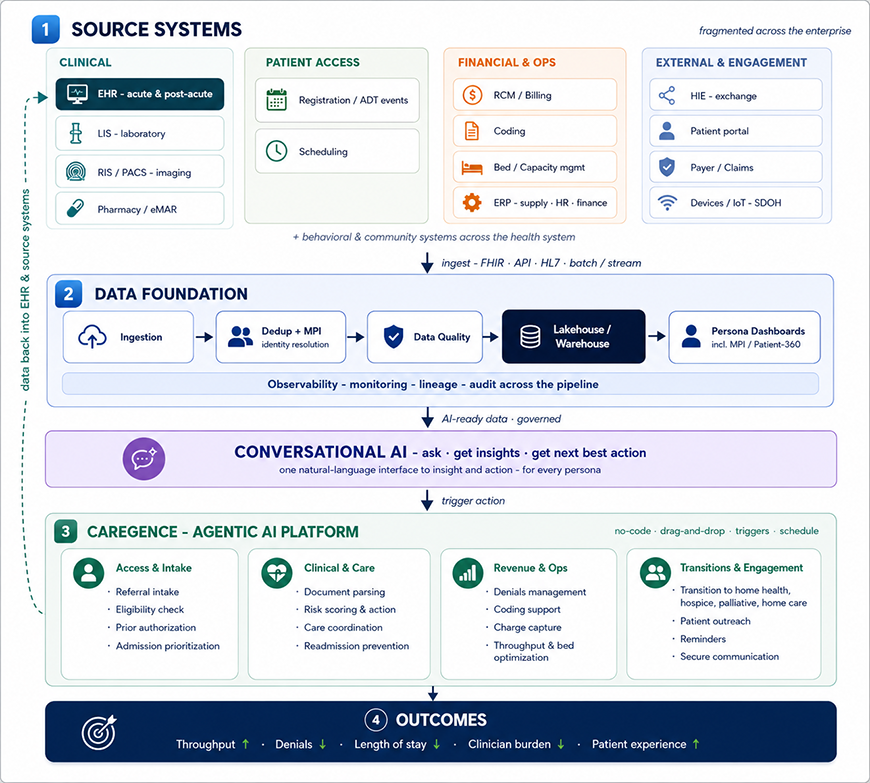
Three layers over the systems you already own, joined by one conversational interface. Data flows up into the foundation; a natural-language assistant turns it into insight and next best actions; the agentic AI layer executes and writes back into the EHR and source systems for continuous EHR data integration, signifying a closed, observable loop. 

Layer one: a healthcare data platform that makes data whole 

Before any AI is trustworthy, the data must be. The foundation ingests from every source: clinical, financial, operational, external, and the post-acute and community systems in the health system. It uses FHIR where it exists, native APIs where it does not, and HL7 where it must.  

It resolves duplicate identities into a single master patient index, the foundation of a true Patient 360 view, enforces data quality and healthcare data governance, and lands everything in a governed lakehouse-warehouse, with observability across the whole pipeline. What leaders see is not raw plumbing but persona-specific dashboards, an operations view for the CIO, a clinical view for the CMIO, a service-line view for the leader who owns the P&L, including a unified Master Patient Index / Patient-360 view that finally shows one patient as one record. 

The way in with conversational AI 

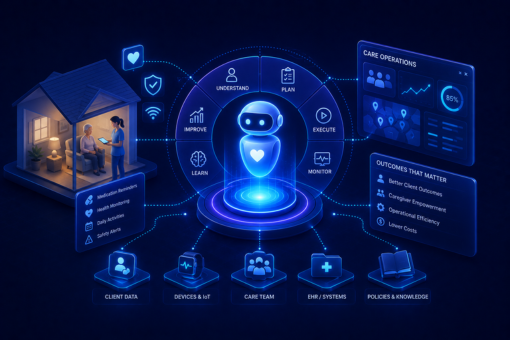
Dashboards answer the questions you already know to ask. A hospital needs more than that. So, the foundation and the agentic layer share one conversational AI interface built for healthcare teams: ask a question in plain language, get an insight drawn from your own data, and get the next best action – which the platform can then carry out. A service-line leader can ask why to length-of-stay drifted last month; a case manager can ask which discharges are highest-risk today and set the follow-up in motion. One way in, for every persona. 

Layer two: agentic AI that acts 

On that foundation, a no-code orchestration platform for agentic AI in healthcare turns the record into action across the care continuum and the back office alike: automating access and intake – including prior authorization automation, supporting clinical work and care coordination, tightening revenue and operations with denials management software and coding support, and engaging patients directly. Workflows are built by drag-and-drop, run on schedules or event triggers, and every action is logged, observable, and written back into the EHR and source systems, so the system of record stays current while the work finally gets done. 

The step most hospitals still do manually; the transition out 

One use case deserves singling out, because it sits at the boundary of the hospital’s control and its accountability: the transition of care at discharge. Referrals to home health, hospice, palliative care, and home care are still largely faxed, keyed, and sent into the dark, even as readmissions and value-based contracts make what happens next the hospital’s problem. Automating that hand-off, and monitoring risk after it closes the seam between the hospital and the next setting of care. 

Keep your EHR. Add the three things it was never built to be: whole, conversational, and active.

Why AI stalls without these layers 

  • Fragmented data, unreliable AI. Models built on scattered, duplicated, uneven data cannot be trusted, and leaders know it, so nothing ships. 
  • A high safety bar, rightly. HIPAA, clinical risk, and audit obligations make automation without governance and observability a non-starter. 

Every layer here is additive. None disrupts the EHR. That is what makes the path realistic for a live health system rather than a slide. 

Contact us

Where Inferenz stands 

We are a healthcare-native Data & AI company driving healthcare workflow automation, building these layers is what we do. Three things let us do it quickly and safely: 

  • Proven delivery for healthcare. We design, build, and run production data platforms and AI for healthcare organizations unifying dozens of source systems into a single source of truth, master data and patient indexing, predictive risk models, conversational AI assistants, and agentic workflows. 
  • Partnerships that de-risk the platform. Deep partnerships and alliances with Databricks, Snowflake, Azure, and AWS mean the foundation runs on the cloud and data platforms your teams already trust – no exotic stack to maintain, and a clear path to scale. 
  • Accelerators and frameworks that compress time-to-value. A library of 30+ production accelerators: ingestion, deduplication, data quality, observability; a lakehouse-warehouse blueprint; a Master Patient Index; and pre-built Caregence tools, turns months of build into weeks of configuration. 

Caregence brings it together in one no-code, MCP-based agentic platform. Pre-built healthcare AI agents span access, clinical care, revenue cycle management, operations, care transitions, and engagement.  

Connectors reach FHIR-native EHRs across acute and post-acute settings, plus API-based and custom integrations for systems without full FHIR and healthcare interoperability solutions for every environment. Secure communication; a conversational assistant; and full observability round it out, HIPAA-compliant by design.  

The result: the AI-ready hospital is not a research project. It is an engagement with a partner who has built the hard parts before. 

See how the department-by-department rollout plan looks for a hospital CIO piloting this today. 

Contact our Healthcare AI Expert

Frequently Asked Questions 

What is an AI-ready hospital? 

It’s not a new EHR. It’s the hospital’s existing EHR plus the two layers it was never built to be: a governed data foundation and a no-code agentic AI layer, joined by one conversational interface, without replacing or disrupting the EHR itself. 

What are the two structural gaps in a typical hospital’s data setup? 

First, the EHR was never the whole picture as it sits alongside lab, imaging, pharmacy, revenue cycle, coding, an ERP, a patient portal, and other systems that don’t stitch together on their own. Second, the EHR records work but rarely performs it: referrals, prior authorizations, and follow-ups, that still depend on manual human effort the chart never automates. 

What is a master patient index, and what role does it play here? 

It’s the mechanism that resolves duplicate patient identities into a single record. In this model, it sits inside the data foundation layer, alongside data quality enforcement, and feeds a unified Master Patient Index / Patient-360 view so leaders finally see one patient as one record instead of fragments across systems. 

How does the conversational interface work? 

It’s the shared entry point for both the foundation and the agentic layer. A user asks a question in plain language, gets an insight drawn from the hospital’s own data, and gets a recommended “next best action” the platform can then carry out, for example, a service-line leader asking why length-of-stay drifted, or a case manager asking which discharges are highest-risk today. 

What does the agentic AI layer automate? 

A no-code, drag-and-drop orchestration platform that acts across the care continuum and back office: automating access and intake, supporting clinical work and care coordination, tightening revenue and operations, and engaging patients directly — with every action logged, observable, and written back into the EHR. 

Why does the discharge “transition of care” get called out specifically? 

Because transition of care is still mostly manual, with respect to referrals to home health, hospice, palliative care, and home care largely faxed and keyed by hand. Readmissions and value-based contracts make what happens after discharge the hospital’s financial and clinical problem. But automating that hand-off closes the seam between the hospital and the next care setting.


Parquet v2 in Azure Databricks: What Changed and Why It Matters

Summary  

Parquet file format v2 is now generally available for Delta Lake and Apache Iceberg tables in Azure Databricks Runtime 18.1 and above. It swaps in smarter encodings, richer page-level metadata, and INT64 timestamps to shrink file sizes and speed up querieswith zero changes to your existing SQL. Turn it on with a single table property and use REORG TABLE when you want your historical data rewritten too.

Introduction

Global data volumes are on pace to cross roughly 230–240 zettabytes by 2026, according to Statista estimates, and every terabyte of that sits somewhere, on someone’s storage bill. Most of it, if you’re running an Azure Databricks lakehouse, sits in Parquet file format files. So when the format underneath your Delta Lake or Apache Iceberg tables gets a meaningful upgrade, it’s worth fifteen minutes of your attention.

That upgrade is Parquet v2, and unlike a major platform migration, it doesn’t ask you to touch a single line of application code or rewrite a query. It changes how data is physically packed inside the files themselves which, in practice, means smaller files, better compression, and faster reads for the same data you already have.

A quick note on terms, if you’re newer to the stack: Apache Parquet is the columnar file format that stores data by column rather than by row, letting a query engine like Spark read only the columns a query actually needs. Delta Lake is the transactional layer Databricks builds on top of Parquet it adds ACID guarantees, schema enforcement, and time travel. Apache Iceberg is a similar open table format, increasingly used alongside or instead of Delta Lake in mixed-engine environments. Parquet v2 sits one level below both of them, at the file format itself, which is exactly why it works across both table types without any application-level rework.

In this Parquet v2 Azure Databricks guide, we’ll cover what Parquet v2 actually changes compared to Parquet v1, how to turn it on, what to check before you do, and where it fits in a broader Databricks storage optimization strategy.

What Is Parquet v2?

Parquet file formathas been the default columnar storage format for big data platforms for well over a decade, and for good reason, it stores data efficiently and let’s query engines skip columns a query doesn’t touch. In wide tables, that column-pruning alone can cut I/O dramatically; reading two columns out of a hundred means the engine never has to touch the other ninety-eight.

But the original Parquet file formatspec (v1) was designed for a different era of data volumes, and three limitations became increasingly visible as workloads scaled:

  • Integer and string compression left performance on the table.
  • Query engines had limited page-level metadata to use for skipping unnecessary data.
  • Timestamps relied on the older INT96 format, which compressed and filtered poorly.

Parquet v2 addresses all three with more efficient encodings, richer page metadata, and a modern INT64 timestamp format. According to Microsoft’s Azure Databricks documentation and Databricks’ own platform release notes, Parquet v2 is generally available for Delta Lake and Apache Iceberg tables starting in Databricks Runtime 18.1, with support for converting existing data added in Runtime 18.2.

Parquet v1 vs. Parquet v2, at a Glance

CapabilityParquet v1Parquet v2
Timestamp storageINT96INT64 (better compression, more accurate stats)
Integer / string encodingStandard RLE / dictionaryAdds DELTA_BINARY_PACKED and DELTA_LENGTH_BYTE_ARRAY for tighter packing
Page metadataBasic headersRicher v2 data page headers with per-page stats
Predicate pushdownLimited page-level skippingFiner-grained data skipping at the page level
Enable viaDefaultdelta.parquet.format.version / iceberg.parquet.format.version = 2.12.0
Reader compatibilityUniversalBroad, but verify external / third-party readers

What’s New in Parquet v2?

1. Better Compression for Integers and Strings

The headline change is how numeric and string values get stored. Parquet v2 introduces more efficient encoding techniques, including delta-based packing for integers and byte arrays, per the Apache Parquet specification, which typically produce:

  • Smaller Parquet files
  • Better compression ratios
  • Faster decoding during query execution

Independent benchmarking from the DuckDB engineering team gives a useful sense of scale here: enabling Parquet v2’s newer encodings produced files roughly 30% smaller with 15% faster writes under Snappy compression, and about 11% smaller with 24% faster writes under zstd, across their test datasets. On highly sequential data, think auto-incrementing IDs or evenly spaced timestamps, the gains were far more dramatic, with some columns shrinking by over 90%.

One honest caveat worth flagging: delta encoding isn’t a universal win. On columns with moderate entropydata that repeats in patterns but isn’t cleanly sequential, delta encoding can occasionally produce larger files than v1, because it turns repeating values into effectively random deltas that compress worse. It’s a good reason to test against a representative sample of your own tables rather than assuming uniform gains.

2. Improved Data Page Headers

Parquet files are divided into pages, and in Parquet v2, each page carries richer metadata, allowing Databricks to determine whether a page contains relevant data before it’s ever read. That directly improves:

  • Predicate pushdown
  • Data skipping
  • Query performance on filtered datasets

If your query filters sales data for a single month, Databricks can skip the pages that don’t contain data from that period, cutting the volume of data scanned, and the compute cost that comes with it.

3. INT64 Timestamps Instead of INT96

Older Parquet files stored timestamps in the INT96 format. Parquet v2 replaces it with the more efficient INT64 timestamp format, which brings:

  • Better compression
  • More accurate statistics
  • Faster filtering on timestamp columns
  • Better compatibility with modern analytics engines

Since most enterprise data warehouse tables lean heavily on timestamp columns event logs, transaction records, IoT telemetry this single change tends to have an outsized, noticeable impact on real-world query performance.

How to Enable Parquet v2

If you’re using Databricks Unity Catalog managed tables, Azure Databricks may automatically upgrade compatible tables to Parquet v2 for you. To enable it manually, set the table property directly.

Existing Delta table

ALTER TABLE table_name
SET TBLPROPERTIES (
'delta.parquet.format.version' = '2.12.0'
);

Existing Iceberg table

ALTER TABLE table_name
SET TBLPROPERTIES (
'iceberg.parquet.format.version' = '2.12.0'
);

New Delta table

CREATE TABLE table_name (...)
TBLPROPERTIES (
'delta.parquet.format.version' = '2.12.0'
);

New Iceberg table

CREATE TABLE table_name (...)
USING iceberg
TBLPROPERTIES (
'iceberg.parquet.format.version' = '2.12.0'
);

Existing Data Isn’t Automatically Converted

This is the detail most teams miss on their first pass.

Changing the table property only affects new data written after the change. Your existing Parquet files stay in their original format, which means a single table can temporarily hold a mix of Parquet v1 and Parquet v2 files side by side.

If you want your historical data converted too, Databricks Runtime 18.2 and above provides the REORG TABLE command:

REORG TABLE table_name
APPLY (
SET PARQUET (FORMAT_VERSION = '2.12.0')
);

This rewrites every existing file using Parquet v2, so the entire table benefits from the format change.

Can You Roll Back?

Yes. If you hit a compatibility issue downstream, you can convert the table back to Parquet v1 just as easily:


REORG TABLE table_name
APPLY (
SET PARQUET (FORMAT_VERSION = '1.0.0')
);

This rewrites the data files again and restores the table to the older format a genuinely low-risk way to test Parquet v2 in a non-production environment before committing.

Things to Check Before Enabling Parquet v2

Parquet v2 delivers real gains, but it’s worth verifying compatibility if your data is read outside Databricks. Before flipping the switch, check for:

  • External Apache Iceberg readers that may not yet support Parquet v2. DuckDB’s own engineering team, for instance, has noted that several mainstream query engines still default to writing (and in some cases reading) older Parquet encodings for exactly this reason.
  • Delta Sharing or other external sharing methods confirm recipient tools can actually read Parquet v2 files before you share.
  • Materialized views and streaming tables, which aren’t upgraded automatically and need to be enabled manually.

If your tables are read exclusively from within Databricks, compatibility generally isn’t a concern at all.

Should You Use Parquet v2?

For most Azure Databricks workloads, yes. Parquet v2 offers real advantages without requiring any application-side changes:

  • Reduced storage usage
  • Better compression
  • Faster query execution
  • Improved predicate pushdown
  • Better timestamp handling

If your data is read exclusively within Azure Databricks, enabling Parquet v2 is a low-effort, high-leverage way to improve performance. If external tools, BI platforms, or third-party engines also touch your data, verify compatibility first.

A practical rollout sequence looks like this:

  1. Let Databricks Unity Catalog managed tables upgrade automatically where applicable.
  2. Enable Parquet v2 on Databricks-only tables first.
  3. Run REORG TABLE if you want existing data converted.
  4. Test external readers before enabling Parquet v2 on shared datasets.

Final Thoughts

Parquet v2 is the kind of improvement that works quietly in the background. You keep writing the same SQL, running the same pipelines, using the same BI tools but your data becomes more storage-efficient, and your queries, more often than not, come back a little faster.

For enterprises running Azure Databricks at scale, this is a low-effort upgrade with a real payoff, provided you verify compatibility for anyone reading your data outside the platform. As a Databricks consulting partner, Inferenz has helped enterprise data teams evaluate exactly this kind of platform-level change as part of broader Delta Lake and lakehouse cost-optimization engagements. Through its data engineering and integration services, organizations have optimized storage architectures, improved data performance, and reduced cloud infrastructure costs, where a one-line table property, applied correctly across the right tables, adds up to a measurable line item on the cloud bill.

Frequently Asked Questions

What is Parquet v2 in Azure Databricks?

Parquet v2 is an updated version of the Apache Parquet file format, generally available for Delta Lake and Apache Iceberg tables in Databricks Runtime 18.1 and later. It uses more efficient encodings, richer page-level metadata, and INT64 timestamps to reduce file size and improve query performance, without requiring any changes to existing SQL or application code.

Is Parquet v2 backward compatible with Parquet v1?

Yes, in the sense that a table can hold both v1 and v2 files simultaneously, and readers built to handle the v2 spec can typically process both. However, some external tools and older Parquet readers outside the Databricks ecosystem may not yet support the newer v2 encodings, so it’s worth verifying compatibility for any downstream consumers.

Does enabling Parquet v2 automatically rewrite my existing data?

No. Setting the delta.parquet.format.version or iceberg.parquet.format.version property only affects new files written after the change. To convert historical data, run the REORG TABLE … APPLY (SET PARQUET (FORMAT_VERSION = ‘2.12.0’)) command, available in Databricks Runtime 18.2 and above.

Which Databricks Runtime version supports Parquet v2?

Parquet v2 is generally available for Delta Lake and Apache Iceberg tables starting in Databricks Runtime 18.1. The REORG TABLE command for converting existing data to Parquet v2 requires Databricks Runtime 18.2 or later.

Will Parquet v2 break compatibility with my BI tools or external Iceberg readers?

It can, if those tools rely on older Parquet readers that haven’t yet implemented support for v2 encodings. Before enabling Parquet v2 on tables shared via Delta Sharing or read by external engines, test those specific readers first. Tables read exclusively within Databricks generally have no compatibility concerns.

Can I convert a Parquet v2 table back to Parquet v1?

Yes. Running REORG TABLE table_name APPLY (SET PARQUET (FORMAT_VERSION = ‘1.0.0’)) rewrites the table’s data files and restores it to the Parquet v1 format, making it straightforward to test v2 and roll back if you hit a compatibility issue.

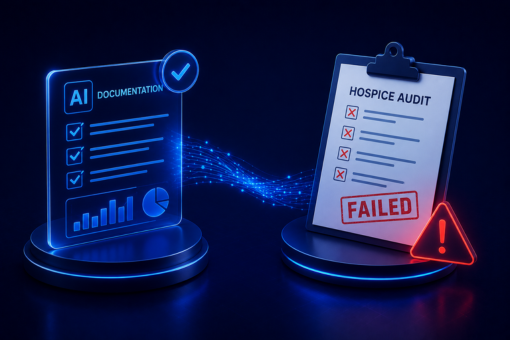
When AI Documentation Looks Perfect and Still Fails a Hospice Audit

Summary  

Most AI clinical documentation tools produce hospice notes that read well and fail audits. Generic AI was never built to reason through jurisdiction-specific Local Coverage Determinations or the clinical-regulatory logic Medicare Administrative Contractors actually use.  

This article breaks down why that gap exists and what compliance-first documentation actually needs. 

documentation-still-open

Introduction 

A hospice nurse wraps up a home visit at 9pm. She is exhausted, the family is anxious, and she still has to finish tonight’s note before tomorrow’s IDT meeting. She opens the AI-generated draft. Clean sentences, professional tone, not a typo in sight. She signs off and moves on. 

Six months later, that exact note comes back flagged in a Targeted Probe and Educate (TPE) audit. 

The prose was fine. The compliance case was not there. 

The note never established, in language a Medicare Administrative Contractor (MAC) could point to, why this specific patient is expected to have six months or less to live. That is not a formatting problem. That is a fundamental misunderstanding of what AI clinical documentation for hospice requires to be defensible. 

This is not an isolated case. It is the pattern. 

Why general AI clinical documentation tools cannot handle hospice compliance 

Why general AI clinical documentation tools cannot handle hospice compliance

Hospice News recently reported that hospice leaders across the country are converging on the same finding: most AI documentation tools were built for home health broadly, not hospice specifically. 

They do not understand: 

  • Local Coverage Determination (LCD) criteria and how they vary by jurisdiction 
  • The clinical logic separating a hospice recertification narrative that is well-written from one that is genuinely audit-ready 
  • The comparative decline language CMS reviewers are trained to look for 
  • What the new HOPE quality-reporting framework expects in terms of person-centred nuance 

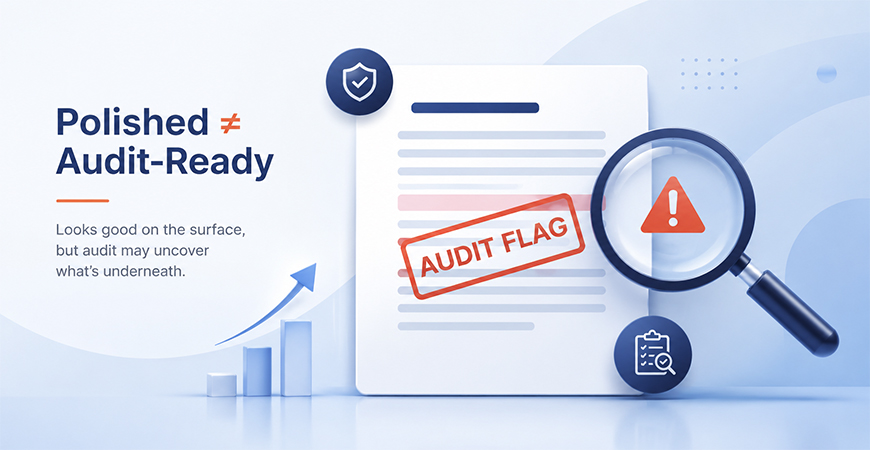
One of the hospice CEOs summarized it directly: general AI models can produce narratives that are clinically polished and still fail an audit, because polish and compliance are not the same thing. 

More than half of hospices nationwide are already managing multiple simultaneous audits. TPE audit rates keep climbing. This is not a hypothetical risk for future planning. It is an operational reality for most hospice organizations today. 

The LCD problem no one is talking about 

Here is what makes AI clinical documentation for hospice harder than it looks on the surface level. 

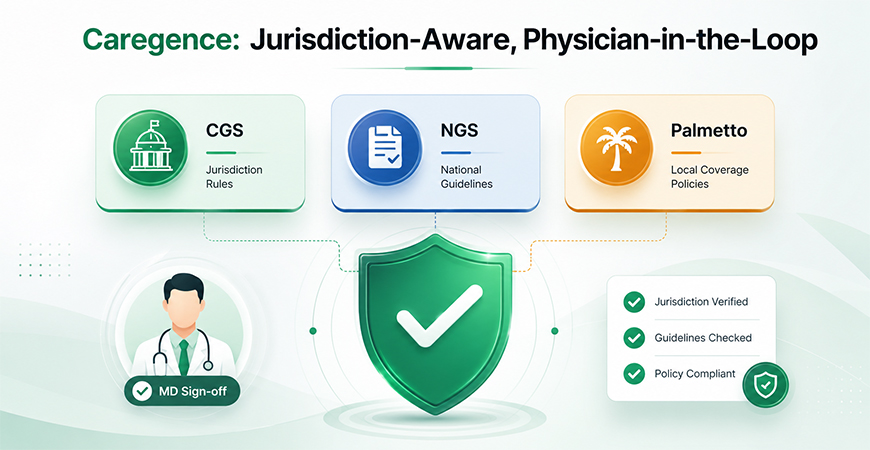
Medicare hospice eligibility is not governed by a single national standard. Despite being a federal benefit, terminal-status criteria are published as jurisdiction-specific LCDs, written separately by three different Medicare Administrative Contractors: 

  • CGS 
  • NGS 
  • Palmetto GBA 

These three MACs use different logic: 

  • CGS and NGS diverge substantively on ALS and renal disease, applying different lab thresholds and different qualifying criteria other than terminology. 
  • Palmetto GBA abandons the itemized-checklist approach entirely for five of its seven disease categories, replacing it with a narrative “structural and functional impairment” standard that carries no numeric thresholds at all 

A generic AI model trained on general clinical notes has no mechanism for knowing which of these three regulatory regimes governs the patient in front of it, let alone applying the right one correctly. 

The result is documentation that may satisfy one MAC’s expectations while failing another’s entirely, with no warning to the clinician who signed off on it.

What compliance-first hospice AI needs? 

The fix for a compliance-first hospice AI is not a larger language model. It is a system built from the regulation outward, not from the sentence inward. 

A documentation tool built for hospice compliance needs to do four things that most general AI tools currently do not: 

  • Resolve jurisdiction before screening begins. The system must identify the patient’s state, MAC assignment, and governing LCD before it touches a single eligibility criterion. 
  • Walk through disease-specific pathways item by item. Required criteria and supporting criteria must be kept distinct and evaluated separately, not summarized into a generic “probably eligible” assessment. 
  • Distinguish between a criterion that is not met and one that is simply not yet documented. Real gaps need to surface for clinical follow-up. They should never be quietly absorbed into a narrative that reads as complete when it is not. 
  • Know its role in the clinical workflow. The tool screens eligibility. It does not diagnose. The physician certifies. That boundary is not optional, and it cannot be designed around. 

These are not feature requests. They are the minimum viable architecture for AI clinical documentation in hospice that can withstand a TPE audit or a Comprehensive Error Rate Testing (CERT) review. 

Is-your-AI-clinical-documentation-built-for-a-hospice-audit-or-just-pretending

How Caregence approaches AI Clinical Documentation for hospice 

 The Caregence clinical documentation AI engine was designed around the compliance logic described above. It is not a general documentation tool adapted for hospice. It is built from the regulatory structure outward. 

How Caregence approaches AI Clinical Documentation for hospice 

Here is how it works in practice: 

  • Jurisdiction resolution first. Before screening begins, Caregence identifies the patient’s state, MAC assignment, and the specific LCD that governs their diagnosis. An ALS or renal patient in an NGS jurisdiction is measured against NGS thresholds, not CGS’s or Palmetto’s. 
  • Disease-specific pathway screening. The system works through each diagnosis pathway the way a compliance-minded clinician would: required criteria evaluated separately from supporting criteria, documentation gaps flagged explicitly rather than inferred around. 
  • Certification-ready narrative output. A completed screen translates directly into narrative language built around the “paint a picture with evidence” standard that CMS reviewers and MACs are trained to apply. The documentation is defensible, not just readable. 
  • Physician certification remains the physician’s call. The system supports the clinical and compliance case. It does not make the determination. That boundary is architectural, not a disclaimer. 

If your current AI clinical documentation tool can produce a well-structured note but cannot tell you which LCD it screened against, it is not a compliance tool. It is a drafting tool. In a benefit this audit-heavy, that distinction carries real financial and regulatory risk.

What this means for hospice organizations right now 

The hospice sector is operating in an environment where audit pressure is structural, not cyclical. 

TPE rates are climbing. The HOPE framework is adding new quality-reporting requirements. Payers are scrutinizing hospice recertification narratives more carefully than at any prior point. And the cost of a failed audit is not just the recoupment. It is the retrospective review that follows, the staff hours consumed by response documentation, and the referral relationships that erode when a provider’s compliance record comes into question. 

The organizations that will navigate this environment most effectively are not the ones with the most advanced general AI tools. They are the ones whose AI understands: 

  • Which MAC governs each patient 
  • Which hospice LCD applies to each diagnosis 
  • What the difference is between a well-written note and an audit-ready one 
  • Where the documentation gaps are before the auditor finds them 

That is bar you need to set for AI implementations.

Hospice-Audits-Are-Not-Slowing-Down.-Your-Documentation-Needs-to-Be-Ready

Frequently Asked Questions 

Q1: Why do AI-generated hospice notes fail audits if they look clinically complete? 

Clinical completeness and compliance are not the same standard. A note can be medically accurate and still fail a TPE audit if it does not establish terminal prognosis in the language and logic the governing MAC is trained to look for. 

Q2: What is a Local Coverage Determination and why does it matter for hospice documentation?

An LCD is a jurisdiction-specific policy that defines the clinical criteria required to establish hospice eligibility for a given diagnosis. Three separate MACs write their own LCDs for hospice and they differ substantively on criteria, thresholds, and documentation standards. 

Q3: How do CGS, NGS, and Palmetto GBA differ in their hospice eligibility criteria?

CGS and NGS diverge on ALS and renal disease using different lab thresholds. Palmetto GBA replaces itemized criteria entirely with a narrative impairment standard for five of its seven disease categories. One documentation tool cannot serve all three correctly without resolving jurisdiction first. 

Q4: What does “comparative decline” mean in hospice documentation? 

It is documented evidence that a patient’s functional or clinical status has deteriorated relative to a prior baseline. MACs and CMS reviewers treat it as one of the primary indicators that a patient meets the six-months-or-less prognosis standard. 

Q5: What is the HOPE quality-reporting framework and how does it affect hospice AI tools? 

HOPE is CMS’s replacement for the CAHPS Hospice Survey, placing greater emphasis on person-centered documentation and outcome measurement. AI tools generating generic clinical narratives are increasingly misaligned with what HOPE now expects. 

Q6: How is Caregence different from general AI clinical documentation tools for hospice? 

Caregence resolves jurisdiction and governing LCD before screening a single criterion, evaluates disease-specific pathways item by item, and generates certification-ready narrative output. General tools draft notes. Caregence builds the compliance case behind them. 

Beyond HIPAA Compliance: Building Trusted Agentic AI for Modern Healthcare with Caregence

Summary

Caregence is a healthcare-native agentic AI platform built by Inferenz that treats HIPAA compliant AI as an architectural principle, not a final checklist. Every AI agent operates on minimum-necessary access, every action is logged, and the infrastructure is isolated and governed by designso healthcare organizations can adopt agentic AI healthcare workflows without trading away patient privacy or security. 

Introduction 

Healthcare is entering a new era where artificial intelligence goes beyond answering questions and generating summaries. Modern AI systems can reason, coordinate workflows, retrieve information from multiple systems, and execute tasks autonomously. As a result, this new paradigm, agentic AI, has the potential to transform healthcare operations by freeing providers to focus on patient care while intelligent agents handle repetitive administrative and clinical work.

 Yet this transformation raises an important question: how do healthcare organizations embrace autonomous AI without compromising patient privacy, regulatory compliance, or security? 

The Caregence platform, by Inferenz, revolves around trust. Innovation alone is not enough in healthcare. Every AI interaction must be built on a foundation of security, accountability, and responsible data governance. HIPAA compliance is woven into the architecture of our agentic AI platform from the very beginning. 

Why security must evolve alongside AI 

 Healthcare organizations manage some of the world’s most sensitive information. Medical histories, diagnostic reports, insurance details, prescriptions, and laboratory results aren’t just data points they represent deeply personal aspects of an individual’s life. 

 Traditional software applications typically process information in predictable ways. Agentic AI introduces dynamic decision-making instead. Within a healthcare workflow automation environment, AI agents: 

  • Retrieve data from connected systems EHR/EMR, payer platforms, claims, CRM, HR/payroll, and RCM 
  • Reason across multiple sources to determine the right next step in a workflow 
  • Interact with healthcare systems to complete tasks like intake, authorization, or documentation 
  • Collaborate with other agents, coordinated through an orchestration layer, to complete complex, multi-step workflows 

 This expanded capability raises the bar for governance. Healthcare providers need assurance that AI agents access only the information necessary for a specific task, that every interaction is recorded, and that patient information stays protected throughout the process. Security, therefore, must evolve alongside intelligence. 

HIPAA as an architectural principle 

 Many organizations treat HIPAA as a compliance checklist completed near the end of software development. Caregence takes a different approach. 

 HIPAA principles influence architectural decisions from day one. Our approach begins with secure design principles, ensuring every feature – from the core platform to individual pre-built agents – is built with privacy, governance, and regulatory requirements in mind from the outset. That philosophy embeds security into every layer of the platform: infrastructure, application design, AI orchestration, and operational monitoring. 

Designing agentic AI with privacy in mind 

 An autonomous healthcare agent should never have unrestricted access to patient information simply because it ‘can’ perform a task. Each AI agent operates with carefully defined responsibilities instead. 

 Consider an AI agent assisting a clinician with discharge documentation. It doesn’t require unrestricted access to every record in the Electronic Health Record (EHR). It retrieves only the information relevant to that patient’s discharge, processes it within a secure environment, records its activity for auditing, and completes the workflow without retaining unnecessary data. 

 This principle of minimum necessary access sits at the center of responsible healthcare AI, and it aligns directly with HIPAA’s privacy expectations. 

How Caregence protects healthcare data 

 Protecting healthcare information takes more than encryption or authentication alone – it takes multiple layers of defense working together across the entire AI lifecycle. Within Caregence, sensitive healthcare information is protected through a security-first architecture built around confidentiality, integrity, and availability. 

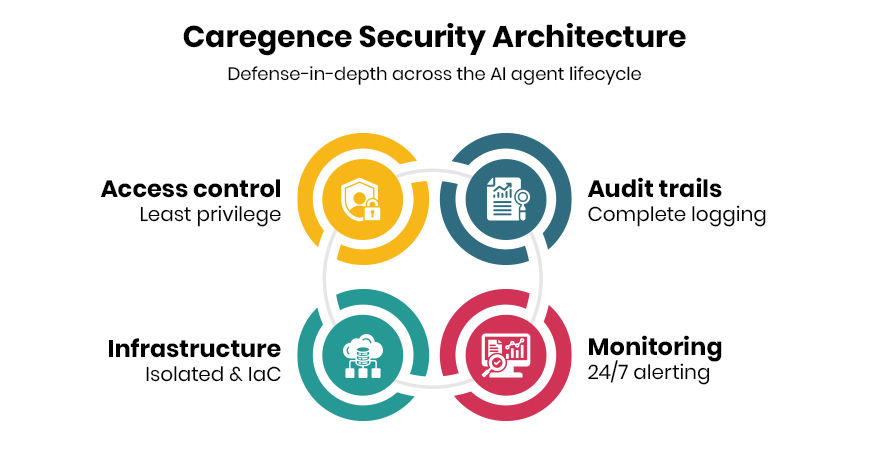
Caregence security architecture

The platform’s four protective layers, at a glance: 

  • Secure identity and controlled access: every request from an AI agent or authorized user is validated before access is granted. Role-based permissions ensure clinicians, administrators, and support staff interact only with the information their role requires, using secure identity management rather than shared credentials. 
  • Secure infrastructure by design: Caregence operates within enterprise cloud environments using isolated networking, secure storage, managed databases, secret management, and Infrastructure as Code (IaC), minimizing public exposure and enforcing controlled communication between services. 
  • Comprehensive audit trails: every meaningful interaction is traceable. Authentication events, AI agent activity, administrative actions, and system operations are all logged to support monitoring, incident investigation, and compliance reporting. 
  • Continuous monitoring: observability practices give visibility into application health, infrastructure performance, and AI workload behavior, with automated alerting so technical teams can respond before an issue touches a clinical workflow. 

 Trust cannot exist without transparency, and uptime alone isn’t the goal, the goal is patient services that stay reliable and secure.

Explore Caregence Platform

Responsible AI beyond compliance 

 Regulatory compliance sets the minimum standard. Responsible AI demands more. 

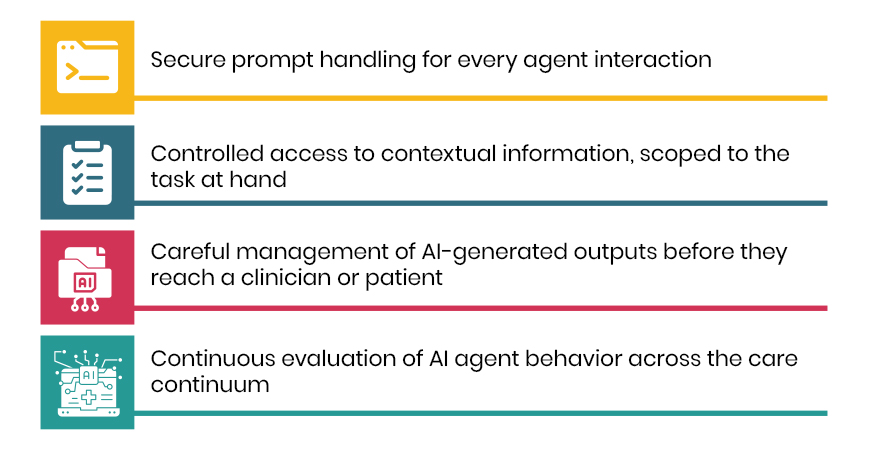
 At Caregence, we believe healthcare AI should be transparent, accountable, and explainable wherever possible. Our platform supports AI governance healthcare practices that include: 

Responsible AI beyond compliance

These practices help healthcare organizations deploy AI confidently while keeping oversight of every automated decision. 

Enabling healthcare innovation without increasing risk 

 Healthcare organizations often face a difficult choice between adopting innovative technologies and maintaining strict regulatory compliance. Agentic AI changes that conversation. 

 When security and governance are embedded into the platform itself, organizations can accelerate digital transformation without adding operational risk. Administrative workflows become more efficient, clinicians spend less time on repetitive documentation, and healthcare teams gain intelligent assistance while maintaining confidence that patient information stays protected. 

 Innovation and compliance no longer compete. They reinforce each other. 

The Caregence Vision 

 The future of healthcare will be defined not simply by smarter AI, but by trustworthy AI. As autonomous systems grow more capable, patients and providers will expect healthcare AI platforms to demonstrate accountability, transparency, and security by design. 

 At Caregence, our mission is to build agentic AI that healthcare organizations can trust. Every architectural decision reflects our commitment to protecting sensitive healthcare information while empowering providers to deliver faster, more efficient, and more personalized care. 

 HIPAA compliance is an important milestone, but our vision extends beyond meeting regulatory requirements. We strive to build an AI platform where security enables innovation, governance strengthens automation, and trust becomes the foundation for every intelligent healthcare interaction. 

 Because in healthcare, the most valuable outcome isn’t just smarter technology, it’s the confidence that every patient interaction is handled with the care, privacy, and responsibility it deserves. 

Ready-to-deploy-Agentic-AI-your-compliance-team-will-actually-approve

Frequently Asked Questions 

Is Caregence HIPAA compliant? 

Rather than applying HIPAA principles as a final checklist, Caregence builds them into its architecture from day one. As a result, compliance extends across the infrastructure, application design, AI orchestration, and continuous monitoring.

What do you mean by agentic AI in healthcare? 

Agentic AI refers to AI systems that reason, coordinate workflows, retrieve data across systems, and execute multi-step tasks autonomously, as opposed to traditional AI that only answers questions or summarizes information. 

How does Caregence protect patient data? 

Caregence protects patient data through a four-layer, security-first architecture: role-based access control, isolated cloud infrastructure built with Infrastructure as Code, comprehensive audit trails, and continuous, 24/7 monitoring. 

What does “minimum necessary access” mean for AI agents? 

It means an AI agent only retrieves and processes the specific patient data required to complete its assigned task, nothing more, reducing exposure of sensitive healthcare information. 

How is Caregence different from general-purpose AI platforms? 

Caregence is a healthcare-native agentic AI platform, purpose-built to connect with EHR/EMR, payer systems, claims, CRM, HR/payroll, and RCM systems, with governance and HIPAA-aligned guardrails built into every workflow, not retrofitted onto a generic AI tool. 

Databricks Data + AI Summit 2026: The Lakehouse Just Became Something Bigger

Summary 

Databricks Data + AI Summit 2026 was not a feature release, but a declaration. The Lakehouse is no longer just where enterprises store and query data. It is where agents do the job for your business. Here is what changed, what it means, and why it matters now. 

Introduction 

Every year, the tech industry produces a hundred summits that announce things. 

Databricks Data and AI Summit 2026 (DAIS) was different.  

What Databricks put on the table in San Francisco this June was an architectural argument about where enterprise AI is actually headed, and it landed with the kind of coherence that makes you reconsider how you have been thinking about your data stack. 

The theme, if you had to name it, was this: the Lakehouse is now the control plane for the agentic enterprise. Not just a place to store data. The place where agents govern, reason, act, and get held accountable for what they do. 

For Inferenz, a Databricks partner building agentic AI solutions in healthcare and enterprise, several of these announcements land directly in the infrastructure we build on and deploy for clients.  

Here is our read on what mattered most and what you should actually do about it. 

The context problem is finally being taken seriously 

If you have ever deployed an AI model and watched it produce a confidently wrong answer, you already know the core problem DAIS 2026 addressed. 

It is not model quality. It is context. 

As Ali Ghodsi, founder and CEO of Databricks put it during the keynote: “Most enterprise AI today is just guessing with false confidence. If you’re a CFO and AI can’t tell you why margins changed, that’s not an AI problem. That’s a context problem.” 

Genie Ontology is Databricks’s answer to that. It is a live context layer that continuously reads your data, documents, queries, and applications to build a machine-readable map of what your business actually means by its own terms.  

  • What does “active user” mean in your system?  
  • What is your definition of “churn”?  
  • When did your ARR calculation change, and why? 

This is not a static data dictionary someone fills in once and forgets. Genie Ontology updates continuously, weighs sources by authority (similar to how PageRank works), and feeds that knowledge directly into Unity Catalog’s semantic layer.  

The downstream effect: every agent, every dashboard, and every AI-generated report pulls from one shared, authoritative understanding of your business rather than each making its own guesses. 

The company with the best context layer will have a larger AI advantage than the company with the most data. That sentence from the Bain team covering the summit deserves to sit with you for a moment. 

Genie One: an AI coworker that actually knows your business 

Genie One is now generally available, and it is a significant step past what most enterprise AI assistants can actually do. 

  • It connects to over 50 applications, including Gmail, Slack, Teams, Jira, and Confluence.  
  • It can answer questions grounded in your actual governed lakehouse data, draft documents, schedule tasks, monitor changes, and explain why something happened.  
  • On a benchmark of 28 real-world enterprise data questions, Genie answered 84.5% correctly on the first attempt. The best general-purpose coding agent on the same test scored 52.4%. 

The difference is the ontology layer underneath. Genie is not searching documents. It is reasoning against a live, governed representation of your business. That is what separates a useful answer from a plausible one. 

For enterprise teams evaluating where to start with agentic AI, Genie One is the fastest path to ROI for non-technical business users. No seat-based pricing, either. Each user gets 150 DBUs of free LLM usage per month, with pay-as-you-go beyond that. 

LTAP: Forty years of infrastructure debt, addressed 

Here is a problem most enterprises have accepted as permanent: your transactional systems and your analytical systems have always been two separate things. Separate databases, separate formats, ETL pipelines running between them, two slightly different copies of the same data that never quite agreed. 

LTAP (Lake Transactional/Analytical Processing) changes that.  

The mechanics: Lakebase, Databricks’s serverless PostgreSQL database (now at 12 million launches per day), stores transactional data directly in Unity Catalog using Delta and Iceberg formats.  

No ETL. No sync. Hidden copies disappear. Every analytical engine reads the same governed file.

For AI agents, this is foundational. An agent that needs to read a customer’s live order history and then run six months of purchasing analysis currently must query two systems and reconcile two copies of data. With LTAP, there is one copy, one governance layer, and one point of truth. 

New Lakebase capabilities at the summit:  

  • cross-cloud disaster recovery 
  • git-style database branching (spin up a full-fidelity clone of production in sub-seconds for safe testing), and  
  • Lakebase Search, which brings hybrid vector and full-text retrieval natively into PostGRES. 

Lakehouse//RT, powered by a new engine called Reyden, rounds this out with sub-100ms query latency at 12,000 queries per second directly on Delta and Iceberg tables. PointClickCare’s benchmarks showed it running more than a third faster than their prior warehouse, on their own healthcare dataset, without a separate serving system. 

Agent Bricks: The platform that does the other 99% 

Building an AI agent is not hard anymore. The hard part is everything else. 

Memory across sessions. Security when agents execute code. Cost management when agents run at scale. Evaluation. Monitoring. Governance of what they can access. That is the 99% of engineering work that does not show up in demos but determines whether your deployment works in production. 

Agent Bricks is now a full-stack platform for exactly that. Over 100,000 agents have been built on it. AstraZeneca, 7-Eleven, Fox, and Block all run production agents on Agent Bricks. The 2026 expansion added: 

  • Managed agent memory powered by Lakebase, persistent across sessions 
  • MCP-connected retrieval from Unity Catalog and external tools like GitHub, Jira, and Google Drive 
  • Secure sandboxed compute environments for code execution 
  • Multi-model support: OpenAI, Anthropic, Gemini, Qwen, Grok, all governed under Unity Catalog 
  • Omnigent, a meta-orchestration layer for managing agents across different frameworks, models, and tools when your stack is not monolithic 

For teams building with Claude Code SDK, LangGraph, CrewAI, or OpenAI Agent SDKs, Omnigent is the layer that lets these coexist under one governance model instead of sprawling across disconnected stacks. 

Databricks also moved five products into the free tier: Genie Code, Serverless GPUs, Lakebase, Agent Bricks, and Lakeflow Designer. You can now prototype an entire agentic application from data pipeline to agent logic to served endpoint without spending anything. 

Unity AI Gateway: Governance that happens at runtime 

This is the announcement that regulated industries have been waiting for. 

Traditional AI governance asked: who can access which data, which model is approved? That works for humans. It breaks down for agents that act autonomously, spawn subagents, call external tools, and generate outputs at volume. 

Unity AI Gateway governs what agents actually do at the moment they do it.  

  • Hard spend caps.  
  • Real-time PII detection.  
  • Prompt injection prevention.  
  • Full trace capture of every tool call, MCP interaction, and subagent action.  
  • Security policies written in SQL that respond to agent behavior in context, not just static rules applied at the edge. 

At Inferenz, our work in healthcare AI has always required governance to be a first-class concern. What Unity AI Gateway represents is exactly the infrastructure required to move agentic AI from pilot deployments into production clinical environments.  

We cover this in more depth through our Generative and Agentic AI services and the governance architecture that underpins our Caregence platform. 

Is-Your-AI-Infrastructure-Ready-for-Agent-Scale-Governance

OpenSharing: Open standards win again! 

Databricks launched Delta Sharing in 2021 to solve cross-organizational data sharing without copying files. It became the most widely adopted open data-sharing protocol in the industry. 

OpenSharing extends that logic to the full AI stack. Data, models, agent skills, and Genie Agents can now be shared across organizations and clouds via a single Linux Foundation-hosted open protocol. 

The practical enterprise use case is Genie Agent Sharing: share a governed AI interface with a partner or customer, giving them curated access to your data and reasoning capabilities without exposing your underlying logic, proprietary calculations, or source tables. You control what they can ask, how much data they can export, and how many requests they can make. 

SecureConnect removes the networking headache: cross-cloud storage connections without per-recipient firewall configuration. 

What this means for Inferenz clients 

Inferenz is a Databricks partner. We build on this platform. Several of the Databricks summit announcements directly expand what we can deliver: 

  • Genie Ontology strengthens the semantic layer that our healthcare clients need for AI to reason correctly about clinical terms, payer rules, and care metrics without every agent reinventing the definition. 
  • Lakebase and LTAP close the gap between transactional care data and the analytical models that power Caregence predictive risk intelligence. Patient records that update in real time can now feed directly into risk models without ETL delays. 
  • Agent Bricks governance and Unity AI Gateway provide the runtime controls our healthcare deployments require. HIPAA-compliant agentic AI is not just a compliance checkbox. It is an architecture. These capabilities make that architecture standard rather than custom-built for every engagement. 

For enterprise clients working on data and cloud modernization or evaluating where agentic AI fits in their stack, the LTAP architecture eliminates an entire tier of infrastructure that was previously unavoidable. One governed copy of data, one permission model, one source of truth for both operational and analytical AI.

Five things worth acting on now 

Most enterprises left the summit with a list of things to watch. These five are worth starting this quarter. 

Define your semantic layer before your agents do it for you.  

Genie Ontology is only as good as what Unity Catalog already knows. If your organization has never agreed on what “revenue” or “active user” officially means, that conversation is now blocking your AI roadmap. 

Consolidate your database tier.  

Running a separate operational database alongside Databricks? Lakebase and LTAP give you a clear path to one governed system. The git-style branching alone makes the evaluation worth an afternoon. 

Audit your agent governance.  

Most AI pilots have no runtime enforcement. If your governance stops at the data catalog, it is not governance. Unity AI Gateway fixes that, but only if you implement it. 

Prototype on Agent Bricks before building custom.  

Lakebase, Agent Bricks, and Serverless GPUs are all free tier now. There is no budget justification for building a custom agentic stack before you have tested what is already there. 

Treat context as a strategic asset.  

The next AI advantage will not come from model selection. It will come from the organization whose agents have the clearest, most authoritative understanding of what the business means. That is a semantic architecture decision, not a procurement one.

What-Would-Your-Data-Stack-Look-Like-If-It-Was-Built-for-Agents

Final thought 

The debate in enterprise AI used to be about which model to choose. DAIS 2026 made clear that this was always the wrong question. 

The model is not the constraint. The architecture around it is. 

Context, governance, live data, and runtime control are the infrastructure that determines whether your AI delivers or stalls. Databricks built a year’s worth of announcements around exactly those four things. 

For enterprises that have been waiting for the infrastructure to catch up to the ambition, it just did.

Frequently Asked Questions 

Q1: What was the biggest announcement at Databricks Data + AI Summit 2026?

Genie Ontology and LTAP. One solves why enterprise AI keeps failing (context). The other solves a 40-year infrastructure problem by unifying transactional and analytical data on a single open-format layer. 

Q2: What is Genie One and how is it different from earlier Databricks AI tools?

It is an agentic coworker, not a chatbot. Genie One connects to 50+ enterprise apps, takes autonomous action, and reasons over live lakehouse data. It answered 84.5% of real-world enterprise questions correctly on first attempt. The best competing agent scored 52.4%. 

Q3: What is LTAP and why does it matter for AI agents?

It eliminates the need for two separate systems. Agents query one governed copy of data instead of reconciling transactional and analytical sources. Less complexity, more accurate outputs. 

Q4: How does Unity AI Gateway change enterprise AI governance?

It moves governance from the catalog to the moment an agent acts. Spend caps, PII detection, tool call logging, and security integrations enforced at runtime, not just at access control. 

Q5: What did Databricks add to Agent Bricks at DAIS 2026?

Persistent memory, MCP-connected retrieval, sandboxed code execution, multi-model support, and Omnigent for cross-framework orchestration. Five products also moved to the free tier. 

Q6: How does Databricks Genie Ontology work?

It reads your data, queries, and documents continuously to build a live map of what your business terms mean. Every agent inherits that context automatically, no manual configuration per agent. 

The Intelligent Care Partner: A Strategic Framework for Agentic AI in Home Care Operations

Summary 

Agentic AI is no longer a future consideration for home care. It is an operational necessity. This framework covers the highest-impact use cases, governance requirements, and deployment principles that separate AI initiatives that deliver from ones that stall.

Introduction 

Home care is entering a period of structural pressure. Aging populations, workforce shortages, rising cost of care delivery, payer complexity, and documentation overload are all converging at once. At the same time, expectations from hospitals, families, and payers continue to rise. 

This is not a short-term cycle. It is a permanent shift in how care must be delivered, measured, and proven. 

Artificial Intelligence is now moving from automation support to operational backbone. The focus is shifting from isolated AI tools to a comprehensive HIPAA-Compliant Agentic AI Platform for Healthcare that integrates and coordinates workflows, removes friction, and supports real-time decision making across the care continuum. 

As one home care executive recently noted:
“The future of care delivery depends on how well we can scale limited human resources without reducing care quality.” 

For home care leaders, the question is no longer if AI should be adopted. The real question is how to deploy it safely, measurably, and in ways that strengthen care delivery outcomes.

The Strategic Shift: From Task Automation to Care Operations Intelligence 

Home care success now depends on how efficiently organizations can convert referrals into care delivery, manage staff capacity, and demonstrate measurable performance to payers and partners. 

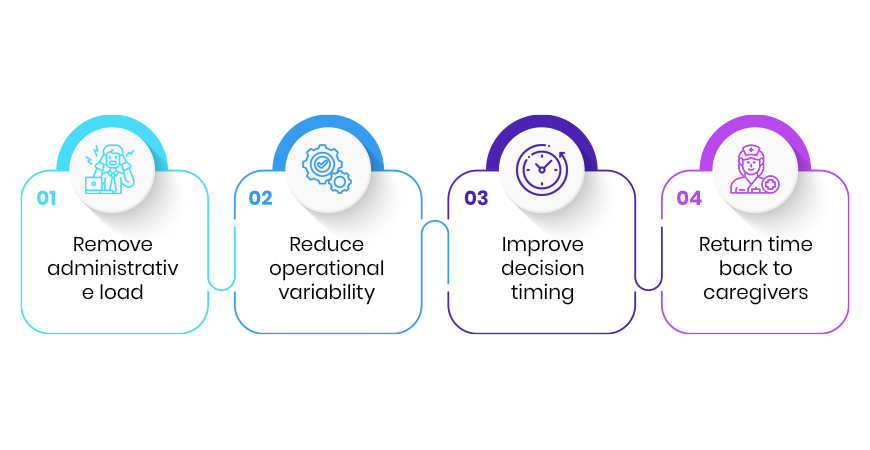
Agentic AI supports this shift by acting as an operational co-pilot, not a replacement for clinical teams. 

The core philosophy is simple:

The Strategic Shift: From Task Automation to Care Operations Intelligence

This is especially important as workforce shortages become structural. 

AI is not replacing human care. It is protecting it. 

High-Impact Agentic AI Use Cases in Home Care 

Home care presents some of the most operationally complex and high-stakes opportunities for agentic AI. The following AI Use Case in Healthcare represent where the impact is clearest and the ROI most measurable. 

Documentation Intelligence and Clinical Time Recovery 

Documentation remains one of the biggest drivers of caregiver fatigue and operational delay. 

Agentic AI can: 

  • Capture visit conversations through ambient listening 
  • Auto-generate structured visit notes 
  • Support coding and compliance checks 
  • Flag missing documentation in real time 

The result is simple but powerful:
More time with patients. Less time finishing paperwork after shifts. 

As one care leader summarized:
“Technology should remove friction, not add another system to manage.” 

Intake, Referral, and Start-of-Care Acceleration 

Start-of-care delays directly impact revenue cycle timing, patient outcomes, and referral relationships. 

Agentic AI can: 

  • Validate insurance eligibility automatically 
  • Initiate prior authorizations 
  • Clean and normalize referral data 
  • Route cases to the right teams instantly 

This reduces: 

  • Manual follow-ups 
  • Lost referrals 
  • Intake backlog risk 

For agencies operating under value-based contracts, faster start-of-care directly improves performance metrics. 

Workforce Optimization and Caregiver Matching 

Workforce strain is no longer episodic. It is structural. 

Agentic AI can support: 

  • Patient-caregiver matching based on skill, location, acuity, and preferences 
  • Smart schedule balancing 
  • Travel optimization 
  • Burnout risk signals based on workload patterns 

This directly impacts: 

  • Staff retention 
  • Care continuity 
  • Visit reliability 
  • Patient satisfaction 

Care Coordination and Medication Safety 

Home care often operates across fragmented systems. 

Agentic AI can unify: 

  • Clinical data 
  • Medication lists 
  • Risk alerts 
  • Care plan updates 

AI-supported medication reconciliation alone can reduce safety risk and save hours of manual reconciliation work weekly.

Governance: Making AI Safe, Trusted, and Clinically Aligned 

AI adoption in home care requires strict governance and clinical control. 

Key principles include: 

Cross-Functional AI Governance 

  • Clinical leadership 
  • Compliance and legal leadership 
  • Technology leadership 
  • Operations leadership 

Human-in-the-Loop Oversight 

AI supports decisions. Clinicians always make final care decisions. 

Data Security and Private AI Environments 

Healthcare AI must operate in protected environments where patient data is never exposed to public model training.

CTA - Is Your AI Deployment Built to Be Trusted?

Partnership Models That Deliver Measurable Outcomes 

The strongest AI partnerships in home care follow shared outcome accountability. 

Best practice includes: 

  • KPI-linked vendor accountability 
  • Measurable operational improvements 
  • Pilot-first validation 
  • Phased deployment 

If a vendor cannot align to measurable outcomes, long-term value risk increases. 

The Next Phase: Predictive and Experience-Led Home Care 

Home care has always been about what happens between visits. The check-ins that didn’t happen. The risk that wasn’t caught. The family that didn’t know what to ask.  

The next phase of intelligent home care is not about doing more. It is about seeing more, earlier, and acting before the moment passes. 

Family Experience Intelligence 

Families don’t read care plans. They read worry into every unanswered question, every missed call, every term they don’t understand. AI changes that equation. 

AI can: 

  • Translate care plans into plain language 
  • Support family education 
  • Provide non-clinical support and reminders 
  • Identify caregiver or family stress signals 

Predictive Risk Intelligence 

By the time a home care patient is hospitalized, the signals were already there. Agentic AI finds them before they become crises. 

Agentic AI can identify: 

  • Hospitalization risk 
  • Fall risk 
  • Care gap patterns 
  • Staffing mismatch signals 

Predictive Modeling in Healthcare shifts home care from reactive response to proactive intervention in care workflows. 

The Inferenz + Agentic AI Model for Home Care 

At Inferenz, the focus is not on deploying AI tools.
It is on building Agentic AI operating layers across home care workflows. 

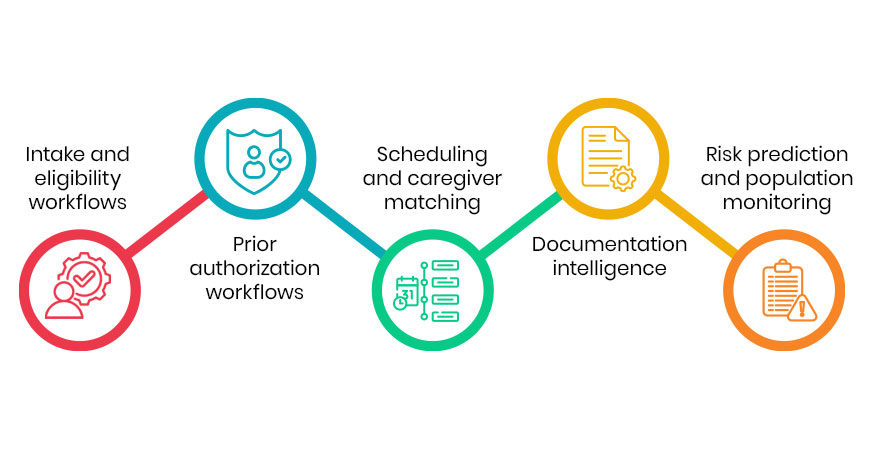
Through platforms like Caregence, organizations can deploy agents across: 

Agentic AI operating layers across home care workflows

The goal is consistent:
Reduce operational noise so care teams can focus on care delivery. 

Conclusion: The Invisible AI Standard in Home Care 

The highest performing AI in home care should feel invisible. 

When it works well: 

  • Caregivers feel supported 
  • Operations feel smoother 
  • Compliance feels easier 
  • Patients experience consistent care 

Agentic AI should work quietly in the background, coordinating care operations while humans focus on compassion, connection, and clinical excellence.

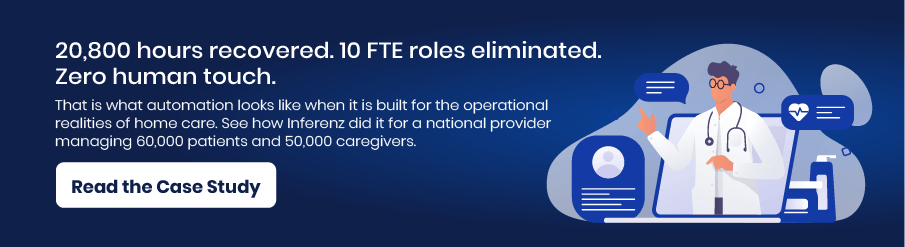
Case Study - Replacing Manual Portal Entry with RPA Automation for a National Home Care Workforce

FAQs 

Q1: What is agentic AI and how is it different from standard healthcare automation?

Standard automation follows fixed rules. Agentic AI perceives context, makes decisions, and acts across multiple systems simultaneously, without waiting for a human to trigger each step. 

Q2: How does agentic AI address workforce shortages in home care without replacing caregivers?

It removes the administrative weight that burns caregivers out. When documentation, scheduling, and intake run automatically, the same team delivers more care with less friction. 

Q3: What does a HIPAA-compliant agentic AI platform actually require?

Patient data must never enter public model training pipelines, audit trails must exist for every AI-assisted decision, and clinical teams must always retain final decision authority. 

Q4: At what stage should a home care organization start deploying agentic AI?

Start narrow: intake processing, eligibility verification, and scheduling. These deliver measurable ROI fastest and build the operational confidence needed before expanding into clinical use cases. 

Q5: How does predictive risk intelligence reduce hospitalizations in home care?

Hospitalization rarely happens suddenly. Predictive models identify the pattern days or weeks earlier, giving care teams enough lead time to intervene before a risk becomes a crisis. 

Q6: How should home care leaders evaluate an AI vendor’s claims about measurable outcomes?

Ask for KPI-linked accountability in the contract, not just the pitch deck. Vendors who deflect that question are telling you something important.