










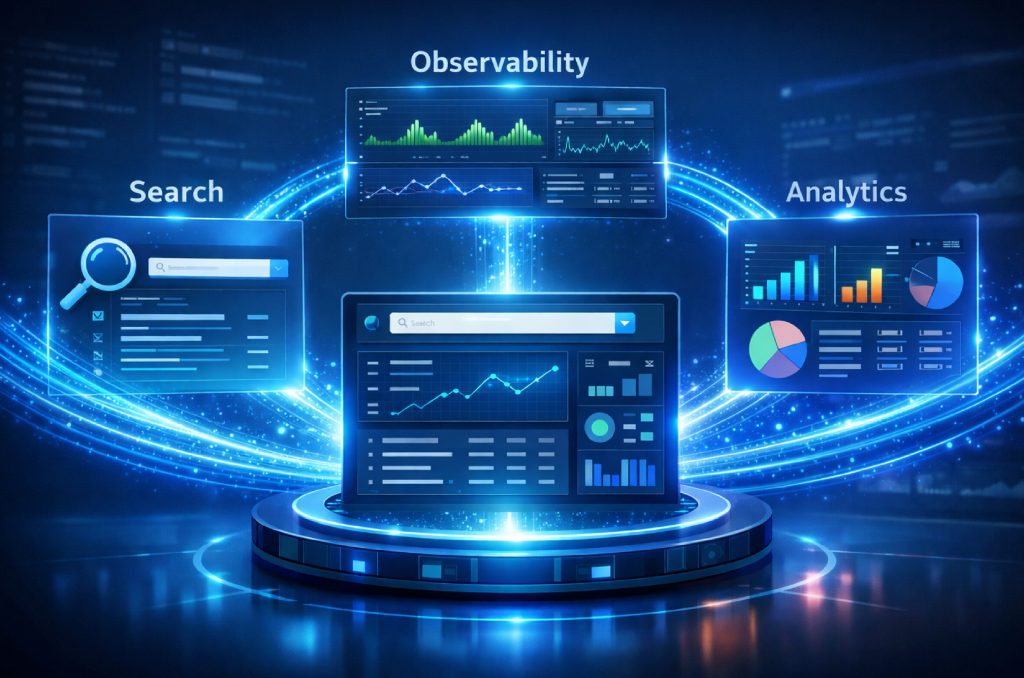
OpenSearch Use Cases: Where Search, Analytics, and Observability Come Together 

Summary 

OpenSearch is a flexible platform used for search, analytics, observability, and security across modern data environments. This article explains how it supports full-text search, log monitoring, threat detection, business analytics, and research use cases at scale. 

Introduction 

OpenSearch is an open-source, distributed search and analytics platform managed by AWS. It supports full-text search, real-time analytics, observability, and security monitoring at scale.  

Across enterprise systems, cloud environments, and research settings, OpenSearch helps teams index, analyze, and act on large volumes of data with speed and flexibility. 

OpenSearch at a Glance 
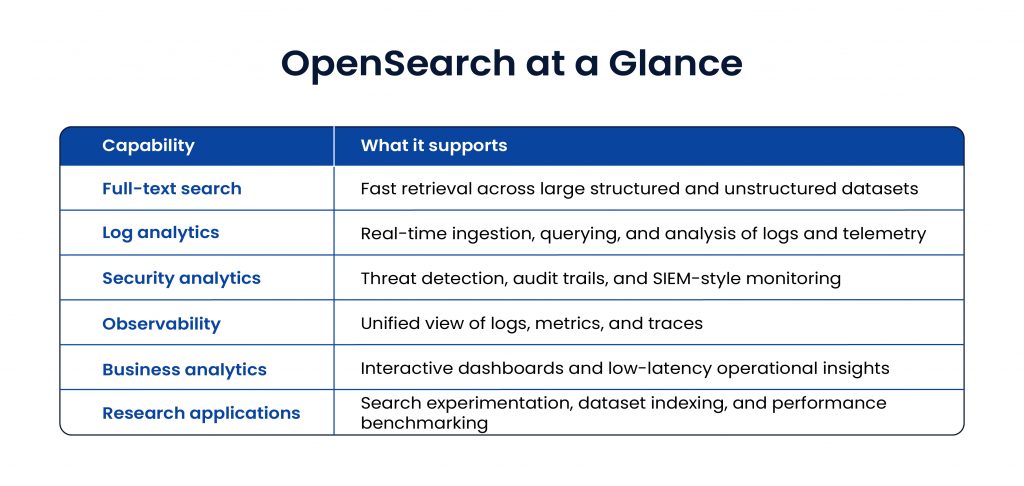
OpenSearch at a Glance

What Is OpenSearch? 

OpenSearch is an open-source, distributed platform built for search, analytics, and observability. Managed by AWS and supported by the open-source community, it was created to offer a transparent and scalable alternative to proprietary search systems. 
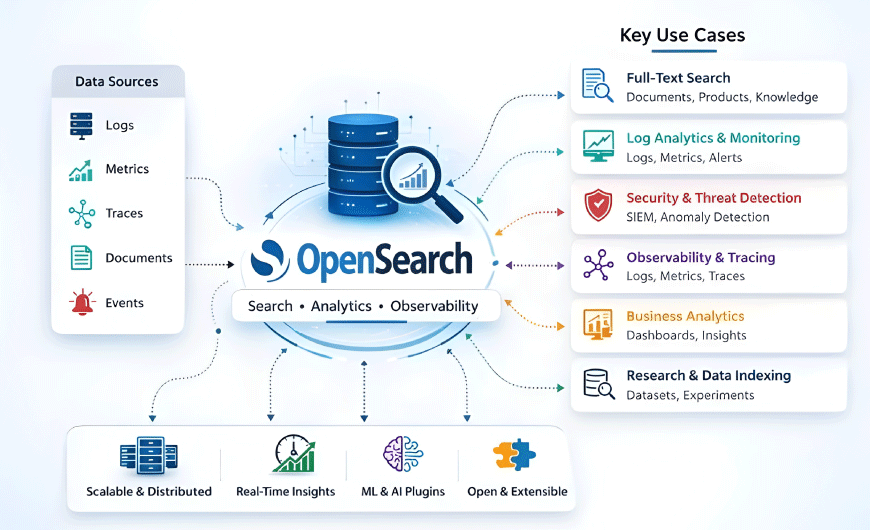
What Is OpenSearch

The platform combines indexing, query processing, machine learning, and visualization within one architecture. Its plugin-based design and compatibility with standard data formats make it suitable for a wide range of environments, from enterprise applications to large cloud-native systems. 

Why OpenSearch Matters? 

Modern systems generate large and varied data streams every second. Businesses need tools that can search documents, monitor infrastructure, detect threats, and analyze operational trends without relying on separate disconnected platforms. 

OpenSearch addresses that need by bringing together several core functions: 

  • Search across large datasets 
  • Real-time analytics on streaming information 
  • Monitoring and observability for distributed systems 
  • Security event analysis and alerting 
  • Flexible deployment for enterprise and research environments 

That makes it useful in both operational and strategic settings. 

Key Use Cases of OpenSearch 

OpenSearch supports far more than basic search. Its architecture makes it useful across monitoring, security, analytics, observability, and research-driven environments where speed, scale, and flexibility matter. 

Full-Text Search and Information Retrieval 

One of the strongest use cases of OpenSearch is high-performance full-text search. It uses inverted indexing and distributed search execution to retrieve results quickly, even across large datasets. Features such as tokenization, language analyzers, and relevance scoring allow teams to build precise and context-aware search experiences. 

This is especially useful in the following scenarios: 

  • Enterprise knowledge repositories 
    Internal documents, support tickets, manuals, and knowledge bases often grow too large for basic search tools. OpenSearch improves findability by supporting semantic relevance and contextual query handling. 
  • E-commerce product search 
    Product catalogs need more than keyword matching. OpenSearch supports filters, facets, ranking logic, and personalization, which helps users find the right products faster. 
  • Digital libraries and academic archives 
    Large document collections demand both speed and accuracy. OpenSearch supports fast corpus exploration while maintaining low response times. 

Another advantage is its extensible query framework. Teams can integrate neural ranking and hybrid search methods that combine keyword and semantic retrieval. 

Log Aggregation and Operational Monitoring 

OpenSearch is widely used for log analytics because it handles time-series data efficiently. Modern applications, cloud services, and distributed systems produce continuous streams of logs that must be collected, stored, and queried in near real time. 

Common uses include: 

  • Centralized ingestion of application, network, and server logs 
  • Performance monitoring through metric analysis 
  • Automated alerting for unusual behavior 
  • Root-cause analysis across distributed environments 

Its built-in anomaly detection capabilities help teams identify unusual patterns before they turn into larger issues. This makes OpenSearch valuable for DevOps teams, SRE functions, and organizations running microservices or cloud-native infrastructure. 
Security Analytics and Threat Detection 

OpenSearch also plays an important role in security operations. It can ingest and analyze events from authentication systems, firewalls, intrusion detection tools, and access control services. By correlating patterns across these data sources, organizations can build strong security monitoring workflows. 

Key applications include: 

  • Detecting abnormal login or access behavior 
  • Identifying possible intrusion attempts 
  • Enriching threat data with intelligence pipelines 
  • Supporting compliance reporting and audit log retention 

Because of this, OpenSearch is often used as the foundation for open SIEM implementations. It gives organizations a more flexible and vendor-neutral way to manage security analytics while reducing dependency on expensive licensing models. 

Observability and Distributed Tracing 

As systems become more distributed, teams need visibility across services, containers, APIs, and infrastructure layers. OpenSearch supports observability by bringing together logs, metrics, and traces in one environment. 

When paired with OpenSearch Dashboards and Trace Analytics, and combined with OpenTelemetry instrumentation, it helps teams: 

  • Trace execution flows across microservices 
  • Analyze latency between service calls 
  • Identify performance bottlenecks 
  • Monitor Kubernetes and container workloads 

This makes OpenSearch a practical choice for teams building resilient cloud platforms. It supports faster troubleshooting and gives engineers a clearer view of system behavior across complex architectures. 

Business Analytics and Decision Intelligence 

OpenSearch is not limited to technical monitoring. It also supports interactive analytics for business teams that need real-time visibility into operations and customer activity. 

Its aggregations engine and fast query performance make it useful for: 

  • Streaming analytics in IoT and industrial systems 
  • Customer behavior analysis on digital platforms 
  • Operational dashboards without complex warehouse dependencies 
  • Low-latency reporting for time-sensitive decisions 

Organizations can use OpenSearch to explore and visualize data without always moving it through heavy, multi-stage analytics pipelines. That gives teams faster access to insights and supports quicker response in operational settings. 

Research and Scientific Computing 

Because OpenSearch is open source and highly configurable, it is increasingly used in research and scientific computing. Academic institutions and technical teams value the ability to test, modify, and benchmark search systems in a reproducible way. 

Typical research applications include: 

  • Indexing large scientific datasets 
  • Managing research corpora 
  • Testing ranking models 
  • Evaluating search relevance methods 
  • Benchmarking distributed query performance at scale 

Its architecture allows researchers to work directly with search behavior and system performance. That creates room for experimentation in information retrieval, distributed systems, and large-scale analytics. 

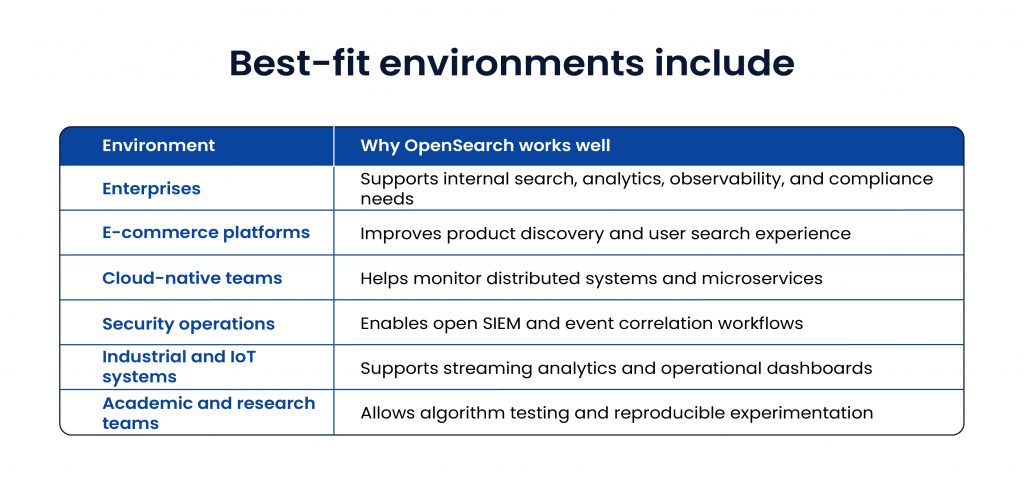
Where OpenSearch Fits Best?

The strength of OpenSearch lies in how broadly it can be applied. It is a strong fit for organizations that need one platform to support several data-heavy functions. 
Core Benefits of OpenSearch 

OpenSearch continues to gain adoption because it offers a practical mix of scale, flexibility, and visibility. 

Key benefits include: 

  • Open-source governance with strong community support 
  • Distributed architecture for high scalability 
  • Extensible plugin ecosystem 
  • Unified support for search, analytics, and observability 
  • Compatibility across varied deployment environments 
  • Lower dependency on proprietary tooling 

These advantages make it relevant for organizations that want both control and performance in their data systems. 
Final Takeaway 

OpenSearch has grown into a flexible platform for much more than search. It supports full-text retrieval, log analytics, security monitoring, observability, business intelligence, and research workloads in one scalable ecosystem. 

For organizations working with growing volumes of operational and business data, OpenSearch offers a clear path to faster search, better visibility, and more responsive analytics. Its broad use across industry and research shows that it remains highly relevant in modern data-driven environments. 
FAQs 

What is OpenSearch mainly used for? 

OpenSearch is mainly used for full-text search, log analytics, observability, security monitoring, and real-time data analysis. It helps organizations search large datasets and monitor systems from a single platform. 

Is OpenSearch good for log analytics? 

Yes, OpenSearch is widely used for log aggregation and log analytics. It can collect, store, query, and visualize logs from servers, applications, and cloud systems in near real time. 

Can OpenSearch be used for observability? 

Yes. OpenSearch supports observability by combining logs, metrics, and traces. With OpenSearch Dashboards and tracing tools, teams can monitor distributed systems and troubleshoot issues faster. 

How does OpenSearch help with security analytics? 

OpenSearch helps security teams analyze events from firewalls, authentication systems, and intrusion detection tools. It supports anomaly detection, event correlation, audit trails, and SIEM-style monitoring. 

Is OpenSearch suitable for e-commerce search? 

Yes, OpenSearch works well for e-commerce search because it supports filtering, faceting, relevance tuning, and personalized product discovery across large catalogs. 

Can OpenSearch be used for business analytics? 

Yes. OpenSearch supports low-latency analytics and interactive dashboards, which makes it useful for operational reporting, customer behavior analysis, and streaming data insights. 

Why do research teams use OpenSearch? 

Research teams use OpenSearch because it is open source, configurable, and suitable for testing ranking models, indexing large datasets, and benchmarking distributed search performance. 

What are the benefits of OpenSearch over proprietary platforms? 

OpenSearch offers open-source flexibility, lower licensing dependency, extensibility through plugins, and strong support for search, analytics, and observability in one system. . 

AWS Vs. Salesforce: 5 Differences Between Cloud Service Providers

AWS vs. Salesforce is a hot debate between the two leading cloud tycoons in the IT sector. Both Salesforce and Amazon Web Services offer comprehensive services to users, including customer interaction management and web development processes. That’s why choosing the best cloud computing platform becomes more challenging. 

While Salesforce’s CRM interaction helps businesses close communication gaps between companies and clients, AWS is the perfect solution that allows business owners to work remotely on the cloud. In this guide, we will reveal the main differences between Salesforce and AWS, along with the advantages and disadvantages of each cloud-based solution. 

What Is AWS?

Amazon Web Services, also known as AWS, is referred to as IaaS (Infrastructure as a Service), SaaS (Software as a Service), and PaaS (Platform as a Service). It has expanded its services across different regions and is offering more than 100 services, including pertinent data, an on-demand directory, and application development. 

AWS, preceded by Azure and GCP, is the leading cloud provider. Earlier on March 23, 2023, AWS expanded its service list by adding AWS clean rooms. The new analytics service helps customers collaborate with their partners without sharing or copying raw data. 

Using AWS services, companies can create clean rooms in minutes. This, in turn, eliminates the need to move data outside AWS or build, manage, or maintain their own solutions. If you want easy collaboration with your partners, choosing AWS could be the ideal choice.

Pros of AWS

Some of the best features of AWS include the following:

  • Reliable: The stable, scalable, and global computing infrastructure acts as the virtual basis of AWS. 
  • Secure: Amazon Web Services ensures that your infrastructure is secured and hardened. 
  • Scalability: AWS is also known for its high scalability and performance. You can increase or decrease the AWS capabilities per your demand. 

Cons of AWS

Learn about the various disadvantages of Amazon Web Services below: 

  • Confused Billing: The billing system of AWS is quite unclear and confusing for users. 
  • Computing Problems: Migrating to the AWS cloud and server downtime is complex for developers and engineers. 
  • Limited to Particular Regions: AWS cloud solutions are limited to specific areas, so resource volumes and storage capacities differ from one region to another. 

What Is Salesforce?

Salesforce is a software as a service that helps businesses boost sales, offer superior customer service, and manage better clients. Nearly 90% of Fortune 500 companies used Salesforce to manage their business relationships in 2022, rising from 83% in 2017. As it can work without the servers or software, you can sign up and start their enterprises. Thus, it is preferred. 

Salesforce recently announced Web3, which helps businesses to create connected customer experiences across Web2 as well as Web3. Brands can create, manage, and deploy NFTs (non-fungible tokens) in a scalable, trusted, and sustainable way. 

Using Salesforce Web3, brands can connect Customer 360 with Web3 Data for a holistic view of customers. If you are a company wanting to leverage the power of blockchain and NFTs, choose the Salesforce CRM platform. 

Pros of Salesforce 

Some of the best advantages of the Salesforce CRM platform include the following: 

  • High Security: Salesforce prioritizes security with its built-in data security safeguards. The privacy laws and security features of Salesforce help you avoid misuse of client information and combat hacker vulnerability. 
  • Flexibility: Salesforce is one of the best cloud platforms that helps customers with flexible data analysis and reporting. 
  • Easy Customization: Salesforce is a CRM tool that features easy scaling and simplifying business operations. 

Cons of Salesforce 

Salesforce CRM is not a fool-proof solution to manage connections and client interactions. A few cons of Salesforce include the following: 

  • High Cost: Salesforce is an expensive solution for startups and small businesses, while AWS pricing is competitive. 
  • Poor Customer Support: Salesforce lacks good customer support, and people find it challenging to implement it. 
  • Complex Configuration: Salesforce installation is complicated compared to AWS, and the initial configuration makes it challenging for employees. 

Choosing anyone between Salesforce vs. AWS depends on the needs of your businesses. Both of them dominate the market. Amazon Web Services is deemed to be excellent in IaaS, while Salesforce dominates in SaaS. Despite the fact that each of them comes with advantages and disadvantages, the two service providers formed a strategic partnership in 2016. 

If you want to choose the best platform between the two, get in touch with Inferenz experts. 

Similarities Between Salesforce And AWS

  • AWS for cloud infrastructure and Salesforce for customer data are both considered global leaders in their respective categories.
  • Salesforce and AWS manage cloud-based operations.
  • Both encourage and promote app deployment strategies.
  • The two cloud computing solution providers offer valuable certifications to the users. 

Differences Between AWS And Salesforce 

In reality, there are certain things you should be aware of when you compare AWS vs. Salesforce. Below are a few differences between the two. 

  • While Amazon Web Services is regarded as one of the best open cloud specialist companies and covers around 40% of the industry. On the other hand, Salesforce is considered to be the most successful CRM. 
  • Salesforce cloud computing is SaaS, whereas Amazon Web Services offers both IaaS and PaaS. 
  • Both Salesforce and AWS offer modest on-demand scaling results. 
  • AWS guarantees 175 fully attributed services from data centers around the world. 
  • The core concept of AWS is that it offers a flexible, reliable, and affordable framework for ongoing operations. 

Briefly said, AWS is a computing stage launched by Amazon and incorporates cloud architecture. Salesforce Inc. is a free company that offers a wide range of abilities and features to increase customer esteem. 

Choose Between Amazon AWS Vs. Salesforce With Inferenz 

As both Salesforce and AWS had advantages and disadvantages, they collaborated in 2019. The two technologies, together, help businesses meet their needs and requirements. With Salesforce, customers can easily organize customer data. On the other hand, AWS helps manage data with proper cloud infrastructure. 

You can choose Salesforce if you need high customization and scalability to make things simple. It is a great marketing team that helps you with lead nurturing, social media integration, marketing data monitoring, sales pipeline monitoring, etc. Alternatively, you can choose AWS if you want to select a cloud solution that offers a pay-as-you-go model. 

If you are still confused between AWS vs. Salesforce, schedule a call with the experts of Inferenz. 

FAQs About Salesforce Vs. AWS

Does Salesforce run on AWS? 

Many Salesforce products work on AWS as they seamlessly collaborate with each other. Whether you are simply using Salesforce CRM applications or leveraging AWS to extend the applications, you can choose their combination to improve business operations. 

Is Salesforce in AWS (Amazon Web Services) or Azure? 

Salesforce utilizes AWS in regions where they don’t have their own data centers. 

Which cloud platform is in high demand: AWS or Azure? 

Amazon Web Services wins the game as it has more cloud market share than other platforms.

A List Of Google Cloud Platform Or GCP Alternatives

GCP alternatives are the common search term as the Google Cloud Platform offers fewer features compared to other cloud platforms like AWS and Azure.  

Many businesses and individuals consider GCP one of the tough contenders in the top cloud storage solutions list. Even though the platform offers reliable services, other platforms like AWS, Azure, IBM Cloud, Alibaba Cloud, etc., are gaining popularity. 

Whether you’re planning to migrate from Google Cloud to other cloud platforms or want to know some top alternatives to GCP, this guide is for you. In this article, we will reveal the top alternatives and competitors to the Google Cloud Platform in 2023. 

What Is Google Cloud Platform? 

Before we discuss the top Google Cloud Platform alternatives in 2023, here is a little about the platform.

Launched in 2008 by Google, GCP is a collection of cloud computing resources. The GCP operates on a similar framework to other Google products, including Gmail, Google Search, and YouTube. Thanks to exclusive features like cloud hosting and management tools, the GCP offers different services, including analytics, security, IoT, storage, etc. Hence, it is one of the main competitors of AWS and Azure. 

The three types of computing environments that GCP supports include: 

  • Serverless computing 
  • Infrastructure as a Service (IaaS) 
  • Platform as a Service (PaaS) 

Some of the leading companies that use Google Cloud services include: 

  • Twitter 
  • PayPal
  • Etsy
  • Blue Apron and King 

Core Features Of Google Cloud Platform 

Some of the best features of GCP include the following: 

Storage 

Business owners always consider understanding the storage when choosing the best cloud platform. In this regard, GCP offers three main products:

  • Cloud Storage: It is one of the most reliable and recommended Google Cloud services. The limitless storage option makes the GCP cloud storage suitable for all business sizes. Global data accessibility, easy data transfer, and 99.99% reliability make cloud storage ideal. 
  • Cloud SQL: GCP also features a MySQL database that helps you manage data with great control. Not only can you connect with the database within a few minutes, but it also offers convenient data migration using DMS. 
  • Cloud Datastore: Some exciting features of using the Cloud Datastore include a fully managed and rich dashboard, ACID transactions, and a multiple-access approach. 

Computing and Hosting 

Google Cloud provides several computing products to the user. The compute engine helps you operate tasks at hand on large virtual machines. As an IaaS platform, it offers easy provisioning, load balancing, and compliance. In addition, the built-in development services of the App Engine improve productivity. 

Big Data 

Google Cloud Platform offers BigQuery to offer speedy answers to complex inquiries. Some critical features of GCP BigQuery include BI Engine, Connected Sheets, and BigQuery ML and GIS. 

AI & Machine Learning 

Google Cloud Platform provides AI infrastructure, Cloud AutoML, and building blocks to deploy AI-oriented projects. 

Best Alternatives To Google Cloud Platform 2023

By 2027, around 50% of enterprises will use industry cloud platforms to improve their business initiatives. Industry cloud platforms enable a shift from generic solutions to platforms designed to fit the specifics of your industry. Below are the comprehensive and broadly adopted cloud platforms considered GCP alternatives. 

Microsoft Azure 

In 2010, Microsoft introduced a cloud computing platform that allows you to quickly build, deploy, and manage applications using Microsoft-managed data centers. It is one of the widely used cloud solutions with a high market share. The core features of Azure include the following: 

  • Data Security: Azure offers multiple security levels to customers. Users can easily customize security features per their requirements. 
  • Analytics: Microsoft Azure helps the admin view all user insights within the company. 
  • Azure Advisor: The advisor of Azure helps companies to utilize resources by analyzing the environment for performance and cost optimization. 

The cost of Azure will entirely depend on the resources you want for your enterprise. 

Update: On March 22, 2023, Azure announced Azure Virtual Network Manager (AVNM). The core purpose of AVNM is to connect, secure, and simplify the network resources in the cloud.

AWS (Amazon Web Services) 

Amazon Web Services, or AWS, is one of the best cloud computing platforms you can consider in 2023. AWS, Azure and GCP are the top three cloud platforms with high cloud market share. Amazon Web Services is a cloud hosting company that provides cloud computing services and APIs. It is an excellent alternative to Google Cloud Platform as it charges according to the pay-as-you-go model. 

  • AWS Advisor: The feature of AWS inspects the environment to maximize the utilization of resources, optimize application performance, and save money. 
  • Physical Security: Amazon holds years of experience in managing data. It is physically secured to eliminate unauthorized access to servers. 
  • Scalability: AWS is a highly scalable and flexible cloud solution available on the market. That means you only have to pay for the resources and services that you are using. 

Alibaba Cloud 

Alibaba Cloud is a well-known Chinese cloud computing company, also known as Aliyun. Flexible and scalable technology is widely preferred in the eCommerce sector. 

  • Cloud Security: Alibaba Cloud provides extra protection and security from various attacks. Some features include Web App Firewall, Anti-DDoS, Cloud Firewall, and more. 
  • Database Backup: Alibaba Cloud, the leading cloud service provider, helps you recover data during data loss or disaster. 
  • Networking Services: Alibaba’s networking service offers a high-speed and highly stable network with flexible cloud connections. 

DigitalOcean

One of the best Google cloud Platform alternatives is DigitalOcean. The best part about DigitalOcean is the low-price quote, which is 26% cheaper than Azure and 28% less than AWS. 

  • Easy to Learn: Most cloud-based platforms are very complex. However, that’s not the case with Digital Ocean. It is an easy-to-learn and straightforward platform that helps developers to deploy and manage cloud applications. 
  • Storage: You can store and access any data size by using DigitalOcean. 
  • Compute: Using the scalable compute products by Digital Ocean, you can quickly build and release applications on the cloud. 

Snowflake 

Snowflake is one of the top alternatives to GCP in 2023 that offers high-end security and cloud services. Back in 2022, Snowflake Data Cloud company announced a new Cybersecurity workload. The new feature enables organizations to better protect their enterprise data from cyberattacks. 

Customers can natively handle semi-structured, structured, and unstructured logs of high-volume data. Besides threat detection and protection, Snowflake’s cybersecurity workload offers other use cases like cloud security, vulnerability management, security compliance, and more. 

👉 Related: 5 Best Practices For Snowflake Implementation 

The choice of the right cloud platform for developers with advanced platform security capabilities will depend on the specific requirements of the company. If you want to choose the best cloud computing platform, feel free to get in touch with the Inferenz experts. 

Pick The Best GCP Alternatives In 2023 

With an intuitive interface, flexible compute options, and preemptible instances, GCP is the latest cloud technology and an attractive alternative to other solutions. Even though Google Cloud owns a good share of the cloud market, many people want to choose a feature-rich alternative. 

If you are still unsure about which is the best GCP alternative, you can contact Inferenz experts. Our expert professionals will help you find a customized cloud-based platform that can stand the test of time. Schedule a call with Inferenz experts and choose the right GCP alternatives which are tailored to your needs.

AI In Customer Service: How To Use The Power Of AI In Business

AI in customer service is changing how companies offer support to their consumers. Thanks to advanced technology, businesses can provide quick solutions to customer queries. In today’s highly competitive era, exceptional customer service is one of the important ways to stand head and shoulders above the competition. 

For a company, meeting customer demands is of utmost importance. However, the ever-evolving customer demands make it hard for businesses to streamline customer communications. That’s why many companies are switching to AI-powered customer service chatbots. 

In this AI guide, we reveal everything related to artificial intelligence tools and how AI helps businesses. 

What Is Artificial Intelligence In Business?

Servion Global Solution predicts that artificial intelligence will power around 95% of all consumer interactions by 2025, including online conversations and live telephones. Before we reveal the key benefits and examples of AI to improve customer experience, let us clear the basics. 

Artificial Intelligence is the smart solution powered and demonstrated by machines and computers. The primary aim of AI applications is to reduce human labor and speed up the process. 

Many companies are incorporating natural language processing (NLP) and machine learning (ML) to solve customer issues without involving humans. 

Key Benefits Of AI For Customer Support 

AI is revolutionizing customer experience by assisting companies with administrative tasks and answering customer questions. Below are a few main benefits of using AI in customer service. 

Lower Customer Handling Time 

Before artificial intelligence technology, businesses had a hard time handling customer queries. The only solution was to scale up the number of human agents to meet the demands of increased customer traffic. Companies can integrate AI bots to answer common queries and solve simple issues. 

Deliver Proactive Support 

As artificial intelligence is getting more advanced, the customer management team is using the tech to identify patterns in customer inquiries. With AI, you can provide proactive support whenever a customer faces an issue. 

Predict Future Trends 

Especially in the beauty and fashion industry, brands are implementing AI to predict future trends. Advanced technology also helps brands understand the style of fashion to attract customers. 

Reduce Unnecessary Expenses 

Many tech giants are using AI to reduce customer service costs by nearly 80%. When businesses provide an automated way or chatbot assistance to customers, they can eliminate endless waiting for customers and improve customer interactions. 

Product and Service Personalization

Back in 2017, eBay introduced an AI chatbot – ShopBot – to help shoppers save time and money. From deal hunting to product discovery, eBay chatbot can do everything for the customers. It acts like a virtual assistant, helping shoppers find relevant items without wasting their precious time. 

According to International Data Corporation, AI is expected to cross the $36.8 billion market by 2025. Leveraging the power of AI technology, customers can get immediate, self-service, and on-demand assistance. AI solutions offer personalized support via voice assistants like Siri or Alexa and live chats. 

Handle Large Datasets 

Many businesses often find it hard to manage large datasets. Using AI in customer service, business owners can handle large volumes of data and build a more efficient, productive, and cost-effective environment. 

Saves Time 

Artificial Intelligence systems can handle small tasks independently, helping in-house employees to focus on high-priority jobs. Integrating AI can free up employee time, helping them solve complex problems that require human intelligence. 

Many brands are focusing on adopting artificial intelligence tools to strengthen their brand reputation, boost sales, and revamp customer journeys. If you want to improve customer service or boost sales with AI, consider integrating advanced technology. You can even create a chatbot using ChatGPT API with a few simple steps or contact professionals. 

Examples Of AI In Customer Service 

In customer service, AI is generally associated with chatbots to offer diverse customer support. Here we have compiled a list of examples of AI in customer service. 

Chatbots

AI is changing the way businesses offer online customer support using chatbots. A chatbot is computer software that mimics human conversations over chats. It is available 24/7 to answer questions in real-time. When chatbots provide correct information for customer questions, it improves brand reputation.

Back in 2021, Walmart (a retail chain operator) acquired the design tool Botmock to help shoppers shop for products via chat and voice. Cheryl Ainoa, SVP of New Business & Emerging Tech at Walmart Global Tech, said that Botmock’s technology would help them create more ways to serve customers, speed time to market, and lower costs.

Self Service 

Another best example of artificial intelligence in customer service is self-service powered by AI. The latest technology helps customers solve problems, navigate the website, or complete purchases without human agents. Thus, it offers a sense of independence to buyers. 

Natural Language Processing 

NLP is one of the most valuable tools to streamline the customer experience. It can be deployed in emails, voice requests, chatbots, phone calls, and anywhere you want people to say or write something. It helps companies analyze data quickly, leading to fewer expenses and more savings. 

AI Training 

Not only do AI tools offer superior customer service, but it also enhances seamless collaboration between employees. Human account managers and other employees can benefit from ongoing AI training to further develop their skills. 

Machine Learning 

Machine Learning, or ML, has become an indispensable part of practically every corporate development. It’s an essential mechanism that helps in data analysis. Human agents can derive valuable insights from the stored data to predict common questions and offer satisfactory answers. 

Support teams are now using the latest technology to automate ticket creation, ticket tagging, etc. The combination of machine learning and natural-level processing can automate email replies and improve self-service. If you want to integrate the tool into your business, contact Inferenz artificial intelligence experts. 

Key Takeaways – Use AI To Improve Customer Service In 2023

AI in customer service is more than a buzzword with a wide range of use cases. From answering customer questions and queries to analyzing data, AI has diverse applications. Hence, there is no doubt that AI is here to stay in customer service. It’s a revolutionary, practical, and low initial investment solution for businesses. 

All in all, using artificial intelligence is becoming a gold standard for businesses, and it’s high time you should focus on adopting it. Whether you’re a healthcare brand wanting to adopt AI or a business owner, feel free to get in touch with Inferenz experts. Our experts will help you understand how to use AI in customer service to improve your brand reputation. 

Customer Service AI FAQs

How does AI improve customer service? 

Thanks to AI tools, time-consuming and challenging processes have become faster and more straightforward. In addition, AI can help customers with relevant products, answering all queries, etc., to improve their overall experience. 

How to use AI technology in business? 

Some common uses of AI are to reduce fraud risk, deliver personalized marketing schemes, and streamline shopping experiences. 

How can AI improve customer satisfaction? 

AI can analyze data to extract behavioral patterns. This, in turn, helps businesses create customer personas and help them with personalized recommendations, leading to improved customer satisfaction.

ChatGPT Vs. Copilot: Comparison Between GitHub Copilot And ChatGPT

The ChatGPT vs. Copilot battle is creating headlines, and the reason is quite simple — the two AI tools are on the verge of revolutionizing the world. 

While both of them can assist us in simplifying work, like writing code faster, they are designed for different purposes. 

In this ChatGPT and GitHub Copilot article, we will dive deep into the features, use cases, and abilities of both AI platforms. 

What Is Chat GPT? 

ChatGPT is a powerful language model developed by OpenAI. The creators of ChatGPT have trained the tool on a vast amount of data to help users get quick answers. 

Launched a few months back in 2022, ChatGPT can help in text generation and various natural language processing tasks, such as suggesting code snippets and answering questions, to name a few. 

How Does It Work? 

As the name defines, ChatGPT is a chat-based AI tool. You have to write a detailed prompt, and it generates a text in response. 

You can ask anything from the chatbot, and it replies quickly. However, it’s worth noting that it has data until 2021. 

If you ask ChatGPT about what happened in 2022 and 2023, it won’t be able to provide accurate answers. Fortunately, there are many free and paid ChatGPT alternatives that can help you bypass the limitations of the OpenAI’s chatbot. 

Use Cases Of ChatGPT

Some specific use cases of the ChatGPT include: 

  • Text summarization
  • Chatbot to generate human-like responses 
  • Writing code 
  • Language Translation 

What Is GitHub Copilot? 

GitHub Copilot is an AI code completion tool that uses artificial intelligence to suggest lines of code during writing. Many developers are turning to GitHub Copilot, a ChatGPT-like tool, to write codes. 

The recent news by Microsoft indicates that Copilot features will be available in the company’s business apps, like Excel, PowerPoint, and Word.

Jaime Teevan, a technical fellow and chief scientist at Microsoft, said: “Copilot passed several privacy checks and has “mitigations in place.” She further added, “We are going to make mistakes. But when we do, we will address them quickly.” 

How GitHub Copilot Works? 

GitHub Copilot uses ML (Machine Learning) to understand code context and suggest lines of code for code completion. 

It’s best to use the tool in a project beginning to generate functions, variable names, as well as algorithms according to programming style. 

Copilot is an AI pair programmer who learns from the code you write over time and gets better at its job. 

Use Cases Of Copilot 

Copilot is like an AI assistant that improves code writing efficiency and helps you to save time. Some specific use cases include: 

  • Autocomplete code suggestions to write code faster
  • Intelligent function and variable suggestions 
GitHub Introduces Copilot X — More Efficient AI-Programmer 

GitHub’s Copilot is already helping developers write 55% faster codes, but the company is leveling up the AI game by introducing GitHub Copilot X. 

According to GitHub, the Copilot X is the future of AI-powered software development. Not only will it adapt OpenAI’s new GPT-4 model, but it will also include chat and voice for Copilot. 

Though the GitHub Copilot X was introduced on March 22, 2023, it is currently unavailable as a product. However, you can join the waitlist to preview the upcoming features in GitHub Copilot X. 

Differences Between ChatGPT Vs. Copilot 

Both Copilot and ChatGPT are AI-powered tools that have their own benefits, but the former is preferred for coding purposes. The only difference between the two tools is that Copilot is for coders, while ChatGPT is designed explicitly for chatbot applications. 

  • Copilot has an easy-to-use user interface for coding, while ChatGPT lags behind. 
  • ChatGPT can produce long-form articles and codes, while Copilot is not suitable for creating fantastic content. 

Copilot helps you create code faster and more efficiently. On the contrary, ChatGPT serves as an AI assistant that offers optimized solutions and suggestions for code refactoring. All in all, coders can use Copilot, which uses the OpenAI Codex, for code proposing and completing functions in real-time. 

GitHub Copilot Vs. ChatGPT – Who Wins The AI War 

The ChatGPT vs. Copilot debate is not going to end anytime soon. ChatGPT has an advantage over Copilot since it offers more detailed information on a topic. On the other hand, GitHub can code efficiently, making it the first choice of programmers. The integration of Copilot with other Microsoft business apps will be a game-changer for enterprises.

However, the right choice ultimately depends on what your needs are. It would be interesting to see how these AI tools impact different industries in 2023 and beyond. If you are looking to understand more about ChatGPT vs. Copilot or choose the best AI tool for your enterprise, contact Inferenz experts today!

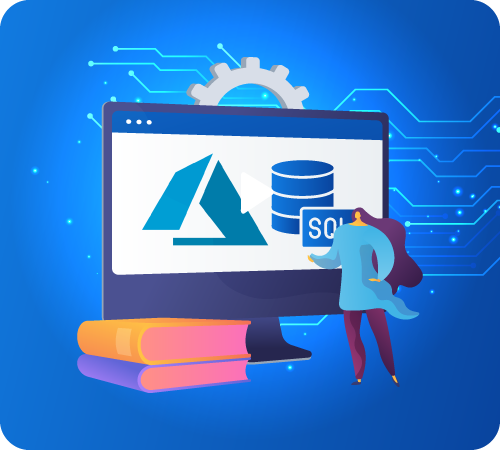
Microsoft Azure SQL Database Tutorial For Beginners: Step-By-Step Guide

Azure SQL database tutorial for beginners will help you understand step by step process of creating a database, architecture, and much more. 

In today’s fast-paced digital era, choosing a cloud solution for data management is vital for businesses. Many enterprises have already adopted modern cloud-based data management solutions. Azure SQL DB is a fully managed cloud database relation solution best known for its high scalability and reliability. 

This Azure SQL database tutorial for beginners will discuss how you can get started with Azure SQL Database. 

What Is Microsoft Azure SQL Database?

Microsoft Azure SQL Database, in simple words, is a reliable and secure relational database as a service. It gives you high performance without you having to worry about the infrastructure. Generally, the Azure service supports JSON, XML, relational, and spatial data structures. 

Another essential thing to understand is that Microsoft has its own on-premise SQL Server and Azure SQL Server. Even though both are slightly different, Azure SQL is preferred due to its high protection. It supports two types of authentication: 

  • SQL authentication 
  • Azure Active Directory authentication 

Advanced threat protection helps quickly detect any anomaly in accessing or using the database. Once the data is stored in the Microsoft SQL Azure database, you can rest assured that all your information is secured. Azure Data Factory is a cloud-based integration platform that allows you to create cloud-based data-driven workflows. 

SQL Database In Azure Architecture

Now let us understand the architecture of a fully managed cloud database service. The architecture has four main layers: client, service, platform, and infrastructure. 

Client Layer 

The layer acts as an interface for an application that helps you access SQL databases. It mainly includes Hypertext Preprocessor (PHP), SQL Server tools, Open Database Connectivity (ODBC), and ADO.NET. 

Tabular Data Stream helps communicate with applications and transfer data between applications and SQL databases. Hence, ADO.NET and ODBC can easily connect to SQL without high demands. 

Service Layer 

The service layer is a doorway between the platform and the client layers. The main uses of the layer include provisioning, billing, diagram, and routing connections. 

The layer works by validating the requests and authenticating the user. In addition, it establishes a connection between the client and the server and routes packets through this connection. 

Platform Layer 

The layer contains data nodes that host the actual Azure SQL server in the data center. You can store each SQL database in one of the nodes. 

The modern database ensures that multiple server copies are kept within Azure Cloud. Furthermore, the layer also ensures that copies are synchronized when clients manipulate data. 

Infrastructure Layer 

The first layer from the bottom of the architecture is responsible for OS and physical hardware administration. 

Steps To Create Azure SQL Database Tutorial 

Let us now understand the steps to create a single database with the help of the Azure SQL database tutorial. 

  • Go to the Azure portal and then sign in to your Azure account. 
  • Click on the search bar and enter “Azure SQL.”
  • On the Azure SQL screen, click on “+ Add.”
  • Click on the “Create Azure SQL resource,” which will redirect you to the “Select SQL deployment option.” 
  • Go to Create SQL Database and select basics. Tap on Azure subscription. 
  • Under the resource group, click on “create new” and type a resource group name. Click OK. 
  • Enter the database details and database name (yourdatabase). 
  • Click on the “Create new” button beneath the server. A pop-up screen will appear where you’ll need to choose the server name and provide credentials. Choose the location and click OK. 
  • Under “Compute + Storage” for data configuration, choose “Configure database.” 
  • Select the “Standard database” on the configure page and click “Apply.”
  • At the top of the page, select “Next: Networking” and choose “connectivity method.”
  • Head to the Additional settings tab located in the data source section. For “Use existing data,” click on Sample and “Review + Create.” Here you can see the pricing model per month in your currency. Tap on Create to proceed. 

That’s it! You can Go to Resource to view information about your database, such as name, status, and pricing models. 

Note: For Querying

You need a built-in Query editor for querying the database. To proceed, you can connect to the database and access the data in the preview result view. Type the query, select “Run,” and then it will show you the result. 

These steps will help you create the database using the Azure portal. Remember, there are multiple methods to create an SQL database. Here we have illustrated how to create databases with the portal. If you’re still confused about how to create a new database, contact Inferenz experts today! 

Scale Your Business With SQL Azure Database

Azure and AWS are the top two cloud platforms to choose from in 2023. Creating an Azure SQL database is a straightforward process and only takes a few minutes. Following the Azure SQL database tutorial, you can have your new database up and running in no time. Remember, it’s vital to delete the resources once you’re finished with them for cost savings. 

Head to the Azure portal and check out the list of resource groups. There you’ll find the “Delete resource group” button at the top. Type the resources you wish to delete and click on the delete button. The pay-as-you-go pricing model makes Azure SQL highly demanding and ideal for enterprise usage. 

To know more about the Azure SQL Database tutorial for beginners, contact the data experts of Inferenz! 

FAQs

What is Azure SQL Database? 

Azure SQL database is a PaaS (platform as a Service) database engine. It can handle most of the database management functions, including but not limited to patching, backups, upgrading, and monitoring without user involvement. 

What are the different types of Microsoft SQL Azure? 

Different Azure SQL databases include fully managed relational, in-memory, and NoSQL databases. 

What is the difference between Azure SQL and SQL Server?

As the two of them share similar qualities, it becomes hard to choose one between the two. Azure SQL uses a tabular data stream (TDS) protocol. On the contrary, SQL Server uses TCP/IP protocol for communication. For those worried about data being vulnerable in the cloud, Azure SQL is the ideal solution.

Expert Predictions: Top Data Analytics Trends

Data analytics trends are constantly evolving. With the new technological advancements, data analytics is expected to continue its upward trajectory in 2023. In the era where business is growing rapidly, data collection and analysis have become more critical for companies to stay ahead in the competitive market. 

Some key trends in today’s data-driven and accelerating market include data science, artificial intelligence, and big data analytics. In this data analytics interview series, we will dive deep into the latest data analytics trends and scope in 2023. Experts will reveal the key component of data analytics in the future, i.e., real-time data visualization and skills required to be successful data analysts.

Expert Insights: Future Trends, Skills & Tools for Data Analysts

The global big data analytics market is expected to grow significantly over the coming years. The data analytics market’s forecasted market value will reach 650 billion dollars by 2029. The rise in data analytics solutions is the rapid digitalization observed across healthcare, retail, manufacturing, and other industries. With that in mind, businesses must focus on data preparation, data exploration, and data storage using the best self-service data analytics software. 

In order to help business owners and data analysts understand the trends, the Inferenz team has conducted an interview with Ms. Aparna Varma. Being a Microsoft Certified Technology Specialist, she has hands-on experience in technologies, including Business Intelligence, Business Analysis, and Artificial Intelligence. 

Internal Team: Hello, Ms. Aparna. We hope you are doing well, and thank you for being a part of our interview series. 

Ms. Aparna: It is my pleasure. 

Internal Team: So, Ms. Aparna, before we understand the skills, tools, and trends of data analytics, could you please let our readers understand the future scope of data in 2023? Will data continue to be a revolutionary and world-changing tool for businesses? 

Ms. Aparna: In 2023, the scope of data is expected to continue growing rapidly in both volume and complexity. The following are some of the key trends that will shape the future of data in 2023:

  • Increased adoption of artificial intelligence (AI) and machine learning (ML) techniques: Organizations will continue to invest in AI and ML technologies to better analyze and extract insights from large and complex datasets.
  • Greater use of real-time data: Businesses will rely more heavily on real-time data to make faster and more accurate decisions, particularly in areas such as customer service, logistics, and supply chain management.
  • Greater emphasis on data security and privacy: With the high volume of data being generated and shared, there will be a growing need for robust data security and privacy measures to protect sensitive information.
  • More extensive use of Internet of Things (IoT) devices: The number of IoT devices in use will continue to grow rapidly, generating huge amounts of data that will need to be analyzed and acted upon in real-time.
  • Greater use of data visualization and storytelling: As data becomes more complex, businesses will need to find new ways to make sense of it and communicate insights effectively to non-technical stakeholders.

Overall, the future scope of data in 2023 will be characterized by a growing need for advanced analytics and visualization tools, greater emphasis on data security and privacy, and increased adoption of real-time and IoT-generated data.

Internal Team: Thank you for helping us understand the future of data in 2023. But, as you said, data visualization will be used more. Could you please tell us how real-time data visualization will impact the future of data analytics?

Ms. Aparna: Real-time data visualization will have a significant impact on the future of data analytics by enabling businesses to make faster, more informed decisions based on real-time insights. With real-time data visualization, businesses will be able to monitor as well as analyze key performance indicators (KPIs) in near real-time, allowing them to quickly identify trends, patterns, and anomalies. This will enable businesses to take proactive measures to improve performance, reduce costs, and increase revenue.

Additionally, real-time data visualization will make it easier for businesses to share data and insights across different departments and teams. This will enable businesses to make better use of the information they collect, as well as improve collaboration and communication between different teams.

Furthermore, real-time data visualization will also enable businesses to make better use of big data. With the ability to process and visualize massive data in real time, businesses will be able to gain in-depth insights and make more accurate predictions. This will help them to identify new opportunities and make better decisions.

Overall, real-time data visualization will play a crucial role in the future of data analytics by making it easier for businesses to make better use of the data they collect, make faster and more informed decisions, and gain deeper insights into their operations.

Customer experience is the bottom line when it comes to decision-making. When customers are waiting in backed-up queues and support agents are struggling to stay afloat, having access to the most recent and relevant data can help you make decisions that make this better for agents and customers alike.

Real-time analytics are crucial to a modern support strategy. This looks like a live feed of all the necessary and important information on your dashboard or can be broadcast to support agents so they can see where to allocate their time. In real-time, you can visualize spikes in calls, changing queues, and which channels need support.

As increasing amounts of data are generated, collected, and stored in data centers around the world, It’s more important than ever that you can quickly analyze and understand what the data is telling you so you can make informed decisions. Real-time data visualization takes visuals to the next level by letting you update charts and graphs in real-time. Having real-time data available helps stakeholders to make better decisions that are based on actual data rather than on intuition.

Advanced analytics tools able to visualize real-time data and historical data can immediately highlight critical conditions so that users can immediately spot and alert teams to intervene at an optimal time.

Internal Team: As the need for data analysis and visualization is increasing for businesses, chances are there will be a rise in data analyst jobs too. According to you, what skills should one have to be an expert data analyst? 

Ms. Aparna: Sure, here are a few important skills: 

  • Strong mathematical and statistical skills: A data analyst should have a solid understanding of mathematical concepts such as probability, statistics, and linear algebra.
  • Programming skills: Data analysts should be proficient in programming languages such as R, Python, and SQL.
  • Data visualization skills: The ability to present data clearly and concisely using tools such as Tableau, Power BI, and Excel is crucial for a data analyst.
  • Machine learning and artificial intelligence skills: With the increasing use of machine learning in data analysis, a data analyst should have knowledge of these technologies and how to apply them to solve real-world problems.
  • Strong problem-solving skills: A data analyst should be able to analyze complex data sets to identify patterns and trends.
  • Communicating effectively: A data analyst should be able to communicate their findings and recommendations to non-technical stakeholders in a clear and concise manner.
  • Attention to detail: A data analyst should have a keen eye for detail to spot errors and inconsistencies in data.
  • Creativity and curiosity: Data analysts should be curious and creative in their approach to problem-solving and be open to new ideas and approaches.

Internal Team: Besides skills, they need tools to work with small data sets and complex datasets. So, what are the top tools that aspiring data analysts should learn?

Ms. Aparna: 

  • Excel: Excel is spreadsheet software that is commonly used for data analysis. It allows users to organize, manipulate, and visualize data easily.
  • R or Python: R and Python are popular programming languages used for data analysis. They offer a wide range of tools and libraries for data manipulation, statistical analysis, and machine learning.
  • SQL: Structured Query Language or SQL is used for managing and querying relational databases. Aspiring data analysts should learn how to use SQL to extract and manipulate data from databases.
  • Tableau or Power BI: Tableau and Power BI are data visualization tools that allow users to create interactive and visually appealing charts and graphs.
  • Git: It is a version control system that allows users to track changes in their code and collaborate with others. It is an essential tool for data analysts who work on projects with multiple contributors.
  • Jupyter Notebook: It is an open-source web application for users to create and share documents that contain live code, equations, visualizations, and narrative text.
  • SAS: SAS (Statistical Analysis System) is a software suite that provides a wide range of tools for data management, statistical analysis, and data visualization.
  • Machine Learning libraries: Aspiring data analysts should learn how to use machine learning libraries such as Scikit-Learn, TensorFlow, and Keras to build predictive models and analyze data.

Internal Team: What can experts predict about data analysts’ trends for 2023?

Ms. Aparna:

  • Increased use of artificial intelligence and machine learning: As these technologies are advancing, data analysts will increasingly use them to automate data cleaning, analysis, and prediction.
  • Greater focus on data privacy and security: With increasing concerns about data breaches and cyber-attacks, data analysts will need to pay more attention to ensuring that sensitive data is protected and secure.
  • More emphasis on data visualization: With the growing volume of data, data analysts will need to develop more sophisticated ways of visualizing and communicating data insights to stakeholders.
  • Greater use of cloud computing: Data analysts will increasingly rely on cloud-based tools and platforms for storing, processing, and analyzing massive data sets.
  • Increased use of natural language processing: Data analysts will use natural language processing to extract insights from unstructured data sources like social media and customer feedback.
  • More focus on real-time data analysis: With the growing need for real-time decision-making, data analysts will need to develop the skills and tools to analyze and interpret data in near real time.
  • Greater collaboration between data analysts and business teams: As data becomes more central to business operations, data analysts will need to work more closely with business teams to understand their needs and goals and to provide actionable insights.

Internal Team: Thank you, Ms. Aparna, for helping our readers understand the key data analytics trends, skills, and tools. 

Manage Real-Time Data With Inferenz Experts 

As the data analytics industry transforms with new inventions, businesses must maintain data quality and utilize data to improve their operations. Predictive analytics enables organizations and business users to use the common data stored to predict future trends. Additionally, understanding the latest trends in data analytics can help organizations with better security and data privacy capabilities. 

Now that you know the future trends in data analytics, it’s time to use analytics for mission-critical data to leverage the power of data storage. If you are confused about how to future-proof your business using real-world data, it is best to contact the data analytics leaders of Inferenz. Our experts can help you analyze data and prepare businesses by understanding data analytics trends. 

Quick Recap: Data Analytics Trends For 2023

In today’s market trend, data is one of the driving forces for organizations. Many enterprises have already adopted data-driven analytics models to streamline in-house business operations. The inclination towards data analytics will help businesses embrace the fact-based decision-making process. 

  • In 2023, there will be increased adoption of technologies like machine learning and artificial intelligence for better data analysis. 
  • Real-time data visualization will enable businesses to leverage effective data and make more informed decisions. 
  • As data analytics helps businesses in multiple ways, we can expect a rise in jobs in this sector. 

As more data trends emerge in 2023, businesses need to identify, experiment, and invest in future technologies. Feel free to contact Inferenz experts if you want to dive deep into the key data analytics trends and how they will impact the future.

Top Data Engineering Tools: Experts Share Their Secrets

Data engineering tools have become increasingly crucial for organizations to manage and analyze large data sets. With 2023 well underway, it’s important to look at the tools recommended by industry experts to ensure that your data operations are efficient and effective. 

The data-driven businesses are hiring engineers to leverage the power of data. Data engineers are responsible for building data pipelines required for infrastructure designs. The best data engineering tools combine programming languages and data warehouses to collect and analyze large data sets. 

Whether you’re a business planning to incorporate data engineering tools or an aspiring engineer, you have come to the right place. In this data engineering interview series, we will help you learn how businesses and engineers can prepare for the future with the right tools. 

Expert Predictions About Top Data Engineering Tools 

The global big data market is predicted to reach US 103 billion dollars by 2027, more than double its expected market size in 2018. That is why businesses seek solutions and tools to utilize big data to improve their internal business operations. 

Before we talk to the experts, let us understand what data engineering is. 

Data engineering is the process that involves extracting, transforming, and loading data into a data lake or data warehouse. Using engineering and analytical tools primarily aims to solve business problems using big data. 

To help our readers understand the future of data engineering and the tools involved in analysis, the Inferenz Tech team conducted an interview with Ms. Aparna Varma. She holds years of experience as Microsoft Certified Technology Specialist and will shed light on hidden facts about data engineering in this interview. 

Internal Team: Hello, Ms. Aparna. Thank you for your valuable time. 

Ms. Aparna: It is my pleasure to be here. 

Internal Team: So, Ms. Aparna, data engineers today are confused about choosing the right data engineering tool and programming language. Many experts prefer Python as it is highly flexible and easy to use. According to you, should data engineers learn only Python?

Ms. Aparna: Data engineers should not limit themselves to learning only Python. While Python is a widely used programming language in data engineering and is commonly used in data science and machine learning, there are other programming languages that are also useful for data integration, such as SQL, Java, and Scala. It is beneficial for data engineers to be familiar with multiple programming languages, as different tools and technologies may require different languages. Additionally, learning multiple languages can broaden a data engineer’s understanding of different programming concepts and paradigms, making them more versatile and adaptable in their field.

Internal Team: We agree with you. Data engineers must learn different skills and tools to stay ahead of the competition. So, according to you, which data engineering tools will be leveraged by businesses in 2023 and why?

Ms. Aparna: It is likely that businesses in 2023 will continue to leverage a variety of data engineering tools in order to effectively manage and analyze their data. Some of the most commonly used data tools include:

  • Apache Hadoop: Hadoop is an open-source framework that allows businesses to store and process large amounts of data on commodity hardware. It is widely used for big data processing and is likely to continue to be a popular choice in 2023.
  • Apache Spark: Spark is a fast, general-purpose cluster-computing framework that can be used for data processing, machine learning, and graph processing. It is known for its speed and ability to handle large data sets, making it a valuable tool for businesses in 2023.
  • Apache Kafka: It is a distributed streaming platform that can be used for data integration and real-time data processing. It is a popular choice for businesses that need to process data in real time and is likely to continue to be widely used in 2023.
  • Apache Airflow: Airflow is a platform for programmatically authoring, scheduling, and monitoring workflows. It is commonly used for data pipeline management and is likely to be a popular choice for businesses in 2023.
  • TensorFlow: It is an open-source machine learning library that can be used for various tasks, including natural language processing, image recognition, and predictive modeling. It is likely to continue to be a popular choice for businesses in 2023 as machine learning becomes increasingly important for businesses.

These tools are likely to be leveraged by businesses in 2023 as they provide the necessary infrastructure and functionality to handle large amounts of data, process it in real-time, and perform advanced analytics. Additionally, the open-source nature of these tools makes them more accessible and cost-effective for businesses of all sizes.

Internal Team: Thank you for sharing the best data engineering tools suitable for small and large enterprises. However, many data engineers use the three most common tools to extract from multiple data sources: PyTorch, TensorFlow, and Keras. According to you, which tool is the expert recommendation and why?

Ms. Aparna: Sure. It ultimately depends on the specific use case and the individual’s expertise. However, in general, experts recommend the following:

  • PyTorch: It is recommended for researchers and developers who prefer a more dynamic and flexible framework. PyTorch allows for easy experimentation and has a more intuitive API compared to TensorFlow. Additionally, it has built-in support for CUDA and can easily run on GPUs.
  • TensorFlow: It is recommended for developers and researchers who are looking for a more production-ready framework. TensorFlow has a more robust ecosystem and is better suited for deploying models in production environments. Additionally, it has a wide range of tools and libraries for monitoring and debugging models.
  • Keras: It is recommended for beginners and developers who are looking for a simple and easy-to-use framework for building deep learning models. Keras provides a high-level abstraction for building models and is built on top of TensorFlow or PyTorch. It allows for rapid prototyping and is great for quickly building and testing models.

Ultimately, the choice of the best framework depends on the specific use case and the individual’s expertise. It is recommended to try out multiple frameworks and see which one works best for a given task.

Internal Team: Many engineers and experts say that Python data engineering tools will grow in 2023 and beyond. What is your take on it? What do you think about the growth of Python data engineering tools?

Ms. Aparna: Experts predict that Python data engineering tools will continue to grow in popularity and usage due to their ability to handle large amounts of data and perform complex data analysis tasks. Python is a versatile programming language widely used in data science and machine learning, and its libraries and frameworks for data engineering, such as Pandas, Numpy, and Dask, are well-established and widely adopted. 

Additionally, the growth of big data and cloud computing has increased the demand for data engineers who can work with large datasets and distributed systems, which Python is well-suited for. Overall, experts believe that Python will continue to be a key tool in data engineering and will see continued growth in the field.

Internal Team: So, here is the last question. Could you please share your thoughts on SQL? Is SQL and database knowledge enough to be a successful data engineer in 2023?

Ms. Aparna: SQL and database knowledge are important skills for a data engineer, but they are not the only skills needed to be successful in 2023. Other important skills for a data engineer include:

  • Programming skills: Data engineers often work with multiple programming languages like Python, Java, and R to extract, transform, and load data into databases.
  • Data warehousing: Understanding data warehousing concepts and technologies, such as data marts and data lakes, is important for data engineers to be able to design and implement data pipelines.
  • Cloud computing: More and more companies are moving their data infrastructure to the cloud, so knowledge of cloud platforms like Amazon Web Services (AWS), Google Cloud Platform (GCP), or Microsoft Azure is important for data engineers.
  • Data modeling and data governance: Data engineers need to have an understanding of data modeling and data governance to ensure that data is accurate, consistent, and accessible for analysis.
  • Big data technologies: As the volume and variety of data continue to grow, data engineers will need to have knowledge of big data technologies such as Hadoop, Spark, and Kafka to handle large-scale data processing.

Overall, while SQL and database knowledge are important skills for data engineers, they will need to have a broad set of skills to be successful in 2023.

Internal Team: Thank you for sharing your knowledge with our readers, Ms. Aparna. We hope you’ve had a wonderful time here. 

Leverage The Power Of Data Engineering Tools In 2023 

As you see, data engineering tools play an important role in managing large amounts of data. Ms. Aparna has shared some of the best data engineering tools that help in data storage, data transformation, and data management. In addition, the right data integration tool allows data engineers to analyze data and build a robust, responsive data analytics infrastructure. 

If you plan to choose the best data engineering tools to analyze and manage massive amounts of data, contact Inferenz experts. The data analysts and engineers team will help you use the maximum power of stored data and solve business problems. 

Quick Recap: Data Engineering Tools For 2023

Using specialized tools, data engineers build data pipelines and produce business intelligence/data visualization reports. The primary role of BI tools in the modern data stack is to make data-informed decisions and improve operational efficiency. 

  • Instead of learning only the Python programming language, data engineers should focus on upskilling and learning tools like SQL, Java, and Scala. 
  • Some of the top data engineering tools for businesses in 2023 include Apache Hadoop, Apache Spark, Apache Kafka, Apache Airflow, PyTorch, and TensorFlow. However, businesses should focus on understanding their business goals and choosing the tools that align with their needs. 
  • Experts predict that Python data tools like Pandas, Numpy, and Dask will keep growing in 2023. Python data tools are versatile as they can handle large amounts of cloud-based data. 
  • Aspiring data scientists and engineers should have programming skills, data warehousing, cloud computing, big data technologies, data modeling, data governance, SQL, and database knowledge. 

We hope this interview series will help you understand the tools for data engineers. If you’re still confused about choosing data engineering tools to manage cloud data from multiple sources, contact Inferenz experts.

Top 10 Applications Of Data Science

Applications of data science are constantly expanding, and in 2023, there are several exciting areas where data science is expected to make a significant impact.

With the help of data science, enterprises can now predict outcomes in minutes from complex data without human labor. Faster computers and cheaper storage have made tasks easier for enterprises. In general, data science or data-driven science combines several aspects of computation and statistics to transform data into actionable insights. 

Data science collects large amounts of data, analyzes it, generates prescriptive, and uses it to make decisions. Some technical disciplines include statistics, data mining, data analytics, machine learning, and programming. In this guide, we reveal the lifecycle and the top 10 data science applications in various domains.

What Is Data Science & Its Lifecycle? 

According to recent research, the data science industry is predicted to reach USD 378.7 billion by 2030, at a CAGR of 16.43%. Data science techniques are evolving, and they involve gathering actionable insights from raw data to make business decisions. It uses complex machine learning and data science algorithms to build predictive models. The data used for data analytics comes from multiple sources and is presented in various formats. 

Now that you understand the basics of data science, let us learn about the various stages of data science. 

  • Capture: The stage involves gathering raw, unstructured, and structured data. 
  • Maintain: It involves gathering the raw data and converting it into a usable form. 
  • Process: In this stage, data scientists use the stored data to perform data mining, data clustering, data modeling, and data summarization. It takes the prepared data to examine specific patterns. 
  • Analyze: The most crucial step in the data science lifecycle is analysis. Here data analysis takes place with techniques like qualitative analysis, regression, text mining, etc. 
  • Communicate: In the final step of the data science lifecycle, data analysts prepare analyses in readable formats like graphs, reports, and charts. 

To understand more about how to obtain valuable results from stored business data, feel free to contact Inferenz. 

Top 10 Applications Of Data Science 

Data science is used in various fields, including travel, marketing, healthcare, social media, and automation. Below we have rounded up some applications of data science in the real world. 

Healthcare 

Technologies like data science are impacting the healthcare sector. Medical professionals use data science to make decisions and improve patient care. In addition, data science plays a vital role in drug development, image recognition in medicine, virtual assistants, genetics, and health bots. AI-based basic healthcare bots provide basic information to patients via smartphones. 

Fraud & Risk Detection 

Banks and financial institutions use data science to identify fraudulent activities. Finance collects a lot of data during loan sanctioning. Using data science, experts can understand the financial abilities of customers and determine the associated risks after loan sanctioning. 

Genetics and Genomics

Data science applications are helping researchers in the field of genetics and genomics. The goal here is to find the connection between genetic diseases and medicine. Acquiring reliable personal genome data allows doctors to improve individual care with personalized medicine. 

Virtual Assistance for Customers 

Mobile applications powered by AI in the business help customers get quick basic support. Based on the gathered data, AI chatbots help customers get information using their smartphones. This data science application is used to help patients get immediate care at home. 

Internet Search 

One of the top data science applications is Google’s Internet search. Search engines like Bing, Yahoo, AOL, Ask, and so on make use of data science algorithms to help users get the best result in a fraction of a second. Google, for example, processes more than 20 petabytes of data every day using data science to help searchers get quick results based on their queries. 

Website Recommendations 

Websites like Amazon help users find similar products from billions of products available, all thanks to data science. Internet giants like Google, Netflix, LinkedIn, Google Play, and IMDb use data science to improve user experience and improve user engagement.

Speech Recognition 

Some of the best speech recognition products that use data science include Google Voice, Cortana, Siri, etc. With the help of a speech recognition feature, you can simply speak out the message instead of typing it. 

Gaming 

With the advent of the latest technologies like machine learning algorithms, the gaming industry is revolutionizing. Motion gaming is improving and upgrading to a high level. Some gaming platforms that use data science to take gaming to the next level include Sony, Zynga, EA Sports, etc. 

Augmented Reality 

Data science and virtual reality are closely related to each other. A VR headset contains algorithms, computing knowledge, and data to provide an exciting viewing experience to the users. One of the best examples where AR and data science come together is Pokemon Go. In the game, data science is used to determine the locations of the Pokemon on walls and make gaming interactive.

Customer Insights 

Enterprises use data science to gather information about customer’s behavior, demographics, aspirations, interests, and more. Every time a customer visits the website, reads an email, adds an item to their shopping cart, etc., you can collect data using the latest technology. You can create promotional strategies that help you connect with your targeted audience and drive sales. 

Integrate Data Science Tools In Your Business 

Many industries are using diverse data science applications to improve their in-house business operations. Marketing departments employ various data applications to obtain critical insights and determine which products sell better. However, to utilize big data to the fullest, you’ll need to evaluate data sources, drive insights, and create forecasts using cutting-edge tech. 

If you plan to integrate data science tools in your business, contact Inferenz data scientist. Our expert data scientists will help you sense your business needs, markets, and customers. Get in touch with Inferenz to understand the applications of data science, machine learning, deep learning, etc., in detail.

FAQs

What is the goal of data science? 

Data science helps find meaningful insights from data using various technologies and techniques. 

Are business intelligence and data science the same? 

Business intelligence and data science both deal with analyzing data. However, they are different. Business intelligence mainly deals with structured data, while data science involves both structured and unstructured data. 

What does a data scientist do? 

Data scientists employ data science techniques to analyze large amounts of data and transform data to extract meaning from it.

Benefits Of Cloud Storage Every Business Should Know

The benefits of cloud storage for businesses cannot be ignored in 2023. The advancements in technology helped enterprises to store their data in the cloud. However, it is important to understand about the cloud service and the provider in detail before migrating. In cloud computing storage solutions, the user stores the data somewhere at a remote location rather than saving data at physical or local storage. 

Like traditional data storage solutions, cloud data storage options have certain advantages and disadvantages. In this article, we will explore the main benefits of choosing cloud storage providers like AWS, Azure, or GCP. 

How Cloud Storage Services & Cloud Computing Work?

Before understanding the advantages and disadvantages of cloud storage services, let’s quickly go over how cloud computing works when you use cloud storage. 

  • When you upload a file to cloud storage services, it automatically gets saved on a remote computer known as a server. 
  • Users can access the servers using the Internet from anywhere in the world. 

That said, all the files in the cloud are no longer tied to the device. Therefore, you can access your data from any device, anywhere and anytime. 

8 Benefits Of Cloud Storage Service

Below are the cloud storage advantages that enterprises can expect when they store data in the cloud service. 

Share File Easily 

One of the main advantages of cloud storage is an easy file-sharing option. If all the files are already in the cloud, you don’t have to upload them to a file transfer service. Instead of sending an email or using a file transfer service, you can click on the “share” icon in the cloud. You will get a link to the file that can be quickly sent to the recipient. 

Update Or Sync Files Remotely

Cloud storage far outweighs traditional solutions as it helps you update or sync your files with any device you want. The synchronization feature allows you to access data from any part of the world. However, it’s essential to keep your credentials handy, so you can log in to your subscribed storage device and make changes. 

Highly Scalable & Flexible 

Many enterprises prefer using a cloud storage solution as it is highly scalable and flexible. If you feel the current storage plan is insufficient, you can upgrade the storage service plan as your business grows. The best part about the scalability is you don’t have to move data from one location to another. Once you upgrade the space, the extra space will be automatically added to the data storage environment. 

Disaster Recovery 

Cloud storage is the best platform for disaster recovery data. With cloud data backup storage, businesses can access a backup storage plan to store all data copies. You can easily retrieve the data from the backup data plan in case of data loss. 

Automation 

Cloud storage services have gained popularity in recent years, as they work like a hard disk on the system and offer multiple benefits. For instance, anyone who wants to store a particular file in the cloud can easily do it without tempering the ongoing tasks. As the solution is automated and fully managed by cloud provider vendors, multiple users can use the service without tempering anyone’s tasks. 

Cost-Efficient

Different cloud storage options available make the solution extremely cost-effective. When small businesses use the cloud storage service, they outsource the data storage solution. This helps them reduce internal expenses and transfer all the tasks to the cloud storage vendor. 

Security & Privacy 

As the cloud computing solution is associated with the Internet, it’s vital to understand the safety concerns. Generally, cloud storage saves information across redundant servers. This is because if one data center collapses, all the data will be managed by the other data center. According to RapidScale, 94% of enterprises reported that they have improved their security after switching to the cloud. Hence, you can rest assured that your data is protected if you choose better data security and privacy fields of the cloud. 

Usability & Accessibility 

Another main benefit of cloud storage is its easy-to-use interface. The best examples of cloud storage platforms are iDrive from Apple and Google drive from Google. The simple interface helps you to easily upload the file without any technical knowledge. Besides its easy-to-use nature, you can access it from anywhere with an Internet connection. 

Cloud storage is one of the best options for storing critical business information. However, it’s vital to contact cloud experts before migrating data from on-premise to cloud storage. Also, analyzing the different prices and features of each cloud vendor is crucial to saving money. If you’re confused about which cloud vendor is the right option for your business needs, feel free to contact the experts of Inferenz. 

Disadvantages Of Cloud Storage

Now that you know the benefits, it’s time to discuss the disadvantages of cloud storage services. 

Drag and Drop

Sometimes the drag and drop can quickly move your data from one location to another. To eliminate this issue, data experts recommend using a copy-and-paste method. 

Costs 

Many best cloud service providers are expensive, as they have better features suitable for business needs. Fortunately, many cloud storage service providers, AWS and Azure, have cost-effective plans for every business. 

Internet Connection is a Must 

The Internet plays a vital role while uploading, storing, or accessing data on the cloud. Even though you can sync and access your files when you’re offline, accessing the entire storage system requires a connection. 

Switch to Cloud-Based Storage Service In 2023

It’s 2023, and data is the next power weapon for all small and big businesses. In the last decade, many companies have adopted cloud storage solutions to keep their data secure and easily accessible. Many big tech companies are investing in the cloud industry as it holds the potential to change how businesses function. 

If you’re planning to try cloud storage, you can choose between the two best vendors – AWS and Azure. Both of them have unique features that keep the business data secure. If you want expert help understanding the benefits of cloud storage specific to your business needs, contact Inferenz experts. 

FAQs 

What is cloud storage? 

In simple words, cloud storage is a computer data storage solution in which digital data is stored on servers, usually in an off-site location. 

What are the main types of cloud storage? 

The main types of cloud storage include file storage, object storage, and block storage. On the other hand, the main types of cloud computing services include public clouds, private clouds, hybrid clouds, and multi-clouds. 

Is cloud storage better than physical storage? 

Yes. Cloud storage offers scalability, cost savings, and the ability to access data from the cloud anywhere. Conversely, in traditional computing, you’ll need to purchase and manage software, hardware, and other related services, which makes it expensive and difficult to scale.