Home Health Quality Reporting in 2027: HH QRP Deadlines, HHVBP, OASIS, and HHCAHPS

Quick Summary

ItemWhat CMS finalized for CY 2027
RuleCY 2027 Home Health PPS final rule (CMS-1844-F), 91 FR 72022, November 9, 2026
OASIS deadlineSubmit assessments and make corrections by the 15th day of the second month after each calendar quarter, beginning with the CY 2027 HH QRP
Weekend or holidayDeadline moves to 11:59 p.m. EST on the next business day
Reporting windowsCalendar-year windows for OASIS and HHCAHPS, with a transition year for the 2028 APU
PenaltyAgencies that miss quality reporting receive a 0.1% update in 2027 instead of 2.1%
HHVBPNo model-specific changes; CY 2027 is the fifth performance year; payment adjustment up to 5% either way
ReconsiderationNotices go through the CMS-designated data submission system; 30 calendar days from the notice date
MeasuresNo advance care planning measure finalized; CMS only reviewed comments on a request for information

Introduction

Starting with the 2027 program year, home health agencies must submit and correct OASIS data by the 15th day of the second month after each quarter, about 45 days instead of 4.5 months. CMS says the change cuts the public reporting lag by up to three months, so patients and referring physicians see current quality data sooner.

This checklist-style guide is part of our full explainer on the CY 2027 home health rule (CMS-1844-F). It covers HH QRP deadlines, reporting windows, HHVBP and HHCAHPS, with a task list at the end.

What is the Home Health Quality Reporting Program?

The Home Health Quality Reporting Program (HH QRP) is the Medicare pay-for-reporting program that cuts an agency’s annual payment update by 2 percentage points when required quality data is missing.

For 2027 the final payment update is 2.1%. An agency that misses the requirements gets 0.1%, according to the final rule. OASIS assessments and the HHCAHPS survey supply most of the data.

What changed in the OASIS submission deadline for 2027?

CMS replaced the roughly 4.5-month OASIS submission and correction window with a deadline of the 15th day of the second month after each calendar quarter.

RequirementBeforeBeginning with the CY 2027 HH QRP
Submission and correction windowAbout 4.5 months after the reporting quarter15th day of the second month after the quarter
Public reporting lagLongerShorter by up to three months, per CMS
Phase-in or extension processNot applicableNone; exceptions only for extraordinary circumstances

CMS finalized the deadline as proposed and declined a phased approach. It reports that 99.27% of OASIS assessments already reach CMS within 45 days, and its press release says about 98% of agencies submit within that window.

When are the 2027 OASIS deadlines by quarter?

The 2027 OASIS deadlines fall on May 17, August 16 and November 15, 2027, and February 15, 2028, once the weekend rule applies.

QuarterReporting period15th of second monthDeadline after weekend rule
Q1 2027January 1 to March 31, 2027May 15, 2027 (Saturday)May 17, 2027
Q2 2027April 1 to June 30, 2027August 15, 2027 (Sunday)August 16, 2027
Q3 2027July 1 to September 30, 2027November 15, 2027 (Monday)November 15, 2027
Q4 2027October 1 to December 31, 2027February 15, 2028 (Tuesday)February 15, 2028

We applied the rule’s next-business-day provision to the calendar. Set your internal lock dates ahead of these, and check CMS’s published deadline table when it posts.

How do the OASIS and HHCAHPS reporting periods change?

OASIS and HHCAHPS reporting for the annual payment update moves to a calendar-year period, with a transition year for the 2028 APU.

APU yearOASIS data windowHHCAHPS data windowNote
2028 APUJuly 1 to December 31, 2026 (six months)April 1 to December 31, 2026 (nine months)Transition period
2029 APUJanuary 1 to December 31, 2027January 1 to December 31, 2027First full calendar-year cycle

The calendar-year reporting period takes effect January 1, 2027. Data collected in 2027 therefore drives the 2029 APU.

What happens if an agency misses a QRP requirement?

An agency that misses a QRP requirement receives the reduced 0.1% payment update for the affected year.

CMS also changed how it tells agencies. It now sends noncompliance notices and final reconsideration decisions through the CMS-designated data submission system, which replaces the letter mailed by the U.S. Postal Service. The 30-calendar-day reconsideration window runs from the date on the notice. Commenters worried about relying on one portal, and CMS said it will keep multiple outreach channels.

Assign a named person to watch that system. A notice that sits unread uses up days of the 30.

What is HHVBP, and did the 2027 rule change it?

The expanded Home Health Value-Based Purchasing (HHVBP) Model adjusts Medicare payments by up to 5% up or down based on an agency’s quality performance against peers, and CMS made no model-specific changes in the CY 2027 final rule.

CY 2027 is the fifth performance year. In the CY 2026 performance year, larger-volume agencies carry weights of 40% for OASIS-based measures, 40% for claims-based measures and 20% for HHCAHPS measures, per the CMS model FAQ. Smaller-volume agencies split 50% and 50% between OASIS and claims. An agency needs at least five measures with enough data to receive a score.

FeatureHH QRPExpanded HHVBP Model
MechanismPay-for-reportingPay-for-performance
Financial effect2-point cut to the annual update when data is missingPayment adjustment up to 5% up or down
What it measuresWhether required data was submitted on timePerformance on OASIS, claims and HHCAHPS measures relative to peers
CY 2027 rule changesNew OASIS deadline and calendar-year reporting windowsNone specific to the model
TimingReporting windows tied to the APU yearPerformance in one year affects payment two years later

CMS did summarize ideas for aligning the QRP and HHVBP, such as shared measure emphasis on expected functional outcomes. It finalized no alignment policy in this rule.

How do OASIS accuracy and HHVBP scores connect?

OASIS accuracy connects to HHVBP because OASIS-based measures carry 40% of the total performance score for larger-volume agencies in the CY 2026 performance year.

The same assessment answers also set the functional impairment level that places each patient in a PDGM payment group. One inaccurate response can therefore touch quality scores and payment grouping together. Our guide to LUPA thresholds and functional levels in 2027 shows how that grouping flows into visit thresholds.

See how OASIS scoring reaches LUPA thresholds

What does the HHCAHPS change mean for survey operations?

The HHCAHPS change means survey data collection now lines up with the calendar year, and the 2028 APU uses a nine-month transition window from April 1 to December 31, 2026.

HHCAHPS measures carry 20% of the HHVBP score for larger-volume agencies in the CY 2026 performance year, and a measure needs at least 40 completed surveys per reporting period to count. Ask your survey vendor to confirm that its submission calendar matches the new windows and that sample counts support the 40-survey minimum.

What is the compliance checklist for 2027?

The 2027 compliance checklist covers six recurring tasks, each with an owner and a rhythm.

TaskOwnerFrequencyReference
Build the quarterly deadline calendar with weekend adjustmentsComplianceOnce, December 2026Deadline table above
Set an internal OASIS lock date ahead of each CMS deadlineClinical operationsEach quarter15th day of second month
Run an OASIS correction review before the lock dateQA leadEach quarterSubmission and correction rule
Review submission validation reportsQA leadWeeklyHH QRP compliance
Confirm HHCAHPS vendor calendar and sample countsQuality directorEach quarterCalendar-year window
Name the contact who monitors the data submission system for QRP noticesComplianceOnce, then review yearly30-day reconsideration window
Compare HHVBP reports with your internal quality dashboardQuality directorEach report releaseInterim and annual performance reports

How can data unification and AI agents support OASIS quality and HHVBP tracking?

Inferenz connects an agency’s EHR, scheduling, documentation and claims data into one system, and the Caregence platform lets agency teams build custom agents on that data, including agents that pre-populate OASIS fields and check them before sign-off.

An OASIS pre-population and QA agent can draft fields from visit documentation and flag missing or conflicting answers for the clinician. The clinician still reviews and signs. A separate dashboard can track HHVBP measures against the reporting calendar, so quarter-end deadlines stop depending on manual exports.

These agents connect to existing systems through MCP tools. See the home health page for how Inferenz supports OASIS accuracy and HHVBP performance tracking.

Explore OASIS accuracy and HHVBP tracking

Frequently Asked Questions

Medicare Enrollment and Program Integrity in the 2027 Home Health Rule: What Agencies Must Document Now

Quick Summary

ItemWhat the final rule does
RuleCY 2027 Home Health PPS final rule (CMS-1844-F), 91 FR 72022, November 9, 2026
ReachMost enrollment provisions apply to all Medicare provider and supplier types, not only home health
Retroactive revocationAll revocation grounds can take effect back to the date noncompliance began
New or expanded groundsHigh-risk geographic concentration; certain misdemeanor convictions tied to sexual assault or financial misconduct; license or program suspensions involving owners and managing employees
Majority ownershipHHAs, hospices and DMEPOS suppliers must reenroll as new providers and complete a survey or accreditation after certain majority ownership changes
Claims window after revocationShortened to 15 days
MoratoriaNationwide moratoria on new HHA and hospice enrollment began May 13, 2026; CMS announced a six-month extension on November 12, 2026
CMS savings estimateAbout $82 million a year

Introduction

CMS finalized Medicare enrollment changes that let it revoke an agency’s enrollment back to the date noncompliance began. For patients, a revoked agency can mean interrupted care and transfers. For referring physicians, it means confirming that partner agencies keep ownership, licensing and managing-employee records current.

This briefing is part of our full explainer on the CY 2027 home health rule (CMS-1844-F). It summarizes the enrollment and program integrity provisions and lists the records agencies should be able to produce.

Not legal advice. This article is general information. Enrollment and revocation outcomes depend on specific facts. Ask qualified healthcare regulatory counsel to review your ownership, licensing and enrollment history before you act.

What did the 2027 final rule change about Medicare enrollment?

CMS used the CY 2027 home health payment rule to finalize broad Medicare enrollment changes that apply across provider and supplier types.

CMS Administrator Dr. Mehmet Oz said the agency is acting to “ensure Medicare works with legitimate, qualified providers.” CMS estimates the changes save about $82 million a year, according to its press release. The provisions most relevant to home health are retroactive revocation, new denial and revocation grounds, majority ownership changes, owner and managing employee rules, and a shorter claims window.

What does retroactive revocation mean for a home health agency?

Retroactive revocation means CMS can make an enrollment revocation effective on the date the agency’s noncompliance began, which lets CMS recover payments made after that date.

TopicBefore the final ruleFinal rule
Revocation effective dateSome grounds took effect 30 days after notice; others applied retroactivelyAll grounds can apply retroactively to the date noncompliance began
Payments in the gap periodExposure depended on the groundPayments after the noncompliance date can become ineligible
Program or license suspension groundsApplied to the providerExtend to owners, managing employees and managing organizations
Claims window after revocationLonger window under 42 CFR 424.535(h)15 days

CMS says it will weigh the facts and circumstances of each case and preserve beneficiary access to care. The CMS fact sheet describes the change as making all revocation grounds retroactive.

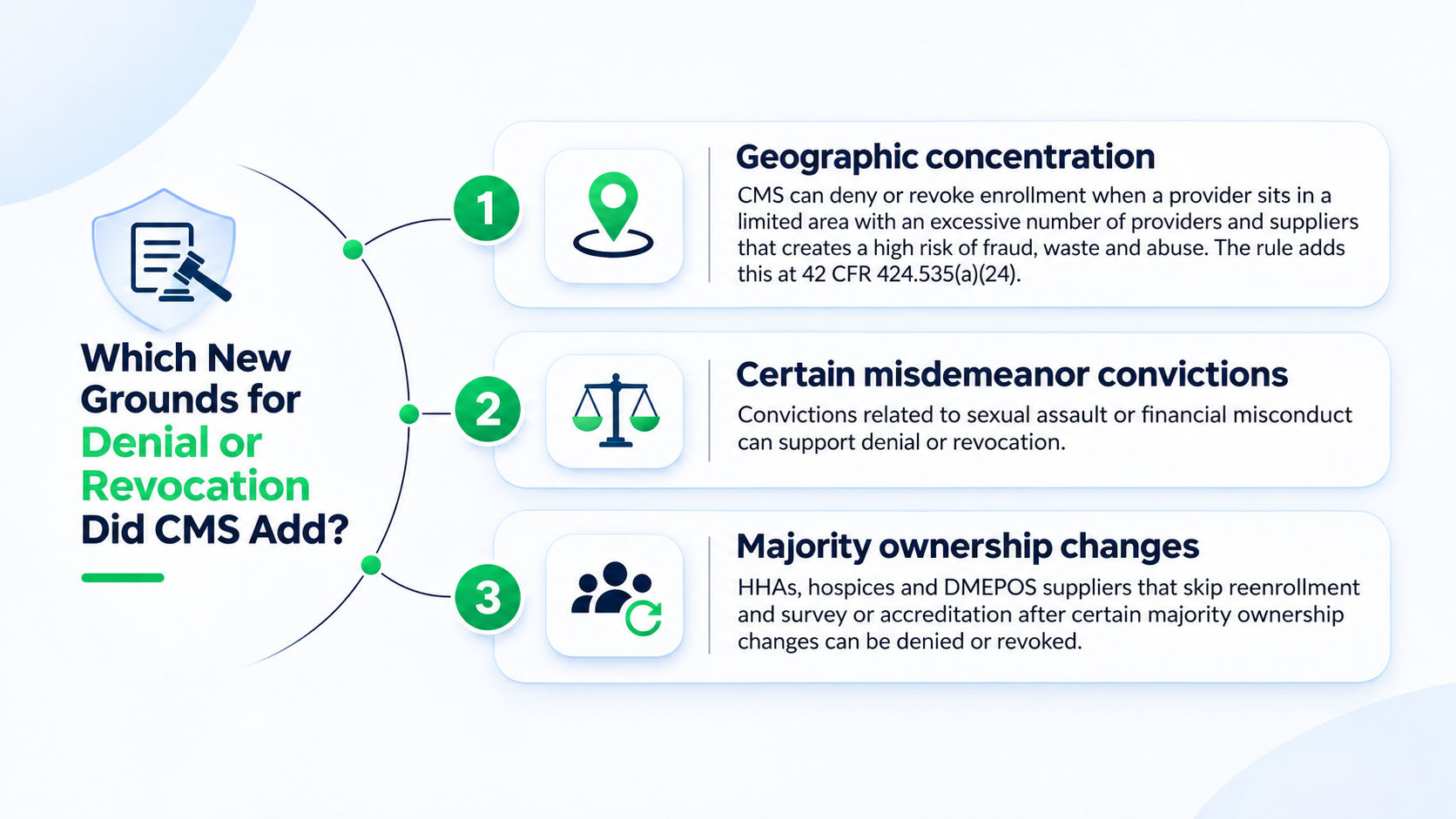
Which new grounds for denial or revocation did CMS add?

Which new grounds for denial or revocation did CMS add?

CMS added several denial and revocation grounds and expanded existing ones, and three stand out for home health agencies.

  • Geographic concentration. CMS can deny or revoke enrollment when a provider sits in a limited area with an excessive number of providers and suppliers that creates a high risk of fraud, waste and abuse. The rule adds this at 42 CFR 424.535(a)(24).
  • Certain misdemeanor convictions. Convictions related to sexual assault or financial misconduct can support denial or revocation.
  • Majority ownership changes. HHAs, hospices and DMEPOS suppliers that skip reenrollment and survey or accreditation after certain majority ownership changes can be denied or revoked.

How do owner and managing employee rules reach an agency?

CMS can now deny or revoke an agency’s enrollment when its owners, managing employees or managing organizations face certain license suspensions or revocations, or suspensions from Medicaid or other federal health care programs.

Before the final rule, those grounds looked at the provider itself. The managing employee definition was finalized without modification. It reaches people who exercise operational or managerial control over day-to-day operations, whether or not they are W-2 employees. CMS listed additional clinical roles in the definition and said those people already qualified as managing employees.

An agency now needs a reliable roster of who holds those roles, including contractors, along with each person’s licensing and program status.

What is a change in majority ownership, and why does it matter?

Under the final rule, HHAs, hospices and DMEPOS suppliers that undergo certain changes in majority ownership must reenroll in Medicare as new providers and complete a survey or accreditation, and CMS may deny or revoke enrollment when they do not.

The records at stake are ownership history, dates of prior ownership changes, survey and accreditation files, and the enrollment applications filed at each step. Counsel should confirm which look-back window and exemptions apply to your ownership history, and deal timelines should be checked against both the final rule and the active moratoria.

What changed in the claims submission window after revocation?

The final rule shortens the claims submission window after revocation in 42 CFR 424.535(h) to 15 days.

CMS says the requirement to submit claims for services provided before revocation stays in place and only the timeframe changes, as the Federal Register text explains. A short window rewards a clean billing queue. An agency that keeps a dated list of unbilled services by date of service can move quickly if a notice arrives.

How does the enrollment moratorium fit with the final rule?

The moratoria limit new entrants, and the final rule governs agencies that are already enrolled.

FeatureNationwide moratoriaFinal rule provisions
Who is affectedNew home health agencies and hospices seeking Medicare enrollmentEnrolled providers and suppliers across Medicare
DurationSix-month periods that CMS can extendPermanent regulation
StartMay 13, 2026Published November 9, 2026
StatusCMS announced a six-month extension on November 12, 2026Final
Main compliance questionCan a new location or entity enroll?Do our records withstand a retroactive review?

The American Hospital Association reports the extension date in its coverage of the final rule. Read CMS’s current notice before you file anything, since it also addresses how the moratoria treat new branches and practice locations.

Make your records audit-ready

What should agencies document now?

Agencies should document ownership, managing employees, license and program status, enrollment filings, survey history and billing readiness, because retroactive revocation puts the burden on dated records.

Record areaWhat to keepWhy it matters
OwnershipCurrent structure with all owners and percentages; dates and files for every prior ownership changeMajority ownership and owner grounds
Managing employees and organizationsNamed roster by role, contract status and start date, including contractorsManaging employee grounds
License and program statusDated verification of state licensure and Medicaid or federal program participation for owners and managing employeesLicense and program suspension grounds
Enrollment filingsCopies of every enrollment application and update with submission dates and confirmationsDate noncompliance began
Survey and accreditationSurvey reports, accreditation records and correction plansReenrollment after ownership change
Billing readinessUnbilled services by date of service with an owner for the queue15-day claims window
Location and marketOperating locations and service areasGeographic concentration ground
Correction logWhen each issue was found, who fixed it and whenRetroactive exposure starts at the noncompliance date

How should leadership and counsel review exposure?

Leadership and counsel should review exposure in a set order, starting with what is on file with Medicare and ending with a response plan.

  1. Inventory the ownership, managing employee, licensing and enrollment records listed above.
  2. Compare each record with what is on file with your Medicare contractor.
  3. Correct mismatches and record the date of each correction.
  4. Have counsel review ownership history, prior ownership changes and any open issues.
  5. Schedule recurring verification of licenses and program status for owners and managing employees.
  6. Write a revocation response plan covering contractor contact, patient transitions and claims submission.

This sequence is a planning aid, not legal advice. Counsel decides what applies to your facts.

How can data governance support audit-ready documentation?

Audit-ready documentation depends on records that are complete, current and traceable. When enrollment-related records sit across HR, credentialing, corporate and billing systems, a governance layer can show where each record came from and who changed it. Inferenz’s data quality, governance and compliance service covers automated quality checks, lineage and audit readiness.

The filings themselves remain a Medicare enrollment and corporate-records task for the agency and its counsel. The data work supports them by keeping the underlying records consistent and dated.

One example of that scale: Inferenz unified 40+ source systems for a national home care provider, as described in this case study.

Talk to Inferenz about audit-ready data

Frequently Asked Questions

EHR vs Data Warehouse vs Data Platform: What Should a Home Health CIO Choose?

Summary

An EHR runs care delivery and billing, a data warehouse joins EMR, EVV, finance and CRM data for trusted reporting, and a data platform adds lakehouse flexibility for unstructured data and AI. Most home health organizations running more than one EMR should start with a governed warehouse built in bronze, silver and gold layers. Extend it into a full platform when AI use cases and data variety justify the cost.

Introduction

The EHR vs data warehouse vs data platform question now decides how quickly a home health organization can see a patient’s full story. When clinical, scheduling and billing data sit in separate systems, referrals stall, physicians wait for answers and readmission risk shows up late. The right data foundation closes that gap before it reaches the patient.

This guide sits inside our wider series on creating a single source of truth across EHR, EVV, billing and CRM. It answers the question every CIO in that series eventually faces: which layer of the stack should carry reporting, analytics and AI?

What is the difference between an EHR, a data warehouse and a data platform?

An EHR is the system of record for care delivery, a data warehouse is the system of insight that joins structured data from many sources for reporting, and a data platform is the broader foundation that stores, governs and serves every kind of data, including the data that feeds AI.

Think of it as three jobs. The EHR (home health teams say EMR just as often) records the visit, the OASIS assessment, the orders and the claim. The warehouse answers questions that cross systems. The platform keeps raw material, curated tables and governance in one place so analytics and AI draw from the same facts. Our guide to EHR and EMR platforms for home care, home health and hospice covers how vendors differ on that first job.

DimensionEHR / EMRData warehouseData platform (lakehouse)
Core jobRecord care, orders, OASIS and claims for one agency or instanceCombine structured data from many sources for reporting and BIStore, govern and serve structured and unstructured data for BI, ML and AI
Workload typeTransactions (OLTP)Analytical queries (OLAP)Analytical and machine learning workloads
Data it holdsCharting, scheduling, referral and billing data inside one vendorCleaned, modeled tables from EMR, EVV, billing, payroll and CRMRaw files, tables, notes, images, device feeds and curated tables
Schema approachVendor-definedSchema-on-writeSchema-on-read plus curated schemas
Typical usersClinicians, schedulers, billersAnalysts, finance and operations leadersData engineers, data scientists, analysts and AI agents
Time to valueAlready liveWeeks to months for first dashboardsLonger to first value, then pays back as use cases multiply
Cost profileLicensed through the vendor contractModerate: cloud compute, engineering, BIHighest: broader tooling, skills and governance
FlexibilityLimited to vendor reports and exportsHigh for structured analyticsHighest, with more to govern
Best fitOne EMR, one agency, standard reportsMulti-EMR, multi-agency or acquisitive organizationsLarge networks with AI roadmaps and varied data

Relative ratings reflect Inferenz’s general guidance. Actual cost and timeline vary with scope, team and cloud contract.

Where does EMR built-in reporting run out?

EMR reporting runs out at the edge of its own database. Built-in reports answer questions about one vendor’s data, and they do it well. A question like “which referral sources lead to admissions that stay profitable and out of the hospital?” touches referral, clinical, scheduling and billing data at once. Some vendors ship a reporting module or data export, and hospital systems use vendor warehouses such as Epic’s Caboodle. Those tools model one vendor’s data. They rarely extend to the second EMR you inherit in an acquisition.

That’s the heart of the home health data visibility problem: plenty of clinical data, spread across systems that can’t see each other.

How do a clinical data repository and a data mart fit in?

A clinical data repository (CDR) holds patient-level clinical data in near real time for care teams. A data warehouse holds modelled, historical data across clinical, operational and financial domains for analysis. A CDR can feed a warehouse, and it can’t answer finance or operations questions on its own. A data mart is a subject-specific slice of the warehouse, such as quality reporting or revenue cycle, and our guide to data warehouse architecture types and best practices explains when each pattern fits.

Is our EMR’s reporting enough, or do we need a separate data warehouse?

EMR reporting is enough when one EMR holds nearly everything you report on and no acquisition is on the horizon. A data warehouse earns its cost once decisions depend on data from more than one system.

A practical threshold helps. Two or more EMRs, a pending acquisition, or a standing request to reconcile EVV visits with billed claims usually means the built-in reports have hit their ceiling. Watch for these signals:

  • Leaders export to spreadsheets to rebuild the same board report every month.
  • The same patient appears twice after a referral partner or acquisition brings in a second system.
  • Finance and clinical teams quote different admission or visit counts.
  • A newly acquired agency takes months to appear in enterprise reporting.
  • AI pilots stall because nobody trusts the input data.

The 2027 rule year adds a deadline angle. CMS finalized a calendar-year reporting period for OASIS and HHCAHPS annual payment update data, and it changed assessment data submission deadlines beginning with the CY 2027 HH QRP, according to the CMS quality reporting announcement. A full year of data means a gap in any source system can surface late. A warehouse with automated quality checks flags those gaps while there’s still time to fix them.

How many EMRs justify a data platform?

As a rule of thumb, two EMRs justify a warehouse. Three or more, or a steady pace of acquisitions, justify designing that warehouse so it can grow into a platform. Every extra EMR multiplies the mapping work for visit types, code sets and identifiers, and a shared model pays that cost once. A national home care provider with more than 40 source systems built one Snowflake warehouse with a standardized acquisition onboarding framework, and the case study reports that acquired entities became analytics-ready in 8 to 10 weeks. Those figures are Inferenz-reported.

Which foundation fits your size: EHR reporting, a warehouse or a platform?

Match the foundation to your scale and your roadmap, and revisit the choice each time you add a system or an AI use case.

ScenarioRecommended foundationWhy it fitsWatch for
One agency, one EMR, no acquisitions plannedEMR reporting plus a BI toolFastest path to dashboards at the lowest costSpreadsheet exports creeping back in
Two or three EMRs, or one acquisition in viewGoverned cloud data warehouse with medallion layersShared definitions and one patient record across systemsSkipping identity resolution
Acquisitive roll-up with many source systemsWarehouse first, designed to grow into a lakehouse, with an onboarding playbookEach new entity follows the same repeatable pathOver-building before use cases exist
AI roadmap with notes, images, remote monitoring or call audioHybrid warehouse plus lake, or a lakehouseHolds unstructured data beside curated tablesGovernance gaps and data swamp risk
Small data team, reporting-led roadmapManaged warehouse using open table formatsLower skills burden and room to growHidden compute cost

The right size is the smallest foundation that serves the decisions on your list, with a clear path to grow.

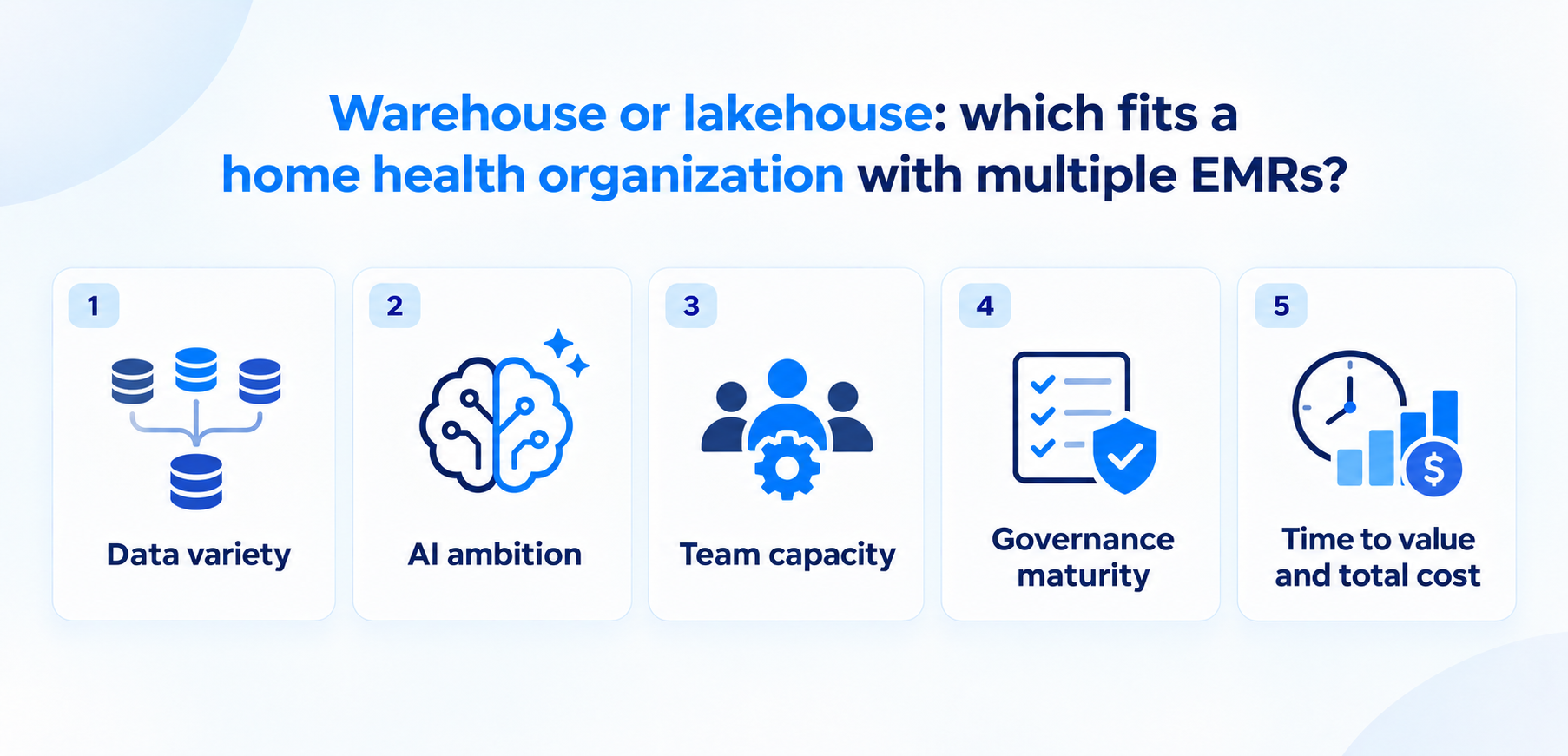
Warehouse or lakehouse: which fits a home health organization with multiple EMRs?

Warehouse or lakehouse: which fits a home health organization with multiple EMRs?

A warehouse fits structured, report-heavy needs, a lakehouse adds room for unstructured data and machine learning, and many home health organizations land on a hybrid warehouse-plus-lake design.

Five factors decide it:

  • Data variety. Claims, OASIS and EVV fit a warehouse neatly. Visit notes, call audio, images and remote monitoring feeds call for lake storage.
  • AI ambition. Predictive models and agents need feature tables and history, which both designs can supply. Unstructured AI inputs favor a lakehouse.
  • Team capacity. A lakehouse asks for more engineering skill. A managed warehouse asks for less.
  • Governance maturity. The more flexible the platform, the more discipline it needs to stay clean.
  • Time to value and total cost. A warehouse usually reaches the first dashboard sooner. A lakehouse spreads its payoff across more use cases.

The engine matters less than the model. Pick the one your cloud contract and team skills already support, whether that’s Snowflake, Databricks or Microsoft Fabric. Our breakdown of data lake versus data warehouse differences on Snowflake covers the trade-offs in detail.

A warehouse applies structure when data is written (schema-on-write). A lake applies it when data is read (schema-on-read), which is flexible and harder to govern. Open table formats such as Delta and Iceberg keep data readable by more than one engine, which lowers lock-in. Data mesh suits large organizations with mature domain teams, so most home health groups begin with a central platform team and a shared model.

What does a medallion architecture look like inside a home health organization?

A medallion architecture organizes home health data into three layers, bronze for raw source data, silver for cleaned and conformed data, and gold for business-ready data products, and each layer adds trust before data moves forward.

The pattern fits home health because the problems are layer-shaped. Source systems disagree, patients get duplicated and leaders argue about definitions. Our guide to medallion architecture for healthcare data explains the mechanics, and this section applies it to EMR, EVV, billing and CRM data.

Bronze: keep every source exactly as it arrived

Bronze holds data exactly as each source delivered it. Nothing gets fixed, renamed or dropped here. What typically lands in bronze:

  • EMR extracts, or FHIR bulk export files (NDJSON) when the vendor supports them
  • OASIS assessment exports and visit documentation
  • EVV punches, schedules and caregiver assignments
  • 837 claims, 835 remittances and payer clearinghouse responses
  • Referral documents from fax, portals and CRM, with OCR output
  • Payroll, HR and workforce files

Every load carries metadata: source system, extract time and batch ID. That raw copy lets a team prove whether an error started in the source or in a transformation, which is the first question an auditor or a skeptical clinical leader will ask.

Silver: clean, match and conform

Silver is where home health data becomes trustworthy, and most of the hard work lives here.

  • Identity resolution. An enterprise master patient index (EMPI) links the same patient across EMRs into one record. See how a master patient index and Patient 360 design resolves duplicates.
  • Standard vocabularies. Map visit types, disciplines and statuses to one set, and use standard codes such as ICD-10, LOINC, RxNorm and SNOMED where they apply.
  • Match EVV visits to scheduled visits and billed visits so mismatches surface as exceptions.
  • Episode logic. Build the 30-day payment period as a conformed entity so PDGM analysis starts from one definition.
  • Quality rules. Validate required fields, quarantine rejected records and log the reason.
  • PHI controls. Apply access rules and de-identify where analysts don’t need patient identifiers.

Gold: data products tied to decisions and owners

Gold holds the data products leaders use every week, each tied to a named decision and a named owner. Typical gold products for home health:

  • HHVBP performance dashboard
  • OASIS completeness and timeliness
  • Referral-to-admission conversion
  • EVV-to-claim reconciliation
  • LUPA and rehospitalization risk features
  • Staffing capacity and caregiver availability

A semantic layer sits on top with governed metrics, so “admission,” “completed visit” and “episode” mean the same thing in the finance dashboard and the clinical one. That single change settles a lot of meeting-room debates. Once those definitions are governed, leaders can ask questions of the data in plain language and trust the answer.

LayerWhat lands thereHome health exampleControlsTypical owner
BronzeRaw, append-only copies from each sourceEMR extracts or FHIR bulk files, OASIS exports, EVV punches, 837 and 835 files, referral documentsLoad metadata, retention rules, restricted accessData engineering
SilverCleaned, conformed, de-duplicated data mapped to standard codesOne patient record via EMPI, standard visit types, reconciled EVV and schedule data, 30-day periodsQuality rules, quarantined rejects, PHI controls, lineageData engineering with domain stewards
GoldCurated data products for named use casesHHVBP dashboard, OASIS timeliness, referral conversion, EVV-to-claim reconciliation, LUPA risk featuresGoverned metric definitions, semantic layer, owner sign-offBusiness domain owners with analytics

Where do Caregence workflows read from this design?

Inferenz connects an agency’s data into one system, and the Caregence platform gives stakeholders a place to build custom agents for their own workflows on top of it. The platform connects to any FHIR-supported EHR plus Snowflake, Databricks, Postgres and MySQL, and your warehouse stays the system of record. Caregence reads only what a workflow needs at the moment it asks, and it doesn’t store patient data itself.

Gold tables are what those workflows read. A referral intake workflow reads eligibility and capacity tables. A scheduling workflow reads clinician skill, geography and caseload. A documentation workflow reads OASIS fields from silver. A clean gold layer gives each workflow trustworthy inputs from day one.

Teams can also build agents that act on predictive outputs, such as rehospitalization and LUPA risk scores served from gold. Our Caregence predictive models page describes that layer.

See Caregence read from the data foundation you already run

Which decisions should the data platform support: HHVBP, OASIS quality, staffing, referrals and AI?

Start from the decisions leaders make every week, then work backward to the data each decision needs.

  • HHVBP performance. Join OASIS, HHCAHPS and claims-based measures at patient level so quality scores trace back to the care behind them.
  • Staffing and capacity. Combine visit demand, clinician availability and turnover signals. Our home health staffing analytics playbook shows the metrics.
  • OASIS quality. Track completeness, timeliness and accuracy before submission, since the CY 2027 reporting year spans a full calendar year.
  • Margin protection. Connect episode cost, LUPA risk and denials. Our PDGM 2027 analysis explains how the final-rule changes affect margin.
  • Referral growth. Follow referral source, intake time and conversion to admission.
  • AI and automation. Serve feature tables and labeled outcomes to agents built on Caregence.

On HHVBP, CMS finalized no model-specific policy changes for CY 2027 but summarized ways to align the model with the HH QRP, so shared OASIS and HHCAHPS data will likely matter to both programs.

What does a home health data platform really cost beyond the license?

License fees are one line in the total cost of ownership, and people, stewardship, testing and support often cost more over time. Budget for these:

  • Cloud storage and compute
  • Engineering and analytics talent
  • Data stewardship, with a named owner for each domain
  • Testing, monitoring and data observability
  • EMR and API integration upkeep as vendors change
  • BI and semantic layer licenses
  • Security and compliance work, including business associate agreements and access reviews
  • Change management and training

Then comes the build-versus-buy question. Building in-house gives control and needs scarce engineers. A packaged platform shortens setup and ties you to the vendor’s model. A partner brings delivery capacity while ownership of the model, pipelines and documentation stays with you. Whichever route you pick, a scoped first release inside one quarter keeps cost visible. Inferenz’s data engineering and integration services follow a staged pattern that runs from discovery through pipelines to ongoing monitoring.

How do you keep a data platform from becoming another silo or a data swamp?

Name an owner for every dataset, enforce quality rules at the silver layer and trace every gold metric back to bronze.

Lineage deserves special attention. When a CMS reviewer or a payer questions a number, you should be able to walk it back to the source record. Our piece on audit-ready data lineage shows what that looks like in practice.

Data contracts help too. A contract is a written agreement with each source owner or vendor about fields, formats, freshness and quality, and a broken contract triggers an alert before the damage reaches a dashboard.

Add a metadata catalog with a business glossary, stewardship roles for each domain, PHI classification and observability for freshness, drift and schema changes. Together they keep the platform usable as it grows. Inferenz’s data quality, governance and compliance services cover governance assessment, stewardship models, quality automation and audit readiness.

What does your EMR vendor’s data export or FHIR API actually let you extract?

Ask your EMR vendor for the data dictionary, the bulk export options and the API rate limits in writing before you design anything.

CMS’s voluntary Interoperability Framework shows what good FHIR-based exchange looks like. It asks participating networks to expose data through FHIR APIs built on US Core and USCDI v3 or later, to use standard terminologies such as LOINC, RxNorm and SNOMED, and to use FHIR bulk data exchange to move full records. That gives you the vocabulary for the vendor conversation.

FHIR is a transport and description standard. A FHIR $export lands in bronze, and silver and gold still do the modeling work that analytics needs.

Questions worth putting in writing:

  • Which data can we extract: OASIS at item level, visit notes, orders, schedules, audit logs?
  • Is there a bulk export, and can we pull incremental changes?
  • What are the rate limits and fees for API access?
  • Does the contract allow a third-party platform to read our data?
  • Is there a sandbox for testing pipelines before production?
  • How does the vendor notify us of schema changes?

The wider market is moving the same way. HHS reported in February 2026 that TEFCA had grown to nearly 500 million exchanged health records, up from roughly 10 million in January 2025, and the national coordinator said AI applied to healthcare makes data liquidity a key need, as the HHS announcement describes.

How do you prove ROI to the board before committing to a multi-year build?

Baseline three or four numbers before you start, pick one gold data product that moves them, and report results at 90 days.

Margin pressure frames the board conversation. CMS estimates that Medicare payments to home health agencies will rise about 2.4% in CY 2027, and the rule keeps a 3% temporary adjustment in place, according to the CMS announcement of the final rule. With a payment update of that size, operational data has to carry more of the margin conversation.

  • Hard savings: hours spent on manual reporting, revenue leakage from unmatched EVV visits and claims, and denial rework.
  • Softer gains: faster onboarding of acquired agencies, quicker answers to referring physicians and leaders who trust the numbers.

One hospice and palliative care provider reported that leadership regained about two hours a day after a Snowflake warehouse and Power BI dashboards replaced a manual spreadsheet audit, according to the Inferenz post-acute data platform case study. Treat that as a vendor-reported example and set your own baseline.

What questions should you ask a data platform vendor or integrator before signing?

Ask eight questions about ownership, skills, security, openness and cost before you sign anything.

  1. Who owns the data model, pipelines and documentation when the contract ends?
  2. Which skills must we hire or keep to run this after go-live?
  3. Does the design use open table formats so another engine can read our data?
  4. Will you sign a business associate agreement and describe PHI controls at each layer?
  5. How do you show lineage from a gold metric back to bronze for an auditor?
  6. Which data quality tests and alerts ship with the first release?
  7. How many acquisitions or new EMRs can you onboard before the architecture changes, and how fast?
  8. What does year two cost, including compute, support and stewardship?

Final thoughts

Most home health CIOs don’t need to pick one option forever. The EHR keeps running care. A warehouse built in clean layers gives leaders one set of numbers. A platform grows around it when AI and data variety call for it. Start with the decisions you make every week, build the layers that serve them and keep every definition in one place.

If you’re mapping the bigger picture across EVV, billing and CRM, the single source of truth guide picks up where this one ends.

Not sure which foundation fits your scale?

Frequently Asked Questions

Top 10 RPA and Intelligent Automation Companies in 2027: Platforms, Partners and Fit

Summary

Robotic process automation has grown from bots that click through screens into intelligent automation that reads documents, routes exceptions and hands work to AI agents, and US providers like Inferenz now compete on process fit, exception handling and governance.

The work done by the top 10 RPA and intelligent automation companies spans process discovery, document processing, bot and agent orchestration and ongoing operations. Prospects match a partner to their processes and pilot one before going ahead with them.

Introduction

Robotic process automation grew up on a simple promise: let software do the clicking. The promise has widened. Bots now read documents, route exceptions and hand work to AI agents, and buyers shop for RPA and intelligent automation partners like Inferenz as much as for software licenses. Searching for RPA companies turns up vendor lists that all look alike, so this guide compares the field on evidence you can check.

Automation has moved past the experiment stage. Banks, hospital systems and government agencies all run bots in production, and what’s left to settle is how much AI to put on top.

Public agencies are moving the same way. Gartner predicts that at least 80% of governments will deploy AI agents to automate routine decision-making by 2028, and its survey of 138 government respondents found that 41% cite siloed strategies and 31% cite legacy systems as key adoption challenges.

Private companies are moving the same way, and the next step is agents. McKinsey’s 2026 survey found that about two in ten respondents are scaling AI agents across their organization, a share that rises to 40% in companies with more than $1 billion in revenue.

This guide profiles ten US-based firms, explains how we chose them and shows how to match one to your processes.

Full disclosure: We kept the field to US-headquartered firms which are dynamic and futuristic in the RPA and intelligent automation domain and highly relevant to American buyers. We ranked every company on the criteria below and included Inferenz too.

Top 10 RPA and intelligent automation companies at a glance

#CompanyModelBest forHeadquarters and signals
1WonderBotzServicesIntelligent automation and agentic process managementPrinceton, New Jersey, founded 2017, 2026 Inc. 5000
2InferenzServicesRPA plus AI and integration for healthcare, insurance and hi-techRound Rock, Texas, seven-part lifecycle, Caregence agents, 30+ accelerators
3HypersciencePlatformDocument-heavy processes at large organizationsNew York, founded 2014
4Skan AIPlatformProcess intelligence that shows where to automateMenlo Park, California, founded 2018, $63 million Series C in 2026
5AshlingServicesIntelligent automation and agentic AI consultingChicago, founded 2017, SS&C Blue Prism partner
6AccelirateServicesAI-enabled automation with integration depthSunrise, Florida, founded 2016
7ProcessMakerPlatformLow-code workflow and process automationDurham, North Carolina, founded 2000
8InfrrdPlatformIntelligent document processing for invoices and mortgagesSan Jose, California, founded 2015
9NividousPlatformRPA, AI and low-code in one intelligent automation platformMount Laurel, New Jersey, founded 2011
10BP3 GlobalServicesProcess automation and BPM consultingAustin, Texas, founded 2007

What do RPA and intelligent automation companies do?

RPA companies provide software robots, or services to build them, that copy the clicks and keystrokes people use to complete a repetitive task across applications. Intelligent automation companies add AI to that base, so the bot can read a document, classify a request, decide on an exception or call an AI agent. Together the work usually covers six jobs:

  • Assessment: finding processes with enough volume and stable rules to automate.
  • Bot design and build: scripting the workflow for structured, rule-based tasks.
  • Intelligent workflows: adding classification, triage and decision support with AI.
  • Document processing: extracting data from forms, emails and PDFs with NLP.
  • Integration: linking CRM, ERP, EHR and finance systems through APIs and screens.
  • Governance and monitoring: audit trails, access controls and bot health checks.

Analysts now fold much of this into broader labels such as business orchestration and automation, so a vendor may describe itself with a different term than the one you searched. Compare capabilities, and don’t get hung up on the label.

How we ranked these RPA companies

Dozens of vendors claim automation expertise. We kept US-headquartered companies of comparable scale with public evidence you can check, and each met most of these six criteria:

  • Process breadth: proven automation of structured work, documents and exceptions.
  • AI capability: document intelligence, decisioning or agents layered over the bots.
  • Integration: connectors or services for the systems you run, including legacy applications.
  • Governance: audit trails, access controls and monitoring that hold up in a review.
  • Evidence: dated awards, funding news, named customers or published outcomes in public sources.
  • Support model: implementation help, managed services or migration support.

We kept a firm only when at least two independent sources agreed on its headquarters and founding year, and we dropped companies that were acquired and absorbed into a larger vendor. Treat the order as editorial judgment, and give every number a pilot before it supports a business case.

The 10 RPA and intelligent automation companies to know in 2027

The 10 RPA and intelligent automation companies to know in 2027


1. WonderBotz

Best for: intelligent automation and agentic process management.

WonderBotz was founded in 2017 by two former Big Four partners and is headquartered in Princeton, New Jersey. It helps enterprises launch, modernize and manage intelligent operations, combining AI agents, automation, human expertise and governance across the leading automation platforms. Its Agentic Process Management framework, relaunched on October 27, 2026, rests on four pillars: orchestration, fidelity, stewardship and data foundation. It ranked No. 2,421 on the 2026 Inc. 5000 with 137% revenue growth from 2022 to 2025, and it reports that a healthcare client cut back-office processing time by 90% (company-reported).

2. Inferenz

Best for: enterprises that want RPA, AI and system integration delivered as one program, especially in healthcare, insurance and hi-tech.

Inferenz is a data and AI engineering company with US operations in Round Rock, Texas, and more than 200 specialists. Its automation practice moves from rule-based RPA toward hyperautomation, combining bots with AI for classification, triage and document processing and integrating with CRM, ERP, EHR and finance systems under audit trails and access controls. In healthcare, the Caregence Prior Authorization Agent completes the payer portal, submits the request and tracks status until a decision arrives, writing the result back to the EHR. Inferenz replaced manual portal entry with RPA for a national home care workforce and automated ingestion across 12 source systems for a nationwide entertainment operator. For processes that cross many systems, one team that owns the bots, the AI and the integrations keeps handoffs from becoming the weak link.

3. Hyperscience

Best for: document-heavy processes at large organizations.

Hyperscience was founded in 2014 and is headquartered in New York. It builds an enterprise AI platform that reads, understands and processes documents at scale and passes the data to downstream systems and processes. It reports 99.5% accuracy and FedRAMP High authorization, and says Gartner named it a Leader in the 2026 Magic Quadrant for Intelligent Document Processing, positioned highest for ability to execute among 15 vendors (company-reported). Forrester also named it a Leader in its Q2 2026 Wave for document mining and analytics platforms.

4. Skan AI

Best for: process intelligence that shows where automation will pay off.

Skan AI was founded in 2018 and is headquartered in Menlo Park, California. It captures how work really happens across applications and teams and turns it into a context graph that shows which processes are worth automating and gives AI agents the context to act. It reports clients that include one in four Fortune 50 companies and seven in ten top US banks, a 30% average productivity lift and $500 million in delivered value (company-reported). In August 2026 it announced a $63 million Series C co-led by Cathay Innovation and Dell Technologies Capital.

5. Ashling

Best for: intelligent automation and agentic AI consulting.

Ashling was founded in 2017 and is headquartered in Chicago. It describes itself as an intelligent automation and agentic AI consulting firm that finds the processes worth automating, designs programs that scale and then delivers and runs the solutions. It reports 250 specialists, 500 prebuilt accelerators, work for more than 300 brands and a Net Promoter Score of 82 (company-reported). SS&C Blue Prism named it a WorkHQ Pioneer Partner in June 2026, and it has grown by acquiring Machina, fourTENS and Reveal Group.

6. Accelirate

Best for: AI-enabled automation with integration depth.

Accelirate was founded in 2016 and is based in Sunrise, Florida. It describes itself as an AI-first provider of agentic automation services, with a 5-Week Activator program, built-in AI governance and products such as FlowAgent for MuleSoft and AcceliQA. It has grown through the acquisitions of Revelation AI, a Platinum Salesforce Partner, and Eshia Solutions, a MuleSoft integration specialist. It reports more than $300 million in realized ROI from automation, and a top-five US insurer on its site cites five agents live by week five and $2.4 million in annual savings (company-reported).

7. ProcessMaker

Best for: low-code workflow and process automation.

ProcessMaker was founded in 2000 and is headquartered in Durham, North Carolina. It sells a business process automation and orchestration platform that coordinates workflows, systems, business rules, people and AI, including tools to build and govern AI agents. The company says Gartner ranked its platform in the top five across all four evaluated use cases in the 2026 Critical Capabilities for Decision Intelligence Platforms (company-reported). It is a platform you operate, so compare it with a services partner on who builds and maintains the workflows.

8. Infrrd

Best for: intelligent document processing for invoices and mortgage files.

Infrrd was founded in 2015 and is headquartered in San Jose, California. It builds intelligent document processing software that extracts data from complex, unstructured documents such as invoices and loan files, and it says fields are found across changing layouts without a document template. In 2026 it launched a developer-focused document automation API. Its own buyer guidance centers on accuracy on your documents, straight-through processing rate and exception quality, which are sound tests to apply to any vendor.

9. Nividous

Best for: RPA, AI and low-code in one intelligent automation platform.

Nividous was founded in 2011 and is based in Mount Laurel, New Jersey. Its platform spans RPA, agentic process automation, document processing and low-code, with governance, audit trails and human-in-the-loop escalation built in, and it is SOC 2 certified. It reports ROI in four to six months, a 60% throughput gain and more than 80% less manual effort, and its quick-start program promises production roll-out in three to four weeks (company-reported). Use cases include IT service desk, supply chain and finance.

10. BP3 Global

Best for: process automation and BPM consulting.

BP3 Global was founded in 2007 and is headquartered in Austin, Texas. It is a consultancy in business process management, RPA and AI that helps clients align people, process and platforms, working with platform partners such as UiPath and Appian. Its services run from strategy and design through automation and ongoing support. It has acquired Agilify, transformAI and Extra Technology to broaden its intelligent automation bench, and it has been named among the top consulting companies in Texas.

See what automation looks like in a real operation

How to choose an RPA company

Automation goes best when the process is understood before the tool is chosen. Each step below narrows the field and keeps the project tied to a result you can measure.

  • Step 1: Pick the process and measure it. Choose a process with high volume and clear rules, then record its cycle time, error rate and exception rate. Those numbers become the baseline for every claim a vendor makes.
  • Step 2: Redesign before you automate. Remove steps that exist only because of old habits. Automating a messy process produces a faster mess, so fix the workflow first.
  • Step 3: Map the systems and documents involved. List the desktop applications, web portals, APIs and document types the process touches. Some tools shine on screen-based tasks, and others are built for documents or system integration.
  • Step 4: Decide how much AI belongs. Rule-based bots suit stable, structured tasks. Document AI helps with invoices and forms, and agents can handle judgment calls. Decide where people stay in the loop for exceptions.
  • Step 5: Shortlist on evidence. Ask for processes running in production at organizations like yours, and for references you can call. Check public sources for dated proof, and ask how long the automations have been live.
  • Step 6: Pilot one process with a before and after. Run the process for a few weeks, compare results with the baseline and review every exception. A pilot that handles the awkward cases tells you more than one that only handles the easy ones.
  • Step 7: Plan operations and governance. Applications change, and bots break when they do. Settle who monitors the automations, who fixes them, how credentials are secured, how audit trails are kept and who owns the roadmap after launch.

Many automation and AI projects stall because the process around them stays outdated. The Inferenz piece on business process reengineering for AI and ML systems makes the case for redesigning the workflow before any bot is built.

Questions to ask every RPA vendor

  • Fit: Which processes like ours have you automated, and what share needed human review?
  • Exceptions: What happens when a screen changes or a document arrives in a new format?
  • AI layer: Which steps use AI, and how are the outputs checked?
  • Governance: What audit trails, access controls and approval rules ship with the bots?
  • Integration: Which of our systems have you connected, and how?
  • Cost: How are licenses priced as bot counts and runs grow?
  • Ownership: Can our team maintain the bots after launch?

RPA and intelligent automation trends to watch in 2027

  • Bots hand work to agents. Platforms now orchestrate people, robots and AI agents in one flow.
  • Orchestration becomes the label. Analysts group RPA with workflow and decisioning under business orchestration and automation.
  • Governance moves into the platform. AI gateways and agent logs are turning into standard features.
  • Process intelligence comes first. Buyers want to see where work stalls before they commit to a bot.
  • Document intelligence gains ground. Extraction and classification are now the usual first AI step beside a bot.

Final thoughts

The best RPA companies in 2027 will show you how a bot behaves when something unexpected happens. They’ll name the AI steps, explain the governance and show dated proof. Choose the partner whose strengths match your processes, pilot on one workflow with a clear before-and-after, and redesign the process before you automate it.

If your processes cross healthcare, insurance or hi-tech systems and need bots, AI and integration working together, Inferenz is a good place to start the conversation.

Have a manual process that eats hours every week?

Frequently Asked Questions

Medicare’s 2027 Home Health Final Rule: Reactions, Impact and What Every Care Setting Should Do Next

Summary

CMS finalized its CY 2027 home health rule on November 4, lifting aggregate Medicare payments to home health agencies by an estimated 2.4% (about $415 million) while keeping a 3.0% temporary cut and widening its power to revoke Medicare enrollment retroactively. 

Providers welcomed the raise, worried about enforcement, and said neither fixes labor costs. This guide covers what changed, who said what, and how the rule lands in home health, hospice, palliative care, home care, hospitals, suppliers, health plans and patients’ homes.

Introduction 

Medicare is paying home health agencies more and watching them harder, all inside one rule. That pairing will decide which agencies keep admitting medically complex patients in 2027, how fast hospital teams can find a place at home for someone ready to leave, and whether physicians feel safe ordering skilled palliative care for people with serious illness. 

The final CY 2027 Home Health Prospective Payment System rule, CMS-1844-F, went on display at the Federal Register on November 4 and was published on November 9 (91 FR 72022). It follows a July proposal that surprised the industry by offering a raise after years of proposed cuts. The final version keeps that raise nearly intact. It also keeps the 3% temporary reduction and adds enrollment powers that reach far beyond home health. 

Here’s the full picture: the provisions, the reactions from every quarter, the impact by care setting, and the questions people keep asking. 

What did CMS finalize in the CY 2027 home health rule? 

CMS finalized a 2.4% aggregate payment increase for home health agencies (about $415 million), a continued 3.0% temporary reduction, retroactive Medicare enrollment revocation across all revocation grounds, a 45-day OASIS submission deadline, and a clarification that skilled palliative care fits inside the existing home health benefit. 

The numbers below come from the CMS fact sheet for the final rule. The home health payment update is 2.1%, worth $365 million. An updated fixed dollar loss amount adds an estimated 0.3%, worth $50 million. Together they produce the 2.4% aggregate figure, slightly under the $420 million CMS estimated in July. 

Provision What CMS finalized Who feels it most 
Aggregate payment About +2.4% ($415 million) versus CY 2026: a 2.1% update plus 0.3% from the outlier threshold Home health agencies 
Temporary adjustment -3.0% to the 30-day base rate, continuing recoupment for CY 2020 to 2025 Agency finance teams 
Permanent adjustment None added for 2027; CMS keeps analyzing CY 2026 claims Agencies planning for 2028 
Case-mix and LUPA Weights recalibrated across 432 PDGM groups on CY 2025 data; LUPA thresholds, functional levels and comorbidity subgroups updated; final 30-day base rate $2,092.69 Clinical, coding and scheduling teams 
Retroactive revocation Every Medicare enrollment revocation ground takes effect as of the date noncompliance began All Medicare providers and suppliers 
New revocation grounds Certain misdemeanor convictions, excessive provider concentration in a limited area, and suspensions tied to owners and managing employees All Medicare providers and suppliers 
Ownership changes Home health agencies, hospices and DMEPOS suppliers re-enroll as new providers and undergo a survey or accreditation after certain majority ownership changes Owners, buyers and investors 
OASIS deadline Submission window shortens from 135 days to 45 days Quality and clinical operations 
Palliative care Skilled palliative care confirmed within the existing home health benefit; examples to follow in guidance Physicians, agencies and hospices 
Home infusion DME External infusion pumps and associated drugs join the DME benefit on April 1, 2027 Infusion suppliers and patients 
Wage index Comments on a home health-specific wage index summarized; no methodology or timeline announced Agencies in low-wage-index areas 

 Payment: a raise after years of cuts 

The direction matters as much as the size. CMS proposed an aggregate cut of 6.4% for CY 2026 and 1.7% for CY 2025, according to Home Health Care News, and the CY 2026 final rule still trimmed payments by 1.3%, or $220 million, by CMS’s estimate. A 2.4% increase reverses the pattern. Providers now have a baseline they can plan around, which is the first thing most leaders mention when asked about the rule. 

Outlier payments, which cover periods of unusually high cost, stay capped at 2.5% of total payments, and the final fixed dollar loss ratio is 0.29%. 

The 3% temporary adjustment is still in place 

CMS finalized another 3.0% temporary reduction to the 2027 national standardized payment rate. The agency says it is recouping retrospective overpayments for calendar years 2020 through 2025, and it believes spreading the recovery may avoid a much larger cut later. The final rule puts the total at about $4.9 billion through CY 2025 and estimates that the 3% reduction will recoup about $500 million of it. The National Alliance for Care at Home has warned that a 3% annual pace would run roughly ten years. 

No new permanent adjustment was added for 2027. CMS says it will keep studying CY 2026 claims, as the statute requires, so the permanent-adjustment question can return in next year’s rule. Our breakdown of the proposed rate math and margin sensitivity shows how a 3% reduction interacts with cost growth. The final 30-day base rate is $2,092.69 after the temporary adjustment, per the final rule. 

Program integrity: the quieter headline 

The enrollment provisions may matter more to many readers than the payment line. CMS says the changes will save about $82 million a year by letting the agency recover payments from noncompliant providers and keep high-risk applicants out of Medicare. Administrator Dr. Mehmet Oz described the goal as holding noncompliant providers accountable while protecting seniors, taxpayer dollars and access to care. CMS also says the new authorities are targeted and that it will weigh the facts of each case. 

  • Retroactive revocation. Every revocation ground now takes effect as of the date noncompliance began, so CMS can recover payments back to that date. Before, some revocations applied only 30 days after notice. The final rule also cuts the window for a revoked provider to submit outstanding claims from 60 days to 15 days, counted from the date of the revocation letter. 
  • New and expanded grounds. These include certain misdemeanor convictions tied to sexual assault or financial misconduct, and enrollments CMS judges high risk because of an excessive concentration of providers in a limited geographic area. 
  • Ownership changes. Home health agencies, hospices and DMEPOS suppliers must re-enroll as new providers and pass a survey or accreditation after certain changes in majority ownership. CMS can deny or revoke enrollment if they skip the step. 
  • Owners and managing employees. Existing license and program suspension grounds now reach a provider’s owners and managing employees or organizations. The final rule defines managing employees as anyone who exercises operational or managerial control over day-to-day operations, and it names medical directors, clinical directors, departmental heads, supervising physicians, nursing directors and alternate administrators. 
  • Affiliations. The final rule removes the five-year affiliation lookback. 
  • Stricter requirements for hospices and home health agencies on administrator qualifications, alongside the ownership rules. 

Context sharpens the picture. On November 12, CMS extended the national enrollment moratorium on new home health agencies and hospices by six months, and the extension lets currently enrolled agencies add new practice locations. Home Health Care News also notes that these provisions arrive next to the CRUSH fraud initiative, so scrutiny stacks. 

TALK TO OUR HEALTHCARE AI EXPERTS

Quality reporting and the 45-day OASIS clock 

CMS cut the OASIS data submission deadline from 135 days to 45 days, which moves public reporting of home health quality up by as much as three months. About 98% of agencies already submit within 45 days, so the change formalizes what most do today. Reporting for the annual payment update will cover a full calendar year of data, and CMS tightened the digital hand-off during compliance reconsideration. It also gathered input on advance care planning as a possible future measure and made no model-specific changes to expanded HHVBP. Agencies still finishing their data groundwork should read our data foundation playbook for 2027, which covers how CMS intends to count OASIS assessments from every payer for start-of-care dates on or after January 1, 2027. 

Palliative care: the existing benefit, spelled out 

CMS confirms that eligible patients with serious illness can receive skilled palliative care, including pain and symptom management, under the home health benefit. The rule creates no new benefit. Eligibility depends on a patient’s care needs and Medicare’s home health criteria, and no specific diagnosis is required. Palliative care under this benefit is separate from hospice. CMS says it will publish examples of skilled palliative services through sub-regulatory guidance after the final rule posts, and it hasn’t given a date. 

Home infusion, DMEPOS and the wage index 

  • Infusion coverage. External infusion pumps and associated home infusion drugs join the DME benefit on April 1, 2027. The FDA labeling must call for administration by or under supervision of a healthcare professional, a qualified home infusion therapy supplier must handle it in the home, and the drug must be infused at least 12 times a year. CMS swapped its proposed once-a-month test for the 12-times-a-year standard and placed no restriction on who counts as a healthcare professional. 
  • Replacement items. An identical DMEPOS replacement item needs no repeat face-to-face visit, though suppliers must produce the original encounter documentation if audited. 
  • Competitive bidding. The Form C reporting form gains a country-of-origin field for lead items, which will appear in the Medicare Supplier Directory. 
  • Wage index. CMS summarized comments on building a home health-specific wage index from an alternate source such as the Bureau of Labor Statistics. It announced no methodology or timeline. 

Proposed rule versus final rule at a glance 

Item July 1 proposal November 4 final rule 
Aggregate payment change +2.4% (about $420 million) +2.4% (about $415 million) 
Payment update 2.1% (about $370 million) 2.1% ($365 million) 
Outlier threshold effect +0.3% ($50 million) +0.3% ($50 million); fixed dollar loss ratio 0.29% 
Temporary adjustment -3.0% -3.0% 
New permanent adjustment None None 
Revocation timing Retroactive revocation proposed Retroactive to the date noncompliance began, for all grounds 
Home infusion frequency test Once per month At least 12 times per year 
OASIS submission Shorter deadline proposed 45 days, down from 135 
Wage index Request for information Comments summarized; no plan announced 
Palliative care Discussion and request for comment Response to comments; examples promised in later guidance 
Claims window after revocation Proposed cutting the window to submit outstanding claims from 60 days to 15 15 days from the date of the revocation letter 
Managing employee definition Proposed expanding it to name clinical roles such as clinical directors and nursing directors Finalized without modification 
Five-year affiliation lookback Proposed removing it Removed 

 How did the healthcare industry react to the 2027 home health final rule? 

Relief on the rate, concern about enforcement, and frustration that a 2.4% increase still trails labor costs. Providers and trade groups mostly back going after bad actors. They split on whether compliant agencies will get swept up with them. 

Home Health Care News collected provider reactions the day after release, and the pattern was consistent. Leaders were glad for a raise and then moved quickly to what the rule leaves out: staffing costs, the temporary adjustment, and the risk of a paperwork error turning into a retroactive revocation. 

Providers 

Voice Reaction 
Bayada Home Health Care (Bryony Winn, CEO) Relieved. The raise supports clinicians and gives dependable funding to onboard new talent, though the rule adds time demands and resource needs. 
LiveWell Partners (Stacie Bratcher, CEO) Says the rule favors agencies that invested in documentation and oversight, and that compliance infrastructure is now a core operating cost. Notes 2.4% trails recruiting and retention costs and wants continued pressure on the temporary adjustment and Medicare Advantage rates. 
VNS Health (Dan Savitt, President and CEO) Points out that cumulative Medicare home health updates total 5.8% since 2020, against 20% or more for hospitals and skilled nursing facilities, and says the gap hurts hiring and capacity. 
HealthView Home Healthcare Services (Steven Gonzalez, CEO) Backs going after bad actors but wants precision, citing this year’s Los Angeles County crackdown. Worries that siloed CMS contractors make good agencies answer the same questions repeatedly. Most encouraged by the palliative care clarification. 
Cornerstone VNA (Jennifer Ufkin, President and CEO) Commenting on the proposal, supported a home health-specific wage index and said costs are rising three to five times faster than reimbursement. 

 Trade groups and advocacy organizations 

Organization Position 
National Alliance for Care at Home Called the increase the biggest update in nearly two decades outside 2022 and welcomed the stability. Still objects to the 3% adjustment as detached from true cost and built on data tainted by bad actors. Says CMS withdrew or narrowed several enrollment proposals, yet warns that broad disclosure provisions can catch legitimate providers over third-party conduct, shared buildings, vendor relationships or administrative errors. Also warns that clinical leadership titles are presumptively reportable managing employees, and that a late disclosure can support a retroactive revocation. 
LeadingAge Called the final rule out of touch with provider realities in a November 5 statement. Said the 2.4% increase beats recent cuts but leaves financial pressure unaddressed, and objected to the 3% temporary reduction. Welcomed the absence of revocation grounds tied to the Medicare debt and payment suspensions of third parties, and warned that the finalized enrollment provisions carry few guardrails. In its comments on the proposal, calculated a 7.3-point cumulative market basket shortfall from 2021 to 2025 and joined 18 other organizations in asking for a separate rulemaking. 
American Hospital Association In August comments, recommended changes to both the payment and provider enrollment provisions. Its November 4 summary notes that the 2.1% update combines a 3.1% market basket increase with a 1.0% productivity adjustment. 

 Technology, legal and policy voices 

  • Axxess urged CMS to treat interoperable, auditable technology as infrastructure. Its CEO expects data-driven enforcement, including predictive analytics, billing-trend reviews, ownership tracking and utilization comparisons, to flag agencies with inconsistent practices or thin documentation even when no one intended fraud. 
  • HCHB asked CMS to reconsider the 3% adjustment and to account for staffing, cost and Medicare Advantage pressure. 
  • Holland & Knight advised hospitals, physician organizations, DMEPOS suppliers and private equity-backed providers to read the rule closely, even if they never touch the home health benefit. 
  • A physician commenter told CMS that replacing objective fraud criteria with undefined agency discretion could expose primary care and wound care clinicians to revocation, and asked for separate rulemaking. 

What the comment record shows 

The proposal drew 657 comments, far fewer than the 952,483 filed against last year’s record cut, according to Home Health Care News. A smaller volume of more technical comments suggests the industry has shifted from alarm to argument. The fight now centers on payment methodology, enrollment safeguards and the long recoupment schedule. 

Reaction scorecard 

Issue Mood Why 
Aggregate rate increase Welcomed First raise after years of cuts and the biggest update in nearly two decades outside 2022, per the Alliance 
3% temporary adjustment Opposed Seen as detached from true cost, with a long recoupment horizon 
Retroactive revocation and new grounds Alarmed Risk to compliant providers from administrative or third-party errors 
Palliative care clarification Welcomed Gives physicians and agencies confidence to order and build services 
45-day OASIS deadline Low resistance About 98% of agencies already comply 
Home health wage index Supported, unresolved Request for information only, with no plan 
Workforce costs Unresolved Updates trail those of hospitals and skilled nursing facilities 

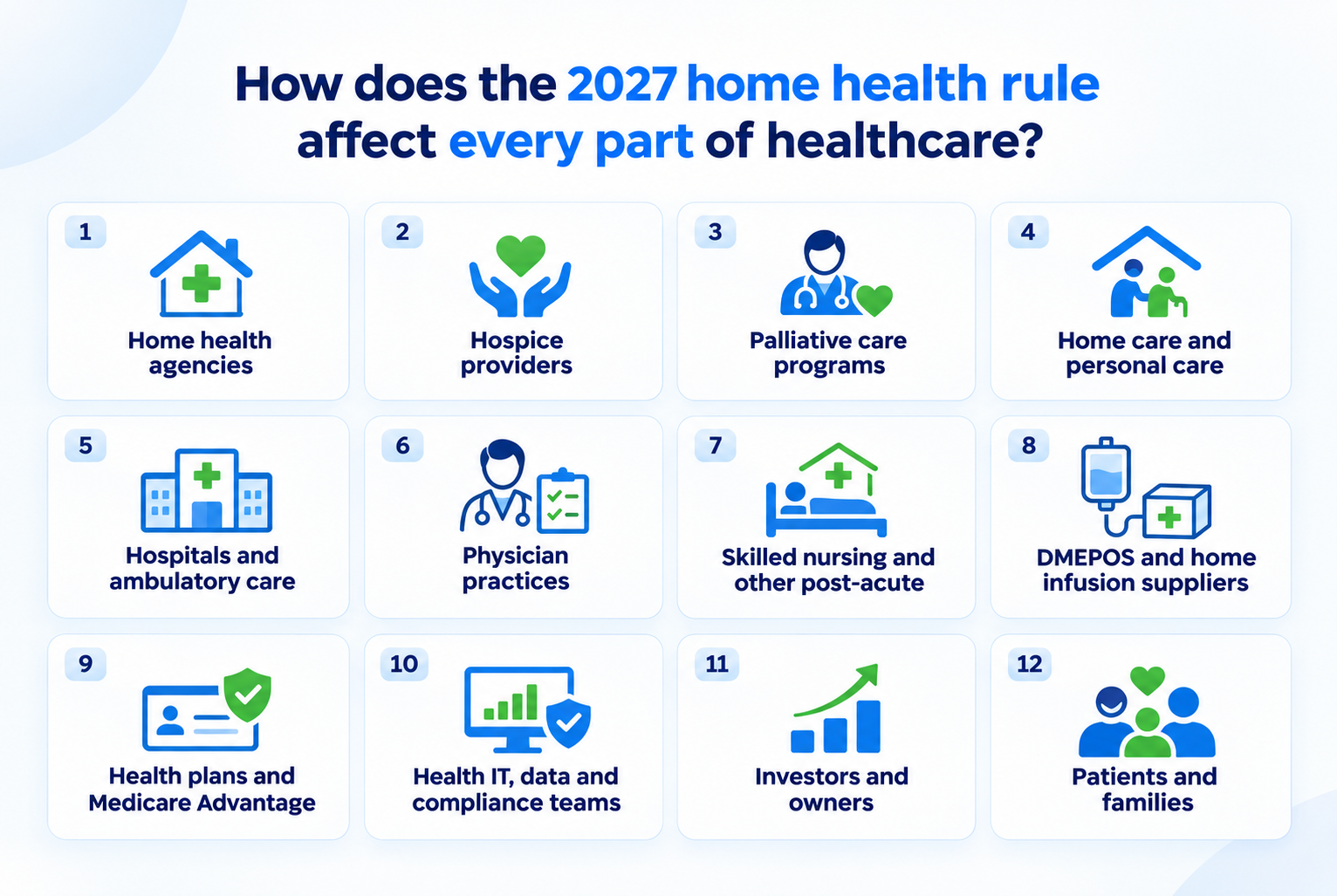
 How does the 2027 home health rule affect every part of healthcare? 

 How does the 2027 home health rule affect every part of healthcare? 

The payment provisions hit home health agencies directly. The enrollment provisions reach every Medicare provider and supplier type. The palliative care, infusion and DMEPOS provisions each open or tighten a specific workflow. Here’s where each care setting feels it. 

Care setting Main effect Watch item 
Home health agencies Aggregate payment up 2.4%, 3% temporary cut continues, new case-mix weights and LUPA thresholds, 45-day OASIS clock Cost growth above 2.4% erodes margin 
Hospice providers Ownership-change re-enrollment and survey, administrator rules, retroactive revocation Deal timing and disclosure accuracy 
Palliative care programs Skilled palliative care confirmed under the home health benefit CMS examples still to come 
Home care and personal care Indirect: shared labor market and multi-line operator exposure Whether one revocation touches affiliated lines 
Hospitals and ambulatory care Discharge placement depends on agency capacity; enrollment rules apply Referral acceptance and discharge delays 
Physician practices Palliative ordering confidence, managing-employee disclosure, DMEPOS documentation Revocation grounds 
Skilled nursing and other post-acute Retroactive revocation and expanded grounds apply Owner and managing-employee reporting 
DMEPOS and home infusion suppliers Infusion DME coverage from April 1, 2027; no repeat face-to-face for replacements Ownership-change survey, country-of-origin field 
Health plans and Medicare Advantage Indirect, through provider margins and network capacity MA rates and authorization workflows 
Health IT, data and compliance teams 45-day OASIS, audit trails, data-driven enforcement Patient-level evidence behind every compliance claim 
Investors and owners Majority ownership change triggers re-enrollment Diligence and closing calendars 
Patients and families Faster public quality data and clearer palliative access Rural access and agency exits 

 Home health agencies 

For home health agencies, the rule sets a rate environment that’s better than 2026 and still tight. The 2.4% aggregate figure is a national estimate. Your result depends on case mix, wage index, LUPA exposure and how fast your costs rise. The recalibrated weights across 432 payment groups, new LUPA thresholds, updated functional levels and comorbidity subgroups all use CY 2025 data, so every agency should re-run its own mix. 

  • Rebuild the 2027 revenue forecast by case-mix group and model the 3% reduction as its own line. 
  • Audit OASIS scoring on high-functional-level and high-comorbidity periods, since a scoring error changes payment for the whole 30-day period. 
  • Move OASIS submission onto a 45-day workflow if you aren’t there already. 
  • Review every owner and managing employee disclosure before CMS does. 

Hospice providers 

Hospice providers get no payment update from this rule, because hospice rates move through a separate annual rule. They do face the enrollment package. A change in majority ownership now sends a hospice back through enrollment as a new provider, with a survey or accreditation, and CMS added stricter requirements around administrator qualifications. Retroactive revocation raises the stakes on every disclosure, and the window to submit outstanding claims after a revocation is now 15 days. 

The palliative care clarification sits next to hospice, and CMS keeps the two distinct. Hospices that run palliative programs should watch for the sub-regulatory examples. The practical groundwork is governance: named data owners, tested rules and traceable records, which our guide to data governance and CMS compliance frameworks for hospice lays out. 

Palliative care programs and physicians 

Physicians and program leaders got what they asked for: a statement from CMS that eligible patients with serious illness can receive skilled palliative care, including pain and symptom management, under the home health benefit. HealthView’s CEO said it gives physicians more confidence to order the service, and LiveWell expects to reach seriously ill patients earlier. Commenters such as Dyad Health asked CMS to include caregiver training and a dementia-specific example in the forthcoming guidance. 

  • Build referral criteria around patient needs and Medicare home health eligibility. 
  • Define your palliative service line now so you can map it to CMS’s examples when they arrive. 

Home care and personal care agencies 

Home care agencies outside the Medicare home health benefit still feel this rule. Skilled agencies and home care agencies recruit from the same pool of nurses and aides, so updates that trail those of hospitals keep wage pressure on everyone. Multi-line operators face a second risk: the Alliance warned during the comment period that a revocation can implicate the other provider numbers a company holds. Electronic visit verification and caregiver scheduling remain the compliance basics for this setting. 

Hospitals, health systems and ambulatory care 

For hospitals and ambulatory networks, the rule matters twice. The enrollment provisions apply to every Medicare provider and supplier type, so hospital and physician group compliance teams need to review disclosure and revocation exposure. The payment provisions shape home health capacity. The Alliance’s comment letter cited data showing 38% of Medicare beneficiaries referred for home health at hospital discharge did not receive it through the third quarter of 2025. If margin pressure leads agencies to tighten admissions, discharge delays can follow. 

Physician practices and skilled nursing facilities 

The enrollment changes reach physician practices and skilled nursing facilities even though neither bills the home health benefit. Retroactive revocation, the broader license and program suspension grounds and the managing-employee disclosures cover all Medicare provider types. The ownership-change re-enrollment requirement applies only to home health agencies, hospices and DMEPOS suppliers. Practices that order DMEPOS get one piece of relief: an identical replacement item needs no repeat face-to-face visit, as long as the original encounter documentation can be produced on audit. 

DMEPOS suppliers and home infusion providers 

  • Prepare for infusion DME coverage on April 1, 2027, and confirm each drug meets the FDA labeling, qualified supplier and 12-infusions-a-year criteria. 
  • Treat a majority ownership change as a re-enrollment and survey or accreditation event. 
  • Keep original face-to-face documentation retrievable for replacement-item audits. 
  • Collect country-of-origin records for lead items. Suppliers can typically find them in product markings, manufacturer certifications, invoices or customs entry records. 

Health plans and Medicare Advantage 

The rule governs fee-for-service payment, so health plans aren’t directly bound by it. Plans still watch it, because agencies squeezed on fee-for-service margins have less room to absorb slow authorizations or lower plan rates. LiveWell’s CEO said access depends on both traditional Medicare and Medicare Advantage rates, and HCHB asked CMS to account for plan penetration. MedPAC reported in April that it found no statistically significant effect of Medicare Advantage growth on home health margins, while providers continue to argue their margins are thinner than MedPAC presents. For agencies, authorization status belongs in the revenue forecast, and a prior authorization agent that completes payer forms, submits requests and tracks status can keep it current. 

Health IT, data and compliance teams 

This is where the rule gets practical. CMS says it will use stronger recovery tools, and observers expect data analytics to drive enforcement. Agencies that can tie every compliance number to a patient-level record answer faster and with less disruption. Our guide to audit-ready dashboards for CMS and compliance reviews shows how to build that trail. 

Disclosure accuracy is a data problem as much as a legal one. Owner, managing employee and affiliation records often sit across HR, credentialing, finance and enrollment systems. Data quality, governance and compliance work that reconciles those sources gives compliance officers one version of the truth before a disclosure deadline arrives. 

Investors, owners and acquirers 

Anyone buying or selling a home health agency, hospice or DMEPOS supplier should treat the ownership-change rule as a deal-timing issue. A qualifying change in majority ownership means re-enrollment as a new provider and a survey or accreditation, with enrollment at risk if the step is missed. The six-month extension of the national enrollment moratorium, announced November 12, still applies to a home health agency that must enroll as a new provider after a qualifying change in majority ownership, so deal calendars carry that constraint too. Holland & Knight flagged private equity-backed providers specifically when the rule was proposed. Diligence now calls for a clean enrollment history, accurate owner and managing employee disclosures under the final definitions, and a realistic re-enrollment calendar. 

Patients, families and rural communities 

Patients get three tangible changes. Quality data reaches the public up to three months sooner. Skilled palliative care at home gets a clearer path. A steadier base rate may keep more agencies accepting complex referrals. The risk sits in rural areas, where Home Health Care News reports the rule leaves financial pressure only partly addressed, and in any community where enforcement pushes smaller agencies out. HealthView’s CEO expects more providers to exit as enforcement increases. 

Will a 2.4% increase cover rising costs? 

Only if your costs grow slower than 2.4%. CMS’s figure is a national aggregate, so each agency’s result depends on case mix, wage index, visit patterns and cost growth. 

Your cost growth Gap versus the 2.4% aggregate Margin direction 
2.4% 0.0 points Holds flat 
3.5% -1.1 points Shrinks 
5.0% -2.6 points Shrinks fast 

Illustrative arithmetic on CMS’s national aggregate estimate. Actual agency results vary with case mix, wage index and payer mix. 

The wider margin debate hasn’t settled. MedPAC’s March 2026 report put freestanding agency margins at 21.2% in 2024, and CMS maintains that payments exceed costs. In comments on the proposal, MedPAC also supported the temporary adjustment and said the base rate exceeds the estimated cost of a typical 30-day period by 34%. LeadingAge, citing CMS Office of the Actuary data, says 36% of agencies had negative total all-payer margins that year. The Alliance says permanent PDGM reductions have already cut the 30-day rate by 9.37%. Both camps can be right because they measure different things: Medicare-only margins on one side, all-payer margins on the other, and averages that hide a wide spread. 

Labor drives most of the gap. VNS Health’s Savitt says the 5.8% cumulative update since 2020 leaves agencies unable to compete with hospitals for nurses and therapists. Agencies can’t change the rate, so many are working on the number they control: visit capacity. Our piece on home health staffing analytics and capacity planning covers turnover, scheduling friction, drive time and documentation load. 

What should healthcare leaders do in the next 90 days? 

Start with two documents: a 2027 revenue forecast built by case-mix group, and an inventory of every owner, managing employee and affiliation CMS could ask about. Then assign each role an owner. 

Role Priority actions 
CEO and board Name an owner for the 2027 enforcement-readiness plan. Check ownership and transaction calendars against the re-enrollment rule. Set a margin trigger that tells you when admissions policy needs review. 
CFO and revenue cycle Rebuild the forecast by case-mix group. Model the 3% reduction as a switch. Stress-test cost growth at 3.5% and 5%. Track Medicare Advantage authorization status. 
Compliance and enrollment Inventory owners, managing employees (including clinical leadership titles) and affiliations. Test disclosure timelines. Document the facts and circumstances behind any past issue. Prepare for contractor requests. 
Clinical and quality Move OASIS submission to a 45-day workflow. Audit functional scoring. Map palliative referral criteria. Prepare for CMS examples. 
IT and data Build patient-level audit trails. Unify owner, clinician and billing records. Stand up dashboards for compliance KPIs. 

 Where AI fits deserves a precise answer. No tool changes the CMS rate or replaces clinical judgment. Inferenz’s healthcare pages describe Caregence agents built for specific jobs in each setting, including OASIS accuracy and documentation monitoring for home health, HOPE compliance monitoring for hospice, and EVV compliance monitoring for home care. Those jobs sit in the places where this rule raises the cost of error. The full set is on the Caregence agents page. 

What happens next after the home health final rule? 

Date Milestone 
November 4, 2026 CMS issues the final rule and places it on public display 
November 9, 2026 Rule published in the Federal Register (91 FR 72022) 
November 12, 2026 CMS extends the national home health and hospice enrollment moratoria by six months 
Early January 2027 Expected effective date for the enrollment provisions, about 60 days after the November 4 filing (the Federal Register date line needs confirming) 
After publication CMS guidance with examples of skilled palliative care (no date announced) 
January 1, 2027 Calendar year 2027 begins; 2027 rates and policies apply, and the new OASIS deadline takes effect with the CY 2027 reporting program year 
April 1, 2027 Home infusion DME expansion takes effect 
Summer 2027 (typical timing) CY 2028 proposed rule expected; CMS’s CY 2026 claims analysis may bring permanent adjustments back to the table 
Ongoing Watch for CMS decisions on the home health and hospice moratoria, which the six-month extension carries to mid-May 2027 

 Final thoughts 

Rate relief and tighter enforcement arrived together, and agencies will feel both. The raise gives leaders a steadier baseline for the first time in years. The enrollment provisions favor organizations whose records are clean, current and traceable. The rule text will keep getting parsed over the coming weeks, and CMS guidance on palliative care is still to come. Start with the forecast and the disclosure inventory. Everything else follows from those two. 

EXPLORE THE CAREGENCE PLATFORM

Frequently Asked Questions

Best Home Health Care Software in 2027

Summary

Home health agencies now judge software by what its AI agents can do: referral intake, OASIS review, scheduling, compliance and billing work that used to fall on staff. This guide compares ten agentic AI platforms that work with your EHR, led by Caregence™ , and shows how to choose.

Introduction 

Home health has a documentation and staffing problem that electronic charts never solved. Clinicians still finish notes after hours, intake teams still rekey referrals, and billers still chase OASIS errors. In 2026 a new class of agentic AI software started taking that work on directly, and the question for 2027 is which platform should sit on top of the EHR you already run.

Inferenz, an AI and data engineering firm serving healthcare, built Caregence™, a HIPAA-compliant agentic AI platform for hospitals, home health, hospice and home care. Teams can drag and drop workflows, use ready-made agents and add custom ones. It leads this list of ten platforms.

Quick Answer: Which Agentic AI Platforms Should Home Health Agencies Shortlist?

The ten platforms fall into three groups, and each solves a different problem:

  • Cross-workflow agent platforms with custom agents and workflow builders: Caregence™ , Element5 and Skypoint.
  • Operations agents for home care, hiring, scheduling and monitoring: Zingage, Arya Health, Vali Health and Sensi.AI.
  • Intake, documentation and OASIS review: Tennr, Lime Health AI and SimiTree SARA.

What Is Agentic AI for Home Health Care?

Agentic AI for home health is software that completes multi-step tasks inside your workflows, such as reading a referral packet, checking eligibility, scoring admission likelihood and drafting the admission for a coordinator to approve. It uses tools and system access, and it hands exceptions to a person. That separates it from a chatbot, which answers questions but doesn’t act inside your systems.

How Is an Agentic AI Platform Different From Your EHR?

Your EHR is the system of record for the chart, orders and claims. An agentic AI platform connects to it through APIs, FHIR or EHR integration, and automates the work around the chart: intake, scheduling, compliance checks, QA and follow-up. You keep the EHR you have and add agents where the pain is greatest.

What Are the Types of Agentic AI Platforms for Home Health?

  • Cross-workflow platforms: One platform runs many agents and lets you build more.
  • Operations agents: Focused on scheduling, hiring, calls, caregiver engagement and monitoring.
  • Point solutions: Focused on one job such as referral intake, ambient documentation or OASIS review.

What Can AI Agents Do for Home Health Agencies Today?

  • Referral intake and triage: Extract diagnoses, face-to-face documentation and insurance details, then score admission likelihood.
  • Documentation and OASIS support: Draft visit notes, review OASIS items and flag gaps before submission.
  • Scheduling and clinician routing: Match discipline, geography and availability.
  • Workforce operations: Onboard, recruit, credential and schedule staff.
  • Compliance and revenue cycle: Track licenses, verify eligibility, handle prior authorizations and work denials.
  • Risk flagging: Surface LUPA, hospitalization and readmission risk during the episode.

Will AI Replace Home Health Clinicians?

No. Every tool in this guide drafts, flags or routes, and a licensed clinician owns the final record. The realistic gain is time: less after-hours charting and fewer administrative handoffs.

How Accurate Is AI Documentation, and Who Reviews It?

Accuracy varies by vendor, specialty and visit type, and most published time-savings figures are vendor-reported. Look for a visible review step, labeled AI-generated content and an audit trail of every edit before you buy.

How Do Agentic AI Platforms Help Patients, Clinicians and Agencies?

  • Patients and families: Faster admissions, steadier schedules and clinicians who look up from a screen.
  • Clinicians: Less after-hours documentation and fewer corrections from QA.
  • Agencies: Quicker referral decisions, cleaner claims, stronger hiring pipelines and better visibility into risk and margin.

Top 10 Agentic AI Platforms for Home Health Care at a Glance

PlatformFocusBest forAgent highlights
1. Caregence™  by InferenzCross-workflow platformHome health, hospice, hospitals and home care wanting custom agentsDrag-and-drop Flow Builder; MCP tools; custom agents; OASIS review and referral triage
2. Element5 (e5.ai)Cross-workflow platformPost-acute revenue cycle, audits and OASIS operationsNeos RCM suite; audit, OASIS and HOPE agents; custom agents
3. SkypointCross-workflow platformAgencies wanting agents plus a unified data layerskyAgent, skyAdmissions, skyCommand; HITRUST r2
4. ZingageOperations agentsAgencies with home care linesVoice receptionist, scheduling coordinator, caregiver engagement
5. Arya HealthOperations agentsHiring, onboarding and compliance workflowsOnboarding, Talent Acquisition and Compliance agents
6. Vali HealthOperations agentsHome care agencies testing early-stage agentsAI agents for home care; $6M raise
7. Sensi.AIMonitoring and operationsHome care networksCare Agent; Growth and Ops Agents
8. TennrIntake automationReferral-heavy front officesReferral reading and routing; RaeLM; KanTime partnership
9. Lime Health AIDocumentation, QA and intakeAgencies wanting an AI layer on their EHROASIS Scribe; Sentinel QA; Lime Intake
10. SimiTree SARAOASIS reviewAgencies wanting AI plus clinical QAICD-10 coding and OASIS scoring review

How We Evaluated Agentic AI Platforms for Home Health

We reviewed vendor pages, 2025 and 2026 press releases and funding announcements, and kept software that applies to home health or home-based care workflows and works alongside an EHR. Zingage, Vali Health and Sensi.AI focus on home care, and we include them for agencies that run both lines. We didn’t score vendors, because fit depends on your EHR, payer mix and size. The weights below are a starting scorecard.

CriterionWeightWhat to test
Agent capability and depth20%Which agents are live today, and how many steps each completes
Customization and workflow flexibility15%Custom agents, no-code workflow builder, MCP or tool connections
Integration with your EHR and systems15%FHIR, APIs, named EHR connectors, RCM and CRM links
Home health clinical and compliance fit15%OASIS, PDGM, LUPA and HHVBP awareness
Security, governance and human oversight15%HIPAA, BAA, SOC 2 or HITRUST, audit trail, review steps
Evidence and customer proof10%References at your size, independent results
Implementation speed and support5%Time to first workflow, training, support
Cost transparency5%Licensing, per-user, per-visit or per-agent fees

The 10 Best Agentic AI Platforms for Home Health Care in 2027

1. Caregence™ by Inferenz

Best for: Hospitals, home health, hospice and home care organizations that want AI agents and workflows on top of the EHR they already run, with room to build their own.

Caregence™ is a HIPAA-compliant healthcare-native agentic AI platform that unifies healthcare data, AI agents and workflows. Its drag-and-drop Flow Builder lets teams automate intake, prior authorization, onboarding, finance, HR and RCM without code. MCP tools and custom agents let you add new tools, connect legacy systems and build autonomous workflows, and the Caregence™  agents library covers the rest.

  • Home health capabilities: OASIS documentation review, referral triage and admission probability scoring, clinician routing, LUPA and readmission risk flagging, and HHVBP metric tracking
  • Cross-segment agents: Risk Analyzer, Predictive Matching, Conversational AI and Prior Authorization
  • Interoperable with existing EHR, RCM, CRM and ERP platforms through FHIR and EHR integration
  • Built-in auditability, encryption, role-based access and audit trails
  • One platform across hospitals, ambulatory care, home health, hospice and home care

Watch for: Caregence™ sits alongside your chart, so scope the first two workflows before you buy.

2. Element5 (e5.ai)

Best for: Post-acute providers that want AI agents to run revenue cycle, compliance and OASIS operations.

Element5, based in San Jose, offers an agentic automation platform where coordinated AI agents run multi-system workflows and escalate exceptions to human reviewers. Its Neos RCM suite covers referral and intake, eligibility and benefit verification, prior authorizations, claims, denials, remittance and collections. Other agents handle face-to-face audits, pre-claim reviews, physician notifications, OASIS and HOPE submissions to iQIES, and custom work.

  • Human-in-the-loop web app with a full audit trail of agent actions
  • Connects to EHRs, portals and internal systems, and augments the systems you have
  • SOC 2 Type II and HIPAA compliant, with 24x7x365 monitoring as a managed service
  • Vendor-reported results: 99% OASIS submission rate, 82% or more labor burden reduction and a 50% time reduction on pre-claim review submissions

Watch for: It’s delivered as a managed service, so you get less self-serve control, and its public page doesn’t spell out care settings.

3. Skypoint

Best for: Agencies that want AI agents and a unified data layer without replacing their EHR.

Skypoint describes its platform as working with your EHR and says it helps automate OASIS documentation without replacing it. For home health it offers skyAgent for administrative agents, skyAdmissions for referral intake, eligibility checks and authorization tracking, and skyCommand, which monitors more than 350 KPIs and flags LUPA risk, staffing gaps and billing exceptions. Further modules cover scheduling, recruiting, credentialing, voice agents and compliance.

  • skyData unifies data across 250+ systems, and skyMDM matches and merges patient records
  • Listed connections include Epic, athenahealth, PointClickCare and FHIR, plus payroll and HR systems
  • HITRUST r2 certified, with HIPAA and SOC listed
  • Vendor-reported: 1,100+ healthcare and home-based care locations, 15% faster OASIS and clinical documentation, and $500,000+ average annual savings per home health agency

Watch for: Its named customers on the page are mostly senior living and rehab organizations, and no home health agency case study is featured, so ask for home health references and confirm a connector for your EHR.

4. Zingage

Best for: Agencies with home care or private duty lines that want AI to answer calls, fill shifts and keep caregivers engaged.

Zingage, a New York company founded in 2023, raised a $12.5 million seed round led by Bessemer Venture Partners, announced in October 2025. Its platform includes Riley Receptionist, a 24/7 voice agent in English and Spanish, Casey Coordinator for scheduling, caregiver matching, verification and documentation, Zingage Perform for caregiver engagement, and Zingage Operator for intake, scheduling and billing.

  • Works alongside existing EMRs, with real-time updates
  • HIPAA compliant with a BAA, and SOC 2 Type II
  • Vendor-reported: 400+ agencies, 2.5M+ calls handled annually and 98% shift coverage

Watch for: Its public materials center on home care operations, so confirm fit for skilled home health work such as OASIS and PDGM.

5. Arya Health

Best for: Home health, home care and hospice providers that want agents for hiring, onboarding and compliance.

Arya Health builds AI agents that sit alongside the EMR to automate scheduling, compliance and other administrative operations. It announced an $18.2 million Series A on October 29, 2025, led by ACME Capital, bringing total funding to $25 million. Its Onboarding Agent, Talent Acquisition Agent and Compliance Agent cover the staffing side, and an Intake Agent was planned at the time of the announcement.

  • Onboarding Agent: vendor-reported 50% faster time to first staffing and 70% less administrative effort
  • Talent Acquisition Agent: recruits and schedules caregivers, with 60% less human effort reported
  • Compliance Agent: license tracking, deployed in about a week

Watch for: Ask about its EMR integrations and the systems it connects to and whether the Intake Agent is live.

6. Vali Health

Best for: Home care agencies that want to evaluate an early-stage agent vendor.

Vali Health builds AI agents for home care agencies and announced a $6 million raise in June 2026, according to an Axios report that quotes CEO Serena Dang. The coverage describes the market need, a senior population growing faster than housing and labor supply, and gives few product specifics.

  • AI agents aimed at home care agency operations
  • Recent funding in 2026

Watch for: Public detail on agent functions, EHR integrations and security is thin, so request a demo, references and security documentation before you commit.

7. Sensi.AI

Best for: Home care networks that want in-home monitoring and agents for demand management and back-office work.

Sensi.AI calls its product a Care Intelligence platform that helps older adults age safely at home. Its Care Agent uses audio technology to detect and predict care events, and its Growth and Ops Agents automate agency demand management and back-office work. It raised a $45 million Series C announced October 9, 2025, led by Qumra Capital, for total funding above $98 million.

  • Care Agent for care event detection and prediction
  • Growth and Ops Agents for demand management and back office
  • Vendor claims: support for more than 80% of the largest home care networks in North America and 400% revenue growth

Watch for: Its announcement focuses on home care and doesn’t use the term home health, and it doesn’t state compliance or integrations. Ask about HIPAA safeguards, consent for audio and EHR connections.

8. Tennr

Best for: Referral-heavy front offices that want AI to read, extract and route incoming referrals.

Tennr uses AI to read referral documents, extract data, route it and automate follow-up workflows. Its RaeLM vision-language model checks documents against payer criteria to flag likely denials, and its product lines cover eligibility and benefits, a billing qualifications engine, a communication coordinator and an auth review tool. Tennr raised a $101 million Series C led by IVP, and it says it works with existing tools without an EMR replacement.

  • Vendor-reported scale: 10 million documents processed per month
  • KanTime partnership, announced October 2024, automates referral data entry, information requests and external prior authorization for home health, hospice and private duty agencies
  • Joint customer MGA Homecare named in the KanTime release

Watch for: Its Series C coverage centers on specialty-care referrals, so ask for home health references and the connectors you need.

9. Lime Health AI

Best for: Agencies that want AI documentation, QA and intake on top of their current EHR.

Lime Health AI offers OASIS Scribe, which listens during visits and drafts OASIS-E items and visit notes for clinician review, plus Sentinel QA for OASIS review, ICD-10 coding suggestions and Lime Intake for admissions automation. It lists native integrations with WellSky, MatrixCare, Axxess, DSL, HCHB and Netsmart.

  • HIPAA compliant with signed BAAs, AES-256 encryption and audit logging
  • iOS, Android and web apps in English and Spanish
  • Vendor-reported: 30,000+ charts processed yearly and a 4.9-star clinician rating

Watch for: Lime also sells its own EMR, though most of its positioning is a layer on existing EHRs, so confirm you’re buying the layer.

10. SimiTree SARA

Best for: Agencies that want AI-assisted OASIS and coding review backed by clinical QA staff.

SARA, short for SimiTree Assessment Review AI, launched July 24, 2025 from SimiTree, a Sheridan Capital Partners portfolio company. It identifies ICD-10 primary and comorbidity codes, optimizes OASIS scoring and flags inconsistencies before charts are finalized. It combines AI with review by SimiTree’s team of clinical nurses.

  • Trained on more than one million charts
  • Vendor claim: charts returned in less than half the time of traditional models
  • Hybrid model of AI plus clinical QA review

Watch for: Ask for numbers and also how its AI system can help out nurses and the scope of the AI training till date.

How to Choose a Home Health Agentic AI Platform

Three decisions come first: how many workflows you want to automate, what you can verify in a demo, and what it costs to run once the pilot ends.

Should You Buy One Platform or Several Point Agents?

Point agents solve one job quickly, such as referral intake or OASIS review, and each adds another vendor, integration and security review. A cross-workflow platform with a workflow builder and custom agents lets you add jobs as they come up, at the cost of a larger first commitment. Start with the EHR you run, and our guide to EHR and EMR platforms for home care, home health and hospice covers that side.

What Questions Should You Ask in an AI Demo?

  • Which AI features are generally available today, and which are announced?
  • Can you run it on our referral packets and a real OASIS visit?
  • What does the human review step look like, and what gets logged?
  • Where does PHI go, do you sign a BAA, and is our data used to train models?
  • Can we build or change agents and workflows without vendor engineering?
  • Which EHRs do you connect to by name, and how: FHIR, APIs or MCP?
  • How is pricing structured, and what’s included?

How Do AI Agents Connect to Your Existing EHR?

Agents usually connect through APIs, FHIR or EHR integration, then read and write specific fields under role-based access. Home health data often sits in separate tools for referrals, scheduling and billing, which is why unifying those views comes first, as our post on the home health data visibility problem explains.

How Do You Compare AI Home Health Software Pricing?

Vendors price per user, per census, per visit or per agent, and some bundle AI into the EMR at no extra cost. Ask for a three-year total at your expected census, including implementation, training, integration and any AI add-ons.

What Are the Most Common Buying Mistakes?

  • Buying on a polished demo without testing your own referral packets and OASIS visits
  • Treating announced AI features as shipped ones
  • Skipping the questions on human review, audit logs and PHI handling
  • Ignoring integration cost until the contract is signed
  • Forgetting that clinicians have to like the tool, or they won’t use it

Home Health Rules and AI Governance to Watch in 2027

Payment rules, quality scoring, visit verification and AI oversight all land on your software. Here’s what to check before you sign.

CMS released the CY 2027 Home Health Prospective Payment System proposed rule on July 1, 2026, with comments due August 31. The CMS-1844-P proposal calls for a 2.4 percent aggregate increase, about $420 million, built on a 2.1 percent payment update. It also proposes a temporary behavior adjustment with no new permanent adjustment, case-mix recalibration, updated LUPA thresholds and a request for information on the wage index.

These were proposals as of this writing, so confirm the final rule on the CMS site before you lock budgets. Whatever the final numbers, your platform needs to load new case-mix weights and LUPA thresholds quickly and let managers model margin by episode.

We cover the margin side in our analysis of PDGM changes in 2027.

OASIS accuracy matters beyond billing, because quality scoring uses it too.

Under the Home Health Value-Based Purchasing Model, the CY 2026 final rule weights OASIS-based measures at 40 percent of the Total Performance Score. AI that catches OASIS gaps before submission protects both payment and quality performance.

AI adds its own checklist. HIPAA applies to any vendor handling PHI, so expect a business associate agreement, encryption, role-based access and an audit trail, plus a clear answer on whether your data trains models. A clinician remains responsible for the final record, so every AI-drafted note needs a visible review step.

Medicaid adds electronic visit verification. The HHS guidance on EVV under the Cures Act sets the framework, and each state runs its own model, so ask vendors which states they support.

Final Thoughts

The best home health software in 2027 gives clinicians their evenings back and gives leaders a clear view of risk and margin. Agentic AI is how that happens, and the real choice is how much of it you want to shape yourself: one point agent, a managed service or a platform you can extend.

Shortlist three platforms, run each on your own referrals and an OASIS visit, and check what’s live versus announced. Then pick the option that lets you start small and add workflows as trust grows.

Frequently Asked Questions

 

Home Care Scheduling Software vs Caregiver Scheduling Software: Features and Differences

Summary

Home care scheduling software keeps every client visit covered, authorized and verified. Caregiver scheduling software keeps availability, shifts and workloads fair for the people delivering care. On Caregence, Inferenz’s HIPAA compliant agentic AI platform, teams can build an AI agent around either priority and run both on the same data, with coordinators approving what the agents recommend.

Why Home Care Scheduling Now Runs on Two Priorities

Home-based care is where healthcare hiring is heading. The Bureau of Labor Statistics projects that services for the elderly and persons with disabilities will add 625,400 jobs between 2025 and 2035, the most of any detailed industry, with rising demand for home-based care cited as a driver.

That demand lands on a workforce under strain. PHI counts nearly 3.5 million home care workers in the country and reports home care turnover of nearly 75 percent in 2024, the latest year it cites. Its research also names heavy workloads and scheduling challenges among the pressures that make direct care jobs hard to keep.

Patients feel the gaps as late arrivals, unfamiliar faces and visits that never happen. Caregivers feel them as long drives, uneven caseloads and calls from the office at short notice. Schedulers sit between the two, trying to protect both. Two kinds of software grew up to help, and choosing between them (or building both) starts with knowing what each one does.

What Is Home Care Scheduling Software?

Home care scheduling software is the system a home care agency uses to plan, assign and verify client visits. Its unit of work is the visit: who needs care, when, under which authorization, and whether the visit happened as planned.

What home care scheduling software typically includes

  • Client and visit calendar with recurring visits and care plan details
  • Authorization and approved-hours tracking
  • Electronic visit verification (EVV) and exception handling for Medicaid-funded visits
  • Travel time and geography between visits
  • Visit data handed to billing and payroll
  • Family and client communication

Its strength is coverage and compliance. Many tools fill an open visit with whoever is free first, which can send a caregiver without the right skills, language or commute to a client who needed all three.

How does EVV fit into home care scheduling?

EVV sits at the center of home care scheduling for agencies serving Medicaid clients. Electronic visit verification records when, where and for whom a visit took place, and a caregiver scheduling app is often where that record starts, through check-in and check-out on the caregiver’s phone. When scheduling and EVV run in separate tools, exceptions can surface after the visit, and supervisors chase them by hand. A Caregence-based home care scheduling agent monitors EVV compliance in real time and flags exceptions to supervisors as they happen. A missed check-in gets a same-day fix before it reaches billing.

What Is Caregiver Scheduling Software?

Caregiver scheduling software is the system built around the person delivering the visit. Its unit of work is the caregiver: availability, time off, shift offers, swaps, hours worked and how evenly the load is shared.

What caregiver scheduling software typically includes

  • Availability and time-off requests
  • Open shift offers and swaps through a caregiver scheduling app
  • Hours and overtime tracking
  • Workload balance across caseloads
  • Credential and certification awareness
  • Messaging between caregivers and the office

Its strength is retention, fairness and flexibility. On its own it knows little about authorizations, care plans or visit verification, so those stay in another system.

Home Care Scheduling Software vs Caregiver Scheduling Software: Side-by-Side Comparison

The table below lays out how the two categories differ on the points agencies ask about most.

FeatureHome care scheduling softwareCaregiver scheduling software
Core questionIs every client visit covered, authorized and verified?Is every caregiver scheduled fairly, within availability and limits?
Unit of workThe client visitThe caregiver and the shift
Main usersSchedulers, coordinators, operations and compliance leadsCaregivers, field staff and the schedulers who manage them
Typical featuresVisit calendar, authorizations, EVV, travel time, billing handoff, family communicationAvailability, time off, shift offers and swaps, overtime tracking, mobile app, messaging
Strongest atCoverage, compliance and billing accuracyRetention, fairness and flexibility
Common gapFills a slot by availability, so the best-fit caregiver can be missedLimited view of authorizations, care plans and visit verification
Metrics it movesFill rate, visit completion, EVV exceptions, authorized hours deliveredCall-outs, overtime hours, shift acceptance time, turnover
AI agent priorityClient coverage and complianceCaregiver fit, fairness and retention

Where the two overlap

Both tools need the same raw material: caregiver profiles and certifications, availability, client care plans and locations. When that data sits in separate systems, coordinators re-key it by hand. Inferenz has unified more than 40 source systems into a single enterprise data platform for a national home care provider, and that kind of data foundation is what makes either priority workable.

What Does an AI Scheduling Agent Add to Either Tool?

An AI scheduling agent is a software worker that watches the schedule, reads the signals around it and takes the next step: recommending a match, filling a shift or alerting a supervisor. It sits on top of the scheduling, HR and EHR systems an agency already runs.

Research points the same direction. A study in Transportation Research Part E (September 2026) models home health routing and scheduling around caregiver skill level and patient familiarity with the caregiver, alongside routing cost and missed time slots. In practice, fit and continuity belong inside the scheduling decision itself.

How the agent works in five steps

  1. Data in: patient needs, caregiver skills, availability, geography and workload come from your scheduling, HR and EHR systems.
  2. Matching analysis: every available caregiver is scored on skill and certification fit, drive time, caseload, patient preference and past performance with similar patients.
  3. Ranking: caregivers are ranked by overall fit, and ties break on continuity of care and travel efficiency.
  4. Action: the agent recommends the top match, or auto-assigns the visit if your rules allow, and flags caregivers nearing a burnout threshold.
  5. Delivery: caregivers get a visit brief through the caregiver scheduling app, coordinators are notified, and the outcome feeds back into the model.

Caregence packages this flow as the Predictive Matching Agent, which reads scheduling data, HR records, EHR/EMR, GPS and travel data, certifications and care plans. It reaches coordinators and caregivers through the scheduler dashboard and the caregiver mobile app.

How Caregence Builds Both Agents with Different Priorities

Caregence is Inferenz’s HIPAA compliant healthcare-native agentic AI platform. Teams build agents and workflows with drag and drop, and the platform runs inside your own environment, so patient data, code and logs stay with you. Three building blocks matter for scheduling: a unified data model, a no-code Workflow Builder that can call agents, predictive models, APIs and human-in-the-loop steps, and an Agent Orchestrator that coordinates agents and hands decisions between them.

Caregence lets teams customize or extend any of its healthcare AI agents to match a workflow. That makes one starting point, the Predictive Matching Agent, adjustable in two directions. The two agents below describe those priorities, and each is configured with your team’s own rules.

The home care scheduling agent: client coverage and compliance first

  • Monitors EVV compliance in real time and flags exceptions
  • Matches caregivers to clients on acuity, skills, geography and preferences
  • Automates scheduling and shift-gap management, with supervisor dashboards
  • Handles cancellations and conflicts in real time and flags coverage gaps early
  • Tracks caregiver and family communication across every visit

The caregiver scheduling agent: fit, fairness and retention first

  • Scores each available caregiver on skill and certification fit, drive time, workload balance, patient preference and performance history
  • Flags burnout and overtime risk and moves upcoming visits to another caregiver before the threshold is reached
  • Fills shifts through auto-assignment when your rules allow
  • Sends visit briefs and patient profiles to the caregiver mobile app
  • Automates recruiting and onboarding workflows for new caregivers

The two agents, at a glance

DimensionHome care scheduling agentCaregiver scheduling agent
Priority oneClient coverage and complianceCaregiver fit, fairness and retention
Starts whenA referral arrives, a visit opens, a cancellation lands or an EVV exception appearsA shift opens, availability changes or a caregiver nears an overtime or burnout threshold
Reads fromScheduling data, EHR/EMR, care plans, authorizations, EVV data, GPS and travel dataScheduling data, HR records, certifications, availability, workload and performance history
DecidesWhich visits need cover and which caregiver fits the client on acuity, skills, geography and preferenceWhich caregiver should take the next shift and whether caseloads need rebalancing
Delivers throughSupervisor dashboards and coordinator routingCaregiver mobile app, scheduler dashboard and in-app notifications
Human controlCoordinators approve; every action is loggedCoordinators approve; every action is logged

Both agents work under the same controls. PHI stays inside your environment, access is role-based, and every match, reassignment and override is logged. The agent recommends and your coordinators approve, so scheduling authority stays with your team.

Caregence also lists scheduling and patient-caregiver matching as a core use case, with predictive matching across skills, geography, language, training and past success, plus real-time handling of cancellations and conflicts.

Which One Should You Build First?

Build first for the problem that costs the most this quarter. Your own week will point to the answer.

Start with the home care scheduling agent when

  • EVV exceptions pile up and supervisors chase them by hand
  • Referrals wait for a visit slot while the schedule looks full
  • Supervisors reconcile several systems to see who is covered

Start with the caregiver scheduling agent when

  • Call-outs are frequent and schedulers spend the day phoning for cover
  • Overtime concentrates on a few caregivers
  • New hires leave in their first months

Run both when

Home care organizations with several branches usually recognize both lists. Running the two agents on one data model avoids duplicate entry and lets a change in caregiver availability reach visit coverage straight away.

For wider context, read Inferenz’s strategic framework for agentic AI in home care operations.

Inferenz has also covered patient-caregiver matching in home care in its blog.

The Bottom Line

Home care scheduling software and caregiver scheduling software answer different questions. One asks whether every visit is covered, authorized and verified. The other asks whether every caregiver is scheduled fairly and can sustain the work.

Agencies need both answers, and an AI agent on top of the systems they already run can supply them: one tuned for coverage and compliance, one tuned for fit, fairness and retention. Caregence builds either, or both, on a single HIPAA compliant platform with your coordinators in control. Start with the priority that hurts most this quarter, list the data it needs, and bring that list to the first conversation.

Frequently Asked Questions

Top Healthcare Interoperability Vendors and Companies: Who to Shortlist for 2027

Summary

Interoperability decides whether a patient’s records arrive before the appointment or after it. This guide compares ten healthcare interoperability vendors and companies on standards, network reach, payer API readiness and fit, along with the rules shaping 2027 buying trends.

Introduction 

When a patient moves between a hospital, a clinic and a home health agency, care only keeps pace if the records do. Too often they arrive late, incomplete or as a fax. Doctors repeat tests, patients repeat their histories, and prior authorizations stall. Federal deadlines now push the industry to fix this, with most payer API requirements under CMS-0057-F due January 1, 2027.

Inferenz works on the provider side of that problem, unifying data from EMRs, labs and billing systems for hospitals and home-based care networks. Its Caregence agentic AI platform connects through FHIR and EHR integration. This guide compares ten interoperability vendors, Inferenz included.

Quick Answer: Which Interoperability Vendors Fit Which Need?

Interoperability buying splits into four jobs, and most organizations need more than one:

  • Connecting your internal systems: Rhapsody, InterSystems Health Connect, Redox.
  • Exchanging records across organizations and networks: Epic (Care Everywhere and Epic Nexus), Oracle Health Information Network, Health Gorilla, Surescripts.
  • Payer-provider APIs and CMS-0057-F readiness: Smile Digital Health, Moxe Health, InterSystems Payer Services.
  • Unifying data from many source systems: Inferenz data engineering and integration.

What Is Healthcare Interoperability?

Healthcare interoperability is the ability of different information systems, devices and applications to exchange health data and use it once it arrives. A lab result that lands in the right chart, in a form the clinician can act on, is interoperability working. A PDF that someone has to retype is not.

What Are the Levels of Interoperability?

Industry bodies describe three levels. Foundational interoperability moves data from one system to another. Structural interoperability keeps the format and syntax intact so the receiver can parse it. Semantic interoperability preserves meaning through shared vocabularies and codes, which is where most projects stall.

FHIR vs HL7 v2 vs C-CDA: What Is the Difference?

HL7 v2 is the older message standard behind admissions, orders and results, and it still runs most hospital interfaces. C-CDA packages clinical summaries as documents. FHIR exposes data as modern web APIs built around resources such as Patient, Observation and Claim. Most buyers need all three for years, so ask each vendor how it bridges them.

What Are TEFCA, QHINs and Carequality?

TEFCA, the Trusted Exchange Framework and Common Agreement, is the federal framework for nationwide exchange. Qualified Health Information Networks, or QHINs, are the designated organizations that connect participants under it. Carequality and CommonWell are long-running frameworks and networks that many providers still use alongside TEFCA.

Why Does Healthcare Interoperability Matter for Patients and Doctors?

Connected records change what happens in the exam room. A physician who sees the outside imaging, the medication list and last month’s discharge summary makes a better call in less time. Patients stop acting as the courier for their own history.

  • Fewer repeat tests and calls: Results travel with the patient, so teams stop reordering what already exists.
  • Safer medication decisions: Complete medication histories reduce interaction and duplication risks.
  • Faster approvals: Prior authorization requests that move by API replace faxed packets and phone tag.
  • Smoother transitions: Home health, hospice and skilled nursing teams get hospital data before the first visit.

What Are the Biggest Healthcare Interoperability Challenges?

Why Does Semantic Mismatch Cause So Many Failures?

Two systems can exchange a perfectly formed message and still disagree on what it means. One site codes a diagnosis in ICD-10, another in a local vocabulary, and a third leaves the field blank. Terminology mapping and normalization decide whether received data is usable or just stored.

How Does Patient Identity Affect Data Exchange?

Every exchange begins with the question of who the patient is. Weak matching creates missed records on one side and mixed-up charts on the other, which is why identity tooling belongs in the evaluation next to the interface engine.

What About Legacy Interfaces and Consent?

Hospitals still run thousands of HL7 v2 interfaces that nobody wants to touch. Add state consent rules and sensitive-data segmentation, and a connected network can still hold back records the clinician needs. Ask vendors how they handle both.

Top 10 Healthcare Interoperability Vendors and Companies at a Glance

VendorCore strengthBest forNetwork or standards note
1. InferenzData engineering and integration across source systemsProviders with many fragmented sourcesCaregence connects via FHIR and EHR integration
2. RhapsodyIntegration engine (Rhapsody and Corepoint)Health systems and HIEs2026 Best in KLAS, Integration Solutions
3. InterSystemsHealth Connect, HealthShare, FHIR ServicesOne platform for integration and recordsPayer Services for CMS-0057-F
4. EpicCare Everywhere and Epic NexusEpic-based health systemsDesignated QHIN (2023)
5. Oracle HealthOracle Health Information NetworkOracle Health customersDesignated QHIN (Feb 2026)
6. RedoxAPI-based integration networkDigital health companies and providersCMS Aligned Network (2026)
7. Health GorillaClinical data retrieval via TEFCAPayers, labs and digital healthDual QHIN and QHIO designation
8. Smile Digital HealthFHIR-first platform with CMS SuitePayers and providers building APIsDrummond-certified for CMS-0057-F
9. SurescriptsMedication and network connectivityE-prescribing and medication dataDesignated QHIN (Aug 2025)
10. Moxe HealthPayer-provider data exchangePayers and providers exchanging clinical data2026 Best in KLAS, Payer-Provider Data Exchange

How We Evaluated Healthcare Interoperability Vendors

We reviewed public product documentation, 2026 announcements, federal designation lists and recognition such as Best in KLAS. We didn’t score vendors, because the right answer depends on your systems and partners. The weights below are a template for your own scorecard.

CriterionWeightWhat to test
Standards coverage20%FHIR R4, HL7 v2, C-CDA, USCDI support and mapping tools
Network reach and TEFCA participation15%QHIN status, Carequality and CommonWell connectivity, partner coverage
Payer API and CMS-0057-F readiness15%Patient, provider, payer-to-payer and prior authorization APIs
Fit with your EHR and systems15%Existing connectors, reference sites on your EHR
Data quality and identity10%Patient matching, normalization, terminology mapping
Security and compliance10%HIPAA, SOC 2 or HITRUST, PHI location
Implementation speed and support10%Time to first interface, staffing model
Total cost5%Licensing, per-message or per-connection fees, services

The 10 Best Healthcare Interoperability Vendors and Companies for 2027

1. Inferenz

Best for: Provider organizations with many fragmented source systems that need a unified, governed data foundation.

Inferenz connects EMR, billing, lab and other sources into one governed platform. One engagement unified 40 source systems into an enterprise data platform for a national home care provider, described in this case study. Caregence, the Inferenz agentic AI platform, sits on a unified data model and connects through FHIR and EHR integration.

  • Source-system integration into a governed data platform
  • Data quality, governance and compliance work built into delivery
  • Identity resolution through its MPI and Patient 360 service

Watch for: Inferenz delivers this as a service engagement and doesn’t operate a national exchange network, so pair it with a network participant for external exchange. Its MPI and Patient 360 service covers the identity side. Pricing: Engagement-based.

2. Rhapsody

Best for: Health systems and HIEs that need a proven integration engine.

Rhapsody, based in Boston, offers the Rhapsody Integration Engine and Corepoint. It was named 2026 Best in KLAS for Integration Solutions, the 17th consecutive year, and reports more than 1,900 customers. Its Axon AI agent became generally available in March 2026.

  • Integration engine for HL7, FHIR and other interface types
  • Corepoint for provider-side interface work
  • AI agent support through Axon

Watch for: Engines reward skilled interface teams, so ask about managed options and staffing. Pricing: On request.

3. InterSystems

Best for: Organizations that want integration, a longitudinal record and FHIR on one platform.

InterSystems offers Health Connect, HealthShare, IRIS for Health and FHIR Services, plus Payer Services built for CMS-0057-F. That breadth lets one vendor cover interface work, record aggregation and payer APIs.

  • Health Connect for integration
  • HealthShare for longitudinal records
  • Payer Services for CMS-0057-F API requirements

Watch for: Breadth needs careful scoping, and value is highest inside the InterSystems stack. Pricing: Not published.

4. Epic (Care Everywhere and Epic Nexus)

Best for: Epic-based health systems exchanging with other Epic sites and TEFCA participants.

Epic’s Care Everywhere moves records between organizations, and Epic Nexus was designated a QHIN in 2023. Epic launched Care Everywhere Diagnostic Image Exchange in August 2026, extending exchange to imaging.

  • Care Everywhere record exchange
  • Epic Nexus QHIN participation
  • Diagnostic image exchange between organizations

Watch for: Exchange is strongest between Epic sites, so test how well non-Epic partners connect. Pricing: Typically part of the Epic relationship; confirm with your account team.

5. Oracle Health

Best for: Oracle Health EHR customers.

Oracle Health Information Network was designated a QHIN in February 2026, according to HealthIT.gov’s designation list. It gives Oracle Health customers a route into nationwide exchange under TEFCA.

  • QHIN designation for national exchange
  • Connection to Oracle Health EHR data

Watch for: The designation is recent, so ask about onboarding for non-Oracle partners. Pricing: Contract-based.

6. Redox

Best for: Digital health companies and providers that want one API connection to many EHRs.

Redox, based in Madison, Wisconsin, runs the Redox Engine and reports more than 12,000 organizations in its network. It became a CMS Aligned Network in 2026 and launched AI capabilities and an MCP server on June 23, 2026. It also formed an alliance with Kno2.

  • Single integration reaching many EHRs
  • CMS Aligned Network status
  • AI tooling and an MCP server for developers

Watch for: Ask how pricing scales with message volume and connections. Pricing: Quote-based.

7. Health Gorilla

Best for: Payers, labs and digital health companies that retrieve clinical data through TEFCA.

Health Gorilla holds dual designation as a QHIN and a Qualified Health Information Organization (QHIO). It joined the CMS Aligned Network as an early adopter in July 2025.

  • QHIN and QHIO designations
  • CMS Aligned Network early adopter

Watch for: Retrieval results depend on participant coverage in your regions. Pricing: Quote-based.

8. Smile Digital Health

Best for: Payers and providers building FHIR APIs under CMS-0057-F.

Smile Digital Health, based in Austin, Texas, offers a FHIR-first platform and a CMS Suite that’s Drummond-certified for CMS-0057-F. A September 2025 partnership with MCG supports prior authorization content, and it offers Digital HEDIS capabilities.

  • FHIR-first data platform
  • Drummond-certified CMS Suite
  • MCG partnership for prior authorization

Watch for: Confirm coverage of legacy HL7 v2 feeds if you still depend on them. Pricing: Quote-based.

9. Surescripts

Best for: E-prescribing, medication history and network connectivity.

Surescripts, best known for its e-prescribing network, was designated a QHIN in August 2025. That adds a TEFCA route to an organization many prescribers already use.

  • Medication-centered data exchange
  • QHIN designation

Watch for: Its center of gravity is medication data, so check breadth for other record types. Pricing: Quote-based.

10. Moxe Health

Best for: Payers and providers exchanging clinical data for quality and payment work.

Moxe Health, based in Madison, Wisconsin, won the inaugural 2026 Best in KLAS award for Payer-Provider Data Exchange.

  • Payer-provider clinical data exchange
  • KLAS recognition in a new 2026 category

Watch for: The KLAS category is new, so ask for references at your size. Pricing: Quote-based.

How to Choose a Healthcare Interoperability Vendor

Integration Engine, API Platform or Network: Which Do You Need?

An integration engine connects systems inside and between your facilities. An API platform exposes data to apps and payers through FHIR. A network connects you to external organizations under shared rules. Many health systems buy one of each, so map your top five data flows before you talk to vendors.

What Questions Should You Ask Before Signing?

  • Which of our EHR versions have you connected, and can we speak with those customers?
  • How do you handle patient matching when records come from outside our walls?
  • Which FHIR resources and USCDI versions do you support today?
  • What are the per-message, per-connection and support charges at our volume?
  • Where does PHI sit, and who can see it?

Where Does AI Fit Once Your Data Is Connected?

Agents are only as useful as the data they read. Platforms such as Caregence run on a unified data model and connect to the EHR through FHIR, which is why integration work comes first. Fix the data flows, and the AI projects that follow get easier to trust.

Interoperability Rules and Networks Shaping 2027 Buying

Three forces shape buying this year: payer API deadlines, national exchange networks and federal framework efforts. Each one changes which vendor capabilities matter most.

The biggest date on the calendar is January 1, 2027, when most payer API requirements under CMS-0057-F take effect. The rule covers Patient Access, Provider Access, Payer-to-Payer and Prior Authorization APIs, and the operational prior authorization provisions began in 2026.

Payers carry the legal burden, but hospitals and physician groups feel it in their workflows. Prior authorization requests will increasingly travel by API, and providers need clean, current data to answer them.

Our blog on what CMS-0057-F requires from hospitals walks through that provider-side work in detail.

National exchange is growing fast. According to HHS reporting, about 500 million records had been exchanged through TEFCA by February 2026, up from roughly 10 million in January 2025.

Under TEFCA, designated QHINs now include Epic Nexus, Health Gorilla, Surescripts and Oracle Health Information Network, with eClinicalWorks (April 2025) and Netsmart (November 2025) among the other designations.

Ask every vendor which network it participates in and how requests reach your systems. Answers vary more than the marketing suggests.

CMS has also organized a Health Tech Ecosystem and an interoperability framework for aligned networks, and vendors such as Redox and Health Gorilla have joined it.

Final Thoughts

Interoperability projects succeed when someone owns the data flows. Start with your five most painful exchanges, pick the vendor type that matches each, and test with real messages and your own data.

The deadlines are real, but the lasting gain is simpler: a clinician opens the chart and finds the whole story. Everything on this list exists to get you there.

Frequently Asked Questions
Clinical AI Documentation Agent: Reducing Charting Time Without Compliance Risk

Summary

Clinical AI documentation agents can cut charting time in hospice care agencies, but the savings are modest and the compliance exposure sits in narratives, level-of-care records, recording consent and unreviewed drafts. This guide shows hospice CIOs and clinical directors how to deploy an ambient AI scribe or documentation agent, measure net time saved and keep every note defensible in a CMS or OIG review.

Introduction 

Documentation is where hospice operations, compliance and clinician well-being collide. Notes feed certification, level-of-care support, HOPE reporting and every audit response, and clinicians write them after visits that are already emotionally heavy. AI tools now promise to lift that load, and the first large real-world numbers are in: a 2023-2025 study of 1,800 clinicians at five academic medical centers found ambient scribes saved about 16 minutes of documentation time per eight hours of patient care. 

That gain is real and modest, which changes how hospices should buy. Speed that arrives with a diluted narrative or an unreviewed fabrication costs more than it saves. This article is a spoke in our series on AI agents for hospice care. The hub, How AI Agents Improve Hospice Operations While Staying CMS-Compliant, covers the full agent layer. Here we stay with documentation. 

The oversight side is just as concrete. OIG’s hospice audit series still has seven audits in progress, and its completed reports repeatedly cite clinical records that did not support the terminal prognosis or the level of care billed. Under 42 CFR 418.104, every entry in the record must be correct, complete and authenticated. Any AI tool you adopt lands inside that standard on day one. 

Below, we cover what Clinical AI documentation agents do, how much time they really save, where hospice-specific risk sits, whether AI should suggest codes, consent, accuracy monitoring, contract terms and a readiness checklist for your next compliance committee meeting. 

Why polished AI notes still fail hospice audits

What is a AI clinical documentation agent, and how do they differ from an ambient AI scribe? 

An ambient AI scribe listens to a visit and drafts a note. A clinical AI documentation agent works across the whole documentation workflow: it reads the chart, drafts sections, checks a note against required elements, routes it for signature and logs every step. Healthcare ready AI agents add the controls a hospice needs, including role-based access, PHI protection and human approval points. Many hospices will run both, with the scribe feeding the agent. 

Dimension Ambient AI scribe Clinical AI documentation agent 
Input Visit audio Visit audio, chart history, orders, prior notes and IDG records 
Output A draft visit note Draft note sections, structured field suggestions, gap flags and signature routing 
Hospice example Drafts the narrative of a home visit from the conversation Drafts the visit note, flags that symptom response to the last medication change is missing, and queues the note for the nurse’s review 
Who acts Clinician edits and signs Clinician edits and signs; the agent also checks completeness and escalates late notes 
Main risk Hallucination and omission in the draft The same risks, plus errors that spread when an agent writes into structured fields 
Controls needed Consent, review, retention limits Consent, review, retention limits, autonomy tiers and a decision log 

How much charting time do AI documentation tools really save once clinicians review and edit? 

Less than the marketing suggests, and more than nothing. In the five-center study STAT reported, clinicians spent 13 fewer minutes in the medical record per eight hours of patient care, with no significant change in after-hours EHR time, and added about one patient every two weeks. Primary care clinicians benefited more than others, and an earlier STAT review of published work had found savings of under a minute per note.  

Hospice adds complications though. Visits happen in homes with family present, which makes audio harder and consent more complex. The note must carry patient-specific clinical reasoning. And most published evidence comes from clinic visits. A 2026 research letter in the Journal of the American Medical Directors Association, from Columbia University School of Nursing and VNS Health, tested AI-generated notes from home health conversations with older adults and warned that errors can affect medication management, care transitions, interdisciplinary communication and longitudinal care planning. 

So, measure net time saved: drafting time saved minus review and editing time. Track after-hours work separately. 

Metric What it tells you How to capture it 
Net documentation time per visit Real savings after review and edits Time-motion sample, or EHR note-open to sign timestamps 
Time outside scheduled hours (TOSH, often called pajama time) Whether after-hours charting falls EHR audit-log timestamps outside shift 
Documentation time versus total EHR time Whether effort shrank or moved EHR usage metadata 
Note edit rate How much clinicians change the draft Percentage of characters or words changed 
Sign-off latency How fast notes are authenticated Draft-ready to signed timestamp 
Late-note rate Whether timeliness improves Notes signed outside your policy window 

Source: Measurement set for AI documentation pilots. 

Where does compliance risk sit when AI drafts hospice documentation? 

Hospice rules put the risk in specific places. The table maps each risk to its rule and the control that contains it. 

Risk Rule or exposure Control 
Narrative dilution and cloned text 42 CFR 418.22(b)(3): the physician composes a brief narrative that reflects the patient’s individual clinical circumstances, with no check boxes or standard language, and attests to it The agent never drafts the signed narrative. It surfaces chart evidence and runs a similarity check across charts 
Hallucination and omission 42 CFR 418.104: the record must contain correct clinical information, and entries must be complete Source-linked statements in every draft; mandatory review before signature 
Rubber-stamp approvals 42 CFR 418.104(b): entries must be appropriately authenticated Track edit rate and sign-off latency; sample notes for second review 
Level-of-care and service support OIG hospice audits cite records that did not support the level of care billed The agent never infers level of care; clinicians attest to continuous care hours and inpatient criteria 
Visit time and the service intensity add-on Medicare pays for RN and social worker visit time in the last seven days of life in 15-minute increments Visit time comes from timestamps or clinician entry, never from an AI estimate 
Privacy and consent 42 CFR 418.104(c) requires HIPAA compliance (45 CFR parts 160 and 164); state recording laws apply Business associate agreement, consent workflow and audio retention limits 

 The evidence-gathering half of the first row suits an eligibility agent, which assembles the clinical findings the physician then cites. Our guide to hospice eligibility agents covers that workflow. 

Will an AI scribe raise our coding levels, and should AI suggest billing codes? 

Coding intensity is the drift toward higher billing and diagnosis codes over time, and the debate over AI scribes is loud. Insurers say scribes push up evaluation and management levels and risk-adjustment capture. In an August 2026 fact sheet, the American Hospital Association called those claims unsubstantiated and pointed to sicker patients and changes in coding rules. Both sides agree that a human must validate coding. 

Hospice is paid differently. Medicare pays a daily rate by level of care, so a longer or more detailed note doesn’t raise the rate. The exposure comes from what the note supports: the terminal prognosis, the level of care, visit time for the service intensity add-on, and which conditions the hospice treats as unrelated on the election statement addendum, which the FY 2027 final rule makes mandatory for every election. Those are the places where an AI draft could overstate, and where payers and OIG look. 

Our position on suggested codes is simple. Let the agent propose ICD-10 candidates with citations to the chart, and require a clinician or credentialed coder to accept each one. Keep AI out of level-of-care selection and visit-time capture. Audit coded diagnoses and levels of care against source notes every quarter, which also gives you evidence to show a payer or auditor that no drift occurred. 

What consent workflow do we need, and how do we prove it happened? 

Recording consent is the fastest-moving legal risk. Federal law requires one party’s consent, but states including California, Florida, Illinois, Maryland, Massachusetts and Pennsylvania require every party’s consent. A proposed class action filed against Sharp HealthCare in November 2025 alleges its ambient AI tool recorded patient visits without consent, and more suits against California health systems followed. Texas’s TRAIGA, in effect since January 1, 2026, adds AI disclosure duties for providers. Confirm your obligations with counsel. 

Hospice visits complicate consent. Several people are often in the room, the patient may lack capacity, and a conversation can turn intimate without warning. Build the workflow around the whole room. 

Step What to do Evidence the agent logs 
1. Notice at admission Disclose AI-assisted documentation in admission paperwork Acknowledged notice linked to the patient record 
2. Verbal confirmation each visit The clinician asks the patient or representative, and others present, before recording starts Timestamped consent event with visit ID and who agreed 
3. Easy opt-out Offer manual charting with no change in care Opt-out flag that disables recording for the patient 
4. Pause control The clinician pauses recording when a conversation turns sensitive Pause and resume timestamps 
5. Audio retention Delete audio after the note is signed, on a stated schedule Deletion confirmation in the log 

Source: Inferenz recommended consent design; not legal advice. 

Family-facing disclosures suit patient and family engagement agents, which can send the pre-visit notice and record acknowledgment while the clinician still confirms in person. 

What accuracy rates should we accept before go-live, and how do we monitor them? 

The hospice CoPs require correct, complete, authenticated entries. That standard doesn’t tell you how many AI errors a draft may contain. It says none should survive into the signed record. A 2026 UC Davis pilot gives a sober baseline. Across 7,545 AI-drafted clinic notes from 31 physicians, reviewers evaluated 356 notes and found accidental omissions in 18%, hallucinations in 11.5% and accidental inclusions in 9.3%. Most errors were mild to moderate, yet 5.3% of evaluated notes held an error rated as a serious or imminent risk if left uncorrected. 

The same study shows that review is where safety is won. Clinicians changed a median of 9.0% of AI-drafted words, 14.9% of notes in the editing data were left entirely unedited, and average edit rates ranged from 1.9% to 69.3% across physicians. The authors concluded that careful clinician review remains imperative and recommended piloting before deployment. 

Measure Pilot gate (Inferenz suggested) Production monitor 
Fabricated clinical facts in signed notes Zero tolerated; every instance triggers root cause review Monthly sample audit with a named reviewer 
Omitted clinically relevant items Logged by type: symptoms, medication changes, family concerns Trend by clinician and visit type 
Edit rate Baseline by clinician Alert on outliers near zero 
Sign-off latency Baseline by note length Alert on unusually fast approval of long notes 
Note quality score Score a sample with an instrument such as PDQI-9 Re-score quarterly 

Source: Inferenz suggested monitoring set; thresholds should be set with your compliance team from pilot data. 

How do you spot clinicians approving notes without reading them? Look for near-zero edit rates, sign-off times too short to have covered the note, and identical phrasing across charts. Treat outliers as a coaching signal first. Then add source-linked drafts, where each statement points to the audio segment or chart entry behind it, so reviewers can verify a claim in seconds. 

What vendor contract terms matter most for a HIPAA-compliant AI scribe? 

Term What to require 
Business associate agreement Signed BAA before any PHI or audio reaches the vendor, covering subprocessors 
Audio retention Audio deleted after note finalization or within a short stated window, with no secondary use 
No-training clause No use of your audio, notes or PHI to train or tune models without written consent 
Audit logs Exportable per-patient logs of inputs, model version, edits, reviewer and signature 
Model change notice Advance notice and re-validation rights when the underlying model changes 
Accuracy commitments Defined error reporting and remediation duties, plus your right to pause the tool 
Indemnification and liability Vendor responsibility for breaches and tool defects, negotiated with counsel; the hospice stays accountable for the record 
Exit terms Data return and certified deletion at termination 

Source: Inferenz vendor evaluation framework for hospice CIOs. 

Architecture matters as much as paper. Our guide to trusted agentic AI beyond HIPAA compliance covers how to design for PHI protection, retention and traceability. 

Which care settings are ready for AI documentation, and which need more caution? 

Setting or task Readiness Why 
IDG meeting preparation and summaries Ready with review Structured inputs from existing chart entries; clinicians approve the summary before it enters the plan of care (42 CFR 418.56) 
Referral and intake paperwork Ready Rule-driven work where gaps surface at certification review 
Routine hospice home visit notes Ready with strict review and consent Family present, several speakers, patient-specific detail required 
Home health and nursing visit notes Pilot first The 2026 JAMDA letter flagged accuracy risks in home health conversations with older adults 
Certification and recertification narratives Human only The physician must compose and attest (42 CFR 418.22(b)(3)) 
Inpatient and continuous care records Caution Level-of-care support is a recurring OIG audit finding 
Bereavement and family calls Caution Sensitive conversations; recording consent and tone risks 

Source: Inferenz assessment based on 42 CFR Part 418 requirements and 2026 published evidence. 

Does less charting time improve retention, and how do you measure ROI honestly? 

Well-being gains show up more reliably than time savings. STAT’s April 2026 coverage noted that, despite modest time savings, other studies have found large improvements in burnout and clinician well-being. The Singapore study added a patient signal: 27 of 39 surveyed patients agreed their physician focused on them more. We didn’t find hospice-specific retention data in 2026 sources, so treat retention as a hypothesis to test in your own agency. 

Build the business case on operating metrics: net minutes saved per visit, after-hours EHR time, late-note rate, chart deficiency rate, response time to additional documentation requests and clinician turnover. Count the costs too: licenses, review time, consent work and compliance monitoring. Revenue effects are contested, so keep them out of the case until your own audit data supports them. 

How do documentation agents fit our CMS audit and compliance program? 

Treat the agent as part of the compliance program from day one. Name an owner, write the policy, train staff, monitor with the metrics above and correct errors. Feed override rates and error reports into QAPI under 42 CFR 418.58. CMS has also begun revising the hospice CoPs for the first time in about 20 years, so design logs and review steps that are easy to adapt. 

Tier Agent authority Documentation examples Control 
Tier 1: Execute Low-risk housekeeping Transcription cleanup, pulling vitals and medication lists into the draft, late-note reminders Logged; weekly sample 
Tier 2: Suggest, clinician approves Prepares clinical content Visit note drafts, IDG summaries, symptom trend summaries, ICD-10 candidates, HOPE item suggestions Reviewer ID and timestamp on every approval 
Tier 3: Human only Surfaces evidence Prognosis statements, certification narratives, level of care, visit time attestation, related versus unrelated decisions Blocked in configuration 

Source: Inferenz autonomy framework for healthcare ready AI agents. 

A 90-day pilot keeps the first deployment measurable. 

Days Work Exit criterion 
1 to 30 Baseline metrics; consent workflow; BAA and contract; recruit 5 to 10 volunteer clinicians Baselines captured and consent logging tested 
31 to 60 Pilot on routine visits with full review sampling No fabricated fact reaches a signed note; error categories defined 
61 to 90 Extend to IDG preparation; move to risk-based sampling Net time saved and edit-rate spread reviewed with compliance 

Source: Inferenz suggested pilot plan. 

The governance model behind these tiers is the subject of our companion spoke, Responsible AI Governance for Agentic Systems in Regulated Healthcare. 

See the evidence behind every admission

AI documentation readiness checklist for hospice leaders 

Use this list at your next compliance committee meeting. Each unchecked box is a question to settle before an agent touches a live chart. 

Data and integration 

☐  EHR note, order, medication and visit-time data reach the agent through governed, logged connections. 

☐  Structured field write-back is limited to fields a clinician confirms. 

Compliance design 

☐  Agents cannot draft or sign certification or recertification narratives. 

☐  Level of care, continuous care hours and visit time never come from AI inference. 

☐  Similarity checks flag cloned or copy-forward text across charts. 

☐  Every draft statement links back to its chart or audio source. 

Consent and privacy 

☐  Admission notice, verbal visit consent, opt-out and pause controls are in place and logged. 

☐  State recording and AI disclosure laws, including TRAIGA and all-party consent states where you operate, are reviewed with counsel. 

☐  Audio is deleted on a stated schedule and the deletion is logged. 

Accuracy and review 

☐  A pilot sample is scored for omissions, hallucinations and inclusions by named reviewers. 

☐  Edit rate and sign-off latency are tracked by clinician, with outlier review. 

Contract and governance 

☐  BAA, no-training clause, audit-log export, model-change notice and exit terms are signed. 

☐  An AI documentation owner reports to the compliance committee, and findings feed QAPI. 

Measurement 

☐  Net time saved, after-hours EHR time and late-note rate are baselined before go-live. 

☐  ICD-10 suggestions need clinician or coder acceptance, with a quarterly audit against source notes. 

☐  A review is scheduled for when the revised CoPs publish. 

 Final thoughts 

AI documentation will save clinicians some time. It won’t save them from review. Hospices that treat the 16 minutes as a bonus and the signed record as the product will get the gain without the audit exposure. Pilot on routine visits. Keep narratives, level of care and visit time in human hands. Log every consent and every approval and measure net time honestly. Done that way, the agent becomes part of your evidence of control.

Plan documentation agents your auditors will accept

Frequently Asked Questions

LUPA in 2027 Updated Thresholds, Functional Levels, and Comorbidity Adjustments Explained

Quick Summary

ItemWhat CMS finalized for CY 2027
RuleCY 2027 Home Health PPS final rule (CMS-1844-F), Federal Register, November 9, 2026
Data usedCY 2025 home health claims as of July 14, 2026
Threshold methodHigher of 2 visits or the 10th percentile of visits in each PDGM payment group
Threshold changes10 groups down one visit and 1 group up one visit, out of 432
Late correctionHIPPS code 4LC11 set at 3 visits after the proposed file showed 3.5
Functional impairmentPoints and levels updated with CY 2025 data, finalized as proposed
Comorbidity22 low subgroups and 103 high interaction subgroups (proposed: 21 and 100)
Payment context2.1% payment update, 3% temporary adjustment to the 30-day base rate, effective January 1, 2027

Introduction

CMS finalized 2027 LUPA thresholds that move 11 of the 432 PDGM payment groups by one visit. A patient who receives one visit fewer than the threshold turns a full 30-day payment into per-visit pay. That ties visit delivery to agency revenue, and to the scheduling and plan-of-care decisions patients and referring physicians depend on.

This guide is part of our full explainer on the CY 2027 home health rule (CMS-1844-F). It covers one piece: how the new LUPA thresholds, functional impairment levels and comorbidity subgroups change visit planning.

What is a LUPA in home health?

A LUPA, or low-utilization payment adjustment, is a per-visit payment that replaces the full 30-day payment when an agency delivers fewer visits than the threshold for that patient’s payment group.

Each of the 432 PDGM payment groups carries its own threshold. A period that reaches the threshold earns the full 30-day payment. A period below it is paid at national per-visit rates by discipline. CMS gives a plain example in the final rule text: with a threshold of four, four or more visits earns the full payment and three or fewer is paid per visit.

Visit frequency still follows the plan of care and clinical need. The threshold marks the point where an unplanned shortfall starts to cost the agency.

How does CMS set LUPA thresholds for 2027?

CMS sets each LUPA threshold at the higher of two visits or the 10th percentile of visits for the payment group.

For 2027, CMS recalculated every threshold with CY 2025 claims as of July 14, 2026. The proposed rule used data as of March 15, 2026, so the final thresholds rest on a more complete year. The results sit in the CY 2027 final case-mix weights and LUPA thresholds file on the CMS-1844-F page.

The method stayed the same. The data moved, and it moved thresholds by one visit at most.

Which LUPA thresholds changed in the 2027 final rule?

Eleven of the 432 thresholds moved by one visit in the final rule: ten went down and one went up.

ComparisonProposed ruleFinal rule
Data cutoffMarch 15, 2026July 14, 2026
Groups with a one-visit decrease1810
Groups with a one-visit increase21
Total groups changed (of 432)2011
HIPPS 4LC11 threshold3.5 visits in the posted file (technical error)3 visits

Eight of the 18 proposed decreases shifted once CMS applied the July 2026 data. An agency that modeled the proposed file will see differences from the final one.

CMS also corrected one posted threshold. The proposed file listed 3.5 visits for HIPPS code 4LC11, which CMS called a technical error. Thresholds are whole numbers, and the final value is three visits.

Group-level changes live in the CMS file. Sort it against your 2026 thresholds, flag the groups that moved, and check them against your ten highest-volume admission groups.

What changed in the functional impairment levels?

CMS finalized updated functional impairment points and levels as proposed, using CY 2025 data.

The proposal cut the point value for OASIS item M1860 (response 3) to zero for 2027. Commenters noted the value was one point in CY 2026 and six points in CY 2022. They also pointed to reduced points for M1830 (bathing) and M1820 (lower-body dressing) at low-to-moderate impairment levels. CMS declined to set a floor or a multiyear fix on point values.

Functional level is one of the dimensions that define a payment group. A different level puts the patient in a different group, and a different group carries a different case-mix weight and LUPA threshold. OASIS scoring practice therefore reaches the LUPA grid.
How do the 2027 comorbidity adjustments change?

The final rule uses 22 low comorbidity subgroups and 103 high comorbidity interaction subgroups for 2027, up from 21 and 100 in the proposal.

CMS rebuilt the subgroups with CY 2025 home health data linked to OASIS. Comorbidity adjustment is part of the payment group, so a change in secondary diagnoses can move a patient into a group with a different threshold.

Read the margin side of the 2027 rule

How does a LUPA payment compare with a full 30-day payment?

A full 30-day payment follows the case-mix weight of the payment group, and a LUPA follows the count and discipline of the visits delivered.

FactorFull 30-day paymentLUPA
Payment basisNational standardized 30-day rate, adjusted for case mix and wage indexNational per-visit rates by discipline
TriggerVisits reach the payment group’s thresholdVisits fall below the payment group’s threshold
2027 update2.1% update, plus the 3% temporary adjustment applied to the 30-day base rate2.1% update applied to per-visit amounts
What drives revenueFunctional level, comorbidity and clinical groupNumber and mix of visits delivered
Main operating riskMismatch between OASIS scoring and care deliveredUnplanned drop in visits during the period

CMS applies the 3% temporary adjustment to the national, standardized 30-day base rate, as its fact sheet states. Check your remittances to confirm how each period type posts.

What causes LUPAs, and which ones are preventable?

Most LUPAs trace to a short list of causes, and several show up before the period ends.

CauseEarly signalOperator response
Hospitalization or early dischargeED visit, clinical decline flag, missed visitSame-day clinical review and a documented reason for the change in frequency
Late start of careLong gap between referral and first visitTrack referral-to-start-of-care time by source and fill first-week visits first
Missed or rescheduled visitsVisit open past its scheduled dateRebook the same day and flag the period when it sits within one visit of the threshold
Patient refusal or access problemsRefusal notes, repeated no-answerDocument the refusal, notify the physician and update the plan of care
Ordered frequency below thresholdTotal ordered visits under the group thresholdConfirm the clinical rationale with the ordering physician at admission

Visit frequency follows clinical need. Threshold tracking catches unplanned shortfalls.

How can agencies monitor LUPA exposure in real time?

Agencies can monitor LUPA exposure by comparing completed and scheduled visits against each open period’s threshold every day. The count needs scheduling, EHR and billing data in one place, and when those sit in separate systems the count lags. Our piece on the home health data visibility problem shows where that lag comes from.

  1. Load the CY 2027 final threshold file into your reporting layer.
  2. Tag every open period with its payment group and threshold at the start of the period.
  3. Count completed plus scheduled visits against the threshold daily.
  4. Flag any period within one visit of its threshold at the midpoint of the period.
  5. Review LUPA rate by clinician, referral source and payment group each month.
  6. Reconcile billed LUPAs against the visit log before claims go out.

How can unified data and AI agents support LUPA management?

Inferenz connects an agency’s scheduling, clinical and billing data into one system, and the Caregence platform lets agency teams build custom agents on top of that data to handle workflows.

For LUPA work, teams can develop agents for rehospitalization and LUPA risk scoring, matching and scheduling, and demand forecasting. Those agents run through MCP tools and connect to the systems an agency already uses. A risk-scoring agent can flag a period that sits one visit above its threshold, and a scheduling agent can propose open slots to close the gap.

The agency decides the rules, the thresholds and who reviews each flag. Know how Inferenz supports OASIS accuracy, readmission and LUPA risk, and HHVBP tracking for agencies.

What should agencies do before January 1, 2027?

The HH PPS provisions of the final rule take effect January 1, 2027, so agencies should load the new thresholds before the first 2027 period opens.

  • Download the CY 2027 final threshold file and compare it with 2026 for your top admission groups.
  • Update the threshold table in your EHR or reporting layer.
  • Re-baseline your 2026 LUPA rate by payment group so the 2027 effect is measurable.
  • Brief schedulers and clinical managers on the groups that moved.
  • Review OASIS functional scoring practice, since impairment points reset.
  • Assign one owner for the daily threshold report.

Talk to Inferenz about home health data and agents

Frequently Asked Questions