












Summary
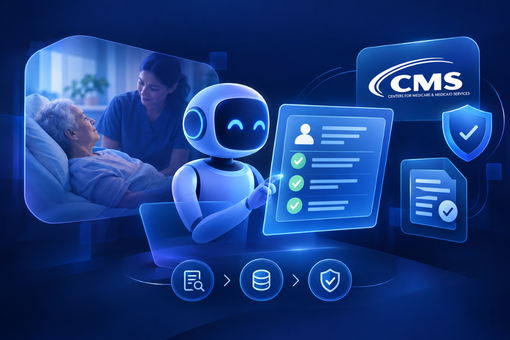
AI agents for hospice care work best as a governed layer on top of clean, traceable data. They handle eligibility checks, family communication, and documentation support while physicians and nurses keep every clinical decision. Here is where agents are safe to deploy, what CMS and OIG expect to see, and how to evaluate a vendor before the first pilot.
Introduction
Hospice sits under a brighter spotlight than it has in years. CMS now screens Medicare claims with AI and machine-learning models, and its August 2026 update tied more than $23 million in suspended payments to suspect hospice providers to the Fraud Defense Operations Center. Patients and families feel that pressure first, because a delayed certification or a missing election statement can push back the start of comfort care. Physicians and nurses feel it next, in the hours they spend proving on paper what they already did at the bedside.
AI agents for hospice care are the answer many COOs and CIOs are weighing. An agent reads a referral, checks it against CMS criteria, routes exceptions to a person, and logs every step it takes. Agentic AI in healthcare only works when the data beneath it is accurate and traceable, which is why most hospices start with a CMS-ready data foundation.
Six questions come up in nearly every executive conversation on the subject. Where does the agent layer sit? Which tasks can it own? What stays with clinicians? How will CMS and OIG judge it? What belongs in a vendor evaluation? And how should the rollout be sequenced? Each gets a direct answer below.
What are AI agents for hospice care, and where do they sit in the data stack?
AI agents for hospice care are software workers that take a defined task, such as validating a referral against CMS criteria, and carry it through several steps using governed data and approved tools. They sit above the data foundation and below the clinician, suggesting and validating work that a person approves.
Picture the stack in four layers. The data foundation cleans and traces records from the EHR, billing, and referral systems. Analytics sits on top and produces forecasts such as length of stay and staffing demand. The agent layer acts on those governed outputs. Clinicians and the interdisciplinary group (IDG) hold the decisions, so they sit above everything.
| Layer | What it does | Who owns it |
| Data foundation | Unifies EHR, billing, and referral data with lineage from source to report | CIO and data team |
| Analytics | Forecasts length of stay, referral volume, and staffing demand | COO and finance |
| Agent layer | Screens eligibility, answers family questions, drafts documentation | COO and CIO, with compliance |
| Clinical decisions | Prognosis, certification, plan of care, and symptom management | Physicians, nurses, IDG |
Each layer leans on the one below it. Leaders who already trust their forecasts leadership can defend will find agents easier to govern, because the lineage behind a forecast also backs an agent’s decision log.
The reverse holds too. An agent fed duplicate patient records or stale referral statuses produces confident errors at machine speed.
How do AI agents improve hospice operations while staying CMS-compliant?
They stay compliant by design when each agent follows a suggest, validate, execute pattern. The agent proposes, rules and CMS criteria validate, and a named person approves before anything is written back to the record. Every step is logged, so the audit trail exists before a surveyor asks for it.
Five controls make that pattern auditable:
- Scoped permissions. Each agent reads and writes only the fields its job requires.
- Rule validation. Outputs are checked against 42 CFR 418.22, the applicable local coverage determination (LCD), and your own policies before anyone sees them.
- Human approval. A named clinician or staff member signs off on anything that touches a certification, a claim, or the plan of care.
- Decision logging. Inputs, rules applied, outputs, and approver identity are recorded for every action.
- Data provenance. Every fact the agent cites traces to a source record and its transformation history.
That last control is where a strong foundation pays off. A reviewer who asks why the agent flagged a referral should be able to follow the answer back to the source document in minutes, which is the standard behind audit-ready data lineage.
The operational gains land in specific places: faster first-pass intake review, fewer incomplete packets reaching the physician, shorter waits for families, and fewer evening hours spent charting. None of them needs the agent to make a clinical call.
Which hospice tasks can an AI agent handle, and which stay with clinicians?
Agents suit work that is repetitive, rule-based, and easy to verify: checking packets for completeness, tracking deadlines, drafting from structured data, and answering routine questions. Judgment calls on prognosis, symptoms, and the plan of care stay with licensed clinicians.
| Task | What the agent does | What a person owns |
| Referral eligibility screening | Extracts packet data, checks completeness, scores against criteria, returns a status with reasoning | Physician judges prognosis and certifies. Staff resolve Pending Review cases. |
| Certification of terminal illness | Flags a missing narrative, signature, or date | Physician writes the narrative and signs |
| Election statement addendum | Confirms the addendum was delivered and logged for each election | Admissions staff deliver and explain it |
| Family questions and scheduling | Answers routine questions, confirms visits, routes after-hours messages | Nurse takes any symptom, distress, or care-plan question |
| Visit documentation | Drafts notes and IDG summaries from visit data | Clinician reviews, edits, and signs |
| HOPE completeness | Watches for missing items and approaching 30-day deadlines | Clinician completes assessment items |
The FY2027 hospice final rule shows why the last three rows matter. CMS made the election statement addendum mandatory for every hospice election, and HOPE quality data must be submitted within 30 days of the admission, HOPE Update Visit, and discharge dates. Both are tracking problems, and tracking is what agents do well.
How do eligibility agents verify hospice eligibility against CMS criteria?
An eligibility agent pulls the referral packet, extracts the clinical and administrative data, and checks completeness against the 42 CFR 418.22 requirements and the applicable LCD. It then returns Eligible, Pending Review, or Ineligible with its reasoning. The physician still certifies terminal illness and writes the narrative.
Terminal-status criteria vary by Medicare Administrative Contractor (MAC) jurisdiction and diagnosis, so the scoring rules have to follow whichever LCD governs the patient. Clinical leadership writes those rules. The agent applies them the same way on every referral, every shift.
The cost of inconsistent review is documented. In its June 2026 audit of hospice payments for new enrollees, the HHS Office of Inspector General found that 45 of 100 sampled initial certification periods did not meet Medicare requirements. Twenty-one lacked clinical information that supported a terminal illness, and 24 fell short on eligibility documentation, including missing election statements and certifications. OIG estimated Medicare could have saved $255.1 million with eligibility reviews aimed at this group, and CMS agreed to share the findings with the hospice MACs.
Those are the gaps an agent can catch before a claim exists: a missing signature, an absent election statement, a narrative with no mention of functional decline. An agent can show the physician exactly where the record is thin.
At Caregence, this takes first-pass review from 30 to 90 minutes of manual work down to under five minutes per determination (Inferenz-reported). The full workflow, including the pipeline steps and a 90-day pilot plan, is covered in hospice eligibility agents that automate intake validation against CMS criteria.
Where do conversational agents help patients and families, and where should humans take over?
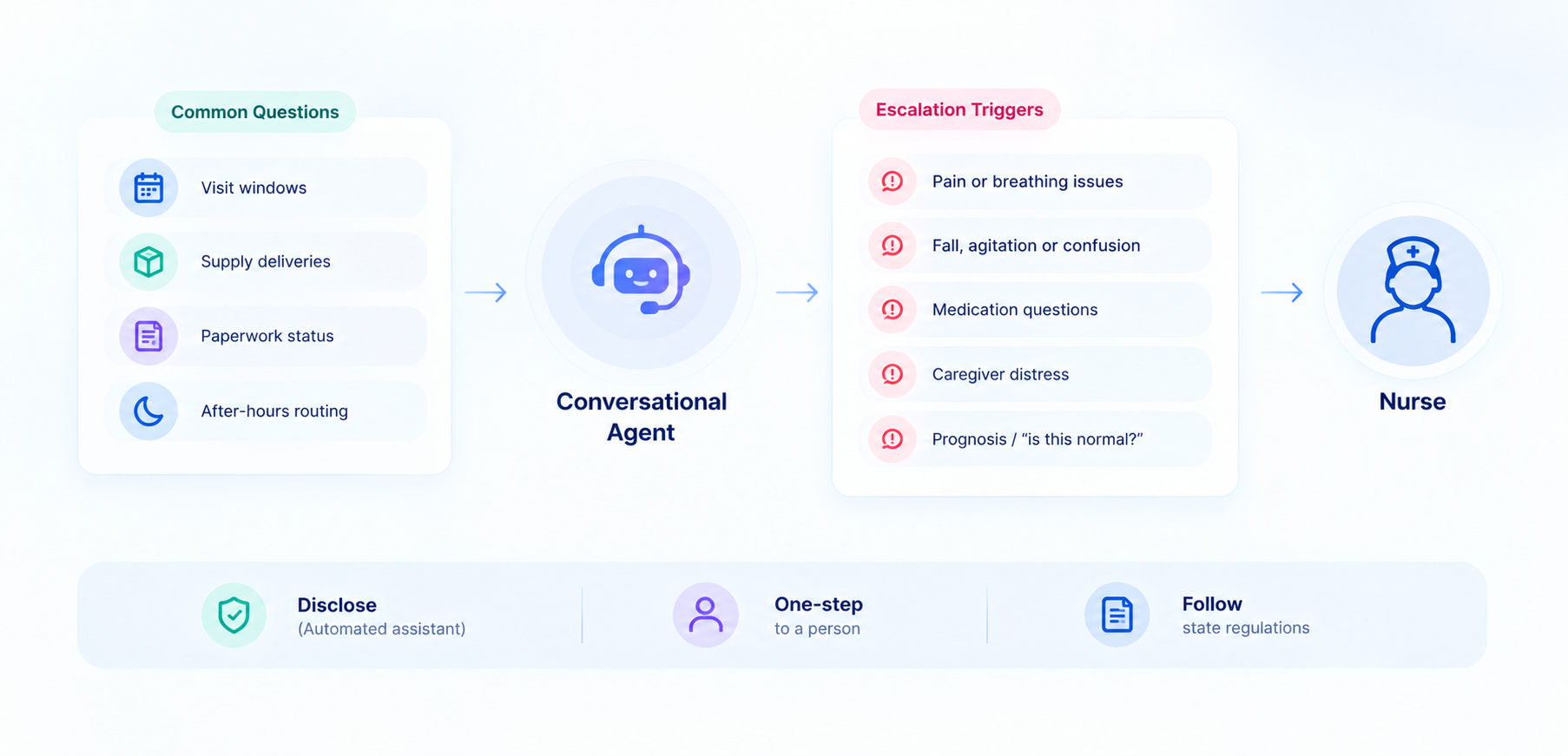
Conversational agents help most with high-volume, low-risk questions: visit windows, supply deliveries, paperwork status, and after-hours routing. They hand the conversation to a nurse the moment a message signals symptoms, distress, or a clinical decision, and they never give medical advice.
Write the escalation triggers down before launch. A message should reach a nurse immediately when it mentions:
- new or worsening pain, or trouble breathing
- a fall, agitation, or confusion
- any question about medications or dosing
- caregiver exhaustion or distress
- prognosis, or any question that starts with “is this normal?”
Families should know they’re talking to an automated assistant and have a one-step path to a person. State disclosure rules for AI are still taking shape, so check the requirements in every state you serve with counsel.
Done well, the agent absorbs the repetitive calls that interrupt nurses and gives families an answer at midnight. The boundaries matter as much as the capability, and the detailed split between what to automate and what to keep human sits in AI agents for patient and family engagement in hospice care.
Can AI documentation agents reduce charting time without creating audit risk?
Yes, when the agent drafts and a clinician verifies. Documentation agents turn visit data into draft notes, IDG summaries, and HOPE-ready fields. Audit risk appears when a draft reads smoothly but drifts from the patient’s actual decline, so every draft must trace to source data and carry clinician sign-off.
Polished language is the trap. A note can look complete and still describe a patient better than the record supports, a pattern examined in when AI documentation looks perfect and still fails a hospice audit. Four guardrails keep drafts honest:
- Every drafted sentence links to the visit data or assessment it came from.
- The clinician edits and signs, and the system records who approved and when.
- Copy-forward language triggers a flag.
- Drafts that contradict structured data, such as a PPS score, are held for review.
Charting time falls when those guardrails sit inside the workflow. The full playbook for clinical AI documentation agents that reduce charting time without compliance risk covers accuracy first and speed second.
What governance does an AI agent need to satisfy CMS, OIG, and your board?
An agent needs five things: a defined scope, human approval points, a decision log, documented data provenance, and a named executive owner. If any one is missing, a reviewer has nothing to inspect and your board has nobody to ask.
OIG’s seven elements of an effective compliance program already apply to AI. Written policies, a compliance officer, training, open lines of communication, monitoring, enforcement, and prompt corrective action each have an agent equivalent: an agent policy, an accountable owner, override training for staff, a channel for reporting bad outputs, a monthly sample review, consequences for bypassing controls, and a way to retire a misbehaving agent. HIPAA adds a business associate agreement (BAA) with any vendor touching PHI, and the design side is covered in trusted agentic AI beyond HIPAA compliance.
Use these questions in every vendor evaluation:
| Ask the vendor | A strong answer looks like |
| Where does PHI go, and who can see it? | A signed BAA, defined data residency, and zero data retention by model providers |
| Can we see every decision? | Searchable logs showing inputs, rules applied, output, and approver |
| What happens at low confidence? | Automatic routing to a person, with the uncertainty shown |
| Which actions run without a human? | A short written list, limited to low-risk tasks and approved by compliance |
| How are model changes handled? | Versioned releases, documented changes, and re-testing before go-live |
| Does it work with our EHR? | Read and write integrations with current systems, no rip-and-replace |
Boards ask the same thing in different words: how do we know the agent is behaving? The answer is a governance framework with owners, metrics, and a review cadence, which responsible AI governance for agentic systems in regulated healthcare sets out in full.
How is CMS using AI, and what does that mean for hospice leaders?
CMS applies AI and machine-learning models to Medicare fee-for-service claims to flag unusual billing patterns, and flagged claims can be held, rejected, or denied before funds are released. Hospice leaders should assume their claims are already read by a model.
The numbers show the scale. Since January 1, 2026, the Fraud Defense Operations Center has accounted for more than $371 million in suspended payments involving 267 providers and suppliers, including more than $23 million tied to suspect hospice providers (CMS, August 2026). In May 2026, CMS also announced a six-month nationwide moratorium on new hospice and home health agency enrollments and said it would deploy advanced data analytics during that period. Existing agencies can keep serving beneficiaries.
Two things follow for the executive team. Review that happens before a claim is billed lets you find the same patterns CMS’s models look for. And agencies that can show sourced, transformation-tracked reporting on demand spend less time defending themselves, which is the case for audit-ready dashboards for CMS and compliance reviews.
How should hospice leaders measure the ROI of AI agents?
Measure agents against a baseline captured before go-live. COOs get the clearest picture from five operating metrics, each tied to a workflow the agent touches.
| Metric | What it tells you |
| Referral-to-admission time | Whether intake delays are shrinking for referral sources and families |
| First-pass review turnaround | How fast a referral gets a status the physician can act on |
| Share of referrals complete at admission | Whether documentation gaps are caught before they reach a claim |
| Clinician charting minutes per visit | Whether time returns to patient care |
| Staff override rate | How often people correct the agent, and whether quality drifts |
Watch the override rate closely. A rate near zero can signal rubber-stamping, and a rate that keeps climbing signals drift. Both deserve a review, and the wider operating case is laid out in how agentic AI is easing admissions, compliance, and documentation in hospice care.
How should a hospice phase its first AI agent rollout?
Start narrow, prove the controls, then widen. A five-step sequence works for most organizations:
- Confirm data readiness. Check record matching, referral status accuracy, and lineage before any agent touches production, because hospice AI projects that skip data readiness tend to stall.
- Pilot eligibility screening. Run one team in suggest-only mode for 90 days, with physician approval on every status.
- Add family engagement. Cover routine questions first, with written escalation triggers and disclosure language.
- Add documentation support. Begin with one discipline, and require source-linked drafts and clinician sign-off.
- Review governance quarterly. Re-check logs, override rates, and vendor changes with compliance and the board.
CIOs sequencing work across departments can borrow the wider planning model in agentic AI in healthcare and how CIOs plan implementation across departments.
Final thoughts
Agents earn their place in hospice when they remove clerical delay and leave judgment where it belongs. Organizations that move well share three habits. They build on governed data, they keep a named person accountable for every consequential output, and they can show a reviewer how any decision was made.
CMS is reading claims with AI. Hospice leaders can read their own records first.