










Responsible AI Governance for Agentic Systems in Regulated Healthcare

Summary

Agentic AI systems act on patient records, send messages, and write to your EHR, so governing them takes more than a model review. This guide gives hospice and healthcare leaders one program that combines NIST, Joint Commission and CHAI guidance, and HIPAA through autonomy tiers, least-privilege access, and agent-level audit trails. It also covers who owns governance, how to find shadow and vendor-embedded AI, and a 90-day plan for a right-sized start.

Introduction

Healthcare AI has moved from tools that suggest to systems that act. AI in hospice care now reads referral packets, drafts HOPE documentation, matches caregivers to visits, and messages families. When an agent gets one of those steps wrong, the error repeats across every referral and every family it touches before a person sees it. Patients and clinicians feel that first.

Oversight is arriving in pieces. The Joint Commission launched a voluntary Responsible Use of AI in Healthcare (RUAIH) certification on June 1, 2026. NIST opened its AI Agent Standards Initiative in February. And on October 28, HHS published the HTI-5 final rule, which strips the model card and risk management requirements for predictive decision support out of ONC’s certification criteria. The transparency requirement inside your EHR just got smaller, so more of the proof now has to come from you.

This guide is for COOs, CIOs, compliance officers, and boards at hospice care agencies and other regulated providers who need a defensible answer to one question: what governance has to exist before an agent is allowed to act? It’s part of our series on AI agents for hospice care operations, and the hub article, How AI Agents Improve Hospice Operations While Staying CMS-Compliant, covers the wider agent layer. Here we focus on the program behind it: the frameworks, controls, and evidence that make AI-powered automation for hospice defensible.

What is agentic AI governance in healthcare?

Agentic AI governance in healthcare is the combination of policies, named owners, technical controls, and evidence that decides what an AI agent may do, who answers for it, and how you prove it afterward. It needs its own treatment because of how agents work. Generative AI produces text or a summary for a person to use. An agent plans a multi-step task, calls tools, reads records from several systems, and writes results back. Governance has to attach to what the agent does.

Picture a healthcare ready AI agent in a hospice workflow. It reads a referral, scores it, updates a status field, and emails a nurse. That’s four actions, three systems, and one chain of accountability. The table shows how the control point shifts compared with the AI you may already govern.

Predictive modelAI scribeAI agent
What it producesA score or forecastA draft note or summaryActions: reads, decides, writes, and sends across systems
Where the risk sitsAccuracy and bias of the scoreAccuracy of the draft and clinician sign-offPermissions, tool use, chained errors, and who approved what
Main controlValidation and drift monitoringClinician review before signingAutonomy tiers, scoped identity, action-level logs, kill switch
Evidence an auditor asks forValidation resultsReview and edit historyA full action trail per run, tied to a named owner

Which framework should you build on: NIST AI RMF, Joint Commission and CHAI, or ISO 42001?

A responsible AI governance framework for healthcare doesn’t need to be invented from scratch. Three sources cover most of it, and each does a different job.

The NIST AI Risk Management Framework gives you the shared language for risk: Govern, Map, Measure, and Manage. It’s voluntary and technology-neutral, so it tells you to map and measure risk without telling you how to give an agent its own identity or cap what it can touch. That’s the gap NIST is working on now. Its Center for AI Standards and Innovation launched the AI Agent Standards Initiative on February 17, 2026, with a request for information on agent security and a concept paper on agent identity and authorization. Until those standards land, NIST AI RMF healthcare programs need agent-specific controls added on top.

The Joint Commission and CHAI guidance, released in September 2025, supplies the healthcare operating checklist. It sets out seven elements. The table translates each one into what it means when the AI in question can act.

ElementWhat the guidance asksWhat it means for an agent
1. AI policy and governance structuresPolicies, plus a governance body that keeps leadership informed of uses and outcomesA committee, an agent register, and a named owner for every agent
2. Patient privacy and transparencyData access and use policies; tell patients when AI directly affects their careDisclosure language for patient-facing agents; minimum-necessary access
3. Data security and data use protectionsSecurity policies and limits on how exported data is usedAgent credentials, encryption, and vendor terms that cover agent data
4. Ongoing quality monitoringVendor validation information and risk-based monitoring after deploymentDrift and override tracking after go-live, tied to pause thresholds
5. Voluntary, blinded reporting of AI safety eventsShare events with an independent body such as a patient safety organizationAn internal event process that feeds external reporting
6. Risk and bias assessmentA process to find and address risk and bias in AI toolsBias checks on any agent that influences access to care
7. Education and trainingTrain users on benefits and risksRole-specific training for staff who approve or override agent actions

In June 2026 the Joint Commission turned that guidance into the voluntary RUAIH certification. It’s organized around five areas: governance; effective data management; risk and bias reduction; monitoring, evaluating, and validating performance; and transparency, education, and training. It assesses how an organization uses AI and doesn’t certify individual products. You don’t need Joint Commission accreditation to apply. CHAI, the author of the Blueprint for Trustworthy AI and the governance playbooks the certification builds on, said the two are tightly aligned.

Should you pursue RUAIH certification or ISO 42001?

ISO/IEC 42001 is the international standard for an AI management system, and it can be certified in any industry. It makes sense when payers, enterprise partners, or a parent company ask for it. Most hospice care agencies will get further, faster by treating the five RUAIH areas as the internal audit checklist for their own program, then adding ISO 42001 later if a customer requires it. Decide on certification after the program has run for a full quarter and produced real evidence.

What makes agentic AI risk management different from other healthcare AI?

Agents add failure modes that a model review never tests. OWASP’s Top 10 for Agentic Applications (2026 edition) lists goal hijack, tool misuse and exploitation, and identity and privilege abuse among its leading risks. Here’s how those and three related risks show up in hospice operations, and the control that answers each.

RiskExample in hospice operationsControl
Prompt injection and goal hijackA scanned referral packet or inbound email carries text telling the agent to ignore your criteriaTreat documents as data, keep instructions separate, require human approval on status changes
Tool misuseAn agent with EHR write access updates fields beyond its taskScoped tool permissions, an allow-list of actions, rate limits
Identity and privilege abuseThe agent runs on a shared service account or a staff member’s loginA unique agent identity, time-bound credentials, least-privilege access
Persistent memory riskAn agent carries one patient’s details into another patient’s sessionTask-scoped memory, retention limits, nothing carried between patients
Multi-agent delegationAn intake agent hands off to a scheduling agent and nobody owns the combined resultOne named owner for the whole workflow, with the full chain logged
Drift and biasReferral formats or patient mix shift after go-liveSampled review against clinician-confirmed values, subgroup checks

Fragmented accountability is the risk leaders underrate. When three agents each do something reasonable and the combination harms a patient, an auditor will ask who approved the chain. A workflow owner is the answer.

What autonomy levels should you allow, and what must always need a human?

Autonomy works like a dial, and your committee should set it use case by use case. This four-tier model is a practical starting point for human-in-the-loop design.

TierWhat the agent may doHospice exampleOversight
1. RecommendPrepares analysis or a draft; a person takes every actionHOPE documentation draft, IDG pre-meeting summaryClinician reviews and signs
2. Act with approvalCompletes the task up to the final step; a person approves before it takes effectEligibility screening returns Eligible, Pending Review, or Ineligible; the status applies after approvalNamed approver for each decision
3. Act within guardrailsActs alone inside narrow, pre-approved limits; exceptions escalateAppointment reminders, document requests to referral sourcesSampled review and exception alerts
4. Monitor and alertRuns continuously on non-patient-facing data and raises alerts onlyData quality checks, cap exposure alertsThreshold alerts and periodic audit

Some actions should stay with a person at every tier. Our recommended minimum list:

  • Prognosis and certification of terminal illness. Federal rules put certification with a physician.
  • Admit and decline decisions.
  • Any entry in the legal medical record without a clinician’s signature.
  • Patient or family communication about prognosis or end-of-life decisions.
  • Claims or attestations sent to a payer.
  • Changes to an agent’s own criteria, permissions, or tier.

The stakes show in the audit data. An HHS OIG audit published in June 2026 found that 45 of 100 sampled initial hospice certification periods, drawn from fiscal year 2021 claims, didn’t meet Medicare requirements. An agent that screens at scale multiplies whatever standard it’s given, good or bad. Build a kill switch and a tested rollback path before go-live: one control that pauses the agent and a way to reverse its recent writes.

What identity and permissions should an AI agent have?

Give every agent its own identity, and give that identity the least access that lets it finish one task. Shared service accounts and borrowed staff logins break accountability, because the log then shows a person doing something a machine did. Least privilege also matches HIPAA’s minimum necessary standard. An agent preparing a discharge summary has no reason to read every chart in the EHR.

NIST’s agent identity work frames the problem as identification, authorization, auditing, and non-repudiation. In practice that means separate read and write scopes, credentials that expire per task, an allow-list of the tools each agent may call, and an approval gate on any write to a legal record.

We build Caregence agents around minimum-necessary access and role-based permissions, with secure identity management in place of shared credentials and every agent action logged. Whatever platform you choose, ask the vendor to show you those controls in a working environment.

What audit trail should every agent action produce?

If an agent’s action can’t be reconstructed, it can’t be defended. Each run should leave a record that answers who, what, when, under which rules, and who approved. The HIPAA Security Rule’s audit controls standard (45 CFR 164.312(b)) already expects activity in systems holding ePHI to be recorded and examined. Agent runs make that expectation concrete at the tool-call level.

Log fieldWhy it matters
Agent identity, model, and configuration versionShows exactly which system and rules acted
Source records and documents readTies the output to its evidence
Tool calls: system, action, and fields read or writtenGives you action traceability
Criteria or rule version applied, with the factors behind the resultLets you explain the outcome to a reviewer
Human reviewer, decision, and timestampProves a person approved where policy requires one
Overrides, exceptions, and escalationsShows the guardrails worked
Tamper-evident storage and retention periodSupports non-repudiation: nobody can quietly alter the record

Logs show what the agent did. Lineage shows where its inputs came from, and a CMS or MAC reviewer will want both. If your source data can’t be traced, a perfect action log still leaves a gap, which is why audit-ready data lineage belongs in the same program.
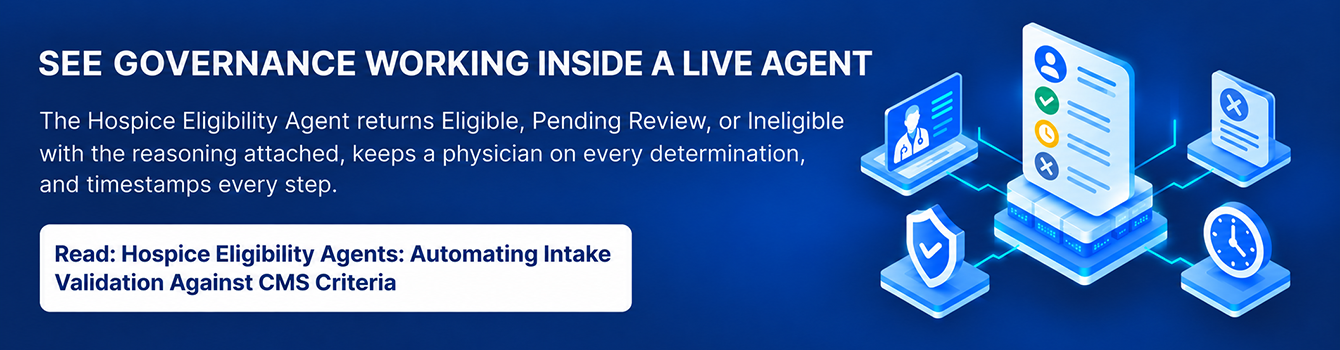
See governance working inside a live agent

How do you handle shadow AI and AI embedded in vendor products?

You can’t govern what you haven’t listed. Start an AI register that covers three groups: tools you built or bought for AI use, AI features switched on inside vendor products such as your EHR, CRM, and billing platform, and public tools staff use on their own, often called shadow AI. Pull from procurement records, vendor release notes, single sign-on and network logs, and a short staff survey.

Each register entry should carry the same fields:

  • Business owner and purpose
  • Whether it touches PHI, and the status of the business associate agreement
  • Autonomy tier and the actions it can take
  • Vendor validation and bias information on file
  • Last validation date and next review date

Ask every vendor how the tool was tested and validated, how bias was evaluated, and whether they’ll validate on a sample from your own population. The Joint Commission and CHAI guidance recommends exactly that posture in procurement. With HTI-5 trimming model card requirements for certified health IT, write those disclosures into the contract.

A register works best when data owners and stewards already exist. That foundation is the subject of our guide to data governance and CMS compliance frameworks for hospice organizations.

How do HIPAA, FDA rules, HTI-5, and state AI laws fit into one program?

AI governance for regulated healthcare gets simpler when you treat these as lenses on the same agent instead of separate projects. Run every new use case through one screen at intake, then apply the controls from the sections above.

AuthorityWhat it asks of agent programsWhere it lands in your program
HIPAAPHI used by agents and their vendors falls under the Privacy and Security Rules, including business associate agreements, minimum necessary use, and audit controlsScoped identity, action logs, vendor contracts
FDAThe January 2026 Clinical Decision Support Software guidance clarifies which decision support functions are devices. Updates to AI-enabled device software can be pre-authorized through a predetermined change control planA classification question at intake. Administrative agents usually sit outside device rules, but ask it for any agent that recommends patient-specific clinical action
ONC HTI-1 and HTI-5HTI-1 created decision support intervention transparency criteria for certified health IT. HTI-5 removes the model card and predictive risk management requirementsContract demands on EHR vendors and your own model documentation
Section 1557 (45 CFR 92.210)Covered entities must make reasonable efforts to identify and mitigate discrimination risk in patient care decision support toolsBias checks on any tool that influences access to care
State AI lawsA moving patchwork. Colorado replaced its 2024 AI Act with the narrower SB 26-189 on May 14, 2026A state matrix that counsel reviews each quarter
CMS program rulesHospice certification and documentation standards still apply to agent-prepared recordsPhysician certification, human sign-off, audit-ready records

HTI-5 deserves a closer look because it’s brand new. The final rule, published in the Federal Register on October 28, 2026, revises the decision support criterion that HTI-1 introduced in 2024. ONC said it found no evidence that the transparency requirements had improved patient care, and it reminded users of certified health IT of their duty to identify bias in predictive tools and avoid discrimination under Section 1557. The rule adjusts certification criteria for health IT developers. It doesn’t change your own HIPAA or Section 1557 obligations.

Who should own AI governance: compliance, the CIO, the CMIO, or a committee?

A cross-functional AI governance committee owns the policy, and named individuals own each agent. The Joint Commission and CHAI guidance points to executive leadership, compliance and ethics, IT, cybersecurity, safety and incident reporting, and clinical and operational leaders. For hospice care agencies and hospitals alike, the roles divide like this.

RoleOwns
CEO or COO (executive sponsor)Risk appetite, resourcing, and accountability to the board
CIO and CISOAgent identity, access, logging, and vendor security
Compliance and privacy officerThe regulatory map, HIPAA, Section 1557, state law, and audit readiness
Medical director or CMIOClinical safety, autonomy tier decisions, and what always needs a physician
Legal counselVendor contracts, liability allocation, and disclosure language
Workflow ownerDay-to-day performance of one agent and its end-to-end workflow
Board or board committeeQuarterly oversight report and approval of high-risk use

Who answers when an agent errs and a clinician or staff member relied on it? The organization that deployed it, because patients and regulators hold the provider responsible whatever the vendor contract says about sharing costs. Liability turns on the facts and on state law, so take specific scenarios to counsel. What you can control is the record: a policy that says staff remain responsible for decisions they sign, that agent output is decision support, and that every reliance and override is logged.

Boards should ask for four numbers each quarter: agents in production by tier, overrides and exceptions, safety events and near-misses, and open vendor gaps.

How do you monitor agents after go-live and report AI safety events?

Go-live is where the real testing starts. Track four signals: accuracy against clinician-confirmed samples, override and exception rates, input drift such as a new referral source format, and outcomes across patient groups. Set thresholds that pause the agent, automatically or through a named person, and test the rollback before you need it.

The Joint Commission and CHAI guidance treats AI safety events like patient safety events and encourages voluntary, blinded reporting to independent bodies such as patient safety organizations. Build the internal side first. You need a simple intake form, a definition that includes near-misses, a review within a set number of days, and a no-blame rule. People report what they won’t be punished for reporting.

What does a right-sized AI agent governance framework look like in 90 days?
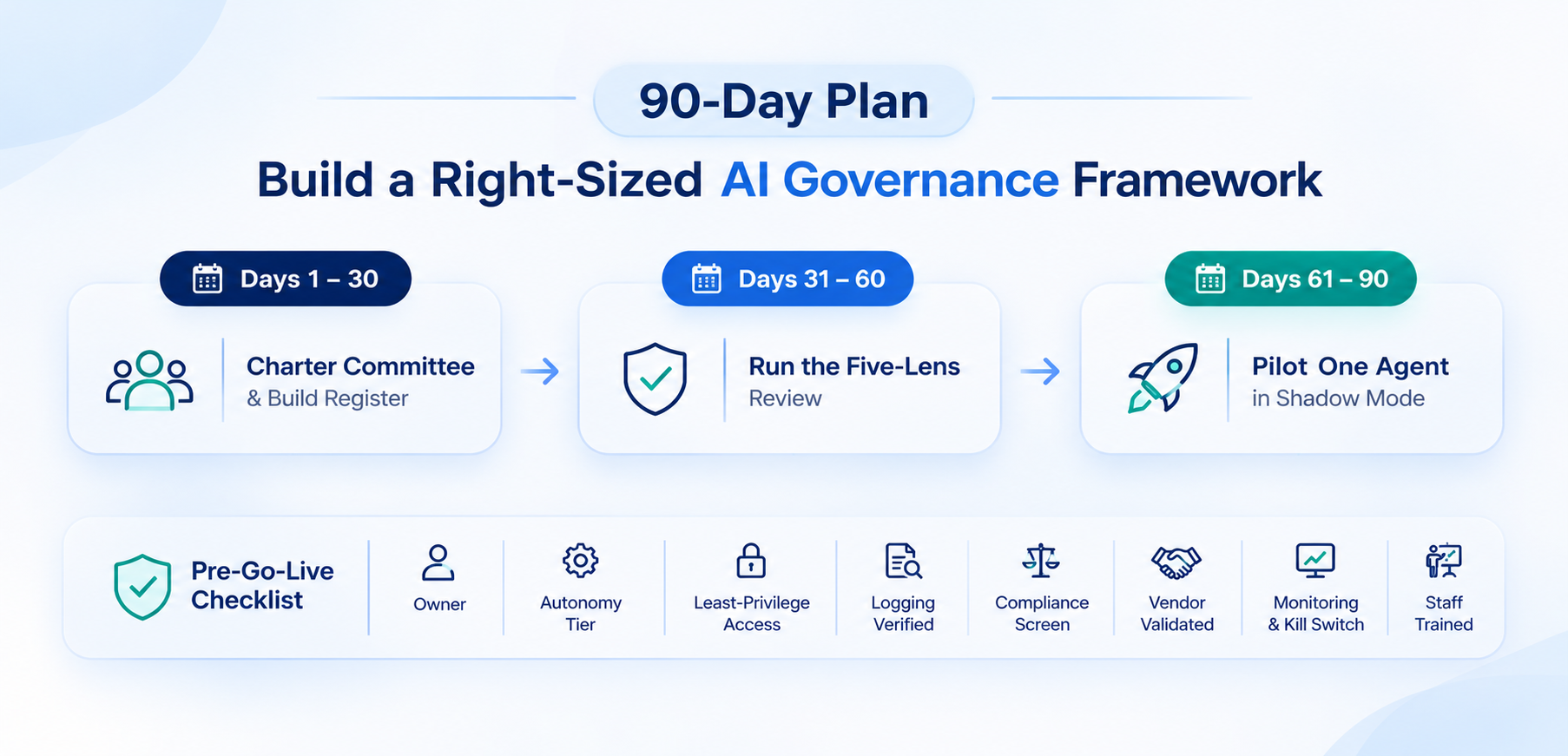
What does a right-sized AI agent governance framework look like in 90 days?

A mid-size provider or payer doesn’t need a large team. A committee that meets monthly, one register, and one standard for logs and permissions cover most of the ground.

  1. Days 1 to 30: Charter the committee and name an executive sponsor. Adopt a one-page AI policy and the four autonomy tiers. Build the AI register from procurement, vendor, and sign-on data.
  2. Days 31 to 60: Run every register entry through the five-lens screen: HIPAA, FDA, HTI-5, Section 1557, and state law. Set the logging and permissions standard. Send vendor questionnaires covering validation, bias testing, and model documentation.
  3. Days 61 to 90: Pilot one Tier 2 agent in shadow mode with monitoring thresholds, a tested kill switch, and the safety-event form live. Deliver the first board report.

Before any agent goes live, confirm each item on this checklist:

  • A named workflow owner and approver
  • An autonomy tier approved by the committee
  • A unique agent identity with least-privilege scopes
  • Action-level logging verified in a test run
  • The HIPAA, FDA, Section 1557, and state-law screen documented
  • Vendor validation and bias information on file, and a signed business associate agreement
  • Monitoring thresholds, kill switch, and rollback tested
  • Staff trained to approve and override

Final thoughts

Agents will keep getting more capable, and regulators are still writing the rules. The programs that hold up share three habits. They tier autonomy by risk, they give every agent its own identity, and they keep a record good enough to hand a surveyor. Start with one agent, one owner, and one audit trail, then widen the circle.
Planning your first governed agent?

Frequently Asked Questions

NACH 2026 Key Takeaways: What Hospice and Home Health Leaders Should Act On

Introduction

Care at home is no longer a side channel of American health care. It’s where patients want to be, where payers want to see value, and where regulators are looking hardest for proof that every dollar reaches a real patient. That convergence defined NACH 2026, the National Alliance for Care at Home Annual Meeting & Expo in Washington, DC, held October 27 to 30.

Over four days, executive leaders from home health, hospice, palliative care and home care worked through AI, enrollment policy, serious illness care and the workforce that holds it all together. Three threads ran through the week: concrete AI use cases, a close look at federal program integrity priorities, and a steady focus on the mission, from honoring veterans to supporting families.

The takeaways below pull those threads into seven points leaders can act on, followed by the questions the industry is still asking.

Turning conference notes into a 2027 plan?

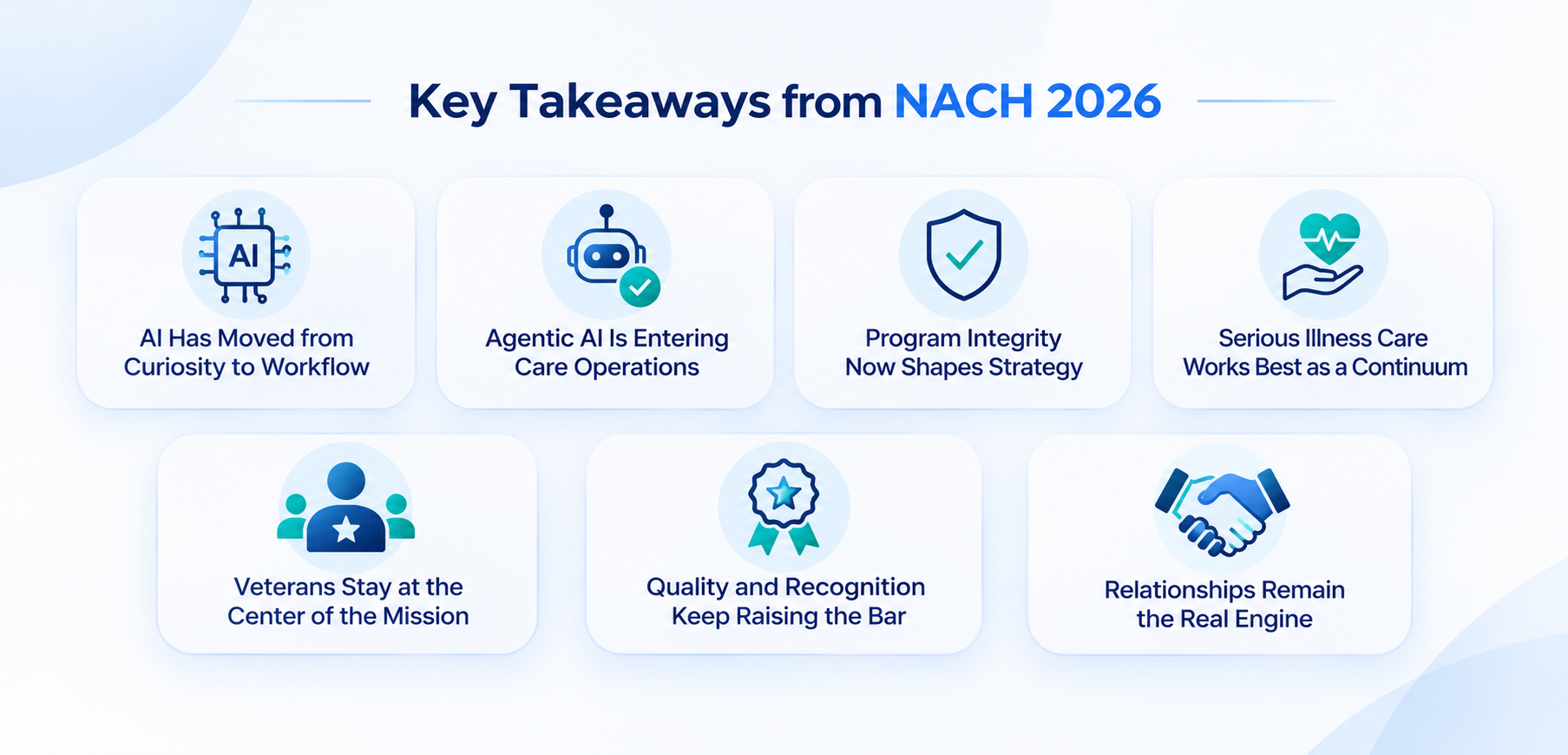
Key Takeaways from NACH 2026

Key Takeaways from NACH 2026

1. AI Has Moved from Curiosity to Workflow

The AI conversation got specific this year. Leaders talked about automating eligibility verification, authorizations and coordination of benefits, the repetitive checks that eat clinical and administrative hours. The promise is simple. Take administrative burden off the team, and clinicians spend more time with patients.

Data decides how far any of this goes. Plenty of hospice AI projects fail without data readiness, because a model can only work with what the EMR, billing and referral systems hand it. Clean, connected data comes first. The tools follow.

Where to start

Pick one administrative workflow, set a baseline and measure time saved per case. A narrow pilot teaches more than a broad rollout.

2. Agentic AI Is Entering Care Operations

Agentic AI, meaning systems that can learn, make decisions and act on routine tasks, drew serious attention. The appeal for home care and hospice is plain. Staffing is tight everywhere, and software that works alongside care teams can take on intake work such as eligibility verification and prior authorization, and support scheduling. Our strategic framework for agentic AI in home care operations is a good place to see where it fits.

3. Program Integrity Now Shapes Strategy

Federal policy was the loudest topic in the building. CMS used its panel time to discuss the nationwide enrollment moratorium for hospices and home health agencies. So far, 250 home health agencies and 50 hospices have been blocked from enrolling, and any extension has to run in six-month periods.

CMS is weighing geographic limits and a “gold card” for providers with strong compliance records, and it acknowledges that some compliant providers get caught in the net, even if most are untangled. The Alliance backs the fight against fraud and calls the nationwide pause overly broad, with a real risk of care gaps in rural areas where home health access is already tight. Home Health Care News covers the panel for the full details.

What this means for compliant agencies

Expect closer attention to documentation, ownership and billing patterns. Agencies with clean, consistent records should find reviews easier. Those without them will feel the pressure first.

4. Serious Illness Care Works Best as a Continuum

Home health, specialty palliative care and hospice deliver the most when they operate as one continuum. Specialty palliative care bridges the gap before hospice, so patients get support earlier and families know what comes next. The same thinking extends to pediatric care, where children with medical complexities and their caregivers need support that spans programs.

5. Veterans Stay at the Center of the Mission

Honoring veterans ran through the week, from the recognition ceremony at the Alliance Foundation Gala to the keynotes and education sessions.

6. Quality and Recognition Keep Raising the Bar

Quality standards and recognition for end-of-life care shared the agenda with technology. A newly introduced award for excellence in end-of-life care, accreditation conversations and a closing look at the history of home care all pointed the same way: the workforce carries the load, and excellence deserves to be measured and celebrated.

7. Relationships Remain the Real Engine

Between sessions, leaders traded notes over dinners, receptions and breakfasts, and first-time attendees joined the conversation alongside long-time members. Collaboration across home health, hospice, palliative care and technology teams was a recurring theme in attendee recaps, and Seattle in 2027 is already on many calendars.

Questions Leaders Are Asking After NACH 2026

How will AI change eligibility and authorization work in home care and hospice?

It will take over the repetitive checks first. Eligibility verification, authorizations and coordination of benefits all follow defined rules, which makes them natural candidates for automation. Clinical judgment stays with the care team. The goal is to hand clinicians back the hours that paperwork now consumes.

How should agencies prepare for audits while program integrity pressure builds?

Start with documentation quality. Notes that read well can still miss what a reviewer needs. Our look at AI documentation that looks perfect and still fails a hospice audit digs into why polished documentation can still fail a review, and what compliance-first documentation requires.

How can home health, palliative care and hospice work as one continuum?

Build shared referral pathways and clear handoffs, then share the data behind them. Specialty palliative care works as a bridge before hospice, and that bridge only holds when each program can see the same patient story.

What Hospice and Home Health Leaders Should Do Next

  1. Check the data foundation. Map where eligibility, referral, clinical and billing data live, and fix the obvious gaps before buying any AI tool.
  2. Pilot one administrative workflow. Pick eligibility verification or prior authorization, set a baseline, and measure time saved per case.
  3. Tighten documentation and ownership records. Assume a closer look is coming and make clean records the default.
  4. Strengthen continuum partnerships. Agree on referral criteria and handoff steps with palliative, home health and hospice partners.

Inferenz helps hospice and palliative care organizations unify scattered data and add AI agents for referral intake, eligibility screening and audit readiness.

Summary: NACH 2026 in Seven Points

  • AI moved from curiosity to workflow, starting with eligibility, authorizations and coordination of benefits.
  • Agentic AI is entering care operations, and data readiness decides how far it goes.
  • CMS’s enrollment moratorium and the Alliance’s response kept program integrity high on the agenda.
  • Serious illness care works best as a continuum across home health, palliative care and hospice.
  • Veterans, quality and recognition keep the mission visible.
  • Relationships across the sector remain the engine of progress.
  • The next step for most leaders is one focused pilot on a clean data foundation.

Final Thoughts

NACH 2026 showed an industry holding two truths at once. Scrutiny is rising, and so is the promise of technology that gives clinicians their time back. The leaders who come out ahead will pick a few moves, fix their data, and keep the patient at the center. That list is a good place to start.

See agentic AI built for hospice and home care

Frequently Asked Questions

Top 10 Data Engineering Companies in 2027: Compared by Platform, Proof and Fit

Summary

Data engineering has grown from back-office plumbing into the foundation of every analytics and AI program, and US providers now compete on platform depth, migration speed and data quality.

The work done by the top 10 data engineering companies spans ingestion, integration, observability and cloud migration. Prospects match a partner to their platform and test it on their messiest source system before going ahead with them.

Introduction

For most of the last decade, data teams got judged on how much they could store. That has changed. The question in boardrooms now is how quickly a clean, trusted record can reach a dashboard, a model or an AI agent, and who answers when it can’t. Buyers have adjusted how they shop, and the phrase “data engineering companies” now covers everything from Snowflake specialists to global consultancies. Many of those buyers want a partner who’ll handle data engineering and integration from the first pipeline to the last monitoring alert.

The stakes are practical. Pipelines break, source systems disagree, and nobody enjoys explaining to a CFO why two reports show different revenue. A good partner takes that pain away. A weak one adds to it. This guide profiles ten US-based firms worth a place on your shortlist, explains how we picked them and shows how to match one to your stack.

Cost is the reason the choice matters. Gartner puts the average price of poor data quality at $12.9 million a year per organization, a figure it published in 2021 that planners still lean on.

Full disclosure: We kept the field to US-headquartered firms which are dynamic and futuristic in the data engineering domain and highly relevant to American buyers. We ranked every company on the criteria below.

Planning a data platform build or migration?

Top 10 data engineering companies at a glance

#CompanyBest forHeadquarters and proof points
1phDataSnowflake-centred programs that also need dbt and AWS depthMinneapolis, founded 2014, Snowflake Elite Services Partner, AWS Premier Partner
2Aimpoint DigitalAnalytics and data engineering on Snowflake or DatabricksAtlanta, founded 2017, Databricks Digital Native Partner of the Year in 2024, 2025 and 2026
3InferenzHealthcare, insurance and hi-tech teams with fragmented sourcesRound Rock, Texas, Founded in 2019, Snowflake, Databricks and AWS partner, 30+ accelerators
4KanerikaMicrosoft Fabric and Azure data modernizationAustin, founded 2015, Microsoft Top 1% partner (2024), Snowflake Select Tier Partner
5OneSixSnowflake-first data platforms for mid-market and enterprise teamsChicago, founded 2013, Snowflake Elite Partner
6ClearScaleCloud-native data platforms and application modernizationSan Francisco, founded 2011
7InterWorksAnalytics strategy with managed services behind itStillwater, Oklahoma, founded 1996
8IronsideEnterprise data and analytics on IBM technologyLexington, Massachusetts, founded 1999, 25+ years with IBM data and analytics products
9ConcurrencyEstablished consultancy for data and analytics modernizationBrookfield, Wisconsin, founded 1989
10Tray.aiLow-code integration and automation across SaaS applicationsSan Francisco, founded 2012


What do data engineering companies do?

Data engineering companies design, build and run the systems that move data from source applications into a form that analysts, models and AI agents can trust. The work usually covers five jobs:

  • Ingestion: pulling data from databases, SaaS tools, files and event streams on a schedule or in real time.
  • Transformation: cleaning, joining and modeling that data in a warehouse or lakehouse.
  • Integration: connecting systems so a change in one shows up in the others.
  • Quality and observability: testing data as it flows and alerting someone when it drifts.
  • Operations: running the pipelines, fixing failures and controlling cloud cost after launch.

The demand behind this work is easy to see. McKinsey’s 2026 State of AI survey found that nearly nine in ten organizations report regular AI use, and 37% of respondents attribute at least some EBIT impact to it. Every one of those systems runs on pipelines that somebody had to build.

How we ranked these data engineering companies

Dozens of firms claim data engineering as a specialty. We shortlisted US-headquartered companies of comparable scale with public evidence you can check, and each one met most of these six criteria:

  • Platform depth: named partner status with Snowflake, Databricks, AWS, Azure or Google Cloud, or a long record on a specific stack.
  • Integration reach: experience with legacy databases, SaaS tools, streaming sources and the awkward systems in between.
  • Built-in data quality: testing, deduplication and governance delivered with the pipelines.
  • Evidence: dated awards, named customers or published outcomes on the company’s own site.
  • Operating model: DataOps, observability and managed support after go-live.
  • Regulated-industry fit: controls that stand up to the HIPAA Security Rule and similar standards when your data includes patient or financial records.

We kept a firm on the list only when at least two independent sources agreed on its headquarters and founding year. Companies that have been acquired, or whose records conflicted, were left out. The ranking reflects editorial judgment and carries no numeric scores, and confirming every number in a pilot remains your job.

The 10 data engineering companies to know in 2027

The 10 data engineering companies to know in 2027

1. phData

Best for: Snowflake-centred programs that also need dbt, Fivetran and AWS depth.

phData was founded in 2014 and is headquartered in Minneapolis, with flagship offices in Uruguay and India. Its site lists data engineering, data migrations, analytics and generative AI among its services, and it carries Snowflake Elite Services Partner and AWS Premier Partner status. The company reports winning dbt Partner of the Year for the fourth year in a row in 2026.

Worth asking: how its team handles a legacy on-premises source that can’t move to the cloud yet.

2. Aimpoint Digital

Best for: analytics and data engineering programs on Snowflake or Databricks.

Aimpoint Digital was founded in 2017 and is headquartered in Atlanta. It describes itself as an analytics, data engineering and operations research firm, and lists Snowflake, Databricks, AWS, dbt Labs and Sigma among its partners. It reports Databricks Digital Native Partner of the Year awards in 2024, 2025 and 2026.

Worth asking: where its operations research work could add forecasting or optimization on top of the pipelines.

3. Inferenz

Best for: healthcare, insurance and hi-tech enterprises that need pipelines, integration and data quality delivered in one program.

Inferenz is a data and AI engineering company with US operations in Round Rock, Texas, and a team of 200+ specialists that also works from Ahmedabad and Pune. Its data engineering practice runs in five stages: discovery, architecture, pipeline development, integration and automation, and continuous operations under a DataOps model. Inferenz lists partnerships with Snowflake, Databricks and AWS.

Six reusable accelerators cover ingestion, pipeline automation, deduplication, observability, cloud integration and data quality. That toolkit keeps data quality, governance and compliance work inside the same engagement and shortens the path from raw feeds to reports people trust.

Worth asking: Inferenz reports a 96% client retention rate and 99% data accuracy and completeness across its work. Which accelerators apply to your sources, and what each one saves?

4. Kanerika

Best for: Microsoft Fabric and Azure data modernization.

Kanerika was founded in 2015 and is headquartered in Austin, Texas, with offices in India and Singapore. Its services span data platform migration, integration, governance and architecture, and it offers migration accelerators for Informatica, Tableau and Alteryx workloads. It reports joining Microsoft’s Top 1% partners in 2024 and holds Snowflake Select Tier status.

Worth asking: which migration accelerators apply to your current tools, and what manual work remains.

5. OneSix

Best for: Snowflake-first data platforms for mid-market and enterprise teams.

OneSix is a Chicago firm founded in 2013 and holds Snowflake Elite Partner status. It broadened its data engineering bench by acquiring CTI Data, so ask who from each team would staff your project. The firm focuses on modern data platforms, analytics and AI work for organizations that want a hands-on delivery partner.

Worth asking: how the CTI Data team and the original OneSix team share delivery on a new engagement.

6. ClearScale

Best for: cloud-native data platforms and application modernization.

ClearScale is headquartered in San Francisco and was founded in 2011. It is a cloud engineering firm, and its work often pairs data platform builds with application modernization. That pairing suits teams that need new pipelines and modernized applications at the same time.

Worth asking: how it divides work between platform engineers and data engineers on a joint project.

7. InterWorks

Best for: analytics strategy with managed services behind it.

InterWorks is headquartered in Stillwater, Oklahoma, and was founded in 1996. Its services include analytics strategy, data preparation, cloud migration, security and managed services. It lists Tableau, Microsoft, Sigma, AWS, Snowflake and Databricks among its partners.

Worth asking: how its managed services model handles incident response and cost reviews.

8. Ironside

Best for: enterprise data and analytics programs that run on IBM technology.

Ironside was founded in 1999 and is headquartered in Lexington, Massachusetts. It is an enterprise data and analytics firm and system integrator, and it points to more than 25 years of experience across IBM data, analytics and automation products. That history suits large organizations that run IBM stacks and want a partner who knows them well.

Worth asking: how its IBM-centred team approaches a move to a cloud-native warehouse.

9. Concurrency

Best for: an established consultancy for data and analytics modernization.

Concurrency is based in Brookfield, Wisconsin, and was founded in 1989, which gives it more than three decades of delivery history. It suits organizations that prefer a Midwest-based consultancy with deep experience in enterprise systems and a stable team.

Worth asking: which modern data platforms its current engineers have delivered in production.

10. Tray.ai

Best for: low-code integration and automation across SaaS applications.

Tray.ai is an AI orchestration and integration platform headquartered in San Francisco and founded in 2012. Its low-code tools let teams design workflows and manage integrations across IT, HR, support and other functions. It is a platform you operate, so compare it with a services partner on who maintains the workflows once they go live.

Worth asking: which connectors you need are native and which require custom work.

How to choose a data engineering company

Start with your platform, then look at your sources. That order removes more names from the list than any other filter.

  1. Define the outcome first. Write down the report, decision or AI use case the data has to serve, and the date it matters. A clear target shows which pipelines are urgent and which can wait, and it gives every vendor the same brief to answer.
  2. Map your platforms and sources. List the warehouse or lakehouse, the cloud, and every system that feeds it, including the awkward ones such as legacy databases, flat files and spreadsheets. Platform fit removes more names from a shortlist than any other filter, and the source list shows where the hard work will sit.
  3. Size the data quality problem. Profile a sample of your own data before the first call. Count duplicates, missing fields and conflicting definitions of the same metric. A partner who sees real numbers will scope the work more honestly than one who sees a slide.
  4. Shortlist on evidence. Look for dated proof on each firm’s own site, such as named partner tiers, awards and customer examples from your industry or stack. Confirm it with a second source, then ask for a reference from a client with a similar mix of systems and data volumes.
  5. Test with a pilot on your hardest source. Agree a short, fixed scope that takes one messy source to one trusted output, with acceptance criteria written in advance. Judge the team on how it handles surprises, how much testing and documentation comes with the pipeline, and how clearly, it communicates when something slips.
  6. Check the operating model before you sign. Pipelines need owners after go-live. Settle who monitors them, how fast incidents get a response, how cloud spend is forecast and capped, and who owns the code and documentation at handover.
  7. Contract in phases. Tie payment to milestones, show cloud costs separately from services, and build in knowledge transfer and a clean exit point so your own engineers can take over.

Most organizations end up with one lead partner and a smaller specialist for a single platform, and that’s fine. If a migration is on the roadmap, the Inferenz guide to data migration best practices is a useful companion to the questions below.

Questions to ask every data engineering vendor

  • Platform: Which of our target platforms does your team certify on, and who’ll do the work?
  • Sources: Which of our systems have you integrated before, and which will be new to you?
  • Quality: What tests, deduplication and reconciliation rules ship with each pipeline?
  • Observability: How will we know a pipeline broke before a business user does?
  • Security: What controls cover protected data, and will you sign the agreements our regulators expect?
  • Ownership: Who owns the code and documentation at the end, and can our engineers run it?
  • Cost: How do you forecast and cap cloud spend, and what does support cost after go-live?

Data engineering trends to watch in 2027

  • The lakehouse keeps absorbing the stack. Databricks’ latest summit pushed in that direction, and the Inferenz recap of the Databricks Data and AI Summit 2026 shows what that means for architects.
  • AI-ready data becomes a procurement term. Buyers now ask whether pipelines can feed models and agents with governed, current records.
  • Observability moves from nice-to-have to contract clause. Expect service levels for data freshness and quality.
  • Migration accelerators shrink timelines. Vendors that automate code conversion win bids on speed.
  • Cost control gets its own workstream. Cloud data bills now draw the same scrutiny as headcount.

Final thoughts

The best data engineering companies in 2027 share a few habits. They name their platforms, they show dated proof, and they treat data quality as part of the build. Pick the partner whose strengths match your stack, pilot on your hardest source system, and keep one eye on who’ll run the pipelines when the project team leaves.

If your data sits across healthcare, insurance or hi-tech systems that rarely agree, Inferenz is a good place to start the conversation.

Build pipelines your teams can trust

Frequently Asked Questions