












Summary
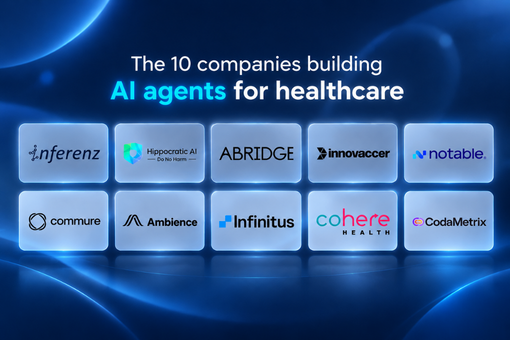
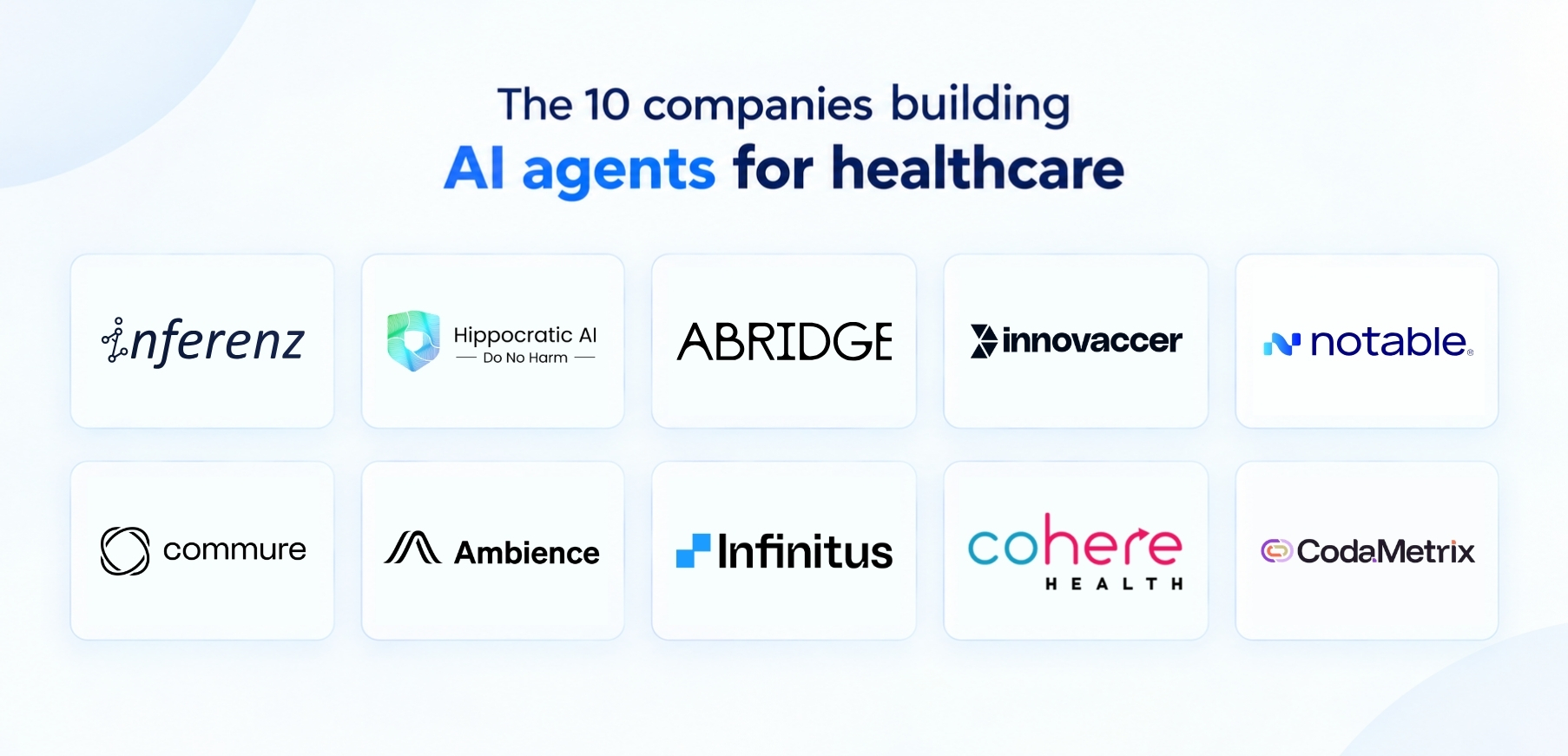
Ten companies lead the conversation on AI agents in healthcare heading into 2027. Inferenz sits first for home health, hospice and home care providers that want agentic AI in healthcare running on top of the EHRs they already own, with a no-code builder their own teams can use. The other nine cover patient voice agents, ambient documentation, revenue cycle and coding, enterprise automation and payer-side prior authorization. Your best pick depends on the workflow you want to automate and where your data lives.
Why AI agents in healthcare moved from pilot to purchase order
Healthcare spent two decades digitizing its records. Now software is starting to do the work inside them. Menlo Ventures put healthcare AI spending at $1.4 billion in 2025, nearly triple the year before, with ambient documentation at $600 million and coding and billing automation at $450 million.
That money is buying AI agents in healthcare. A copilot suggests. An agent finishes the job: it pulls the data it needs, acts within set guardrails and hands a person the result to review. Clinicians get hours back from paperwork, and patients get answers sooner.
Hospice intake shows the difference. Inferenz’s Hospice Eligibility Agent scores a referral packet against the hospice’s own criteria in under five minutes, according to Inferenz, compared with 30 to 90 minutes of manual review. A clinician still approves the result.
This guide profiles ten companies building agents like these and shows how to match a vendor to your workflow. Inferenz publishes this guide and sits first for the reasons in its profile. Companies two through ten are grouped by the kind of work their agents do, with no ranking implied.
Top 10 companies building AI agents for healthcare: quick comparison
| Company | Best for | Agent focus | Main buyers |
| Inferenz | Home health, hospice, home care and hospital operations on existing EHRs | Risk analysis and next best action, caregiver matching, conversational AI, hospice eligibility, prior authorization | Home-based care, hospice, hospital and ambulatory providers |
| Hippocratic AI | Patient outreach and follow-up calls at scale | Generative voice agents for scheduling, intake, post-discharge and chronic care calls | Health systems, payers, pharma |
| Abridge | Clinician documentation that carries through to coding | Ambient documentation, pre-visit prep, pre-bill review | Health systems |
| Innovaccer | Enterprise agents across access, revenue and value-based care | Patient access, value-based care, revenue cycle, risk and quality, utilization management | Health systems, ACOs, payers |
| Notable | Referrals, scheduling, registration and care gap outreach | Multimodal agents for patient access, revenue cycle and care operations | Health systems |
| Commure | End-to-end revenue cycle plus ambient documentation | Calling, intake, documentation, coding, claims and payments | Health systems, physician practices |
| Ambience Healthcare | Documentation, CDI and coding at complex health systems | Ambient documentation, coding, chart question answering | Health systems |
| Infinitus | Phone-heavy coordination with payers, pharma and patients | Voice agents for benefit verification, authorization status and patient support | Pharma, payers, specialty pharmacy, providers |
| Cohere Health | Utilization management and payment integrity | Prior authorization, appeals, quality and claims | Health plans |
| CodaMetrix | Autonomous coding at hospitals | Touchless medical coding from EHR data | Hospitals and health systems |
What AI agents in healthcare actually do
AI agents in healthcare are software systems that take a goal, pull the data they need from clinical and administrative systems, act across several steps, and hand the result to a person when a decision needs human judgment. Typical jobs include prior authorization, intake and eligibility checks, scheduling, outreach calls, documentation, coding and claims follow-up.
Three traits set an agent apart from the chatbots of a few years ago:
- It acts. It fills the payer portal, books the visit or files the appeal.
- It works from live context. It reads EHR, claims, scheduling and payroll data, so each decision rests on the full record.
- It stays supervised. Audit trails, escalation rules and human review wrap every high-stakes step.
Ambient scribes lead the market because the pain is easy to see: clinicians finish notes at night. Documentation is one lane, though. The same agent logic now runs across intake, access, revenue cycle and care coordination, which is why this list reaches well past scribes.
How the healthcare agent market is organized
Scalekit’s 2026 market map of healthcare agents sorts the field into eleven layers, from the EHRs and data networks at the bottom to the agents that take action on top. It reads best as three bands:
- Systems of record and data. EHR platforms, interoperability and data networks, and clearinghouses. These hold the records agents read and write.
- Workflow agents. Ambient documentation, prior authorization and utilization management, revenue cycle and coding, patient access and voice, care coordination and trials, and clinical decision support. Most companies in this guide live here.
- Infrastructure and governance. Agent infrastructure, plus the groups that set standards for evaluating and governing agents.
Two details stand out. The workflow band is crowded, with more than thirty vendors across six layers. And home health, hospice and home care have no lane of their own, even though staffing is a daily constraint in those settings. Inferenz doesn’t appear on the map either, which is one reason its Caregence platform leads this list.
How we selected these companies
Dozens of vendors now call themselves agentic. To build this list we looked for companies whose software takes action inside a healthcare workflow, with public evidence you can check. Each company met most of these criteria:
- Agent depth: software that completes multi-step work such as calls, intake, coding or prior authorization, with a person reviewing the result.
- Healthcare focus: workflows, data models and compliance practices built for clinical and administrative settings.
- Integration: documented connections to EHRs and other systems of record.
- Safety and governance: audit trails, escalation rules, clinician review and clear accountability.
- Evidence on its own website: published outcomes, named customers or independent recognition.
- Momentum: product launches or partnerships in 2026.
Profiles draw on each company’s own website as of October 23, 2026. Where a figure comes from the company, we say so. Companies whose claims we couldn’t confirm on their own sites were left out. Confirm every number in a pilot before you build a business case.
The 10 companies building AI agents for healthcare in 2027
1. Inferenz
Best for: home health, hospice, home care, hospital and ambulatory providers that want AI agents running on top of the EHR and data stack they already have.
Inferenz is a data and AI engineering company for healthcare, insurance and hi-tech enterprises. In December 2025 it merged with Caregence, and it now offers Caregence as a HIPAA compliant, healthcare-native agentic AI platform. The platform joins a unified data model, a no-code workflow builder, an agent orchestrator and prebuilt agents. It connects to EHR and EMR systems, payer systems, claims, CRM and HR data. In October 2026 Inferenz added a custom agent builder, new EHR integrations and predictive models.
Among its prebuilt agents:
- Risk Analyzer and Next Best Action Agent: reads clinical and operational signals, explains why a patient’s risk score fired and recommends the next step.
- Hospice Eligibility Agent: automates eligibility screening and admission prioritization. Inferenz reports that manual review time falls from 30 to 90 minutes to under five, and that clinical staff edit the scoring rules in plain English.
- Prior Authorization Agent: pulls patient and payer details, completes the payer portal, submits the request and tracks status.
- Predictive Matching Agent: handles caregiver matching and scheduling.
- Conversational AI Agent: answers leadership questions using real-time data from across systems.
Why it made the list: Inferenz covers the full path from scattered data to a working agent. The team that unified more than 40 source systems for a national home care provider managing over 60,000 patients also builds the agents that depend on that data, which matters because agents act on whatever records they can see. Inferenz reports that Caregence customers see 45% less administrative load, 5x faster onboarding and 30% better caregiver allocation.
Worth asking: which agents are live for your care setting today, and how the custom agent builder would handle a workflow unique to your organization.
2. Hippocratic AI
Best for: health systems, payers and pharma teams that want patient-facing voice agents handling outreach, intake, follow-up and chronic care calls at scale.
Hippocratic AI builds generative voice agents that phone patients for tasks such as appointment scheduling, intake history, post-discharge recovery checks and screening reminders. Its website reports more than 250 million patient interactions, over 300 clinical use cases live, more than 50 EMR integrations including Epic, and work with 7 of the top 20 pharma companies.
Why it made the list: Safety evidence sits at the front of the pitch. The company says more than 7,700 licensed clinicians tested its outputs across over 775,000 calls, that it samples between 0.5% and 1% of live calls for safety review, and that its contracts take responsibility for outcomes. Its customer results include a 30% drop in readmission rates and a 12x average return across use cases.
Worth asking: which of the live use cases match your patient population, and how escalations reach your nurses.
3. Abridge
Best for: health systems that want clinician documentation to carry through to coding and billing.
Abridge began with ambient listening and has grown into what it calls a single intelligence layer for care teams. Its site says more than 300 health systems use it and that the platform powers over 100 million clinical conversations a year. It covers the whole visit: preparation before the conversation, documentation during it, and finalized notes, coding specificity and orders afterward. It earned Best in KLAS for ambient AI in 2025 and 2026.
Why it made the list: The customer numbers are concrete. Reid Health reports an 86% reduction in documentation effort, and WVU Medicine reports a 43% increase in clinicians’ ability to fit in an additional urgent patient per clinic session. In September 2026 Abridge added pre-bill review for CDI and coding teams, which extends the same record from the visit toward the claim.
Worth asking: how coding suggestions are validated, and how your team will test the audit readiness of AI-generated notes.
4. Innovaccer
Best for: health systems, ACOs and payers that want one agent platform across patient access, revenue cycle and value-based care.
Innovaccer calls its platform the agentic cloud for healthcare. Its agents cover patient access, value-based care, revenue cycle, risk and quality, and utilization management, and they run on a shared data layer that connects a customer’s systems into one governed view. Customers can also build a custom agent.
Why it made the list: The site pairs each area with a named result. Cone Health cut prior authorization prep from 45 minutes to 3. Franciscan Alliance reports $19.2 million in annual value and 54% less call handling time. Intermountain Health reports 65% fewer hospitalizations and 53% less ED use in heart failure medication management. The site also lists 40 days from conception to deployment for new agents.
Worth asking: how the shared data layer will sit alongside your EHRs, and which agents are live today versus on the roadmap.
5. Notable
Best for: health systems automating referrals, scheduling, registration, prior authorization and care gap outreach.
Notable builds AI agents for patient access, revenue cycle and care operations. Its site cites 1.5 million tasks automated daily, 97% of in-scope referrals automated and referral work cut from 14 days to 3. Operators can build and customize workflows themselves in Flow Builder, a low-code tool with drag-and-drop design and prebuilt skills and connectors.
Why it made the list: Notable invests in oversight as well as agents. Its October 2026 Flow Compass release lets operators ask what’s working in their automations, what’s at risk and what to do next, with role-based access and audit trails. The site also lists reducing referral leakage as a core use case.
Worth asking: which prebuilt flows match your referral and scheduling patterns, and how long go-live takes with your EHR.
6. Commure
Best for: health systems and physician practices that want revenue cycle automation alongside ambient documentation.
Commure describes itself as the agentic platform for every voice, note and claim. One data model runs from the patient’s first call through documentation, coding, claims and payments, and it integrates with more than 60 EHRs. Its site cites 40 million ambient appointments, over $25 billion in annual claims, 130-plus health systems and 3,000 sites of care.
Why it made the list: The case studies give the pitch weight. One shows a 53% decrease in timely filing denials. Another shows a 54% reduction in no-show and cancellation rates after pre-appointment texting at Yale New Haven Health. A third reports more than 350 hours of documentation time saved per year.
Worth asking: how much of the revenue cycle work runs without review for your specialty mix, and where your team keeps checkpoints.
7. Ambience Healthcare
Best for: large, complex health systems that want ambient documentation, CDI and coding tied to measurable financial outcomes.
Ambience supports more than 200 specialties across ambulatory, inpatient and emergency department settings. Its site reports a 3x return on investment, 95% coding compliance verified by AAPC and use in 80% of visits, and it says its fees are tied to customer outcomes.
Why it made the list: Ambience describes an agent platform built for healthcare, with a system of context that reconciles conflicting chart data and a system of action that writes decisions back to the record. Every action is clinician-reviewed and audited. At Ardent Health, the company says, the platform returns $3 of operating margin for every $1 spent. It received the 2026 Trailblazer Award from KLAS and CHIME.
Worth asking: how outcome-based fees are defined and measured in your contract.
8. Infinitus
Best for: pharma, payer, specialty pharmacy and provider teams whose staff spend their days on the phone verifying benefits, chasing authorizations and supporting patients.
Infinitus builds voice agents for the communication that sits between a patient and the care they need, from first contact to long-term adherence. Its site reports 350 million healthcare interactions automated, use by 8 of the top 10 pharma manufacturers and use by more than half of the Fortune 50 healthcare companies.
Why it made the list: Safety is built into how it describes the product. It enforces verbatim language where required, limits answers to pre-approved knowledge bases and has a clinical team of doctors and nurses evaluate every agent, reporting a 0% under-triage rate. Its results include 3x faster time to therapy and up to 5x ROI. Teams can also design their own agents in Infinitus Studio, a no-code builder introduced in April 2026.
Worth asking: which of your workflows are phone-heavy enough to justify an agent, and how escalations route to your staff.
9. Cohere Health
Best for: health plans that want prior authorization, appeals, quality and payment integrity on one clinical intelligence platform.
Cohere Health builds for the payer side of the table. Its Cohere Unify platform connects utilization management, payment integrity, appeals, care management, quality and claims operations. The company reports 17 clients, 25 million covered lives and 47 million plan and provider interactions, with 85% of prior authorizations approved in real time. A clinician reviews the remaining requests before a final decision.
Why it made the list: Humans stay in charge of critical decisions, which suits payers working toward the January 1, 2027 deadline for most API requirements under CMS’s interoperability and prior authorization rule. Cohere also reports an 18x return on investment for utilization management at a regional plan, up to 40% faster appeal decisions and closure rates of 20% to 25% on high-value HEDIS measures.
Worth asking: how its decisions line up with the prior authorization agents your provider network uses, so requests don’t bounce between systems.
10. CodaMetrix
Best for: hospitals and health systems that want autonomous coding for inpatient professional fees and diagnostic and procedural services.
CodaMetrix sells CMX CARE, an autonomous medical coding platform. It pulls data from the EHR and ancillary systems, builds a timeline of each patient’s care and codes it without manual touch. Coverage includes inpatient professional fee coding and diagnostic and procedural services such as radiology, pathology and endoscopy.
Why it made the list: Its site reports a 70% reduction in manual coding, 5x faster turnaround, 60% fewer coding-related denials and up to 30% lower coding cost. It earned Best in KLAS for autonomous medical coding in 2026.
Worth asking: the figures are vendor-reported, so request references from a hospital with a case mix like yours.
What the ten have in common
Put the ten profiles side by side and the same habits show up. They explain why these companies win deals, and they make a useful checklist for any vendor you meet.
- They start with one workflow that carries a number. Cone Health’s prior authorization prep fell from 45 minutes to 3 with Innovaccer. Notable cites referral work shrinking from 14 days to 3. Inferenz reports hospice eligibility review dropping from 30 to 90 minutes to under five. A narrow start with a clear before-and-after is easy to fund and easy to defend.
- They connect to the systems clinicians already use. Hippocratic AI lists more than 50 EMR integrations and Commure more than 60 EHRs. Caregence plugs into EHR, payer, claims and HR data and runs on top of the systems a provider already owns.
- They publish safety evidence. Hippocratic AI had licensed clinicians test outputs across more than 775,000 calls. Infinitus has doctors and nurses evaluate every agent. Ambience reports AAPC-verified coding compliance. Caregence builds in audit trails, role-based access and explainable decisions.
- They keep a person in the loop. Cohere sends the remaining prior authorization requests to a clinician. Ambience says every action is clinician-reviewed. Caregence workflows can include human-in-the-loop steps.
- They fix the data first. Innovaccer’s agents share one governed data layer, Commure runs on one data model, and Caregence starts from a unified data model. Weak data is also the reason most health systems stay early in AI maturity.
- They let customers shape the agents. Notable, Infinitus, Innovaccer and Inferenz each offer a way for customers to build or customize agents. The next section compares them.
Who can build the agents? Build, buy or both
Most buyers ask an early, practical question: can our own team build or change an agent, or does every change go through the vendor? Gartner’s September 2026 guidance points the same way. In a cross-industry forecast, it predicts that 70% of enterprises will abandon agentic AI built through vendor forward-deployed engineering by 2028, citing rising costs and customers’ limited ability to evolve the systems themselves. Several healthcare platforms now offer builders. The table lists the ones we could confirm on the vendors’ own sites.
| Company | Builder | What the company says |
| Inferenz | Caregence workflow builder, custom agents and MCP tools | Drag-and-drop, no-code workflow design on a unified healthcare data model, with room to add custom agents and tools. Inferenz says care teams can build a custom agent in minutes, and that clinical staff edit hospice eligibility rules in plain English without a developer. |
| Notable | Flow Builder | Low-code, drag-and-drop tool with prebuilt skills and connectors. Its site says operators and IT teams build and customize workflows. |
| Infinitus | Infinitus Studio | No-code builder introduced in April 2026. Users describe an agent in plain language and Studio generates the configuration for review. Early access, aimed at pharma and payer teams. |
| Innovaccer | Custom agents | Its site invites customers to build a custom agent on the Healthcare Autonomy platform, alongside its prebuilt agents. |
Build or buy is rarely an either-or call. Inferenz’s buy-versus-build analysis for CIOs argues for deciding layer by layer: buy the commodity layers for speed and build where your own data and workflows differ.
Caregence leans in on that second half. It pairs the builder with a healthcare-native data model and ready-made agents for home-based care, hospice and hospital workflows, which gives an operations team a working starting point and room to change it. Whichever vendor you pick, ask what your staff can change alone and what still needs vendor support.
How to choose the right AI agent partner
Start with the workflow, then look at where your data lives. That order removes more of the list than any other filter.
- Home health, hospice and home care operations: Inferenz, for agents built around eligibility, caregiver matching and risk on top of your existing EHR.
- Patient outreach and follow-up calls: Hippocratic AI and Infinitus, with Notable for access workflows.
- Documentation tied to coding and claims: Abridge, Ambience Healthcare and Commure.
- Autonomous coding at hospitals: CodaMetrix, with Commure for broader revenue cycle work.
- Enterprise-wide automation across access, revenue and value-based care: Innovaccer and Notable.
- Payer-side utilization management and appeals: Cohere Health.
Most organizations end up running two or three of these tools. If you operate several EHRs after a run of acquisitions, settle the data question first. Our guide to the top 10 EHR/EMR platforms for home care and hospice covers the systems these agents plug into.
What to ask every vendor before you sign
The Peterson Health Technology Institute’s April 2026 review of administrative AI sounds a note of caution. It found that AI may reduce what an individual organization spends on prior authorizations, yet it has not reduced system-level costs, and workshop participants worried that automating both sides of a transaction could multiply activity. The report also cites the CAQH Index figure that only 40% of prior authorization transactions are automated. Ask each vendor to show how your own numbers will move.
- Integration: Which EHRs and payer systems are live today, and does the agent connect through FHIR, MCP or custom work?
- Safety: How are risky moments scored, escalated and logged, and who carries liability if an agent gets it wrong?
- Evidence: Can you speak with a customer in your care setting and see before-and-after numbers?
- Governance: What audit trails, role-based access and HIPAA controls come with the platform, and will the vendor sign a business associate agreement?
- Build rights: Can your own team build or change an agent, and what does that take?
- Data readiness: Can your records support an agent today, or do duplicate patient identities need cleaning first?
- Pricing: Is it priced per seat, per completed task or tied to outcomes, and what does integration add?
Healthcare AI agent trends to watch in 2027
From scribes to full workflows. Abridge’s pre-bill review, Commure’s front-to-back platform and CodaMetrix’s autonomous coding show documentation vendors following the note all the way to the claim.
Prior authorization gets a deadline. Payers have until January 1, 2027 to meet most API requirements under CMS’s rule, and hospitals carry obligations of their own.
Agent oversight becomes a product. Notable’s Flow Compass, Infinitus’s clinical evaluation of every agent and Ambience’s clinician-reviewed actions all aim at the same problem: keeping a growing fleet of agents dependable.
Capital keeps flowing. Rock Health counted $7.4 billion in US digital health funding in the first half of 2026 across 244 deals, with rounds of $100 million or more taking 45% of the total.
Builders go mainstream. Infinitus Studio, Notable’s Flow Builder, Innovaccer’s custom agents and Caregence’s workflow builder all put agent design in customers’ hands. Expect that to become a standard buying question.
Agents reach home-based care. Home health, hospice and home care teams face tight staffing and heavy compliance work, and agentic AI in home care operations is arriving for referral intake, scheduling and compliance monitoring.
Final thoughts
Across all ten companies, AI agents in healthcare earn trust the same way. They start with one measurable workflow, connect to the systems clinicians already use, publish safety evidence and keep a person in the loop. The vendors pulling ahead in 2026 name their customers and show their numbers.
Match the company to the workflow you want to automate, pilot with your own census and fix your data before you add a second agent. If home health, hospice or home care sits at the center of your operation, Inferenz is a good place to start the conversation.
Frequently Asked Questions